#DeSci infrastructure and primitives. #MolNFT#BioTech#OpenScience#GenesisL1
https://t.co/vblYBEveN1
https://t.co/biKdVpS8sI
Why MolNFT? On-Chain Molecular Data, Explained
MolNFT places complete macromolecular structural data directly on GenesisL1, where it can be read natively by web3 applications. The first reaction from scientists and crypto-natives alike is some version of the same question: the data already exists and moves freely elsewhere — why does it need to be here?
That is the right question, and it deserves a direct answer rather than a slogan. The short version: MolNFT is not trying to replace the Protein Data Bank, and its value is not the data. Its value is what becomes possible when structural data is a native, verifiable, composable on-chain object. MolNFT is infrastructure; the science built on top of it is the impact. The same question gets a different answer depending on where you are standing, so we answer it for both audiences below.
The Protein Data Bank is free, open, CC0-licensed, and wrapped in excellent APIs (RCSB, PDBe). Why does any of this need to be on-chain?
Because MolNFT is not a redistribution of the PDB; it is infrastructure built on the same public data. The distinction is everything. Mirroring RCSB on-chain would be pointless — the existing mirrors are excellent, fast, and free, and you should keep using them. What the public databases cannot do is let a structure act as a verifiable, programmable component inside other on-chain systems.
A structure in MolNFT is not merely retrievable. It is referenceable with cryptographic integrity, ownable and licensable as a discrete object, and directly callable by other on-chain logic. The PDB gives you the data. MolNFT gives you the data as a building block that contracts, models, and applications can use without trusting any intermediary. Everything below follows from that single difference.
(For a crypto-native reader) Isn't this just "tokenize everything"? Tokenized stocks already trade fine on centralized exchanges — why put assets on-chain at all?
"It already exists elsewhere" has been said about every successful tokenized asset — stablecoins, tokenized treasuries, tokenized gold, tokenized equities — and demand materialized anyway, because the product was never the novelty of the underlying. It was composability, programmability, and permissionless access.
Tokenized AAPL matters not because shares were hard to buy, but because the token can become collateral in a lending market, a leg in an automated strategy, or a component in a structured product without asking anyone's permission. MolNFT applies the same logic to molecular data: the point is not that structures were unavailable, but that they could not be consumed programmatically by on-chain systems. A protein structure that a smart contract can read, reference, and run a model against is a different kind of object than a file behind a REST API.
There is one inversion worth stating plainly, because it is a place where MolNFT is stronger than a tokenized stock rather than merely analogous. A tokenized stock can never escape the backing question: the token is a claim on a share held by a custodian, and it carries counterparty and redemption risk. The token is a pointer to value sitting somewhere else. MolNFT, when it stores the full structural data on-chain, has no such dependency — the asset is the data itself, not a claim on data held off-chain. There is nothing to redeem and no custodian to trust.
That is a higher-integrity guarantee than any tokenized real-world asset can offer. The caveat is the same fact that makes the claim meaningful: this only holds if the complete data lives on-chain, not as a hash pointing at a file that can move, change, or vanish. Full data on-chain is the difference between an asset and an IOU.
(For a scientific reader) What does on-chain storage give a researcher that RCSB or PDBe doesn't?
For everyday structure retrieval, nothing, and you should keep using them. MolNFT addresses a different set of problems, all downstream of one property the public databases do not provide: a permanent, cryptographically verifiable reference that cannot be silently changed.
Reproducibility. A method that references an on-chain structure by its hash can prove, years later, the exact bytes it was computed against — even if the canonical PDB entry is subsequently revised, re-refined, or superseded. The version you ran against is frozen and verifiable, not "whatever the database happens to serve today." For any pipeline whose results depend on the precise input coordinates, that is the difference between a reproducible claim and a best-effort one.
Attribution and provenance. Derived work — a trained model, a curated subset, a benchmark — can reference the exact structures it was built from, immutably. That creates rails for credit, and where desired for licensing or royalty flow back to data curators, which do not exist when the inputs are anonymous CC0 bytes pulled from an endpoint. Provenance stops being a footnote and becomes a property of the object.
Composability with computation. This is the consequence that is new rather than incremental, and it is large enough to deserve its own answer below.
In the vocabulary that matters to scientists — reproducibility, provenance, verifiable benchmarks — these are real gains, not financialization dressed up as research.
What can you actually build with MolNFT that you can't build today?
This is the strongest reason MolNFT exists, and it is where the crypto and scientific cases finally converge. GenesisL1 supports on-chain ML inference, which means a model, a structure, and a prediction can all live on the same chain as mutually referenceable objects, and a computation over them can be verifiable from end to end.
Concrete example: a protein-stability (ΔΔG) prediction model deployed on-chain can take an on-chain MolNFT structure as input and produce a prediction whose entire lineage — which model, which weights, which input structure — is verifiable on-chain, with no off-chain trust anywhere in the path. A third party can independently confirm that this model produced this prediction from this structure. Today that chain of custody lives in a private notebook, a data-repository upload, and a README, and any link in it can rot or be quietly altered. On-chain, the whole pipeline is a single verifiable record.
The capability compounds. Structures reference the models trained on them; models reference the structures they consumed; predictions reference both. The result is a verifiable scientific dependency graph: the substrate for reproducible computational biology, and for a marketplace of composable models and data where each can be used, credited, and built upon without trusting a host. A single dApp call can pull a structure and run inference against it. None of this is reachable when the structure is a file behind an API and the model is a binary on someone's hard drive.
How is this different from speculative projects that wrap public data just to launch a token?
Two tests separate infrastructure from a wrapper, and MolNFT is built to pass both.
First, the data is real and complete on-chain. The asset is the structure itself, not a pointer to a file that can disappear — which is precisely the failure mode of most "tokenized data" projects, where the token survives but the data it supposedly represents drifts away. If the bytes are on-chain, the integrity guarantee is real; if they are not, no amount of tokenization fixes it.
Second, there is a real consumer. GenesisL1's own on-chain inference stack, including a protein-stability predictor, is designed to take MolNFT structures as inputs. A working application that reads on-chain structures is the molecular-data equivalent of an asset already being used as collateral in a live market: it converts hypothetical composability into demonstrated composability. A wrapper has a token and a promise. Infrastructure has a dependent application.
MolNFT is not the PDB on a blockchain. It is the substrate that lets structural data carry provenance, participate in computation, and compose with other on-chain objects — and the science built on that substrate is the point.
GenesisL1 just shipped v1.6.2 — the biggest upgrade in our history, here is what come next
The chain is now on par with cronos from @cryptocom at the protocol layer.
The path here was not a simple patch. It was TWO coordinated network upgrades, both flawless, with 100% of validators upgraded and on board. ⚡️
Two clean jumps. One unified validator set. Zero drama.
Jump 1 → v1.1.1
Jump 2 → v1.6.2
Each was a single atomic on-chain migration. And v1.6.2 alone telescoped four release lines — v1.3 → v1.4 → v1.5 → v1.6 — into ONE safe jump.
That matters.
Because upgrades are where chains prove what they are made of. Anyone can publish a roadmap. Anyone can talk about decentralization. But when the network has to migrate and continue together — that is where real coordination, real validator discipline and real infrastructure maturity show up.
GenesisL1 delivered.
The core engine was rebuilt.
Cosmos SDK moved from v0.47 → v0.53
CometBFT moved from v0.37 → v0.38
IAVL moved from v0.21 → v1.x
That means faster blocks, optimistic execution, modern consensus and a next-generation state tree. The chain is now leaner, quicker and stronger — built for higher demand, heavier data and a much larger ecosystem.
The EVM leapt years forward.
go-ethereum moved from v1.10 → v1.15
The Ethermint/Cronos stack was modernized across the board.
This brings GenesisL1 into the Shanghai + Cancun era: PUSH0, transient storage, MCOPY, blob opcode compatibility and better modern contract tooling support.
For builders, this means the latest Solidity, Foundry, Hardhat and EVM workflows can land on GenesisL1 with far less friction. 🛠️
The headline feature: EIP-7702. 🔥
Smart accounts and account abstraction are now native on GenesisL1. EOAs can behave more like contracts — enabling batched transactions, sponsored gas flows, programmable wallets and better user experiences.
This is the UX frontier of Ethereum, now live on GenesisL1.
Interoperability went supersonic.
ibc-go moved from v7 → v10.
Modern IBC, callbacks, stronger relayer events and Interchain Accounts support bring GenesisL1 deeper into the interchain. With ICA host capabilities, other Cosmos chains can drive accounts on GenesisL1.
GenesisL1 is not building an island.
It is building a scientific, AI-native, EVM-compatible L1 that can connect outward — to Cosmos, to Ethereum ecosystems, to Base and to the next generation of decentralized applications. 🌌
Security and privacy were hardened.
GenesisL1 now includes a new e2ee module as an end-to-end encryption primitive.
The stack also includes the latest CometBFT and IBC security patches, authorization-list blocklist enforcement on EVM transactions, improved transaction validation and updated governance parameter handling.
Safer base → safer growth.
This is how network expansion becomes sustainable. Not through hype alone — but through stronger primitives, cleaner execution, better validation, safer interoperability and a validator set capable of upgrading as one.
Infrastructure and tooling were refreshed top to bottom.
gRPC moved from v1.60 → v1.75
Go moved from 1.22 → 1.23
gogoproto, cosmos-db and store modules were modernized
JSON-RPC became richer with eth_getBlockReceipts, improved tracers and better gas estimation
Better RPC means better explorers.
Better indexers.
Better dApps.
Better developer experience.
And better developer experience is how ecosystems grow.
None of this ships without coordination — and GenesisL1 delivered it twice.
Both upgrades ran through on-chain governance. Validators upgraded and came online together. Clean upgrades, no forks, no stragglers.
This is how an L1 grows securely. 🛡️
v1.6.2 is not just another release.
It is the launchpad: faster, safer, EVM-current, interchain-ready — proven by a validator set that upgrades as one.
For years, GenesisL1 shipped first and explained later.
We delivered before we explained.
Now the foundation is set.
The explain-and-expand era begins.
The first GenesisL1 whitepaper is coming.
After years of building in production, GenesisL1 will publish its first whitepaper: the vision, the architecture, the thesis and the long-term roadmap.
This is the moment where the story is finally told in full.
Why GenesisL1 exists.
Why it is different.
Why on-chain science, AI, biological data and decentralized compute belong on one native L1.
We deliver first, then we explain — and now we explain.
Sounder economics are coming.
A governance proposal will be put forward to reduce network inflation from 20% → 10%.
This is about a healthier, more sustainable chain. Tighter issuance. Stronger long-term alignment. A cleaner economic base for validators, builders, researchers, holders and everyone helping secure GenesisL1.
Growth needs infrastructure.
Growth also needs economics that can support the long game.
GenesisL1 is reaching outward to Base.
Two major moves are planned to expand the ecosystem:
A secure, decentralized GenesisL1 ↔ Base bridge via hyperlane.
A governance proposal to allocate approximately 25% of the community pool in L1 coins to Base liquidity.
This is about reach. Liquidity. Visibility. Participation.
More people should be able to discover GenesisL1.
More builders should be able to access it.
More communities should be able to participate in it.
Base liquidity can become a major doorway into the GenesisL1 ecosystem.
Real science is coming to the front.
On-chain machine learning on GenesisL1 is not a slogan. It is not a buzzword. It is not “AI” painted on top of an empty roadmap.
It is producing work.
Coming soon:
The GenesisL1 Forest preprint at https://t.co/bfofPmyf8b.
Protein-stability research conducted with GL1F and biological models.
This is where verifiable compute begins to meet peer-reviewable science.
This is where blockchain stops being just finance infrastructure and starts becoming research infrastructure.
The human genome belongs on-chain.
Another major plan: putting the entire human genome reference on GenesisL1.
Not as a symbolic gesture.
As infrastructure.
GenesisL1 is developing a novel, efficient format for storing genetic information — compact, structured and version-aware, conceptually similar to Git for biological data.
A format designed for genomic references, differences, updates, provenance and reproducibility.
Because science does not only need storage.
It needs history.
It needs versioning.
It needs open verification.
It needs a way to preserve humanity’s biological reference data in a form that can be cited, compared, extended and used by machines.
A human genome reference on-chain is more than data.
It is a public scientific anchor.
A foundation for bioinformatics, biological AI, molecular NFTs, open datasets, model training and reproducible computational biology.
Humanity’s code, preserved in humanity’s open ledger.
The agentic layer is next.
The Agent Hub API will allow other AI models, programs and external systems to tap directly into GenesisL1 Forest.
Local models.
Remote models.
External applications.
Autonomous research workflows.
GL1F becomes more than a platform. It becomes open scientific infrastructure — accessible to other agents, models and tools.
Then comes GL1F Autopilot.
Native GL1F Autopilot will let users plug any LLM — local or remote — into GenesisL1 Forest through Agent Hub.
That means models can create, coordinate and manage other models on-chain.
AI that builds AI, verifiably, on L1.
This is one of the most important frontiers GenesisL1 is moving toward: agentic science, on-chain model coordination and decentralized AI workflows that can be inspected, reproduced and extended.
GenesisL1 is building a native home for science.
An advanced DAO engine is coming to host a wide range of scientific communities.
The goal is to provide a state-of-the-art DeSci launchpad and DeSciFi environment — decentralized science finance built natively into the GenesisL1 ecosystem.
Scientific communities need more than tokens.
They need governance.
They need funding tools.
They need transparent coordination.
They need contributor management.
They need incentive systems.
They need infrastructure that understands research.
GenesisL1 is building toward that.
https://t.co/8tcjfYX5L1 is being reborn.
The plan is to remodel https://t.co/8tcjfYX5L1 into a fully permissionless service — the final piece of the puzzle for on-chain machine learning.
Dataset → train → deploy
End to end.
In one place.
On GenesisL1.
A complete on-chain machine-learning loop: open to everyone, powered by GenesisL1, and designed for a world where datasets, models, compute and deployment can all live in the same decentralized environment.
And this is only the shortlist.
More integrations, more research, more tools, more community-led expansion and more ecosystem infrastructure are already in motion.
The build years gave GenesisL1 its foundation.
Now comes the era of research, AI, DeSci, decentralized model coordination, open scientific finance, genomic infrastructure and real ecosystem growth — all on one chain.
GenesisL1’s best chapter starts now. 🌱
#GenesisL1 #blockchain #crypto #L1coin $L1 #EVM #NFT #MolNFT #DeSci #biotech #bioinformatics #AI #MachineLearning #OpenScience #DecentralizedAI #genomics #onchainAI
https://t.co/PaYFEtVpXd
https://t.co/PTng2NoDu9
https://t.co/j9rJs6gtqK
https://t.co/vmC1XUvgkb
https://t.co/vblYBEveN1
https://t.co/biKdVpS8sI
https://t.co/8tcjfYX5L1
https://t.co/bfofPmyf8b
https://t.co/sojQoWyzUY
https://t.co/0yIhpW5Uc9
https://t.co/KWIWMxgyl8
https://t.co/S7KmEEM3L5
Nog niet eerder kregen vrouwen in Nederland zo weinig kinderen.
Jongeren stellen hun kinderwens uit omdat het leven te duur is geworden. Niet omdat ze geen gezin willen. Niet omdat ze geen verantwoordelijkheid willen. Maar omdat verantwoordelijkheid in Nederland steeds vaker wordt bestraft.
Een kind krijgen is geen lifestylekeuze zoals een nieuwe telefoon of vakantie. Het is de meest fundamentele voortzetting van een samenleving. En toch hebben we een land gebouwd waarin jonge mensen eerst moeten rekenen of liefde wel in hun maandbudget past.
Een huis is te duur. Kinderopvang is duur. Energie is duur. Boodschappen zijn duur. Studeren is duur. En als je dan toch probeert vooruit te komen, als je spaart, belegt of iets opbouwt voor later, dan staat de overheid alweer klaar met box 3.
En dan vragen we ons verbaasd af waarom jonge mensen wachten met kinderen.
Geen wonder.
We hebben gezinnen jarenlang verteld dat ze belangrijk zijn, maar behandelen ze ondertussen als sluitpost.
De gewone Nederlander wordt steeds vaker teruggebracht tot een administratieve eenheid. Een BSN-nummer. Een inkomenscategorie. Een huishoudenstype. Een belastinggrondslag. Een variabele in een model.
Man, vrouw, vader, moeder, gezin, thuis, land, wortels; het zijn woorden die in beleidsstukken steeds kouder klinken, alsof ze verdacht zijn geworden. Alsof identiteit alleen nog mag bestaan zolang ze abstract, tijdelijk en bureaucratisch genoeg is.
Maar mensen zijn geen regel in Excel.
Een gezin is geen fiscale constructie.
Een kind is geen kostenpost.
Een vader is geen ouder 1.
Een moeder is geen ouder 2.
Een Nederlander is geen administratief incident.
En vermogen opbouwen voor je kinderen is geen misdaad.
Het wrange is: je mag als burger steeds minder vanzelfsprekend bestaan, maar je mag wel steeds vanzelfsprekender betalen. Je bestaat niet als persoon. Je bestaat niet als gezin. Je bestaat niet als ouder of iemand met een kinderwens.
Maar je bestaat wél als belastingplichtige.
Je mag je kinderwens uitstellen.
Je mag langer doorwerken.
Je mag je pensioen onzeker zien worden.
Je mag belasting betalen over rendement dat je nog niet hebt verzilverd.
Je mag je gender heruitvinden in elk formulier dat de staat voor je maakt.
Maar ergens houdt die ontmenselijking op.
Ieder mens draagt een unieke genetische DNA in zich.
On-aanpasbaar. Eén keer in de geschiedenis van de mensheid. En of men dat nu graag hoort of niet: daar zit iets heiligs in. Dat verdient bescherming.
Een samenleving die dat vergeet, raakt meer kwijt dan koopkracht.
Wat mij misschien nog het meest stoort aan die €380 miljoen extra voor ontwikkelingshulp, is hoe achteloos er met belastinggeld wordt omgegaan.
Een minister is geen ondernemer, hij is tijdelijk ambtsdrager en beheert geld dat onder dwang bij burgers en bedrijven is opgehaald.
En toch kan er via een politieke deal ineens honderden miljoenen worden verschoven. Niet omdat wij dat willen of omdat Nederland daar beter van wordt. Maar omdat een begroting gered moet worden.
Dan moet je je toch afvragen: zijn politici eigenlijk wel geschikt om met dit soort bedragen om te gaan?
Een ondernemer die €380 miljoen verkeerd besteedt, gaat failliet. Een politicus verhoogt de lasten, schuift met potjes of bezuinigt later op iets anders. De rekening komt toch wel bij de burger terecht.
Misschien moeten we de burger niet alleen beschermen tégen bedrijven, markten en 'graaiers', maar vooral tegen een overheid die bijna onbeperkt geld kan uitgeven. Ons geld.
https://t.co/0UR64Z5Fk3
Kijk eens goed naar haar gezicht terwijl ze dit zegt. Het interesseert haar niets dat een hele sector plus de sociale gemeenschap in de kustplaatsen wordt beroofd van hun bestaan en identiteit. Kustvolken zijn al eeuwenlang met de zee en de visserij verbonden. Maar bij Bromet zie ik
alleen maar puberale minachting en haat. Het is ongelooflijk dat dit in de kamer zit.
Read our latest Medium article on @genesis_L1.
We believe Genesis is one of the most exciting projects in the digital asset sector today, with the potential to have a meaningful impact on the future of blockchain infrastructure.
Our latest analysis explores why.
ALDERLUX
A private Bitcoin & digital asset education platform built for professionals, investors, and long-term thinkers seeking clarity in an increasingly complex financial world.
most entertaining outcome:
Elon fully intends to introduce Asteroid as the mascot but is waiting to solidify details on the SpaceX + Tesla + XAI merger beforehand, and it allows him to go beyond in honoring/supporting Liv’s final wishes
meanwhile ct crashes out bc they see number go down and because attention spans are fried they cut their positions
grave dancing reaches its peak
chart levels out and most forget and write off the possibility of it all
then out of seemingly nowhere official endorsement hits
max pain + the most hated rally
coin becomes a wealth creation event and leads the charge into the next bull market as the next 1B+ memecoin as it gets deeper integration as the mascot of the most influential technology company of our time
but before all of that, everyone must give up
$asteroid
☄️🐕
The EU is 6% of global emissions. Committing economic harakiri in response to climate concerns is pure vanity. Europe can't save the planet because the continent doesn't have any meaningful influence on the outcome.
Het grootste gevaar voor democratiën is dat burgers in ideologische informatiebubbels terechtkomen, waarmee ’de waarheid’ eigenlijk niet meer bestaat. Wie de democratie wilt versterken, is daarom juist actief op X (en andere mediaplatformen).
https://t.co/RJHyCSkfNZ
Er was een tijd dat sparen gold als verstandig.
Dat je iets opzij zette voor later. Voor tegenvallers. Voor onderhoud aan je huis. Voor je pensioen. Voor je kinderen misschien.
Tegenwoordig lijkt de overheid vooral te denken:
mooi, daar kunnen we nóg een keer belasting op heffen.
Je werkt jarenlang. Iedere maand verdwijnt bijna de helft van je salaris richting Belastingdienst. Van wat overblijft spaar je een beetje. Je krijgt een bonus: belast. Je erft wat van je ouders: belast. Dat spaargeld groeit langzaam aan. Inflatie tikt door, maar ondertussen betaal je belasting over je vermogen.
Na tien jaar besluit je verstandig te investeren in je woning. Geen Lamborghini. Geen exotische constructie via een belastingparadijs. Gewoon een aanbouw omdat het gezin groeit. Een nieuwe keuken omdat de oude versleten is. Daarnaast onderhoud je het huis en doe je aan verduurzaming door te investeren in zonnepanelen en een warmtepomp. Netjes. Verantwoord.
Allemaal betaald van geld waar al belasting over betaald is.
Tien jaar later verkoop je je huis. De buurt is populairder geworden, huizenprijzen zijn gestegen, mede dankzij schaarste waar de overheid zelf jarenlang beleid op voerde. En daar is hij ineens: de overwaarde.
En dan begint het politieke morele vingertje.
Want inmiddels discussiëren we in Nederland openlijk over belasting op vermogensaanwas. Dus niet alleen belasting op rendement dat je daadwerkelijk ontvangt, maar op waardestijgingen op papier. Winst die nog niet eens gerealiseerd is. Geld dat misschien volledig vastzit in stenen.
Het wrange is niet eens alleen het bedrag. Het wrange is de mentaliteit erachter.
Alsof iedere vorm van opgebouwd vermogen verdacht is geworden. Alsof mensen die jarenlang voorzichtig leven, sparen, investeren en risico nemen een soort melkkoe zijn.
We zijn in Nederland inmiddels op een punt aangekomen dat dezelfde euro onderweg meerdere keren wordt aangeslagen:
bij verdienen,
bij sparen,
bij erven,
bij investeren,
bij bezit,
bij waardestijging,
en straks misschien zelfs bij niet-gerealiseerde winst.
Ondertussen roept diezelfde overheid dat burgers financieel weerbaarder moeten worden, zelf verantwoordelijkheid moeten nemen en minder afhankelijk moeten zijn.
Waarvan dan precies?
Want wie werkt, spaart, aflost, investeert en vermogen opbouwt, lijkt tegenwoordig vooral een wandelende fiscale kansberekening.
Veel politici verkopen dit alsof het alleen de ‘rijken’ raakt. Maar uiteindelijk raakt dit gewoon de Nederlandse middenklasse.
Nederland dreigt langzaam een land te worden waar bezit niet meer wordt gezien als resultaat van discipline, risico en jarenlang werken, maar als iets waar de overheid automatisch mede-eigenaar van is.
Oh wat voelen ze zich toch bedreigd door gebrek aan totale controle over communicatie & informatie. Nou hup, journo's, voor zover die er nog zijn: doe nou voor 1x eens jullie werk om deze dictatoriale geest terug in de fles te krijgen
🧵 Seeing a lot of "Zcash is quantum-proof now!" takes going around. It's a great development, but it's worth clarifying what ZIP 2005 actually is and is not. Quick Q&A 👇 zcash:native
Losgezongen van de meerderheid van de eigen bevolking. Breken van de belofte om nu eens echt iets te doen aan de migratie. Elke week nog steeds ongeveer 1000 mensen erbij. Man man man. Waar gaat dit heen? 😞
I read everywhere about the 'hard right'
This the term used to describe people who are
Islamosceptic - that is, people who are doubtful about the merits of a religion that demands child marriage, the beating of women, and death to all who oppose it
Perhaps 'sensible right' would be a better description
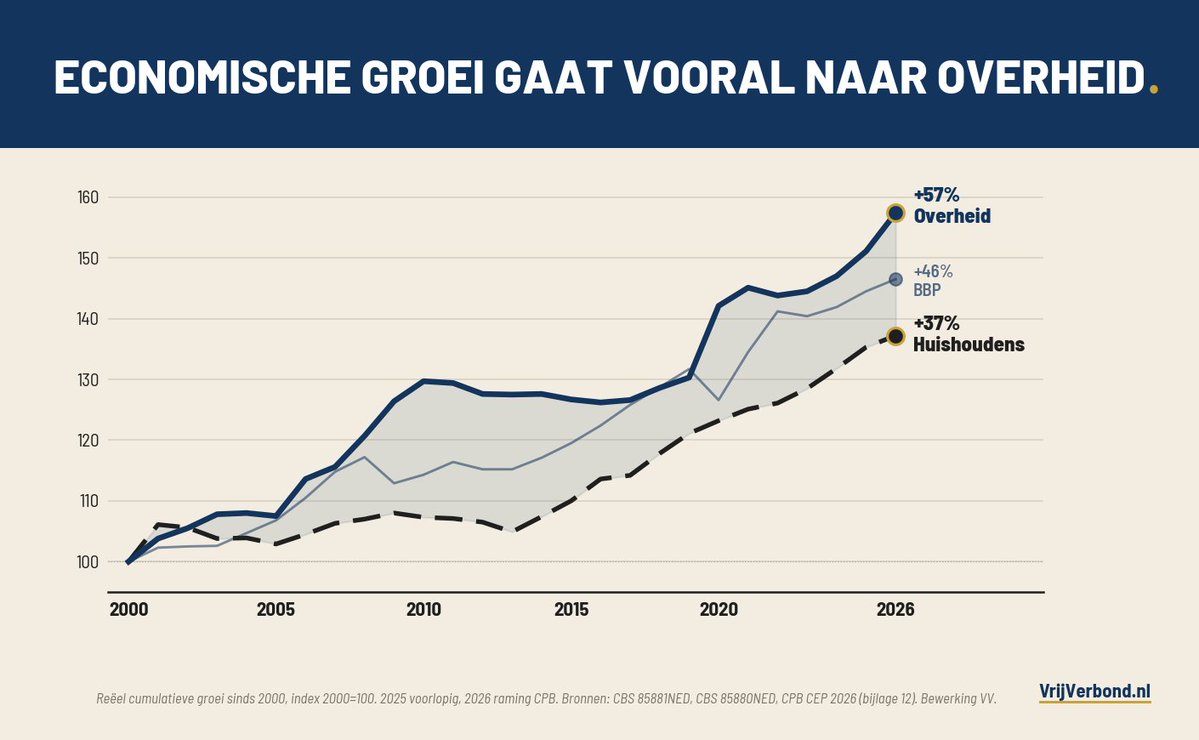
Vanaf 2000 groeide de overheid sneller dan de economie, en veel sneller dan huishoudens.
Had ons inkomen meegegroeid met de overheid, dan was het netto inkomen per huishouden dit jaar ongeveer €10k hoger.
In Zwitserland kwam in deze periode ~64c van elke euro BBP-groei terecht bij huishoudens. In Nederland slechts 27c. Een groot deel van het verschil komt door de omvang van de overheid: 45% van het BBP, tegenover 31% in Zwitserland.
Dit is het echte probleem.
De overheid moet kleiner zodat wij groter kunnen worden.
Nog even over het nakba-deugmomentje.
Het oorlogsmonument 1940-1945 in Utrecht werd bevuild met leuzen en de vlag van Hamas. De kransen van 4 mei werden als grof vuil áchter het monument gedonderd.
Zo gaan ze om met de nagedachtenis van onze verzetsstrijders. Onze geschiedenis moet plaatsmaken voor een nieuwe geschiedenis. Hún geschiedenis. We zijn toe aan vervanging.