@edsuh Exactly the problem with mark-driven performance: the supposed 10x pre-seed markup is often challenged or discounted when it’s a SAFE, especially within the same quarter
Most people have no idea what it actually takes to be a founder. They talk about vision, grit, or passion. Those words are props.
What you really sign up for is a life where every decision feels like it costs something real. You will spend years being misunderstood. By your team, your family, even the people you hire to help you. You will fail in public and still need to keep the energy up in private. Every founder lives with the weight of knowing that you can do everything right and still get crushed by luck, timing, or somebody else’s mistake.
Founders aren’t braver than anyone else. They just get used to uncertainty, then stop waiting for clarity. Most of your wins won’t feel like wins at all. The first revenue will be too small. The first team will outgrow you or leave. The first product that feels right will barely matter to the market. You will doubt yourself in private, sometimes every week. The founders who last figure out how to keep moving while the ground shifts underneath them.
Most outsiders want the founder badge but none of the scars. They want the upside, not the drag. The hardest part is sticking around after every plan gets blown up and you have to rebuild with less optimism and more scar tissue. What makes it work isn’t relentless hustle or some mythical trait. It’s learning to make peace with constant discomfort, and then making decisions anyway.
If you need constant reassurance, you’ll give up before the real work begins. If you want everyone to like you, you’ll never make the calls that matter. If you can’t handle months where nothing feels certain, this life will eat you alive.
But if you can hold your own in chaos, get better at being wrong, and still want to show up and try again, you just might have a shot at building something that matters.
That’s what it actually takes. And nobody cares until you make it work.
We know that there is a power law for early-stage VC funds, but what does this look like for growth funds? We've just updated our power law analysis to Q2 2024 and have included growth funds for the first time. Here's what we found. /1
When I see an MBA student who wants to work at a startup in a “strategy” role, I interpret that to mean “I want to be in the room where important decisions are made, but not do any real work myself”
I had a chat last night with a billion-dollar SaaS founder/CEO. He's raised $200M at a $2B valuation in 2021.
Living the high life in SF with a crazy house and a Porsche 911. On the surface, it seems like he has it all and living the dream.
But he called me out of the blue at 11p last night to vent.
It’s been 9 years since he started the company although people think it's overnight success.
Last two years have been brutal.
He’s sprinting to profitability. Layoffs. Now navigating the AI landscape.
He goes: “I hope we can compete in an OpenAI world”
I could practically hear his uncertainty crackling through the phone.
Four years ago, he had a full head of blonde hair. Today, it’s mostly gray. He looks like Obama post-presidency.
Then he dropped the bombshell, “I’m running a zombie company. I don’t know if we’ll ever IPO. Hopefully, we sell, and I get a 1-3x return for investors. I feel stuck.”
This is the dirty secret of Silicon Valley.
So many founders are trapped in the hype cycle, drowning in VC money but feeling like teenage toddlers trying to figure it out.
I've been stuck before. I've been on this treadmill before.
Sometimes you get unstuck, find that killer product and before you know it you're Silicon Valley's darling again.
But most, time you're not. You're just treading water.
And then you wake-up, you're 45, no hair, no kids, only yearly trips to visits family and realized you could have made a more profitable career (and more fruitful life?) just doing your own thing.
Maybe you're happy. Because you gave it your best shot at "building something big". You wanted to become the next Mark Zuckerberg.
But maybe you aren't. Maybe you realize that you can build something big on your own. No investors. Or join something early that isnt on the VC-train.
He called because he’s desperate for a new direction. Profitable, indie startups.
I keep getting these calls.
The air is thick with anxiety.
The unicorn dream is cracking, and people are waking up.
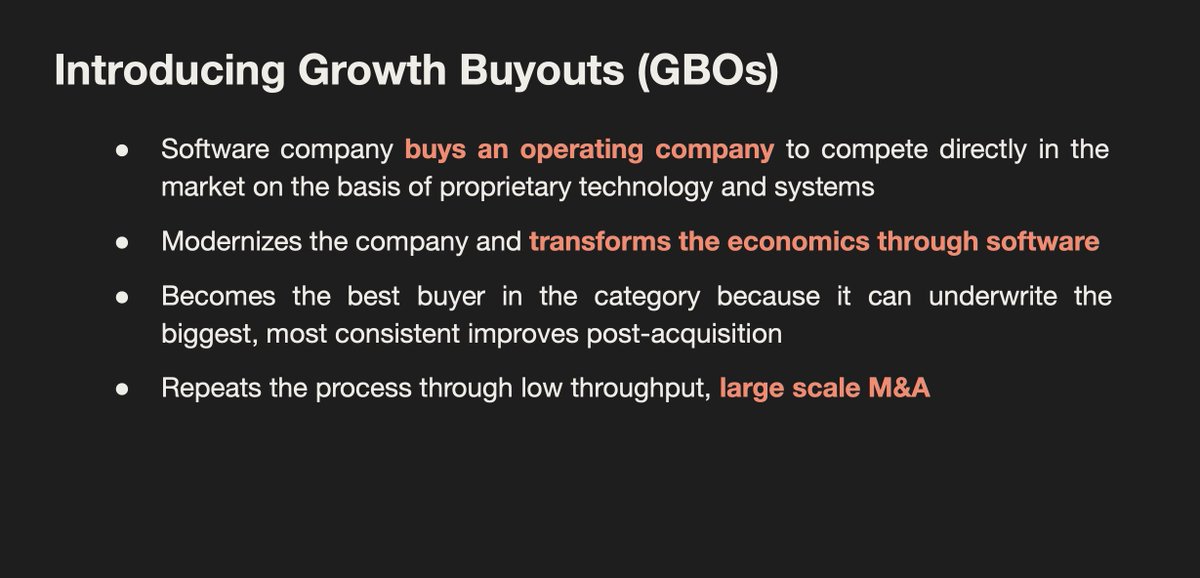
The age of the Software-Led Growth Buyout is Here.
Bringing software to industry remains the biggest opportunity for software to orchestrate/accelerate GDP but only if we can work beyond vSaaS biz models and capital structures.
Our deck and thesis:
https://t.co/HND2TeBzsB
@leojrr Have you checked out @loops? They offer a more affordable option at $149/month for 15k users with unlimited sends. I'm not a user yet, but I'm considering it. Might be worth looking into!
I used to pitch seed investors with a fancy slide deck. It generated average interest from average investors—and virtually no interest from sophisticated consumer investors.
After about 3 months of trial & error, I switched to:
⬝ Hand them a prototype
⬝ Leave the room
⬝ Quickly text my team to interact with the investor on the app
Then after 5 minutes, I would come back into the room and start explaining the longterm vision. Virtually every time they would interrupt me and say they'd like to invest.
For consumer products, you should let them speak for themselves, instead of wasting your time on a presentation that convinces your idea is good.
While you should certainly have slides ready to explain your tactical plans, getting an investor to experience the Aha Moment themselves will compensate for any other issue with your pitch. The last mile of conviction—when they tap "Send" on the wire—all comes down to intuitively understanding the concept.
And if the product demo doesn't resonate with them: they were never going to invest anyway.