My website https://t.co/Tn7KuCwiwa Come visit to see all my books -- Vikings, Regency/Victorian and Roman set historical romance. Timeless heroes, intrepid heroines, sexy escapist reads.
82 years on from the Normandy landings, we reflect on the thousands of British, Commonwealth and Allied forces who lost their lives for the liberation of Western Europe.
We will remember them.
@JohnHMcWhorter I realise you were talking about the Karmelo case, but you and Glenn should look at the Nowak case as there are echoes of Stephan Lawrence and police incompetence, possibly down to training which led them to discount Nowak's assertions of being stabbed.
98 names. Not forgotten – finally found.
On the 82nd anniversary of D-Day – the Allied landings that helped secure Europe’s freedom – these names are added to the @britishmemorial
Every man is remembered. Each one is a hero.
We shall never forget. #DDay
My tribute in @Daily_Express to our D-Day veterans - heroes every one of them – a full 82 years after the event that changed the course of World War Two
Today I have met Lucy, Mark and Katie, Henry Nowak’s mother, father and stepmother. Their courage is extraordinary.
They have endured the most appalling loss, it is a life sentence for them.
They have also faced the agonising decision to release the harrowing body-worn camera footage, knowing how painful it would be and how strongly people would react. They did so because they want truth, accountability and change.
They have asked that we work across political parties and religions to rebuild trust in the police. That trust has been broken because of what happened, and I agree with them on that.
We must also be prepared to examine, carefully and seriously, religious practices or exemptions that permit the carrying of dangerous weapons in public, and other activities that are not conducive to the public good. We also need to examine where the law needs to change.
Henry’s family do not want anger to tear communities apart. They are a family who have friends across faith and race, and so did Henry. His family want his memory to help bring our society together.
Everyone knows I have strong views about how we should deal with equality under the law. What the family agreed with me on is that we need to bring common sense back, and that is what we should all be fighting for.
I promised the family that we will work to ensure there is a positive legacy for Henry out of this tragedy.
That is my focus now.
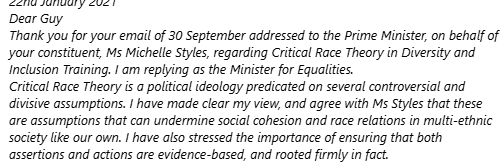
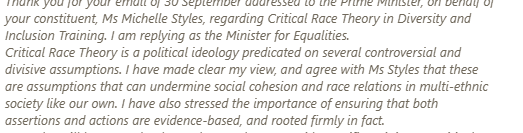
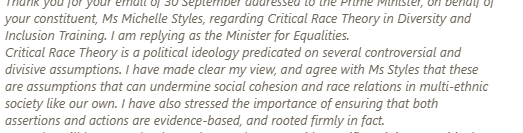
This is why I support Kemi Badenoch. She has been consistent in her approach (I still have the email she sent my then MP back on 22 Jan 21 which says basically the same thing in response to my concerns).
Identity politics divides our country whoever is doing it.
The Conservative Party rejects it.
We believe in universalism and equality under the law. We must not treat people differently on the basis of skin colour. We have to build faith and trust in our institutions.
If there is one thing that should come from Henry’s death, it is that we make things better, so that this does not happen to any of our boys again.
That is what I am committed to.
I do not want his death to be in vain.
Let’s do this for Henry. Let’s get this right.
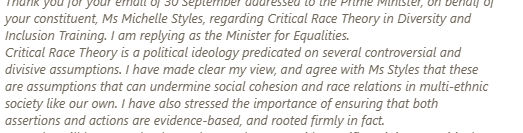
@hannahsbee Misleading propaganda by Reform. Kemi has been consistent in what she says. This is from an email to my MP which he then forwarded to me in Jan 2021
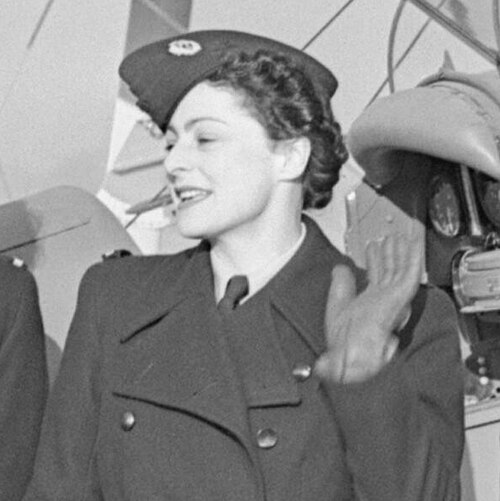
Woman of the Day pilot Mona Friedlander, one of the first eight women to join the Air Transport Auxiliary during WW2. She specialised in night flying, having spent nine months in 1939 as a “human target” for anti-aircraft batteries to practise on so they could be ready for enemy aircraft.
Mona’s family was wealthy and she could have sat the war out in comfort but she was bitten by the flying bug at 21 when a friend took her to Brooklands and "gave me a couple of gins and tonics and sent me up in an aeroplane".
Her parents indulged her at first. They funded her flying lessons until she earned her 'B' licence, No. 14599, on 11 November 1936 at Brooklands in a De Havilland DH60 Moth, but they stopped when they realised it wasn’t just a hobby. She wanted to train as a flying instructor. Her mother was horrified. Nice girls didn’t fly professionally. Undeterred, Mona earned the money for tuition fees by trailing aerial advertising banners around the Scottish coast, especially over Aberdeen.
“Some pilots have them attached before they leave the ground, but I always preferred to pick them up after I took off, in the same way as the RAF pick up their messages. It is only a matter of judging your height.”
In early 1939, Mona became a pilot for Air Taxis Ltd of Croydon and when the Government used wartime powers to move the company to Barton Aerodrome, Manchester, she went too. That’s when she became an Army Cooperation Pilot, flying back and forth along a defined route during the hours of darkness so that anti-aircraft gun batteries could practise training their guns on her.
At first, she wasn’t allowed to fly because no wireless operator would fly after dark in all weathers with a woman. Eventually, one reluctantly said that he “didn't mind very much”. When Mona’s competence became clear, others stepped forward.
She had to design her own uniform. She was the only woman “human target” so she designed her own. “It Is not so dark a blue as the men's and I decided not to have too many pockets. Also I chose my own tailor. Otherwise, lt ls just a neat trouser-and-coat affair."
Every night for three or four hours after midnight, month after month without a break, Mona flew up and down a stipulated route — no lights — while anti-aircraft guns searched for her aircraft. Eventually, the War Office granted her a couple of nights off.
“The only thing I can think of doing, now I need not be at the Croydon aerodrome waiting for orders, is to sleep and sleep and sleep."
By the time the ATA was ready to accept women pilots on 1 January 1940, Mona was ready for the ATA test at Filton, Bristol, having already clocked up more than 600 flying hours, well over the minimum requirement of 200 hours.
One of the first intake of women pilots known as the First Eight, Mona was assigned to Pauline Gower’s all-women section. Initially, they were restricted to flying trainer or communications aircraft and paid 20% less than male pilots with the same responsibilities (of course they were!) but as pressure grew for the speedy delivery of replacement aircraft from factory to RAF airfields, Attagirls were allowed to fly any aircraft, and in 1943, awarded the same pay as men.
Mona flew 32 different types of aircraft, including the De Havilland Mosquito and Wellington bombers. She had three accidents but was exonerated each time: the defective undercarriage of an Oxford failed to descend and lock before landing, she made a forced landing in a Lysander when the engine failed, and another forced landing in March 1941 in a Hawker Hind.
She was promoted to First Officer in May 1942, but in October, suffered from carbon monoxide poisoning requiring a prolonged recovery. She resigned from the ATA in February 1943 and became a censor, inspecting press photographs to determine if they revealed secret information.
At its height, 650 ATA pilots delivered aircraft from factories to RAF airfields in all weathers. Of these, 164 were women. They were not honoured for their war service with a medal until 2012, and by then, only 15 of the 164 had survived.
Mona was not one. She died in 1993, aged 79, but her war service stands on its own merits.
@TheAttagirls Good morning Lily. Petrova was the one who fixed cars etc and hated the stage. It was the first time I had heard about women doing the transport network. Pauline was the one who became an actress and Posy the dancer.
Only a few more weeks to enter the brilliant Martha Mills Young Writers’
Prize, set up by @meropemills and @paullaity in honour of the brilliant Martha
https://t.co/VlyNptABoz
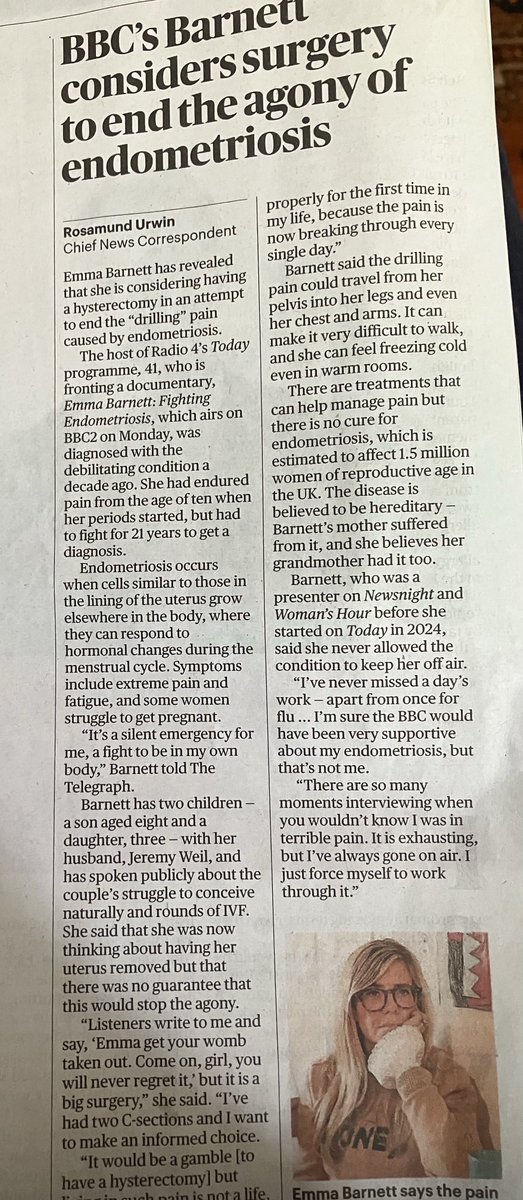
Deepest sympathies to Emma Barnett for her continued agonies with endometriosis as described @RosamundUrwin. But it is NOT incurable! I had it for 7 years and the Mirena coil is better than hysterectomy. It is quick, and if properly done, painless. Not enough women know this.
Woman of the Day British Overseas Airways Corporation flight attendant Jane Harrison, born in OTD 1945 in Bradford, the first woman ever to be awarded the George Cross in peacetime for her heroism. She saved 28 passengers during an aircraft fire.
On 8 April 1968, just another Monday, Jane donned her uniform and reported for duty at Heathrow Airport, joining ten other cabin crew members on BOAC Flight 712, bound for Sydney via Zurich and Singapore.
About a minute after take-off at 1527 hours, a loud and unexpected bang shook the aircraft. Engine No. 2 had caught fire. Two minutes later, the Mayday signal went out, with the pilots requesting an immediate return to Heathrow. As the plane started to circle back, the engine fell to the ground but the fuel continued to flow.
Three minutes and 32 seconds after take-off, the plane made an emergency landing. Flames began licking the fuselage.
On the flight deck, the pilots began to shut the plane down while cabin crew commenced evacuation. Jane, seated at the back, was responsible for opening the rear emergency exits and evacuating passengers via emergency chutes.
That’s exactly what happened at the front of the plane, but at the rear, the situation was very different.
The starboard slide had twisted, rendering it useless, and the fire quickly took hold, destroying the port slide. Realising that the twisted slide was the only means of escape, a cabin steward climbed down to straighten it out but was unable to climb back up, leaving Jane on her own to assist passengers.
Six passengers managed to escape before it punctured and deflated. Jane rescued 22 more by encouraging some to jump and by pushing out those too frightened to jump, but by this time, flames and thick smoke engulfed the cabin. The heat was intense — the windows were starting to melt — and there were three or four explosions as fuel tanks blew up and tyres burst. Jane was exhausted and choking but she continued trying to evacuate her passengers.
A colleague later said, “She had plenty of opportunity to escape but did not feel right about leaving a wheelchair passenger and three others on board. The Captain kept screaming at her to jump”.
Jane was just about to jump, but eyewitnesses recounted how something caught her eye and she turned back into the burning fuselage where an eight year old girl and an elderly woman in a wheelchair were trapped with two other passengers.
Her body was found near them, in the last row.
In August 1969, Barbara Jane Harrison was awarded the George Cross. It is reserved for acts of the greatest heroism or “for most conspicuous courage in circumstance of extreme danger".
Only four women have been awarded the George Cross: the all three WW2 Special Operations Executive agents during WW2 — and Jane.
Jane was the youngest. She was 22.