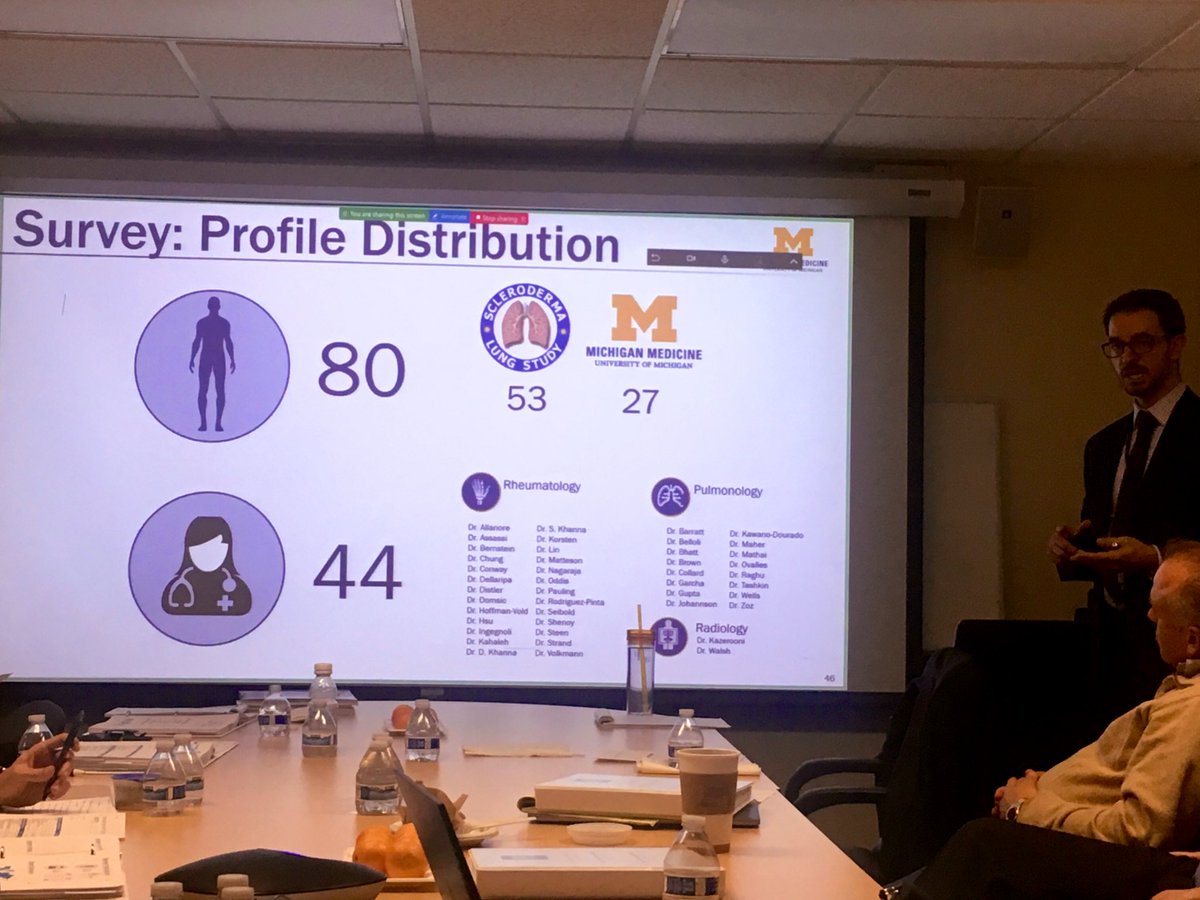
David Roofeh presenting his NIH T32 project to external advisors. Supported by @MichiganILD@ellakaz@UMIntMed and all the experts around the globe who have supported him
@EBRheum@leticiakawano@sclerodermaUM @DrPujaMehta1 @TobyMMaher@RheumILD@UMIntMed Potential harm is what patients MAY experience on a medication. It is not a guarantee of an adverse effect. And yes, an RCT. But there’s a difference between a drug effect and a synergy between 2 drugs to cause an effect.
@EBRheum@leticiakawano@sclerodermaUM @DrPujaMehta1 @TobyMMaher@RheumILD@UMIntMed That’s “potential harm” in numbers similar to the INPULSIS trials. We’re also unable to determine how much of those adverse effects are from the MMF as well, So you weigh risks and benefits. Many IPF patients on nintedanib and pirfenidone tolerate them enough to continue.
@EBRheum@leticiakawano@sclerodermaUM @DrPujaMehta1 @TobyMMaher@RheumILD@UMIntMed You could also argue that there was a small benefit, and certainly no harm, in patients on background MMF receiving nintedanib. Denying patients a medication that *might* work is also reasonable.
@leticiakawano@MariPiervalerio@sclerodermaUM@RheumILD Will take a 280-character stab at this. No “proof” that IPAF is a separate disease. HOWEVER, only 16% went on to develop a CTD-ILD, and the survival clearly differs from IPF, even when the pattern on CT or biopsy is UIP. Argues that maybe there is a separate clinical condition?
#ERS2019#ILD#IPAF
My #2 e-poster, IPAF (of course).
Are you sure that IPAF is another, confusing, research term? Is it a clinical entity? Is a different subgroup of other ILDs such as IPF?
If you really want to pull my legs, take a look at the poster!
Patients w/ a progressive interstitial lung disease, 62% of whom had a CT pattern of usual interstitial pneumonia, treated with nintedanib had a lower rate of loss of forced vital capacity than those given placebo. See the INBUILD trial. #ERSCongress https://t.co/PtU6HuZVQs