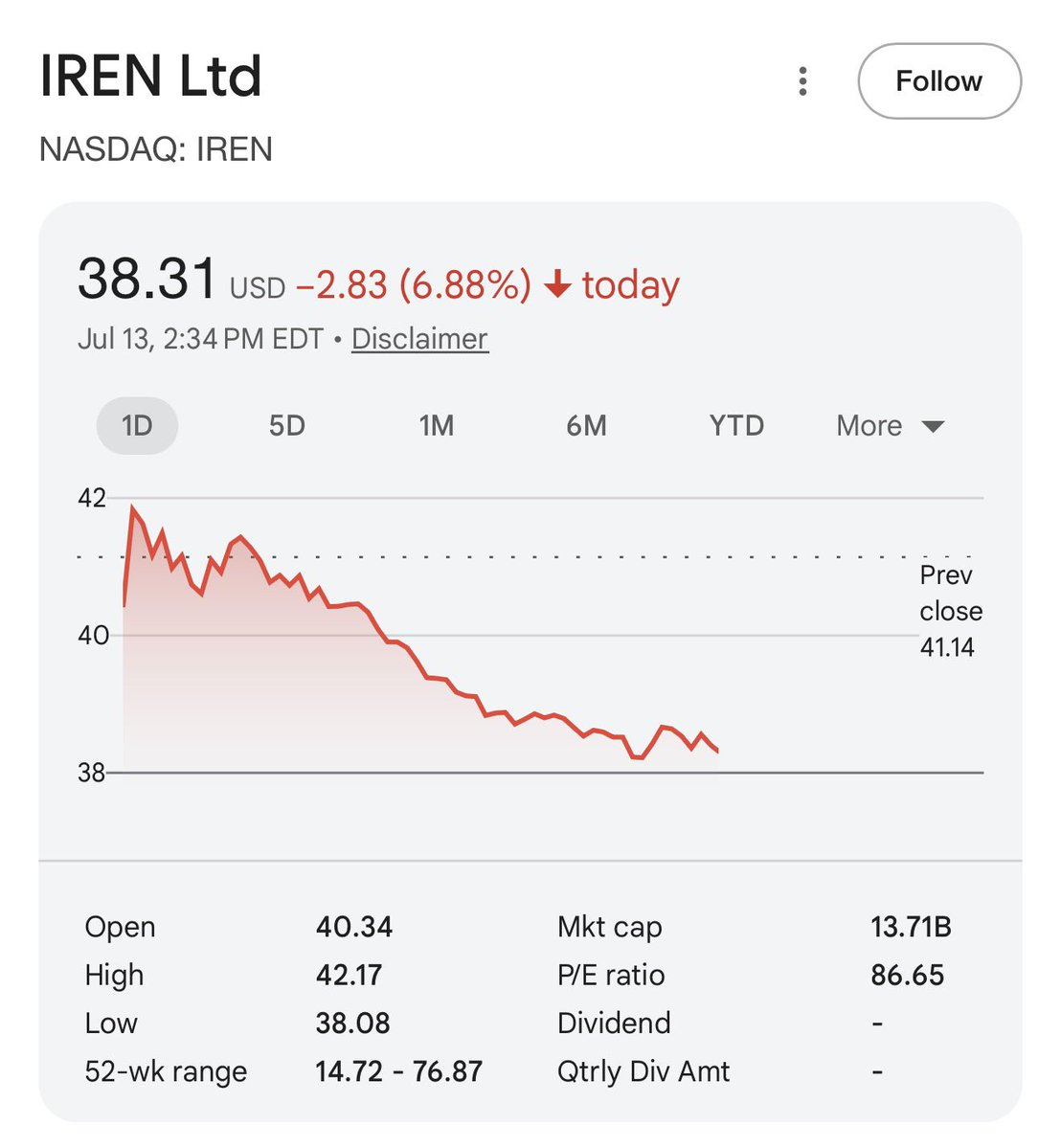
@brianfry01@brianfry01 Thanks for that long message, really interesting, would love to have you aboard one of the spaces foing forward with @bitcoinbutcher1 .
As you know this stock has been so unpredictable last 6 months, to read your text makes it easier to hold trough this ❤️🩹
You’re welcome and fantastic question, Jeff — and I’m not just saying that to expand your head. I lived through almost exactly this while co-founding RackForce in 2001. We were a small team with strong technical vision, including Denis Skrinnikoff (now IREN’s CTO).
We designed, built, and operated highly flexible, energy- and cooling-dense HPC-capable data centers. We launched our first cloud/IaaS offerings around 2002 and attracted thousands of startups from over 100 countries. That caught the attention of Microsoft (around 2005) and IBM (around 2009). Both became customers and partners who told us how important we were to their emerging cloud strategies.
We had big dreams to be a major player, but our model didn’t have the structural moat we needed. Microsoft went its own way (Azure in 2010), so we sold RackForce in 2015. That led us to launch PodTech in 2018 — much more strategically positioned this time, with owned land and power, a massive fabrication shop, and a full team of engineers and trades on site. PodTech merged with IREN in January 2020, which is how we’re connected today.
The standout success from that era was Amazon Web Services (public launch in 2006 with S3 and EC2). They built on open-source tech and excess e-commerce capacity. Jeff Bezos brought financial/quant experience from D.E. Shaw plus deep retail scaling know-how — very similar to the Roberts brothers’ Macquarie finance background and bold infrastructure approach. AWS quickly took the lead in public IaaS and changed the industry forever.
What the Roberts brothers are doing differently (and better):
• Vertical integration on land and power from day one (hydro in BC and strategic sites). Even the hyperscalers and Elon Musk didn’t secure enough strategic land and power for the AI boom — but the Roberts brothers did. This is essential for power-hungry AI/HPC workloads.
• Founder financial acumen, control, and optionality. They’ve made incredibly bold and strategic moves while staying aligned as a public Nasdaq-listed company (unlike private RackForce). Their Australian global perspective helped them move fast. IREN doesn’t pivot — it uses optionality to keep doors open, giving powerful flexibility to seize opportunities as they emerge.
• Bitcoin mining as a smart strategy, not the whole business. Dan Roberts put it well: “We built the data centers from day one capable of supporting these [AI] applications… the whole idea was to bootstrap the platform using Bitcoin… and then layer in higher and better use cases over time as they emerge.” Unlike most miners, Bitcoin was just the starting point for funding and proving the infrastructure.
• Strategic ecosystem and talent. Their NVIDIA partnership (including the Mirantis acquisition for orchestration and Sovereign AI control — clearly NVIDIA-approved and supported) plus world-leading data center design in close collaboration with NVIDIA. AI Sovereignty is a huge moat here. NVIDIA and Jensen Huang have talked about it for years, but few executed like IREN + Mirantis. That’s why IREN is attracting the very best people. Unlike most Bitcoin miners, they didn’t just sell colo capacity — they built the complete stack.
• First-principles flexibility. They know their strengths and gaps, then fill them decisively. The moment they merged with PodTech, I knew they got it.
Land + power + vertical integration is the foundation, but IREN’s real moat is the full package: NVIDIA partnership + AI Sovereignty + strategic optionality + top talent + world-class design + founder control. It positions them as a serious, vertically integrated AI Cloud platform — not just GPUs for rent.
If I were doing it all over again, I’d follow their playbook. In the future there will be books written about $IREN and the early days of AI. Excited to be on this ride with all of you.
$Iren
With the hire of Eric Hammersley, former Nvdia, we are laying a strategic peice of the puzzle in place.
His previous roles include leading software product security architecture for NVIDIA’s high-performance computing environments and senior engineering positions in the U.S. federal government and defense sector, including Chief Engineer supporting the Joint Chiefs of Staff (J6) 👀
Bullish on $IREN 🔥🔥🔥
New York just became the first U.S. state to slap a full one-year moratorium on new large data centers (50 MW+). While others get blocked by red tape, power shortages, and local backlash, IREN is sitting on one of the largest secured power portfolios in the industry …. ~6GW scale across Texas, Canada, Europe and Australia.
• Childress & Sweetwater campuses already energizing
• 150,000 NVIDIA GPUs on track for ~$3.7B AI Cloud ARR by end-2026
• Major Microsoft deal locked in + vertical integration advantage
When supply gets choked in high-cost states, the winners are the ones who already secured the power and land. IREN’s early-mover execution in friendly markets just got even more valuable.
AI compute hunger isn’t slowing down … it’s accelerating. $IREN is best positioned to capture it.
https://t.co/GiP3oOZ0YH
@insearch0fvalue@RealJimChanos If that were true than $iren would have signed exclusively bare metal deals like $msft but opted to dedicate 5 GW to $nvda to create a token factory for sovereign uses cases, be it government or enterprise at higher margins
$IREN
Why did Mirantis sell their company to $Iren for Iren-shares? Listen to this video and you will understand why Mirantis is o bullish of Iren.
How Mirantis and IREN Are Building the AI Factory Control Plane | Alex F... https://t.co/aQ5sfQtRag via @YouTube
$IREN remains one of the most undervalued AI data center company on Wall Street.
Look at what is happening across the sector.
In the UK, around 140 proposed data center projects have requested approximately 50 GW of electricity. That is more than Britain’s current peak electricity demand. Developers are now facing grid connection delays that can stretch for years.
In the US, data center projects are being delayed by local opposition, electricity costs, water concerns, permitting issues and environmental reviews. Around $64 billion of proposed developments have already been blocked or delayed.
Nebius is facing a lawsuit from residents over its proposed 300 MW data center in Birmingham, Alabama.
Nebius has also agreed to pay Bloom Energy up to $2.6 billion for behind-the-meter fuel cells. The first phase will provide 328 MW of power.
Why would Nebius commit that much capital?
Because getting power faster means bringing compute online faster.
Now look at IREN.
IREN already has a power and data center pipeline of approximately 5.8 GW across Texas, Oklahoma, Canada and Australia.
It has major sites in Childress and Sweetwater in Texas, Kiowa in Oklahoma and several operating locations in British Columbia.
It has also secured a transmission connection agreement for an 800 MW campus in South Australia. The project has received public support from the South Australian government and is expected to begin energisation in 2028.
This is what the market continues to overlook.
IREN has spent years securing sites, power agreements, grid connections and access to transmission infrastructure while many other companies are only now trying to solve those problems.
Yet IREN is still valued at $13.75 billion compared with Coreweave at around $43 billion and Nebius at around $51 billion.
CoreWeave and Nebius are ahead in cloud services and software. IREN addressed part of that gap through the acquisition of Mirantis, which gives the company a stronger enterprise software layer and a presence in Silicon Valley.
IREN now has the power portfolio, the data center pipeline, the financing capability and the software platform needed to sell more than basic infrastructure.
Given the value being placed on powered land and available compute, I am genuinely surprised a hyperscaler has not already tried to acquire the company. Maybe they have and IREN rejected it.
The largest technology companies are spending billions to secure the exact assets IREN already controls.
I believe the market is valuing IREN based largely on current revenue.
I am looking at what nearly 6 GW of power capacity could generate once more of that pipeline is energized and converted into AI compute.
I am very much looking forward to Horizon 1 delivery in the coming weeks.
10 years ago this was a $50K satellite intel report sold to hedge funds.
Today @FransBakker9812 hands it out for free.
Retail has never had more edge. Most still won’t use it.
$IREN
$IREN Horizon 1 handover imminent
Satellite imagery confirms that the grounds around the Horizon 1 complex, including data halls, liquid cooling plant, and network core building — have been paved ahead of customer handover.
Furthermore, security has increased, with Microsoft bringing in their own security equipment, including a brand new security booth, which needs to be passed to enter the complex grounds.
If you have any sense of how these projects work, then you realize that these events are the final details of a customer moving in, rather than a construction team moving out.
Do with that information what you will, but shorting @IREN_Ltd ahead of a PR storm of relevant stakeholders, celebrating a 1 out of 4 identical projects successfully being turned into a billing AI factory, sounds pretty irresponsible to me.
Not financial advice ☝️