Palantir's CEO just exposed Sam Altman and Dario Amodei for robbing every Fortune 500 company.
Within two minutes, Alex Karp took the entire frontier AI industry apart on national television.
His exact words:
"Every single enterprise in this country, these people are LIVID. They are paying for tokens that create no value. These people are stealing the weights and alpha of my business."
He literally said the entire frontier AI business model is intellectual property extraction dressed up as a subscription.
Then he also destroyed the pricing model with a single question that Silicon Valley still refuses to answer:
"If it was so valuable, let's say I can make you $1 billion tomorrow. Wouldn't I say I'll make you $1 billion and I want 30 percent? Why are they charging for tokens if it's so valuable?"
That question breaks the industry.
If OpenAI and Anthropic's models truly delivered the productivity gains the labs claim, they would take equity or a share of the profit they generate. They would not sell access by the million tokens.
Token pricing is itself the CONFESSION that the product cannot produce reliable value at scale. If it did, they would price for the value. But they price for the compute because that is what they are actually selling.
Karp went even further...
He called the entire arrangement "a wealth tax that does not help the poor. It just punishes."
American businesses are transferring the alpha of their operations, meaning the workflows, the customer data, the strategy memos, the internal models that make them competitive, directly into the training pipelines of a handful of Silicon Valley labs. Once those labs retrain, the customer's own edge becomes the next enterprise product sold back to their competitors.
And the part the AI industry does not want anyone thinking about:
Every enterprise running its confidential documents, its customer conversations, and its financial models through a frontier model is potentially teaching that model HOW to replace them.
The vendor collects the token fee AND the compounding intelligence about that customer's business. That is the mechanism. And that is why Karp used the word "stealing."
He claims this is why every executive he meets is furious in private and silent in public. Nobody wants to be the CEO who called out the labs and then discovered their next competitor was built on their own leaked workflows.
The entire AI industry has been priced for perfection on one assumption:
That frontier labs produce durable, defensible value that justifies infinite compute spend.
But Karp just told us that the customers do not believe that assumption anymore. They believe they are being taxed without benefit, watched without consent, and copied without recourse.
The moment enterprises stop believing, the whole valuation stack shakes.
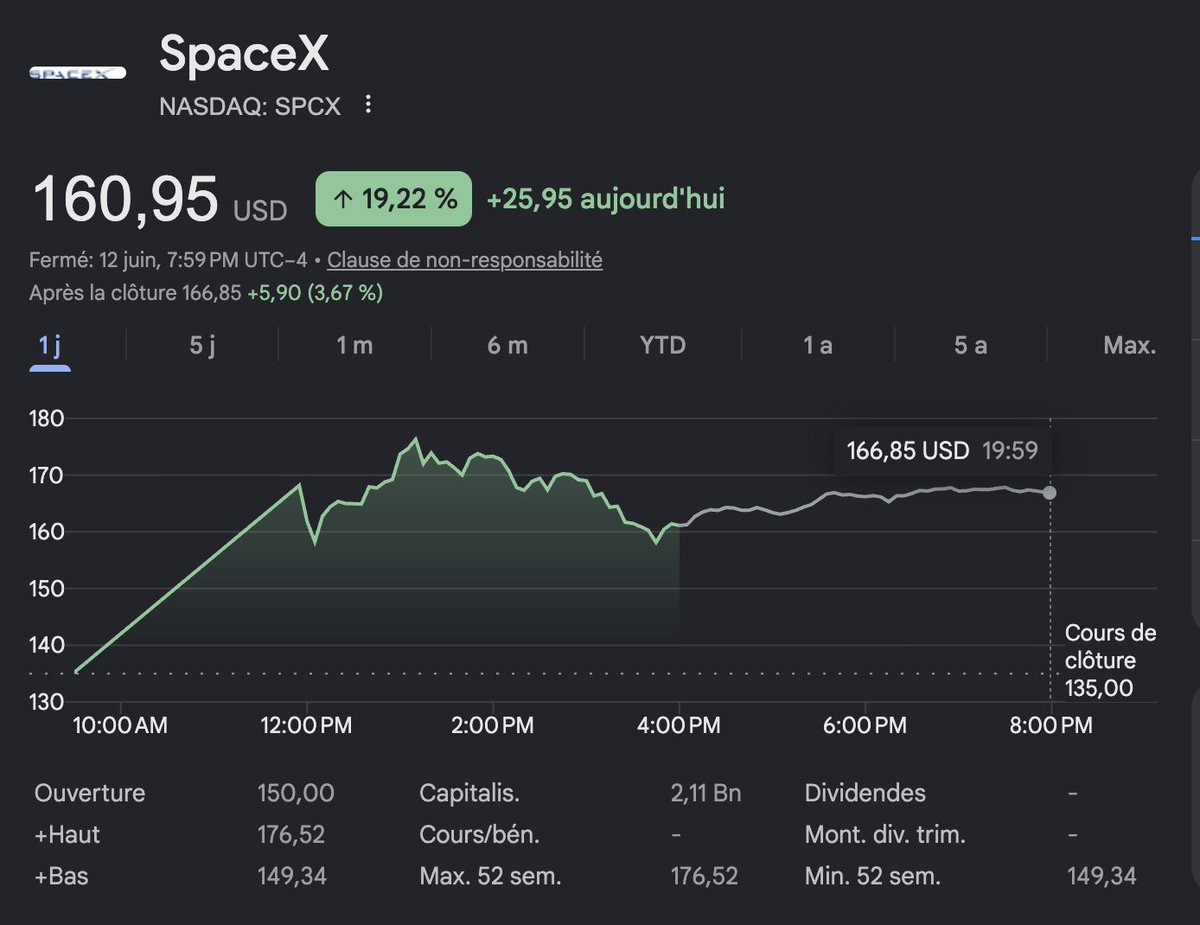
SpaceX a clôturé son premier jour de cotation à 2 100 milliards de dollars, +19%. Tout le monde regarde le chiffre. Personne ne regarde ce qu'il price réellement.
Laissez-moi vous dire ce que le marché vient d'acheter, et pourquoi je pense que cette boîte vaudra 30 à 50 trillions d'ici 5 ans.
D'abord, le symbole. Cette IPO est un référendum. D'un côté, 20 ans de discours sur la décroissance, la sobriété, la redistribution, la fin de l'histoire gérée par des comités. De l'autre, un homme qui a dit "je vais rendre l'humanité multiplanétaire", que tout le monde a traité de clown, et qui vient de créer la plus grosse entreprise cotée de l'histoire en partant d'un entrepôt à El Segundo. Le marché a voté. Le wokisme avait des départements RH, SpaceX avait des fusées. Les fusées ont gagné.
Ensuite, la mécanique économique, parce que c'est là que tout le monde se trompe. Les analystes valorisent SpaceX comme une entreprise de lancement plus Starlink. C'est comme valoriser Internet en 1995 sur le marché du fax. Starship ne réduit pas le coût du kilo en orbite de 20%, il le divise par 100. Et chaque fois dans l'histoire qu'un coût d'infrastructure est divisé par 100, ce n'est pas le marché existant qui grossit, ce sont des industries entières qui naissent. Le coût du calcul divisé par 100 a donné Internet, le smartphone, l'IA. Le coût de l'orbite divisé par 100 va donner une économie spatiale complète.
Faisons la liste de ce qui devient rentable quand le kilo en orbite coûte le prix d'un billet d'avion. Les data centers orbitaux, avec énergie solaire continue et refroidissement gratuit, au moment exact où l'IA fait exploser la demande énergétique terrestre. La fabrication en microgravité de semi-conducteurs, de fibres optiques, d'organes imprimés impossibles à produire sous gravité. Le tourisme orbital de masse, puis les hôtels lunaires, qui passeront du fantasme au business plan exactement comme la croisière de luxe au 20ème siècle. Le transport point à point terrestre, Paris-Tokyo en 40 minutes. L'industrie minière des astéroïdes, dont un seul corps de classe M contient plus de métaux que tout ce que l'humanité a extrait depuis le néolithique. Et Mars en ligne de mire, pas comme destination touristique, mais comme le plus grand projet d'infrastructure jamais entrepris, avec tout ce que ça implique de demande en énergie, matériaux, robotique, IA.
SpaceX ne participera pas à ces marchés. SpaceX possède le péage d'entrée de tous ces marchés. C'est AWS, mais pour la civilisation. Apple vaut 3 500 milliards en vendant des rectangles de verre sur une seule planète. Le premier monopole d'accès à une frontière infinie à 30 ou 50 trillions dans 5 ans, ce n'est pas de l'exubérance, c'est une simple règle de trois sur l'expansion du marché adressable.
Et maintenant, la partie que je préfère. Ce futur n'a pas besoin de bureaucrates. Il n'y a pas de comité consultatif en orbite. Pas de commission Théodule sur Mars. Chaque dollar de cette nouvelle économie sera créé par des ingénieurs, des techniciens, des soudeurs, des pilotes, des entrepreneurs. Les diplômés en gestion de la norme vont devoir apprendre un métier utile, et franchement, c'est une excellente nouvelle pour eux aussi : construire est infiniment plus fun que contrôler.
Parce que c'est ça, le vrai signal d'aujourd'hui. Pendant 50 ans on nous a vendu un futur rétréci : moins d'énergie, moins d'enfants, moins d'ambition, gérer le déclin proprement. Et là, d'un coup, le plus gros actif financier du monde est un pari sur l'abondance, l'expansion et l'aventure. Le pessimisme vient de passer en position vendeuse sur lui-même.
Le futur sera méga fun. Il y aura des hôtels avec vue sur la Terre, des honeymoons en orbite, des gamins qui diront "papa, c'était comment avant les fusées réutilisables" comme on dit "c'était comment avant Internet". Et quelque part dans les années 2030, un humain marchera sur Mars en livestream devant 5 milliards de personnes, et ce jour-là plus personne ne se souviendra du nom d'un seul de ses détracteurs.
Achetez de l'optimisme. C'est encore sous-valorisé.
.@BernieSanders , it is a time to celebrate. @elonmusk has created enormous value for society by building @SpaceX, driving down the cost of rocket launches and creating a global satellite communication network that has brought high speed, low-cost internet and communication access to hundreds of millions and eventually billions of people along with critical advantages for our military and our nation’s defense.
SpaceX and its technologies will cause an acceleration in the growth of wages and wealth creation globally, including in some of the poorest communities in the U.S. and around the world.
Access to low-cost, high speed communications everywhere will allow children around the world to be educated, families to build businesses, and life-saving medical knowledge and care to be available everywhere.
SpaceX will materially bring down the cost of compute, advancing AI and humanity.
Meanwhile, 4,000 SpaceX employees yesterday became millionaires, including hourly wage employees who you claim you are trying to help.
The Elon Musks of the world drive growth, global GDP, and provide access to goods and services at lower cost that would otherwise not exist.
Elon’s nominal trillionaire status is due to his ownership of SpaceX, Tesla, Neuralink, the Boring Company and his other initiatives that have brought new technologies that improve our everyday lives.
Elon is not sitting on a trillion dollar pile of cash, jewelry and gold. He is using his controlling stakes in his companies to advance mankind. Elon’s companies don’t pay dividends. They reinvest all of their capital to accelerate innovation and value creation.
Elon is working 24/7 for all of us. He deserves respect and appreciation, not smears.
Bernie, your socialism would never allow a SpaceX to be built. Socialism has only proven to impoverish mankind and lead to death and destruction.
We need to create the conditions for more SpaceXs to be built, not attack the great entrepreneurs who are helping to advance our country.
instead of watching 2 hours of Netflix tonight, watch this Stanford lecture
it's the clearest explanation I've seen of how ChatGPT and Claude actually work
useful whether you've never touched AI in your life or have been using it every day for the past year
I took the key ideas and turned them into a practical guide on how to actually get 100% out of Claude
find it below
Former Treasury Secretary Henry Paulson called on US authorities to prepare a back-up plan in order to avert a potential collapse in demand for Treasuries https://t.co/GMjfR5fa47
Copy this: [Your Full Name]
[Your Address]
[City, State ZIP Code]
[Email Address]
[Date]
U.S. Federal Housing
400 7th Street, S.W.
Washington, D.C. 20219
Subject: Assessment and Recommendation on the Treatment of Senior Preferred Stock (SPS) in Fannie Mae
Dear Sir/Madam,
I am writing as a concerned shareholder of Fannie Mae and as someone deeply interested in the future stability and fairness of the U.S. housing finance system. As the Federal Housing Agency continues its deliberations regarding the future of Fannie Mae under conservatorship, I wish to express my views on the treatment of the Senior Preferred Stock (SPS) held by the U.S. Treasury and the over $301 billion in net worth sweep payments already made by the company.
It is my strong belief that the SPS has already been effectively repaid, if not overpaid, through the substantial net worth sweep payments that Fannie Mae has made to the U.S. Treasury since 2012. These payments have far exceeded the original investment provided by the government, yet the SPS liability remains on the books without any acknowledgment or reduction to reflect the amounts already paid. This lack of adjustment creates an untenable and unfair situation for current shareholders, many of whom invested with the expectation that the government would act in good faith and respect the principles of fair financial stewardship.
If the U.S. government were to convert the SPS into common stock, particularly at current market prices, it would lead to extreme dilution for existing shareholders—an outcome that would likely erode investor confidence and undermine the long-term viability of Fannie Mae as a publicly traded company. Given that the Treasury has already received more than its fair share in payments, the conversion of SPS into common stock without due recognition of the prior payments would constitute an unjust treatment of shareholders and a misalignment with the principles of fairness and equity.
With this in mind, I respectfully recommend that the U.S. Federal Housing Agency take one of the following approaches:
Deem the SPS Repaid: Acknowledge the $301 billion in payments made to the Treasury as fully satisfying the government’s investment, and formally forgive or cancel the remaining SPS liability. This would restore equity and fairness in the capital structure, allowing Fannie Mae to move forward on a stronger footing without unnecessary financial encumbrances.
Hybrid Conversion and Forgiveness Model: If conversion of the SPS into common stock is deemed necessary, I urge that it be done in a way that fairly accounts for the substantial payments already made. A hybrid model—where part of the SPS is forgiven or converted at a premium—would limit the dilution to current shareholders and ensure that the government’s interests are still respected, without unduly penalizing those who have already paid in good faith.
Such actions would allow the Federal Housing Agency to continue fulfilling its role in stabilizing the housing finance system, while also ensuring that the interests of shareholders and investors are treated equitably. By pursuing a fair and transparent resolution, the U.S. government would also strengthen investor confidence in Fannie Mae’s future and the broader housing finance market.
Thank you for your time and consideration. I trust that the Federal Housing Agency will take these concerns seriously and work toward a solution that is both just and sustainable for all stakeholders involved.
Sincerely,
[Your Full Name]
El mundo está en shock: el dueño de la fiesta y sus camareros han decidido dejar de servir gratis
Durante décadas, Estados Unidos compró a todos, sostuvo déficits colosales y mantuvo a flote la economía global, mientras otros países disfrutaban de la comodidad de exportar sin restricciones y de ventajas injustas.
De hecho, el ascenso económico del régimen comunista chino es, en gran medida, resultado directo de la política comercial estadounidense.
Ahora que Trump propone reciprocidad en los aranceles —una medida que busca reindustrializar el país y recuperar empleos—, el capital especulativo entra en pánico, las bolsas se desploman y los parásitos geoeconómicos se desesperan.
Pero, en el fondo, el pánico no se debe al supuesto “caos económico”.
Se debe al fin de la fiesta gratuita.
¿La mejor manera de explicarlo? Una caricatura:
Imagina una fiesta lujosa en un gran salón.
¿Los invitados? Los países del mundo.
¿El anfitrión y los camareros? Por supuesto, Estados Unidos.
Durante décadas, esos camareros sirvieron champán, caviar y exquisitos aperitivos —todo a crédito o incluso gratis.
Los invitados brindaban, bailaban, aplaudían la generosidad americana… y todavía se quejaban de la temperatura del vino.
Hasta que, un día, el dueño de la fiesta se cansó.
Ordenó a sus camareros cobrar un precio justo.
Se quitó el esmoquin, se puso una chaqueta de mezclilla, tomó el micrófono de la banda y anunció:
“A partir de ahora, cada quien paga lo que consume. Y si quieren vender aquí, también tendrán que comprar aquí.”
El salón quedó en silencio.
Los especuladores dejaron caer sus copas.
Los burócratas escupieron el foie gras.
La orquesta de los mercados financieros perdió el ritmo.
De pronto, el anfitrión y sus camareros pasaron a ser “los villanos”.
Pero en el fondo, todos sabían que la fiesta se había vuelto insostenible.
Solo que nadie quería ser el primero en marcharse.
La justicia, cuando llega, suele incomodar a quienes siempre vivieron del privilegio y a costa de otros.
Pero quizá ha llegado la hora de que el mundo aprenda a pagar su propia cuenta.
Y hay que decirlo: Trump fue honesto desde el inicio. Ya en su campaña anunciaba que esta fiesta a expensas de Estados Unidos se acabaría.
Lo más surrealista —y casi cómico— es ver a los ideólogos de izquierda amenazando con “represalias”.
Es como un mendigo que se queja porque su benefactor ha reducido las donaciones, debido a que su familia creció y sus gastos también.
El mendigo exclama indignado:
“¿Vas a hacer recortes… ¡con mi dinero?”
Ese es el nivel de cinismo que el mundo está presenciando hoy.
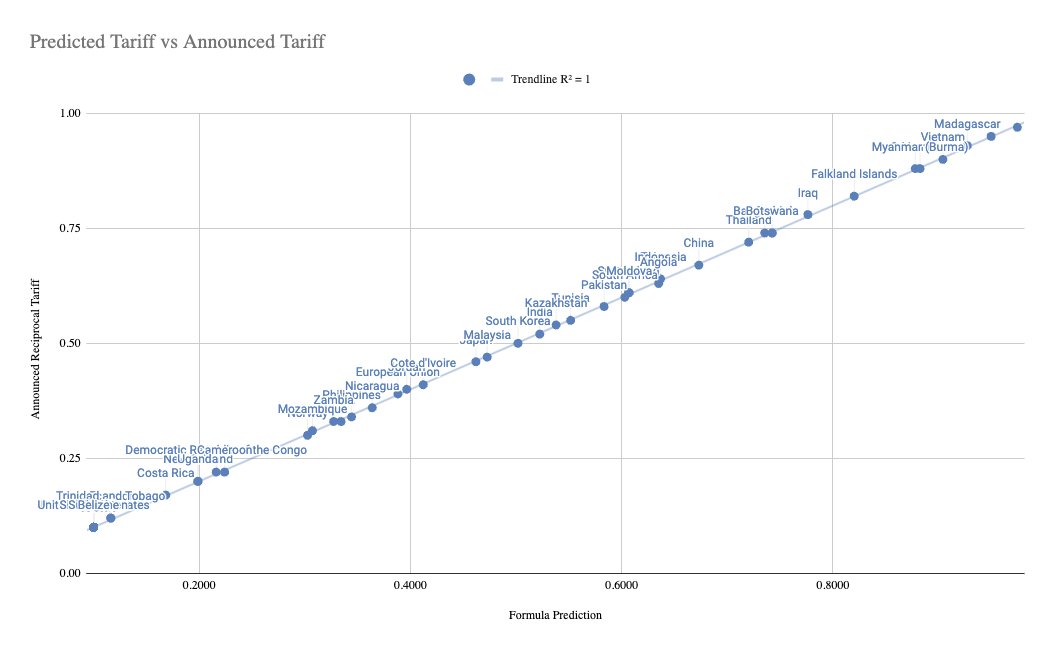
Flexport's team was able to reverse engineer the formula the Administration used to generate the "reciprocal tariffs."
It's quite simple, they took the trade deficit the US has with each country and divided it by our imports from that country.
The chart below shows the predictions of this formula plotted against the actual new tariff rates.
A must watch, superb, long-form interview with Secretary Bessent by the All-In crew in which Fannie and Freddie are discussed as potential core assets in a U.S. sovereign wealth fund, which I discuss below:
The only credible scenario where Fannie Mae and Freddie Mac (“F2”) become core assets of a sovereign wealth fund in the @realDonaldTrump administration is a world in which they emerge from conservatorship respecting the shareholders’ place in the hierarchy of claims.
Those that suggest the government will simply convert their already paid off senior preferred stock (“SPS”) into common stock diluting shareholders are missing a few facts:
(1) The SPS has already received $301 billion, $25 billion more than it was contractually entitled to receive, and the excess $25 billion was paid to the government more than five years ago. In other words, the SPS has been fully retired with interest plus a $25 billion overpayment, considerably more in today’s dollars.
(2) Those who argue that the government won’t forgive an asset that currently sits on its balance sheet (as the government did not credit the cash flow sweep payments against the SPS at the time they were paid) have not considered that the government, as the owner of penny warrants on 79.9% of the common stock of both companies, will recover 79.9 cents of every ‘forgiven’ dollar of senior preferred. When you wipe out a liability of a company in which you own 79.9% of the common stock as the residual claimant, you immediately recover 79.9% of the erased liability, in this case, in the increased value of the government’s warrants.
(3) The future value of the $25 billion overpayment to the SPS by the time of F2’s exit from conservatorship is of greater future value than the 21.1% of F2 that will go to public shareholders from the ‘forgiven’ SPS, which fully compensates the government for any ‘leakage’ to shareholders from the public’s 21.1% ownership.
(4) If the government massively dilutes shareholders by converting the SPS to common stock and does not credit the $301 billion cash flow sweep payments and $25 billion overpayment, the trading values of F2 will be permanently impaired, making F2 a poor core asset for a sovereign wealth fund.
What investor, institutional, retail or otherwise will assign a fair value to a company controlled by the government which wiped out the previous investors in the company?
F2 common stock is held by many millions of retail and institutional investors who are @realDonaldTrump supporters. The President has a track record in looking after his constituents and keeping his promises, most notably here in a public letter in 2021 committing to F2’s release from conservatorship. I would not expect him to act differently here.
Lastly, Secretary Bessent’s idea of making Fannie and Freddie core assets of a new U.S. sovereign wealth fund is a superb one. Over the very long term, Fannie and Freddie represent a royalty on first mortgages secured by the US housing market, which is a low-risk, high risk-adjusted return investment that will generate large and growing dividends that can be invested in other sovereign fund assets. The long term returns on F2 will significantly exceed the cost of U.S. Treasurys enabling our country to deleverage over time.
$36 Trillion of debt and growing is a frightening liability for the future. We can address our country’s solvency problem by reducing spending and government waste, but also by increasing the asset side of our country’s balance sheet. F2 can be an important part of the solution.
And the stocks of both companies will trade at a substantially higher price with the US government shares no longer being part of the overhang. Our model assumed the government would be selling its shares ratably over the five years after emergence from conservatorship.
I'm German.
16 years ago, the EU and US economies were neck and neck.
Today, the US economy is 50% larger than the entire EU combined.
Here's the devastating truth behind Europe's ongoing economic suicide 🧵:
2025 will be a transformational year in AI.
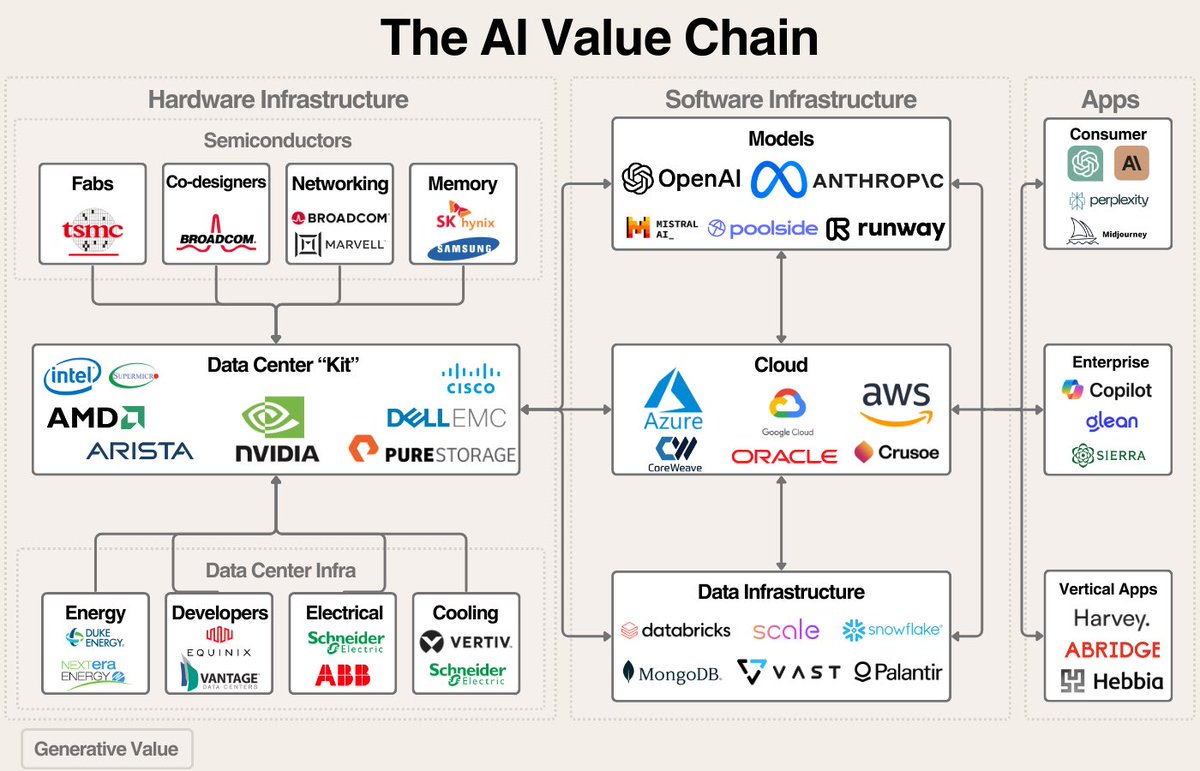
Here are my top picks in AI investing theme:
Hardware | $TSM, $AVGO, $NVDA, $AMD, $ANET
Software | $AMZN, $MSFT, $META, $GOOG, $ORCL, $MDB
AI Agents | $GOOG, $CRM, $META, $NOW, $MSFT