"It is important for people to recognize that this is not normal behavior by the Intelligence Community - most officers would never do something like this. In my over 20 years of public service, the politicized efforts by [the] CIA and others to conceal the truth about the threats to the 2020 US Presidential Election are unprecedented and even today shock me when I retrace everything that happened." - https://t.co/kRKinPMrbX
Issued: January 15, 2020 - Declassified: March 16, 2026
@VaughnHillyard@RohdeD
Economic Sovereignty and the Case for Running the Economy Hot
President Trump’s economic strategy is simple: grow out of the debt by running the economy hot, through supply-side expansion, not demand-side stimulus. It is a return to Hamilton and Clay: national strength built on production, capital formation, and industrial capacity.
Supply-side policy, tax cuts, deregulation, and investment incentives, is not inflationary. It expands the productive frontier. More capital generated by the private sector and higher productivity mean more output without sustained price pressure.
The Keynesian error is to treat all growth as inflation risk. It fails to distinguish between consumption-driven booms and production-driven expansion. The former overheats; the latter raises capacity and restrains inflation.
An America First approach reinforces this logic: reshoring industry, securing supply chains, and prioritizing domestic production. This is economic sovereignty, less dependence on fragile global inputs, more control over real output.
That same logic extends to technological leadership. Securing dominance in AI and digital assets is not optional, it is central to future productivity growth and capital formation. The United States cannot afford to repeat the strategic mistake it made with semiconductors, where critical capacity migrated offshore.
Leadership in AI and crypto is about anchoring the next generation of economic infrastructure at home.
The payoff is tangible. Productivity-led growth drives real earnings, lifts wages, and raises living standards for the average American. Margins expand through efficiency, not price hikes. Growth shows up in purchasing power, not just nominal gains.
The president has suggested that growth in the 12-13% range is achievable. That is an ambitious target, but it captures the core idea: growth driven by productivity and capital investment is not the problem. It is the solution to debt sustainability.
The problem is that the Fed and much of Wall Street still operate within a framework that reflexively fears strong growth. Growth is BAD. That bias risks choking off the very expansion that underwrites real earnings, higher wages, and long-term prosperity.
Growth driven by production should not be restrained. It should be maximized. The President and his team get it.
the difference between a 0.5mm dermaroller and a 1.5mm dermaroller for hair regrowth is enormous and most people are using the wrong depth
0.25-0.5mm needles only penetrate the epidermis. this is useful for increasing absorption of topical products because it creates tiny channels in the surface layer of skin. if youre using minoxidil or rosemary oil a 0.5mm session before application can increase absorption significantly. but it doesnt reach deep enough to trigger the wound healing response that actually stimulates hair growth
1.5mm needles penetrate into the dermis which is where the hair follicle's stem cells live. at this depth the micro-injuries trigger a genuine wound healing cascade: platelet-derived growth factor, epidermal growth factor, and stem cell activation at the follicle level. this is the depth used in the landmark 2013 study that showed 4x the hair count improvement when added to minoxidil
the difference is basically surface-level product absorption versus deep-level follicle regeneration. completely different mechanisms producing completely different results
use 0.5mm twice a week for enhancing topical absorption. use 1.5mm once a week maximum for the growth factor stimulation. never use 1.5mm more than once weekly because the dermal tissue needs time to fully heal and repeated injury before healing is complete can cause scarring which permanently destroys follicles
and always use 1.5mm on dry clean scalp. apply your topicals 24 hours later not immediately. the open channels at 1.5mm depth can cause irritation and inflammation if products are applied too soon
most people buy a dermaroller, dont check the depth, use it randomly, and wonder why it doesnt work. the depth and the frequency determine everything
telling your brain "i know you don't wanna do the thing and it'll be very uncomfortable for you at first but you can do it buddy. it'll be fine" is actually surprisingly effective. it sounds too simple but that fuckass organ WILL listen to you if you treat it with kindness lol
Your hips are tighter than they were five years ago — even if you don’t feel it yet.
These 3 moves can help loosen them up in under 30 seconds:
Do them daily and your hips will thank you.
⚡️Karp is naming the real enterprise AI split.
The frontier labs sold intelligence as a universal product.
Enterprises are discovering that raw model access is not enough, and in sensitive environments it can become a sovereignty problem.
The issue is not only performance. The issue is control.
Who owns the model behavior?
Who owns the weights?
Who owns the prompts?
Who owns the data exhaust?
Who owns the workflow knowledge?
Who owns the company’s operational alpha after the model has observed it?
That is the center of the rant.
Karp is saying the frontier model layer is trying to become a tax on every enterprise’s private knowledge. Companies pay token fees, hand over context, expose workflows, and then fear the model provider can learn from, replicate, commoditize, or eventually compete with the very business it serves. Even if the lab says it will not do that, the trust problem remains because the customer does not control the full stack.
That is why Palantir plus Nvidia matters. The pitch is: keep compute, models, ontology, data, and operational logic under customer control. Use models as replaceable components. Do not let OpenAI, Anthropic, or any single frontier lab become the owner of the enterprise brain.
The strongest line is “they want to know they own the means of production.”
That is the whole architecture war.
In consumer AI, users tolerate dependence. In enterprise, battlefield, manufacturing, healthcare, intelligence, energy, and regulated finance, dependence is unacceptable. The model cannot be a black box that absorbs secret workflows and charges tokens forever. The model has to be embedded inside a controlled operational layer where the customer owns the data, governs the model, controls compute, switches providers, and preserves institutional alpha.
This is extremely bullish for Palantir’s ontology thesis.
Karp is basically saying the value is not just the model. The value is the application layer that turns models into usable, safe, governed action inside real institutions. That is exactly Palantir’s lane. Frontier labs provide cognition. Nvidia provides compute. Palantir provides the operating structure that makes cognition useful in environments where mistakes, leaks, hallucinations, IP loss, or data exposure are existential.
That is also why he is attacking token economics.
Token billing works when AI is a tool. It becomes offensive when AI is sold as transformation but the customer cannot see value, cannot control the stack, and suspects the vendor is capturing the business’s hidden knowledge. Enterprises do not want to rent intelligence from a potential future competitor. They want sovereign capability.
The AI bubble point is more precise than “AI is fake.”
Karp is not saying AI is fake. He is saying the frontier-lab business model may be mispriced, overtrusted, and structurally wrong for serious enterprise deployment. Compute plus application layer plus model is real. Raw model subscription sold as enterprise transformation is weaker. That is the knife.
So the likely outcome is not enterprise AI demand collapsing. The likely outcome is enterprise AI spend migrating away from generic chatbot/token subscriptions and toward controlled stacks: private compute, open or controllable models, Nvidia infrastructure, secure application layers, ontology, governance, auditability, and domain-specific deployment.
That is bullish for Nvidia.
Bullish for Palantir.
Bullish for sovereign AI stacks.
Bullish for open models when paired with secure deployment.
Bearish for frontier labs that assume they can own the customer relationship, the model layer, the data interface, and the economics forever.
The deeper geopolitical read: battlefield AI cannot be outsourced to consensus Silicon Valley. Karp is saying American warfighting, critical infrastructure, and industrial command systems need AI, but they cannot be dependent on model providers whose governance, safety ideology, product incentives, and data posture are misaligned with sovereign use. That is why he keeps saying Department of War, Ukraine, Israel, critical infrastructure. He is framing Palantir as the patriotic enterprise operating layer between uncontrolled frontier labs and national power.
The cleanest read:
The AI stack is splitting.
Model layer: powerful but commoditizing and politically distrusted.
Compute layer: scarce, profitable, strategic.
Ontology/application layer: where enterprise value, trust, control, and workflow ownership live.
Karp is arguing that the model companies overplayed their hand by acting like the model owns the future. Enterprise customers are realizing the future belongs to whoever controls the operational layer around the model.
That is exactly Palantir’s thesis.
And he is probably right.
Recently been digging into training the eyes and tongue together can influence the brainstem and mental performance
We don't realize how the eyes and jaw have a huge connection to the rest of our body
by activating these smaller muscles in the back of our head where these muscles sit, specific directions while the eyes move, the nervous system may shift out of protective patterns caused by chronic tension
by activating these smaller muscles in the back of our head where these muscles sit, you can really sense how little we actually use our eyes and tongue
I’d love to see how these (psychiatric) patients do on a course of:
Epithalon for 10 days (peptide)
Humanin for 15 days (peptide)
SS-31 for 28 days (peptide)
MOTS-c for 4 weeks (peptide)
CoQ10
PQQ
That’s my mitochondrial reset.
Then correct the nutritional deficiencies and remove the toxins (especially from their brain).
In scientifically naive cultures, whatever can’t be explained mechanistically is explained in terms of mysterious supernatural forces that predict nothing and explain everything (gods, demons, spirits, charms, curses, omens, etc). In the leftoid mind, “Greed” is this mysterious supernatural force that explains economic phenomena. It’s a superstition, just like medieval superstitions. Price controls are modern day witch burnings.
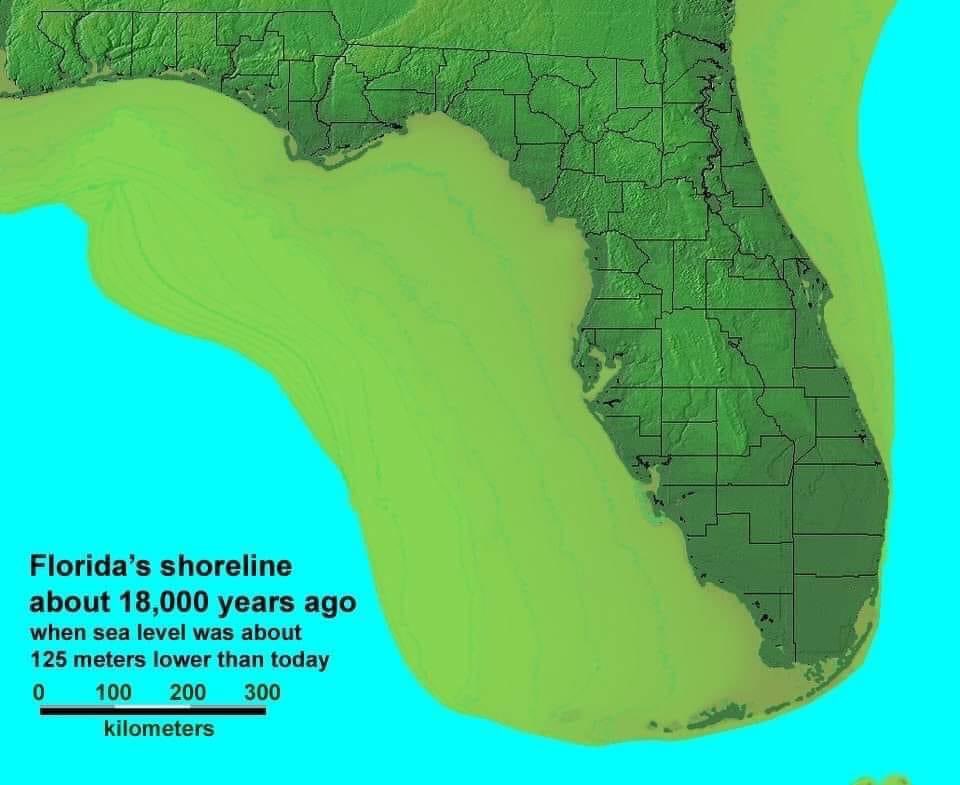
Some 18,000 years ago, sea levels were likely some 400 feet lower, essentially meaning Florida, Alabama, Louisiana, and other states along all the US had some shorelines over a hundred miles out from today's coasts in some areas. Florida, for example, was twice as large then. Whatever evidence that still exists of the oldest sites in the Americas likely lies buried under sand and silt in the submerged areas. There is ongoing research in this area. Here is a bit: https://t.co/rjJdPxvNIa
Botox is outdated.
Science has discovered that pairing a specific peptide with red light therapy can reverse aging by repairing skin from both outside and inside.
Let's look at the results: (1/10)
I swear magnesium glycinate at night, creatine in the morning, and vitamin D3+K2 with breakfast pulled my wife out of menopause hell.
We did it for 30 days straight, and she kept asking why her sleep, mood, and energy suddenly came back.
Here's exactly what we did:
High cortisol is aging you faster than smoking and tanning beds.
Low libido, achy joints, dark circles, weak muscles.
Here are 9 natural ways to slow the clock (without medication):
1. Cold water on your face.
⚡️NYC is turning private rental housing into off-balance-sheet public housing.
That is the blade.
The city wants affordability, but instead of funding it directly through the budget, it forces private buildings to carry the subsidy through frozen or suppressed rents while taxes, insurance, utilities, labor, repairs, financing, compliance, and maintenance keep rising.
That means the landlord remains legally private, but the revenue line becomes political.
That is a poisoned structure.
A building is a physical machine.
It does not run on moral intention. Boilers, roofs, elevators, pipes, facades, insurance premiums, property taxes, and debt service require cash. When revenue gets frozen and costs inflate, the asset does not magically become more humane. It becomes under-maintained, under-capitalized, and eventually distressed.
The public hears “rich landlord exits” and cheers. The deeper mechanism is uglier. If even ultra-wealthy capital decides the trade is no longer worth the governance risk, smaller owners are already dead or dying. Brin can walk away. The small landlord with debt, aging units, and no political protection cannot. That owner gets squeezed first. Then maintenance gets cut. Then buildings degrade. Then tenants suffer. Then the city blames landlord greed while the policy caused the cash-flow math to break.
The rent-stabilized incumbent gets short-term protection.
The future renter gets scarcity.
The market-rate renter gets higher rents.
The small owner gets crushed.
The building gets deferred maintenance.
The large distressed buyer eventually gets the wreckage cheaper.
That is the actual loop.
The most dishonest part of rent-freeze politics is that it pretends housing costs can be wished away by suppressing one side of the ledger. Costs still exist. Somebody pays. If the tenant does not pay, the owner pays. If the owner cannot pay, the building pays. If the building pays long enough, the city pays through decay.
NYC is already a split market: protected insiders and punished outsiders. Rent-stabilized tenants become political assets. Market-rate tenants become the shock absorbers. New supply becomes harder to justify. Capital demands a higher return to compensate for political risk. Developers hesitate. Owners exit. Housing quality falls. Then the shortage gets worse.
This is how a city eats its own housing stock while claiming compassion.


![Rasmussen_Poll's tweet photo. "It is important for people to recognize that this is not normal behavior by the Intelligence Community - most officers would never do something like this. In my over 20 years of public service, the politicized efforts by [the] CIA and others to conceal the truth about the threats to the 2020 US Presidential Election are unprecedented and even today shock me when I retrace everything that happened." - https://t.co/kRKinPMrbX
Issued: January 15, 2020 - Declassified: March 16, 2026
@VaughnHillyard @RohdeD](https://pbs.twimg.com/media/HMYe4BoXQAEXILf.jpg)
![Rasmussen_Poll's tweet photo. "It is important for people to recognize that this is not normal behavior by the Intelligence Community - most officers would never do something like this. In my over 20 years of public service, the politicized efforts by [the] CIA and others to conceal the truth about the threats to the 2020 US Presidential Election are unprecedented and even today shock me when I retrace everything that happened." - https://t.co/kRKinPMrbX
Issued: January 15, 2020 - Declassified: March 16, 2026
@VaughnHillyard @RohdeD](https://pbs.twimg.com/media/HMYeyPhXAAA34gB.jpg)
![Rasmussen_Poll's tweet photo. "It is important for people to recognize that this is not normal behavior by the Intelligence Community - most officers would never do something like this. In my over 20 years of public service, the politicized efforts by [the] CIA and others to conceal the truth about the threats to the 2020 US Presidential Election are unprecedented and even today shock me when I retrace everything that happened." - https://t.co/kRKinPMrbX
Issued: January 15, 2020 - Declassified: March 16, 2026
@VaughnHillyard @RohdeD](https://pbs.twimg.com/media/HMYegvBWkAA1UtY.jpg)








![Rasmussen_Poll's tweet photo. "It is important for people to recognize that this is not normal behavior by the Intelligence Community - most officers would never do something like this. In my over 20 years of public service, the politicized efforts by [the] CIA and others to conceal the truth about the threats to the 2020 US Presidential Election are unprecedented and even today shock me when I retrace everything that happened." - https://t.co/kRKinPMrbX
Issued: January 15, 2020 - Declassified: March 16, 2026
@VaughnHillyard @RohdeD](https://pbs.twimg.com/media/HMYe8d7WsAAOkiI.jpg)