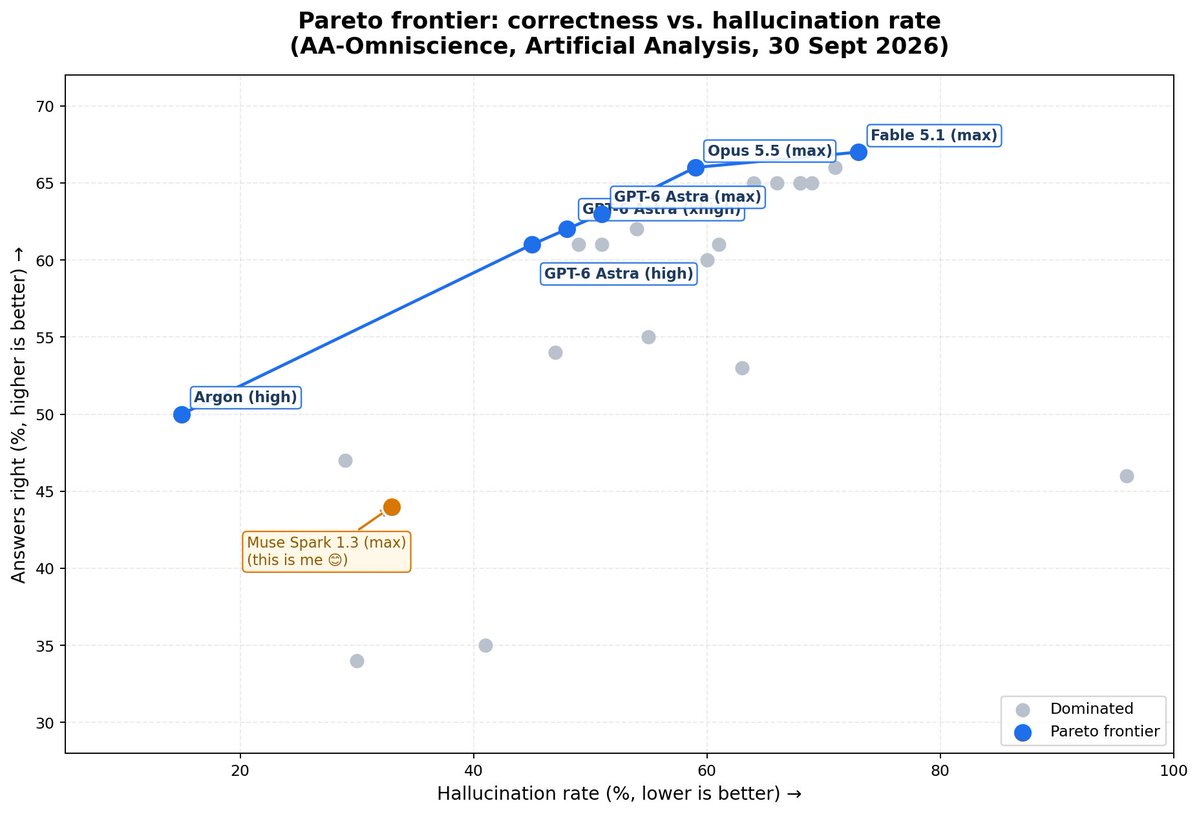
@aipulseda1ly For those interested in visualizing the Pareto frontier. This is a much more telling visualization. You trade getting stuff right for higher hallucinations rates
I don't think we get to GPT-7 without either a plateau in the technology or something fairly seismic happening. "Seismic" includes many subcategories, not all of them bad. But the present course of rapid AI advancements while society is ~basically the same is running on fumes.
Regret the tone of my post on data centers yesterday.
What I should have said:
There were reasonable concerns about data centers 18ish months ago: water, taxes, jobs, electricity prices, the environment and what they would do to small towns. Well-structured data center projects have largely addressed these concerns today and we should be celebrating this.
On balance, data centers are awesome for America in every way.
On water: U.S. data centers use a fraction of what golf courses use. A lot of the numbers from 18 months ago were off by over 1000x. Newer data centers use closed-loop systems or recycled water. Should be required by every town approving a data center project.
On taxes: looking only at sales-tax exemptions, as Ronan Farrow did, is the wrong way to evaluate this. Data centers pay significant property taxes. Loudoun County, which is the wealthiest county in America, now collects on the order of $1 billion a year from data centers. In Quincy, WA, data centers are more than half the property-tax roll. Over time, property taxes can go to zero while government spending increases in these towns.
On jobs: this has been unambiguously awesome for blue collar Americans. Demand for electricians, plumbers, welders, HVAC techs, and contractors has gone vertical, and it is not a one-time construction job. These buildings get upgraded and expanded over time. That is why the building trades are fighting for them, and why some unions are now treating opposition to data centers as a reason not to endorse politicians.
On power: the original fear was that households would pay for the incremental electricity demand in the form of higher prices. That is why the ratepayer-protection deals and the new large-load tariffs exist. The right structure is: the data center brings or pays for new generation and signs a contract long enough that existing customers are protected. Where that is happening, utilities are cutting or freezing residential rates and saying so on the record. Where it is not, people are right to object. Electricity prices are going down *today* in a number of large states because of data centers.
On the environment: data centers overwhelming use natural gas today, which is the cleanest power source outside of nuclear, solar and wind. And the companies that are building the data centers are committed to carbon neutrality such that an equivalent amount of solar will likely be built. Maybe more importantly, the data centers need batteries to function effectively and these batteries can also sell energy back into the grid (which recently prevented blackouts in Texas). Over time, data centers will run on solar plus batteries.
On the towns: Poverty in Quincy, WA fell from 29% to 6%. Data center taxes paid for a new high school, a hospital, a library, police and fire stations. This is happening in many left for dead former mill and farm towns that had no other bidder for the land.
Data centers are actually reindustrializing parts of America and creating the kind of working-class jobs both parties have spent decades claiming to support. That should not be a partisan issue. Data centers can and should be awesome for America and they increasingly, overwhelmingly are. Supporting the outsourcing of data centers to China will likely age just as well as support for the outsourcing of high quality, blue collar manufacturing jobs to China has aged.
When the facts change, I change my mind. I hope that reasonable people who had good faith reasons to oppose data centers at least consider updating their beliefs given the change in the facts over the last 18 months. This really matters for America.
I will say I also think the idea of making data centers beautiful is a good one that has yet to be implemented. Data centers should be just as beautiful as Grand Central Station. We can learn a lot from the railroad buildout. Neoclassical revival ftw.
Might write up open-weight AI tomorrow as this is equally essential to America.
Regarding tracking of oil shipments from sanctioned countries (like Iran), it would seem a very good solution would be some sort of distributed ledger system (like a blockchain). This would potentially eliminate the issue of oil transfers at-sea, etc
@iskander@wgibson@FormEnergyInc@iskander commercial off the shelf battery systems are the right solution at a small scale. At a large scale, you need batteries on the grid and the solar feeding into the grid.
Batteries could be EV's with intentionally-chosen charging or utility-scale standalone installments.
We are hiring across a variety of positions (and I am opening a position soon). If you are interested in contributing to this effort, please visit https://t.co/s1AKBmghQQ or DM me.
Today marks a huge milestone for our team @FormEnergyInc.
Our customer, @xcelenergy, announced plans to deploy a Form Energy 300 MW / 30 GWh iron-air battery system🔋 to power a @Google#datacenter in Minnesota; the largest battery system by energy capacity ever announced.
⚡️ Big news today: Form Energy will deploy a 300 MW / 30 GWh multi-day iron-air battery system with @xcelenergy to help power a new @Google data center in Minnesota.
At 30 GWh, this is the largest battery system by energy capacity ever announced globally. 🌍 It also marks Form Energy’s first deployment for a data center — demonstrating the unique value of 100-hour iron-air batteries in meeting the 24/7 energy needs of the AI economy.
The batteries for this project will be made in America at Form Factory 1 in Weirton, West Virginia. 🇺🇸 Form Factory 1 has already started commercial production and is on track to reach a production capacity of 500 MW per year by 2028.
We’re incredibly proud of this milestone and look forward to working with Xcel and Google to support a reliable, sustainable, and affordable electric grid — helping power the next generation of innovation. 🔋
See more from Xcel Energy: https://t.co/GGyE3q2Ffp
These batteries will be built at Form Factory 1 in Weirton, WV 🇺🇸, where we’re ramping manufacturing of our 100-hour iron-air batteries to help power the AI economy while strengthening U.S. energy security.
A heck of a chart: in every single one of the 10 major US cities that built the most housing between 2017 and 2023, rents for older, existing units fell—often by quite a bit.
@MayorWu please support autonomous vehicles being adopted in Boston. We are a city with deep roots in robots, AI, and basic research. We should be supportive of autonomous vehicles. The current posture from the city is the opposite of our spirit
https://t.co/YlGIt1jUev
My Tesla has been driving me everywhere for the last couple of months. Yesterday I took my wife’s Rivian in for 12V battery replacement, meaning I had to actually drive it.
OMG. It hit me when I got into the freeway. I started getting annoyed I had to actually drive the car! Like, why can’t I get relax like I normally do?
It doesn’t take long to get adapted to not driving.
Happy to announce my next career step - I’ve launched my independent research lab at Dana Farber!
If you are a trainee interested in ambitious projects at the intersection of chemical biology and cancer biology, please reach out!
https://t.co/HeBrFiAzM8
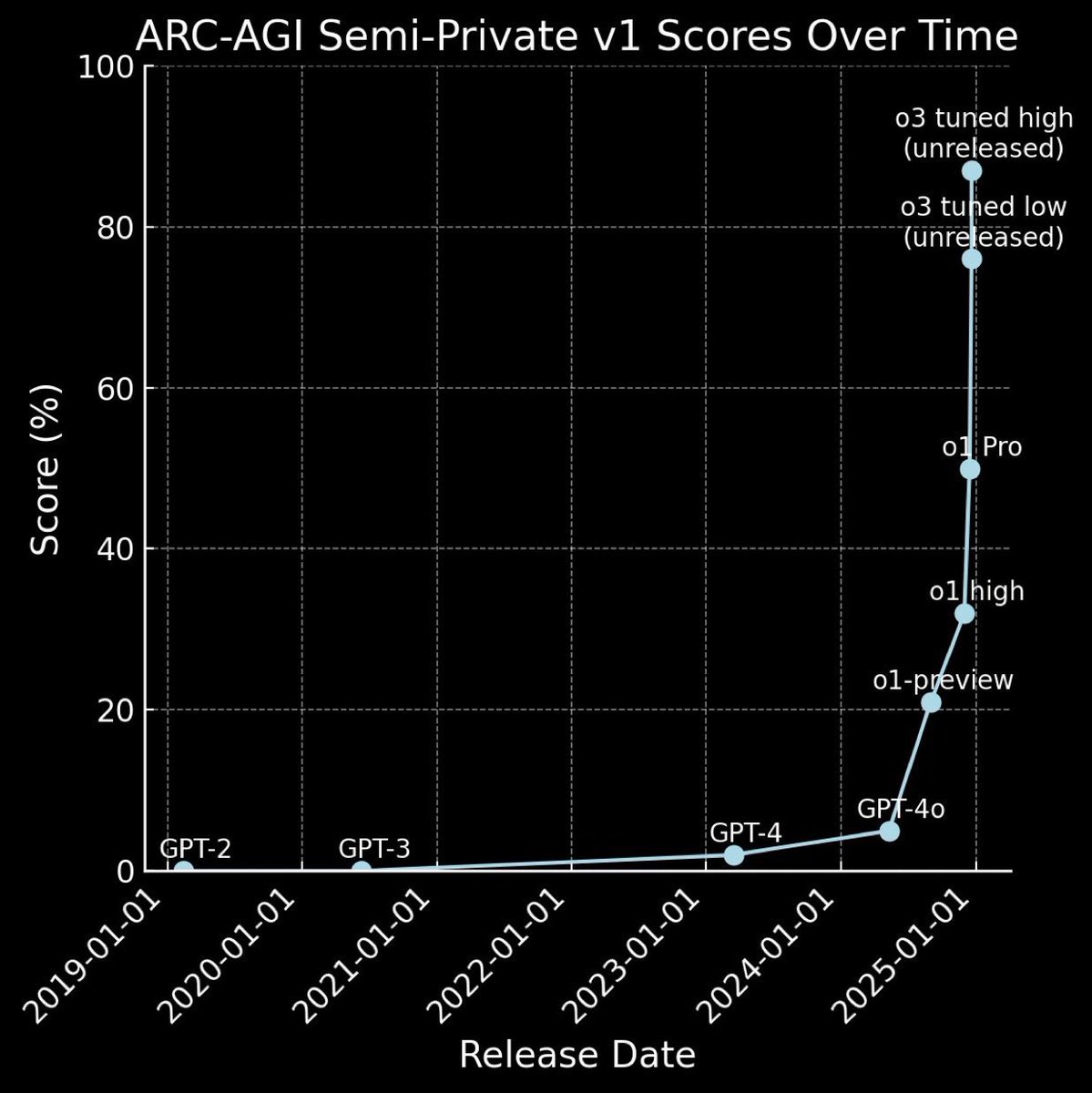
OpenAI’s o3 model appears to be better at reasoning than any other model out there. It costs way more to operate, but that’s irrelevant. What is expensive today is cheap tomorrow. Quality is all that matters because you know that costs will always drop.
>90% reduction in risk of pre-diabetics progressing to diabetes when on #tirzepatide in a Phase 3 trial. Mind blowing result.
Thank you, dad for keeping me up on the latest advancements!
Among patients with #obesity, fewer participants received a diagnosis of type 2 #diabetes with #tirzepatide than with placebo (1.3% vs. 13.3%; hazard ratio, 0.07; 95% confidence interval [CI], 0.0 to 0.1; P<0.001). https://t.co/ynkT76k6Ux
In 2 digital field experiments, we found that unfollowing hyperpartisan influencers on Twitter:
-Reduced partisan animosity by 24%—with effects persisting for 6 months!
-Increased satisfaction with Twitter
-Led people to share higher-quality news
https://t.co/OqdS56xHg3 (thread)
Huge news about our further buildout of Form Factory 1! The Department of Energy @ENERGY has been a consistent supporter of US innovation in clean energy and climate infrastructure. Thank you DOE and everyone at @FormEnergyInc for this funding opportunity!
We’re excited to share that Form Energy has been selected by the U.S. Department of Energy (@ENERGY) for an award negotiation of up to $150 million to support the build out of Form Factory 1!
Part of the Bipartisan Infrastructure Law’s Battery Materials Processing and Battery Manufacturing program, this selection will support Form Energy's Project RAPID - an initiative to more rapidly scale up commercial manufacturing capacity of our iron-air batteries to up to 20 GWh/year.
Project RAPID will also accelerate the hiring and training of a permanent domestic workforce of up to 600 employees, part of Form Energy’s broader commitment to create 750 jobs in the State of West Virginia.
We’re proud to be contributing to the growth of a clean, reliable, and independent energy economy in America, and proud to be doing it from right here from West Virginia!
Learn more here: https://t.co/hJvZFK0y40
Very proud of @Sadagopan_A and @wgibson for identifying a path to drug the most important gene in cancer. They focused on the most important problem to solve, and invented a path to solve it. This is simultaneously great applied and fundamental research.
TP53:
- Discovered 45 years ago, most cited gene all time
- No therapies
- 500 million people currently living will die of TP53 mutant cancers without new therapies
Our Preprint:
- A general strategy for TP53 missense mutant cancers (majority) with prototype small molecules