@ChenxinLi2 We had an incident where the -20C was left open over a weekend, everything at room temperature for at least 36 hours. Every single enzyme that was in there still works just fine.
@VincentPennetti@TimFutureLeaf Great, thanks for that paper! Yes it looks like, based on that paper, that Gold Bio's documentation may be incorrect. Appreciate it!
Plant folks: When transforming Agro. tumefacians EHA105, do you select for the Vir plasmid too? (Gent I think?). For GV3101 (our usual strain) we always have included Gent to ensure the Vir plasmid stays put ... but a protocol we had for EHA105 didn't include Gent selection....
@VincentPennetti Gold Bio's annals say that the Ti plasmid in EHA105 is pTiBo542DT-DNA which has a Gent marker https://t.co/VwcEyykmUf ... but Gold also says that the strain is only partially Gent-R
@ChenxinLi2 It is listed as Strep-resistant but Spec-sensitive. But the Ti plasmid has Gent-resistance marker. Just not sure how stable the Ti is without selecting for it.
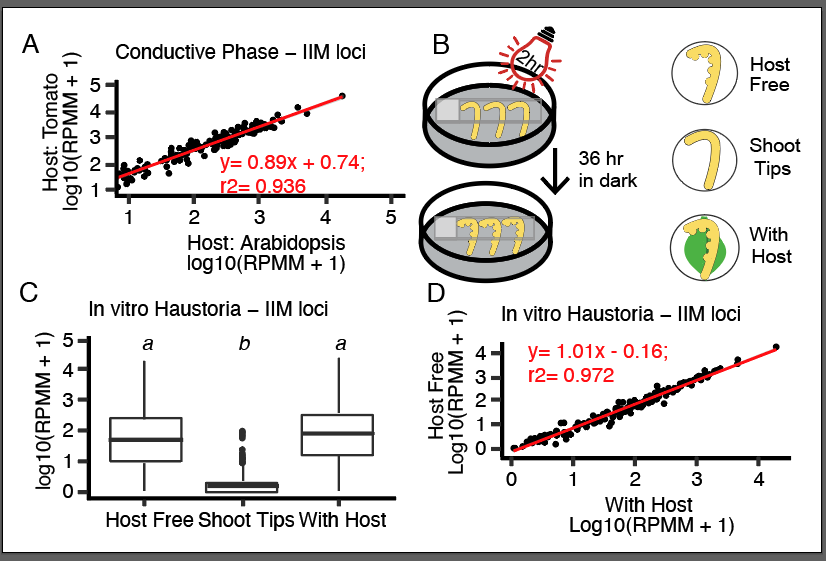
@ChenxinLi2@Choukri607A Confirmed that I transposed the slopes and intercepts on Figures 3A and 3D. Here's a screenshot of a corrected Figure 3 showing the correct equations. I will ask @ThePlantCell to issue a corrigendum ASAP. In other news, I did manage to get my left shoe on my left foot today...
@ChenxinLi2@Choukri607A Uh oh. I made that figure. At first glance I think you might be right. Checking the original data now. If needed I will ask for correctef figure(s) to be issued. Stay tuned ....
Easier installation with dependencies using bioconda recipe.
Most options the same, but some changes (sorry if I break your pipelines!).
Feedback, bugs reports, etc. --> GitHub at https://t.co/mv3pgmtvpX
2/2
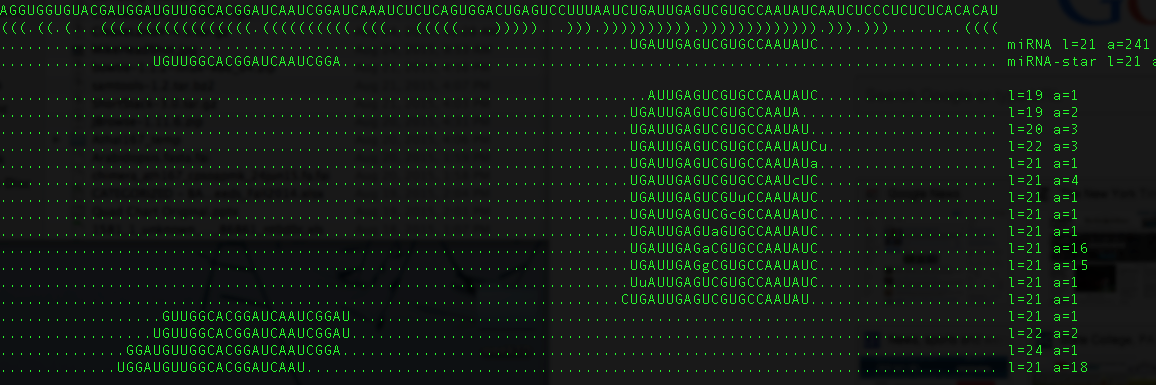
I've released a major update, version 4.0.0, to my small RNA annotation tool ShortStack https://t.co/soBuAZbKRw
Major changes:
- fully re-written in python
- faster, fully-multi-threaded
- much better annotation of microRNA loci
- outputs tweaked for good visualizations
1/2
Surfacing (briefly) to promote our latest preprint, by @colliflower7 and friends. Trans species microRNA genes from a parasitic plant have a common, likely Pol III, promoter. https://t.co/LS3RtsHy0S
RNA PLANT BIOLOGY MEETING!
23rd Penn State Plant Biology Symposium
Penn State University May 18-20, 2022
https://t.co/I65Ft780zO
April 1 - Abstract Submission for travel award consideration
April 15 - Abstract Submission
May 6 - Registration Deadline
Targeted capture, sequencing, and assembly of microRNA-encoding genes (including hairpin and flanking regions), based on 21-22nt capture probes. We tried in 2013 (https://t.co/P4x7j20i1V) ... has anyone else done this or improved on the method?
An artificial host system for studying parasitic dodder and haustorial development - without the complication of host-specific effects! A very useful method developed by Vivian, and Jim Westwood @vtspes
https://t.co/xAw3nXg7Y0
#parasiticplants#cuscuta