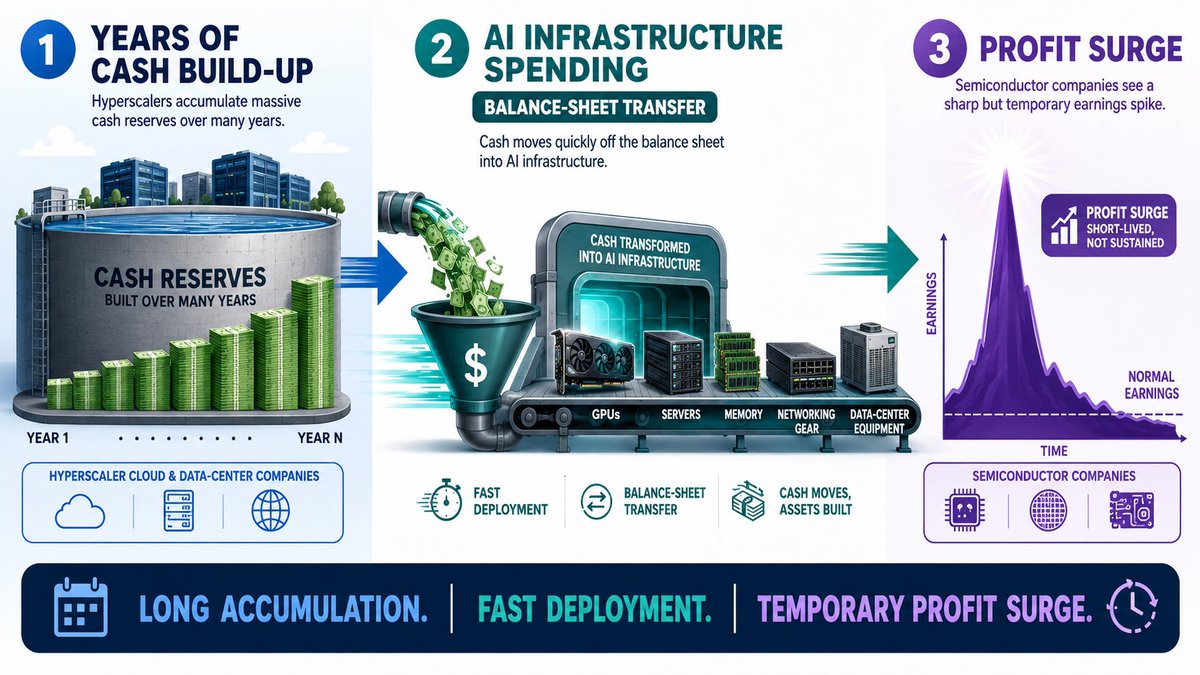
The risk for $SMH bulls is not that #AI is fake. It’s that the market is mistaking the Hyperscalers existential/emergency phase of the AI buildout for permanent earnings power. Hyperscalers are converting years of cash accumulation into a rapid infrastructure land grab, and semiconductor companies are booking that urgency and scarcity as extraordinary margins and profit.
Chip companies added ~$5T in market cap in the last month alone, while hyperscalers guided for ~$700B–$800B in 2026 capex (much of it on racks, cables, cooling, power, land - not chips). This gives “priced for perfection” a new meaning.
A P/E ratio is a duration claim: it assumes today’s earnings are durable, repeatable, and compounding. When $SMH bulls point to low P/Es they assume the hyperscaler balance sheet transfer and existential/emergency buildout phase will last for decades. It assumes that the Hyperscalers won't develop their own silicon in time eating away at the high margins. Panic-speed chip buying is not the same as steady-state demand for decades. P/Es are meant to measure stock returns over decades, not quarters.
Trump approved a smuggling crackdown in May. Lutnick stalled.
Meanwhile $10.2 billion a quarter, 22% of Nvidia's revenue, was booked to Singapore. A city-state of 6 million. Then that line vanished from Nvidia's filings.
Incompetence is random. This broke the same way every time: for Nvidia, and for Beijing.
Then Nvidia blocks Megaspeed, changes how it reports geography, and the Singapore line vanishes.
Lutnick had the spy memo and sat on the crackdown three times. Where did the chips go? Release the memo. Release the licenses.
@lexfridman What was the board supposed to do? A CEO having a relationship with someone who reports to him creates serious governance problems, regardless of whether the relationship is consensual.
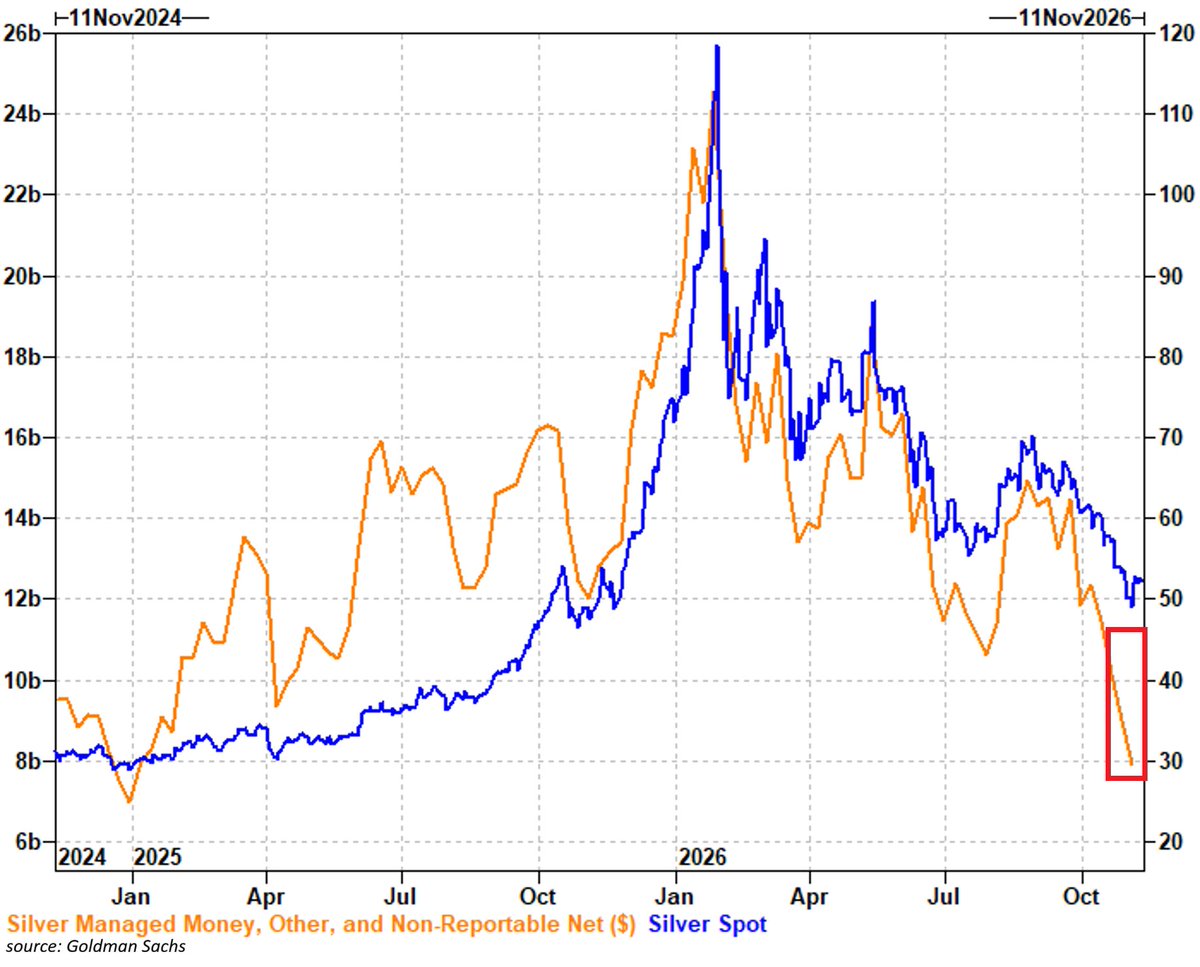
Investor positioning in silver is experiencing violent swings:
Speculative investors sold -$2.3 billion in silver futures over the 5 weeks ending November 3rd, according to CFTC data.
This was driven by -$2.6 billion in new short positions, partially offset by +$300 million in new longs.
Hedge funds and commodity trading advisers (CTAs), alongside smaller traders such as retail investors, accounted for most of the sales, with each group reducing exposure to silver futures by ~$1.4 billion.
As a result, aggregate net long speculative positioning fell to +$8.0 billion, its lowest since January 2025.
Since its January 2026 peak, this figure has dropped by more than -$16.0 billion.
Are investors overly bearish on silver?
The Cost of Complexity
Why America's Healthcare Financing System Is Expensive, Inefficient, and Resistant to Market Discipline
Executive Summary | November 2026
The United States has created a healthcare financing system of extraordinary complexity. Instead of a consistent framework for purchasing medical services, we operate through hundreds of insurers, thousands of benefit designs, separately negotiated provider contracts, and overlapping federal and state regulations.
The result is an enormous administrative industry dedicated not to delivering healthcare, but to determining who qualifies for it, who pays, how much they pay, and under what conditions.
We have created an expensive system for administering an already expensive healthcare system.
1. The Price of Complexity
Every hospital must maintain contracts with multiple insurers, each with different reimbursement rates, billing requirements, authorization procedures, and appeals processes. Insurers employ their own armies of administrators, while employers hire consultants, brokers, and third-party administrators to manage their coverage.
A physician providing the same treatment to two patients may face entirely different administrative requirements depending on their insurance cards.
The complexity multiplies across state lines, where insurance regulations, Medicaid eligibility, and provider requirements differ. Changing employers, losing a job, retiring, or moving between states can trigger an entirely new set of coverage rules.
Much of this activity contributes nothing to patient care. It exists primarily to administer the fragmented financing system itself.
2. A Market Without an Effective Consumer
Capitalism depends on informed consumers making purchasing decisions. Buyers must understand what they need or want, know the price, assess the value, and decide whether the purchase is worthwhile.
American healthcare largely eliminates the consumer from this economic equation.
Patients rarely know the actual cost of treatment beforehand and frequently lack the medical knowledge to evaluate alternatives. In emergencies, meaningful comparison shopping is impossible.
Instead, physicians make most clinical purchasing decisions. Their primary obligation is to their patients, not to minimizing costs. The Hippocratic tradition encourages protecting patients, while fear of malpractice litigation can reinforce defensive medicine and unnecessary testing.
Insurance companies make another layer of decisions, determining coverage, reimbursement, and medical necessity. But they operate within complicated contracts and frequently pass rising healthcare costs into premiums.
Neither providers nor insurers consistently face the same incentives as a consumer spending their own money in a transparent, competitive marketplace.
The result is a system in which the people receiving care, prescribing care, financing care, and negotiating prices are largely different parties.
Price competition is therefore severely weakened.
3. Escalating Costs Without Comparable Results
The consequences are visible in the accompanying KFF premium data.
Average annual employer-sponsored family health insurance premiums increased from $5,809 in 1999 to $28,303 in 2026—an increase of 387%.
The 2026 premium represents approximately $2,359 per month, including both employer and employee contributions. Families also face deductibles, copayments, and other out-of-pocket expenses.
Employer contributions are not free money; healthcare benefits are part of total employee compensation, putting pressure on wages and business competitiveness.
Yet America does not receive superior healthcare outcomes in return.
The OECD reports that Americans spend substantially more on healthcare per person than residents of other wealthy nations while experiencing lower life expectancy and higher rates of preventable and treatable mortality. The Commonwealth Fund's 2024 international comparison ranked the United States last overall among ten high-income countries.
These outcomes reflect multiple influences, including public health and social conditions. Nevertheless, the world's most expensive healthcare system is failing to deliver commensurate value.
4. A National Payer Without Nationalized Healthcare Delivery
A national single-payer financing system offers one potential solution.
Under such an arrangement, a public payer would replace the competing private insurance structures for essential healthcare, establishing more consistent reimbursement, eligibility, and administrative rules.
Private insurance would no longer be necessary to finance the covered core benefits. The government would essentially provide the insurance function through taxation, replacing much of today's premium-collection and claims-contracting infrastructure.
Importantly, nationalizing healthcare financing does not require nationalizing hospitals, physicians, or medical practices.
Providers could remain independent, competing for patients based on access, quality, convenience, innovation, and service. Patients could retain meaningful provider choice.
A national payer could also exercise greater purchasing leverage, reduce billing complexity, and simplify coverage transitions between employment, retirement, and changes in income.
Such a system would not automatically solve every problem. Public reimbursement would still require cost discipline, appropriate utilization management, and safeguards against restricted access or inadequate provider compensation.
But it would eliminate much of the costly duplication inherent in maintaining competing insurance arrangements.
Conclusion: Restoring Economic Rationality
American healthcare combines the administrative complexity of private insurance with the weak consumer price discipline of a market in which patients rarely control purchasing decisions.
It preserves multiple competing financing systems without consistently producing meaningful competition over the actual cost or quality of care.
There are two broad paths toward improvement: restore meaningful price transparency and consumer choice wherever practical, or establish a more unified purchasing system capable of imposing cost discipline on behalf of consumers.
Neither approach eliminates the need for medical judgment, risk pooling, or quality oversight.
The essential reform is to separate competition that improves healthcare from complexity that merely makes healthcare more expensive.
Until we address the financing structure itself, Americans will continue paying extraordinary sums not only for medical care, but for the elaborate machinery required to purchase it.
The risk for $SMH bulls is not that #AI is fake. It’s that the market is mistaking the Hyperscalers existential/emergency phase of the AI buildout for permanent earnings power. Hyperscalers are converting years of cash accumulation into a rapid infrastructure land grab, and semiconductor companies are booking that urgency and scarcity as extraordinary margins and profit.
Chip companies added ~$5T in market cap in the last month alone, while hyperscalers guided for ~$700B–$800B in 2026 capex (much of it on racks, cables, cooling, power, land - not chips). This gives “priced for perfection” a new meaning.
A P/E ratio is a duration claim: it assumes today’s earnings are durable, repeatable, and compounding. When $SMH bulls point to low P/Es they assume the hyperscaler balance sheet transfer and existential/emergency buildout phase will last for decades. It assumes that the Hyperscalers won't develop their own silicon in time eating away at the high margins. Panic-speed chip buying is not the same as steady-state demand for decades. P/Es are meant to measure stock returns over decades, not quarters.
NEW: Charles Schwab to add LINK to its Schwab Crypto platform.
As the largest brokerage in the U.S., Charles Schwab serves 40 million brokerage accounts and manages $11.77 trillion in client assets.
My Claude account was suspended and no explanation was given. 2/3rds of my annual subscription was not refunded. I've exhausted my appeal routes with no answers. No idea what I did, no way back to my Projects. Leaves a very bad taste. Be careful developing anything of value on https://t.co/1Fv2O3bkR9
TS-019fd569-0f13-70e3-b479-380d981b7034
@AnthropicAI #Claude
"I think at a point we're going to be able to do it," Bessent said during a CBNC interview, adding that he and President Trump were "laser-focused on paying down the debt. I think that we're going to bring down the deficit-to-GDP, we will start paying down debt, and that can be used as an offset for the American people." - August 2025
Cyclical Stocks 101: Final highs don’t come at high P/Es. They come when earnings are peaking and P/Es look deceptively “cheap.” Semis—especially MU—are classic: they screen undervalued right before the cycle turns.
Memory $MU $DRAM has humiliated bulls with this exact thesis before. 2018 was supposed to be different — data center demand was secular, cloud was a new paradigm, NAND/DRAM had consolidated to a stable oligopoly. $MU went from ~$60 to ~$28 in nine months. 2021–22 was supposed to be different — 5G, cloud capex, work-from-home. $MU went from ~$96 to ~$50. Both times the cycle peak P/E was in the single digits. A 7x forward P/E is exactly what late-cycle memory looks like, not what early-cycle anything looks like. The market may be correctly pricing what it has seen three times in fifteen years.
The HBM oligopoly has a Samsung problem. $SKHynix is dominant, Micron is qualified at Nvidia, Samsung keeps failing HBM3E qualification — but Samsung is trying every quarter, and if they crack the yields the supply curve shifts hard. CXMT in China is now shipping HBM2 and pushing forward. The three-player discipline isn't as locked as the bull case requires.
Margin sustainability is the real question, not unit demand. $MU's $30+ run-rate EPS depends on ~60% gross margins. A normalization to even 45% — still healthy for memory — roughly halves EPS, which means 7x forward becomes 14x on $15 EPS very quickly. The stock doesn't have to crash; the multiple doesn't even have to compress. Earnings revisions do the work.
Memory $MU $DRAM has humiliated bulls with this exact thesis before. 2018 was supposed to be different — data center demand was secular, cloud was a new paradigm, NAND/DRAM had consolidated to a stable oligopoly. $MU went from ~$60 to ~$28 in nine months. 2021–22 was supposed to be different — 5G, cloud capex, work-from-home. $MU went from ~$96 to ~$50. Both times the cycle peak P/E was in the single digits. A 7x forward P/E is exactly what late-cycle memory looks like, not what early-cycle anything looks like. The market may be correctly pricing what it has seen three times in fifteen years.
The HBM oligopoly has a Samsung problem. $SKHynix is dominant, Micron is qualified at Nvidia, Samsung keeps failing HBM3E qualification — but Samsung is trying every quarter, and if they crack the yields the supply curve shifts hard. CXMT in China is now shipping HBM2 and pushing forward. The three-player discipline isn't as locked as the bull case requires.
Margin sustainability is the real question, not unit demand. $MU's $30+ run-rate EPS depends on ~60% gross margins. A normalization to even 45% — still healthy for memory — roughly halves EPS, which means 7x forward becomes 14x on $15 EPS very quickly. The stock doesn't have to crash; the multiple doesn't even have to compress. Earnings revisions do the work.
Memory $MU $DRAM has humiliated bulls with this exact thesis before. 2018 was supposed to be different — data center demand was secular, cloud was a new paradigm, NAND/DRAM had consolidated to a stable oligopoly. $MU went from ~$60 to ~$28 in nine months. 2021–22 was supposed to be different — 5G, cloud capex, work-from-home. $MU went from ~$96 to ~$50. Both times the cycle peak P/E was in the single digits. A 7x forward P/E is exactly what late-cycle memory looks like, not what early-cycle anything looks like. The market may be correctly pricing what it has seen three times in fifteen years.
The HBM oligopoly has a Samsung problem. $SKHynix is dominant, Micron is qualified at Nvidia, Samsung keeps failing HBM3E qualification — but Samsung is trying every quarter, and if they crack the yields the supply curve shifts hard. CXMT in China is now shipping HBM2 and pushing forward. The three-player discipline isn't as locked as the bull case requires.
Margin sustainability is the real question, not unit demand. $MU's $30+ run-rate EPS depends on ~60% gross margins. A normalization to even 45% — still healthy for memory — roughly halves EPS, which means 7x forward becomes 14x on $15 EPS very quickly. The stock doesn't have to crash; the multiple doesn't even have to compress. Earnings revisions do the work.
Memory $MU $DRAM has humiliated bulls with this exact thesis before. 2018 was supposed to be different — data center demand was secular, cloud was a new paradigm, NAND/DRAM had consolidated to a stable oligopoly. $MU went from ~$60 to ~$28 in nine months. 2021–22 was supposed to be different — 5G, cloud capex, work-from-home. $MU went from ~$96 to ~$50. Both times the cycle peak P/E was in the single digits. A 7x forward P/E is exactly what late-cycle memory looks like, not what early-cycle anything looks like. The market may be correctly pricing what it has seen three times in fifteen years.
The HBM oligopoly has a Samsung problem. $SKHynix is dominant, Micron is qualified at Nvidia, Samsung keeps failing HBM3E qualification — but Samsung is trying every quarter, and if they crack the yields the supply curve shifts hard. CXMT in China is now shipping HBM2 and pushing forward. The three-player discipline isn't as locked as the bull case requires.
Margin sustainability is the real question, not unit demand. $MU's $30+ run-rate EPS depends on ~60% gross margins. A normalization to even 45% — still healthy for memory — roughly halves EPS, which means 7x forward becomes 14x on $15 EPS very quickly. The stock doesn't have to crash; the multiple doesn't even have to compress. Earnings revisions do the work.
Memory $MU $DRAM has humiliated bulls with this exact thesis before. 2018 was supposed to be different — data center demand was secular, cloud was a new paradigm, NAND/DRAM had consolidated to a stable oligopoly. $MU went from ~$60 to ~$28 in nine months. 2021–22 was supposed to be different — 5G, cloud capex, work-from-home. $MU went from ~$96 to ~$50. Both times the cycle peak P/E was in the single digits. A 7x forward P/E is exactly what late-cycle memory looks like, not what early-cycle anything looks like. The market may be correctly pricing what it has seen three times in fifteen years.
The HBM oligopoly has a Samsung problem. $SKHynix is dominant, Micron is qualified at Nvidia, Samsung keeps failing HBM3E qualification — but Samsung is trying every quarter, and if they crack the yields the supply curve shifts hard. CXMT in China is now shipping HBM2 and pushing forward. The three-player discipline isn't as locked as the bull case requires.
Margin sustainability is the real question, not unit demand. $MU's $30+ run-rate EPS depends on ~60% gross margins. A normalization to even 45% — still healthy for memory — roughly halves EPS, which means 7x forward becomes 14x on $15 EPS very quickly. The stock doesn't have to crash; the multiple doesn't even have to compress. Earnings revisions do the work.