To show you guys how I think through my swings, I wrote a FREE post recapping the incredibly successful trading week last week. Link in first reply.
I go through the thought process of every trade and here are the numbers -
$MU: 5%
$DELL rounds 1&2: 8%
$MU round 2: 12%
$PENG: 8%
$META: 6%
$GOOGL, $LLY, $ISRG: 2-3% each
$SMH doubled in three months.
That’s not normal, and you had trash companies like $AEHR with 100M backlog trading at 4B. It had to come crashing down.
So, price action was important to get out on time as there was a lot of exuberance.
To $MU’s credit, it is still 2x this year while SMH has given up all its gains.
Great points, Dean. I’m quote tweeting you as I want my followers to read your post.
When we first started investing in $MU, it wasn’t a consensus trade. Now everybody knows about DRAM and HBM supply tightness.
I think the problem is institutions had already been equal weight $MU while pod boys were levering up to buy. That over shot the price in short term, and now it has mean reverted.
As traders, we take advantage of an overshoot and sell into it. And we can’t get back in until there’s a clear bottom base.
If Micron keeps beating and raising, its stock price will reflect it but I think it’ll always trade at a low PE as long as they don’t have a unique product that competitors can’t compete with on price (non commodity).
The argument that memory will peak one day is indefensible. People have been saying this for over 2 years. But today, the voices are much louder. When there is no time limit to disprove a future prediction, it’s impossible to argue. When will they peak? Then will they level off or fall sharply?
Every quarter Micron and the memory makers keep making more money and guiding for even more next quarter. Plus the backlog keeps getting bigger. But none of that seems to matter when enough people believe that memory will not only peak soon, but margins will crash. No one, including you, can say when that will happen. But yet, it can’t be disproved, since there is no time limit. 2027 is basically sold out for Micron. Another $180 billion in profits right around the corner.
What happens next quarter when the memory makers beat earnings and guide higher again? What happens if that happens every quarter in 2027? Will the naysayers just keep saying it’s coming soon? That’s a serious question. What happens if that continues in 2028? 2029? Will they just keep saying the margin crash is right around the corner?
I’ve been in the stock market since 1998. I’ve seen a lot. I’ve seen the .com bubble, the housing crises, and everything else that has happened from 1998 - today. I’ve made a lot of money during that time. I’ve never seen a consensus of people predict a future earnings crash without any signs of one. Every Ai company keeps destroying earnings. From Dell to Sandisk, to NVDA, and everyone else. And the market just keeps saying, it doesn’t count. Because they know it won’t last. How does that thinking get proven wrong? This is like cutting Patrick Mahomes today because one day in the future he won’t be as good as he is today. I don’t get it. There are so many unknowns, yet so many assign a collapse as if it’s a guarantee. But there isn’t any evidence of that happening now.
I followed you when you were a bull on Micron. You and I made a killing on it. You literally called the exact top in Micron’s stock price. Like to the day, this past June. But you didn’t call a top in the earnings. The earnings and guidance have far exceeded the expectations for the last 2 quarters, since the stock topped out in June. Earnings will crush again this current quarter. And I’m sure the following quarter.
So, my questions to you are what happens if Micron just keeps beating earnings every quarter? And how many quarters do they have to continue to grow before you, and everyone else stop thinking that peak earnings are right around the corner? Is it 2 quarters? 4 quarters? 8 quarters? How are we supposed to disprove the theory that margins have peaked and earnings will crash soon when there isn’t a time limit?
And, When will capacity finally catch demand? and by how much? Will memory prices crash if this happens? Will it Level off? Slowly rise? Slowly fall?
I’m looking forward to your response since you are literally the only person that called the stock perfectly.
New $SMCI whistleblower has emerged to file a lawsuit alleging that $SMCI boasted of its sales to a restricted Chinese entity in internal documents as a "success story". The whistleblower says he was fired after reporting alleged sales of restricted $NVDA GPUs to CEO Charlies Liang.
Wow, memory names like $SNDK just keep on dropping.
At a $89B MC they have:
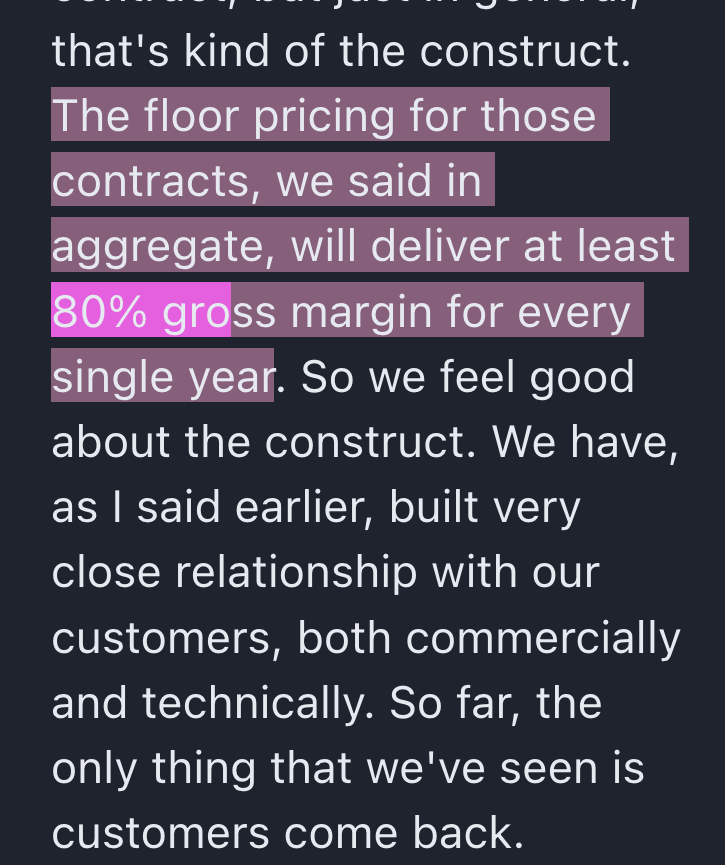
> $89B minimum in LTAs with contractual price floors supporting at least 80% gross margins
"The floor pricing for those contracts, we said in aggregate, will deliver at least 80% gross margin for every single year"
> Not including HBF and uncommited capacity (~50% for 2027, ~33% for 2028)
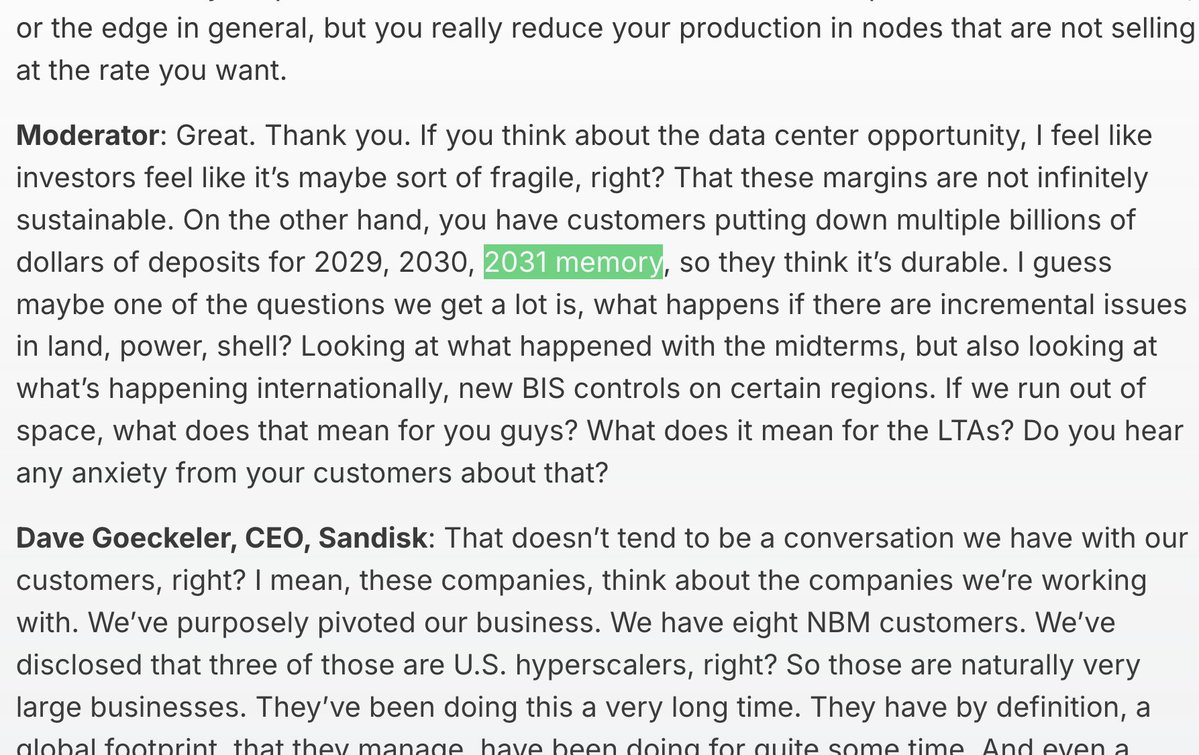
> Customers placing billions in deposits for 2029-2031 capacity already (Morgan Stanley)
I really disagree with the notion that you need need NAND pricing to keep exponentially increasing Q/Q.
At long as pricing remains elevated and you have duration visibility, lot of these memory companies look very undervalued.
Notice a pattern on X -
Traders that made multibaggers on a stock can’t exit once it tops out and they keep pumping it.
$ASTS $RKLB $GME $AMC $IREN $NBIS $SNDK all have cults that want to revive the stock’s previous glory.
But every cycle has a new set of winners while previous leaders keep falling.
We’re here to make money, not cheerleaders for a company.
I love semis too, and they rallied for 4 straight years! But now they need to take a back seat for the markets to rally. We need hyperscalers to be fcf positive again and CapEx growth to taper out.
What you also learned from Kioxia is that business can seem good but stock can’t get wiped out overnight on bad guidance.
Semis are not for everybody, ask folks burned by $MU in the last cycle. They didn’t even buy it this cycle.
So was Jensen's reinstatement just an engineered last ditch grab for exit liquidity by institutions. Entire move happened in pre-market then you could tell something was off as every stock grinded down from the open as the transfer happened.