Offchain Labs and Solana Co-Founders Debate Robinhood Chain Fee Model
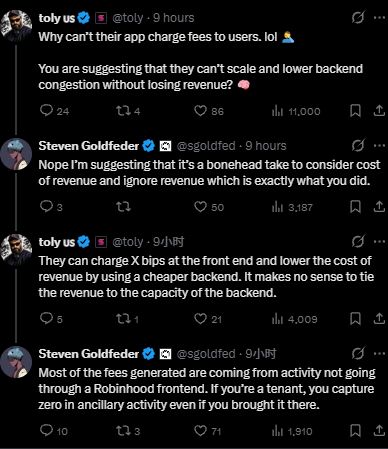
Offchain Labs co-founder Steven Goldfeder and Solana co-founder Anatoly Yakovenko debated Robinhood Chain’s fee model. Yakovenko said the 10% revenue share paid to Arbitrum would have been enough to cover Solana transaction fees four times over, allowing Robinhood to offer users a fully gasless experience.
Goldfeder called that a “ridiculous take,” saying Robinhood keeps about 90% of gas fees on Arbitrum, whereas on Solana it would retain none of the base-layer fees and would have to subsidize user fees out of pocket. “Robinhood chose Arbitrum so they could be a landlord and not a tenant,” he wrote.
Yakovenko argued that Robinhood could charge users at the frontend while lowering costs by using a cheaper backend. Goldfeder replied that most of the fees are generated by activity that does not pass through Robinhood’s frontend. If Robinhood were merely a tenant on another chain, he said, it would capture none of that ancillary activity, even if it had brought those users there.
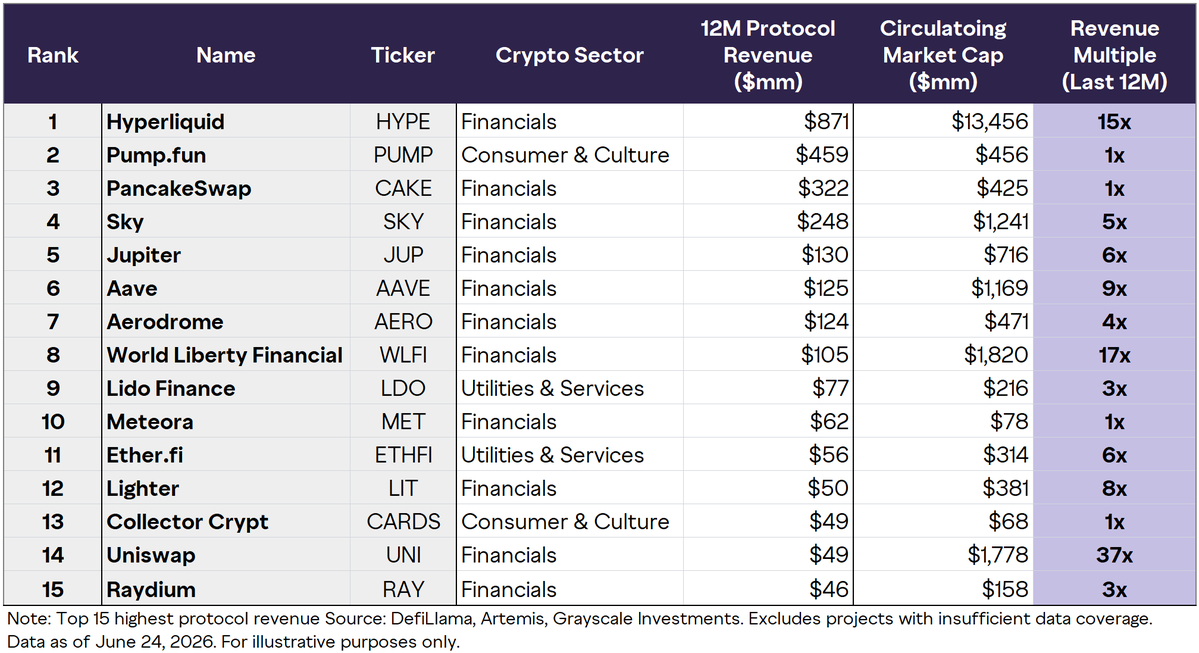
If you’d invested $200k in Grayscale’s 15-alt basket when it went public on Jun 25, you’d be up $110K today.
Only 2/15 alts are down. The rest are up big: $PUMP +200%, $UNI & $LIT 140%+, most others +25–60%+, except $AERO.
Sometimes the opportunity is right in front of us, but we overlook it because we’ve been scammed too many times lol 😄
The $25 Trillion Trigger for Bitcoin’s Next Big Pump | Mark Yusko
Sat down with @MarkYusko on why $25 trillion in debt buybacks could be the Bitcoin catalyst.
He walks through why printing does not stop, why debasement is the long-term case, and why $BTC can trade well beyond fair value. We cover whether the bottom is in, the risk of one more flush, why almost half his book is Bitcoin, and why he sold 90% of his $SOL.
Cathie Wood says Anthropic agreed to pay 50 billion a gigawatt for compute that cost Musk and his team somewhere in the mid to high twenties
"We see Elon's terrestrial data centers turning from huge losses to massive profits as he has pivoted that part of the business for the short term into the neo cloud business. So huge returns on invested capital."
"I think Anthropic agreed to pay $50 billion per gigawatt, that's the equivalent, just the $50 billion, and I think it cost Elon and team somewhere in the mid to high twenties."
"So right there, immediate returns on invested capital."
"But we do think that there is going to be a lot of creative destruction as this new world happens."
Jason Calacanis @Jason on Nvidia:
"I believe right now, starting today, Nvidia is the number one competitor for OpenAI and Anthropic, not just for tokens but for enterprise compute and I think now Jensen is the leading open source provider in America. I think he's going to take the world, he's going to catch up and blow past China and the Chinese models I think by the end of 2027. And then that means you're going to have a player...I am more convinced than ever now that we can win the race, because Jensen represents open source globally. He's going to be able to take a rack of compute, bring it into a company that is currently using tokens from OpenAI and Anthropic and say here's your rack, soup to nuts, complete vertical solution and you have total sovereignty and i'm reducing your prices 80 or 90% cause I don't need to make money off the tokens I made money off the hardware."
Via @theallinpod
$NVDA
Robinhood users are getting raped.
I don't know how to say this. I don't mean to fud or hurt your feelings, I genuinely love all of you and wish you nothing but the best in life.
- Robinhood fees did $8.2m in a single day with only 14M transactions.
- Solana fees were $531k that same day with 309M transactions.
- Solana users paid only 6.5% of Robinhood's total fees to execute 22x more transactions than Robinhood.
On RH you are paying more for an objectively slower and shittier user experience.
Read this again and choose wisely. I love you.
BREAKING: Iran has DIRECTLY STRUCK SIX SHIPS with ANTI-SHIP MISSILES in the Strait of Hormuz and surrounding waters — its LARGEST-EVER ATTACK in the strategic waterway, according to the IRGC.
The attack came in response to this morning’s U.S. strike on THREE Iranian oil tankers transiting the Strait.
The IRGC says it struck THREE oil tankers using “unauthorized” routes through Hormuz, along with THREE additional U.S. Navy warships and U.S.-linked vessels in other areas.
Iran has now MASSIVELY ESCALATED its direct attacks on maritime targets.
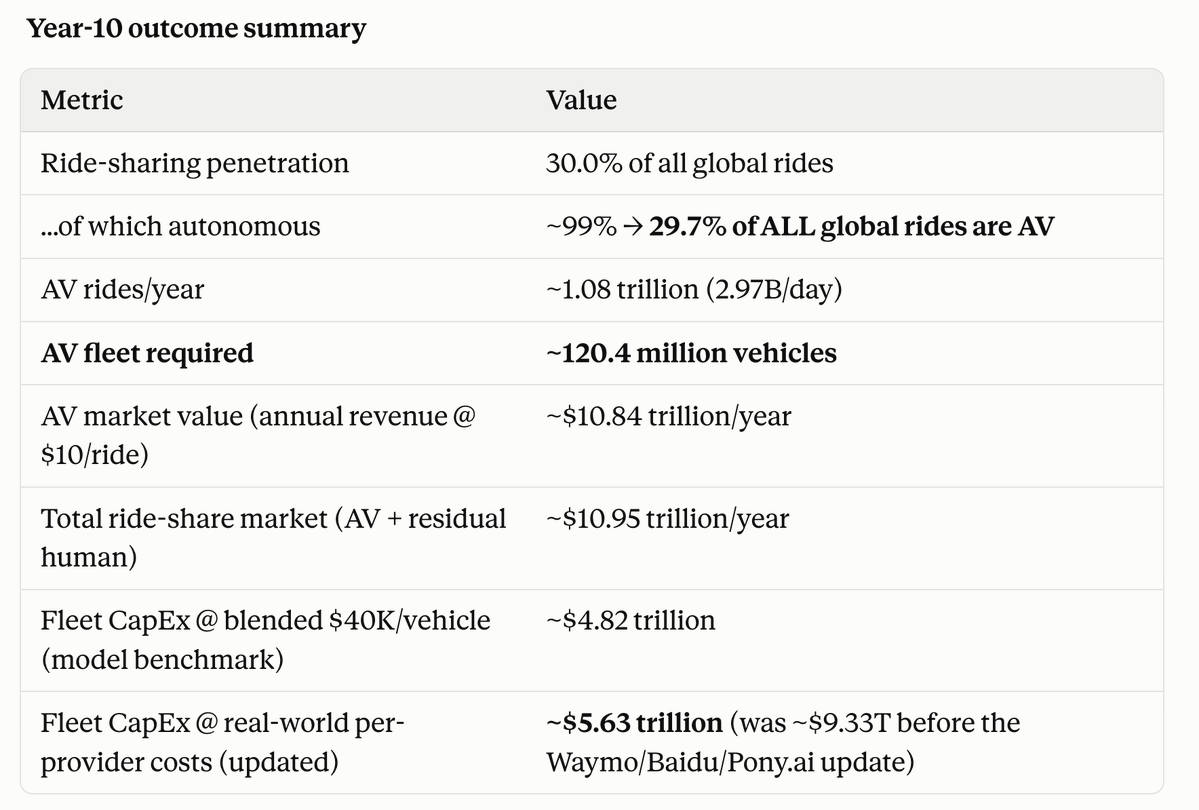
My hyper-bull case is that 30% of global rides will be driven by AVs in 10 years.
This will require ~120M+ cars doing ~25 rides a day ~360 days a year.
It will cost ~$5T to build these cars at ~$40,000 each.
12M cars are built a year on average, but there will be a slow and steady ramp; perhaps 250k in 2027, 500k in 2028, 1m, 3m, etc (build your own model).
Predict Tesla will be #1 in this space with 40% market share -- which would mean building ~50M cars in a decade.
Zero to 40% market share and 5M cars a year on average is an insane ramp up -- but Tesla is the company best positioned to do this.
Uber will be in second place with 35% market share, with two dozen partners putting absurdly cheap Chinese, Japanese, and purpose-built robotaxis into their fleet -- as no car maker wants to go head-to-head with Tesla building cars AND building a network.
Waymo will buy a car maker in the next 12 months, creating a hybrid of Tesla and Uber: full-stack cars built in its factory, deployed on its network, and also added to Grab, Lyft, Uber, and other networks to increase utilization.
The big story?
Someone will need to fund FIVE TRILLION DOLLARS WORTH OF CARS
120M+ cars @ $40,000 each on average; some will be 15-20k two-seaters, some will be premium SUVS at $80,000.
$7-10T+ in annual revenue is at stake for AVs alone.
At a 20-40%+ gross margin, $1-2T+ in EBIDA/cash flow, we will be talking about ~20-30T in market cap.
Waymo and Uber are worth ~$120B and $150B; Tesla is worth $1.4T at the moment.
There's 18-28T in market cap about to be created.
Please run this through your own LLMs and models... move the variables around however you like. $5 average ride, $10 average ride, $50k average vehicle cost, etc.
10% of total rides... 50% of total rides...
... however you slice it, this will be the largest market in the world for AI over the next decade.
After that, human robotics will be the TAM/biggest market cap opportunity in the world... but we can do that model next.
THE AI CYCLE THAT WILL RETIRE YOU IN THE NEXT 5-10 YEARS
Sharing this once. Do NOT lose it. Keep this.
The government and the largest companies in the world are showing you where capital is going.
Follow the BUILDOUT:
PHASE 1 2026–2027: BUILD THE AI STACK
AI Chips: $NVDA $AMD $AVGO $INTC
Memory / HBM: $MU $SNDK
Networking: $MRVL $QCOM
Photonics / Optics: $AAOI $LITE
Data Centers: $IREN $APLD
Cooling / Infrastructure: $SMCI $DELL
Storage: $HPE
GPU Cloud: $CRWV $NBIS $MSFT $AMZN
Electrical Equipment: $NVT
Cybersecurity: $CRWD
PHASE 2 2028–2030: POWER THE MACHINE
Grid Infrastructure: $PWR
Power Producers: $CEG
Natural Gas / Turbines: $VST
On-Site Power: $BE
Nuclear: $OKLO $CEG
Fusion: Emerging / mostly private
Copper: $FCX $SCCO
Critical Metals: $ALB $MP
Rare Earths: $MP $USAR
Electrification: $TE
PHASE 3 2030+: AUTOMATE THE WORLD
AI Applications: $PLTR $NOW $SNOW
Robotics: $TSLA $SERV
Autonomy: $ACHR
Drones: $AVAV $ONDS $KTOS
Defense Tech: $KTOS $AVAV
Space Economy: $RKLB $ASTS
Quantum: $IONQ $QBTS
WHAT DOES AI FORCE THE WORLD TO BUILD NEXT?
That’s what you ask yourself.
Save this.
Elon Musk explains how Tesla owners will make money from its Cybercab fleet:
“For the fleet that is owned by our customers, it’ll be like an Airbnb thing. You can add or subtract your car to the fleet whenever you want.
You can say, ‘I’m going away for a week.’ Just one tap on your Tesla app, your car gets added to the fleet, and it just makes money for you while you’re gone. You can add it to the fleet for a few hours, a few days, or a few weeks.
Whenever you want it back, you can say, ‘Come back,’ and the car will come right back. I’m highly confident that the revenue made by the owner of the car will far exceed the actual monthly payment.”
🚨 RAY DALIO’S LATEST PORTFOLIO JUST DROPPED
$24.38 billion in positions revealed in the last 24 hours.
This is more important than you think:
Ray Dalio is a billionaire who has predicted all the major economic crises for years.
Here’s what Dalio just did with his portfolio:
SPY: Increased +21.89%. His biggest position. He’s increasing broad U.S. market exposure.
VOO: Added +188.97%. One of the biggest increases in the entire portfolio.
NVIDIA: Reduced -17.62%. Taking profits from the biggest AI winner.
AMD: Trimmed -58.34%. Massive reduction in semiconductor exposure.
Micron: Trimmed -92.09%. Almost completely exited the position.
Amazon: Reduced -53.85%.
Google: Trimmed -33.81%.
Microsoft: Reduced -34.39%.
Interesting: Newmont: +16.34%. Increasing exposure to gold while cutting AI.
His strategy: Moving money out of concentrated AI and semiconductor winners while adding heavily to broad index exposure and gold.
Less AI risk. More diversification. More protection.
Dalio has been warning about this for months.
Now his portfolio reflects it.
Keep in mind: I’ve been trading markets for 20+ years.
I’ve seen every kind of bubble, crash and liquidation.
I only care about the moves that matter.
When the next one comes, my followers will see it first.
Follow and turn notifications on.
You won’t get a second warning.
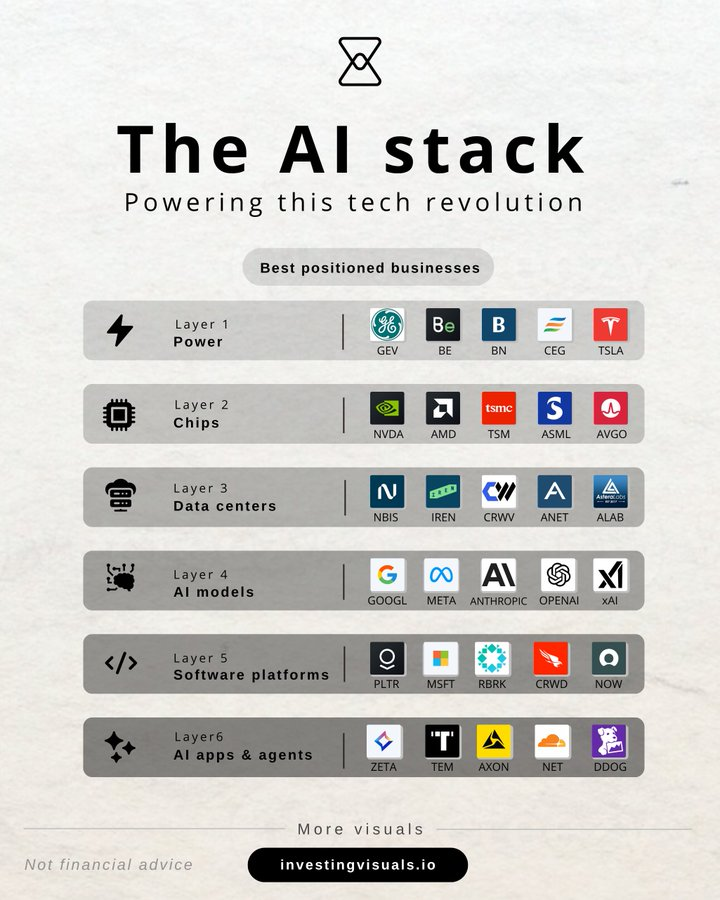
Who's your favorite buy in the AI stack?
1 | Power:
• $GEV at $948
• $BE at $242
• $BN at $40
• $CEG at $290
• $TSLA at $353
2 | Chips:
• $NVDA at $234
• $AMD at $472
• $TSM at $426
• $ASML at $1715
• $AVGO at $355
3 | Data centers:
• $NBIS at $215
• $IREN at $42
• $CRWV $86
• $ANET at $195
• $ALAB at $315
4 | AI models:
• $GOOGL at $340
• $META at $609
• Anthropic
• OpenAI
• xAI
5 | Software platforms:
• $PLTR at $176
• $MSFT at $502
• $RBRK at $93
• $CRWD at $215
• $NOW $141
6 | AI apps and agents:
• $ZETA at $31
• $TEM at $64
• $AXON at $519
• $NET at $283
• $DDOG at $213
I strongly believe the YziLabs investments over the last few months will be some of the best performing because those investments were done during the depth of the crypto winter.
⚠️ Don’t Drink Coffee on an Empty Stomach! Here’s Why
You love that morning coffee, right? But if you drink it before eating, it can actually stress out your body. Your body naturally makes a stress hormone called cortisol in the morning to wake you up. Coffee on an empty stomach can push it way higher, making your body think it’s under stress.
This can lead to anxiety, upset stomach, acid reflux, sugar spikes, and even tiredness later. Over time, it can mess with your sleep, make you more stressed during the day, and make you crave even more coffee.
The simple fix? Eat something first. Even a small breakfast or snack can stop your body from freaking out and help your coffee give you energy instead of stress. ☕💛
Memecoin MEME Surges 500,000% as Robinhood-AMC Controversy Grows
Memecoin MEME has surged more than 500,000% in a single day, briefly topping $250 million market cap on Pumpfun.
FrankDeGods reportedly turned $1,491 into more than $1.2 million after buying 11 million MEME tokens, per lookonchain. Another trader reportedly invested $2,972 and saw the position climb above $2.1 million within 12 hours.
The frenzy has also unfolded alongside controversy surrounding Robinhood’s tokenized AMC shares. AMC CEO Adam Aron said the tokens have no connection to AMC and were never endorsed by the company.
Much of the confusion surrounding the Cybercab stems from a single question: How can Tesla deploy a vehicle without a steering wheel or pedals without first securing an FMVSS exemption from NHTSA?
It sounds impossible, mostly because we assume the government has to greenlight every radical new car before it hits public roads.
In the US, that is not how it works.
Unlike regulators in many other countries who inspect and approve every model beforehand, the U.S. relies on a self-certification system.
Basically, the automaker does its own homework. Tesla determines which federal safety standards apply to its vehicle, compiles the engineering data to prove the design is safe, and signs off on the car itself. Regulators at NHTSA only step in on the back end to test, audit, and push back if they think something looks wrong.
That is why Tesla skipped the route most people expected: a Part 555 exemption.
Carmakers normally use that pathway when they admit a vehicle breaks existing rules and ask the government for temporary hall passes, which are usually capped at just 2,500 vehicles a year.
Tesla did not ask for a hall pass. Instead, the company self-certified the Cybercab as fully compliant with the standards that apply to its setup.
That bold move kicks off a fascinating showdown.
Many federal vehicle standards were drafted decades ago, when the idea of a self-driving car was pure science fiction.
Because the rules assumed a person would always be behind the wheel, they do not just demand safe performance—they explicitly require physical hardware like brake pedals, steering wheels, mirrors, and dashboard warning lights.
NHTSA knows these legacy rules are overdue for an overhaul, and the agency is already working to rewrite them for driverless fleets.
For example, regulators recently proposed updating braking rules so fully autonomous cars do not need physical pedals, provided the vehicle can still stop on a dime. Similar updates are in the works for mirrors, lighting controls, and driver displays.
The burning question around the Cybercab is not simply "Where are the pedals?". The real debate is much bigger: Which rules written for human drivers even apply to a vehicle that was never built for a human in the first place?
That question is the exact target of NHTSA’s audit. The agency is digging into Tesla’s engineering rationale to see whether the company has a rock-solid basis for bypassing those legacy hardware rules.
NHTSA has not signed off on Tesla’s argument, but it has not shot it down yet either. Regulators are essentially checking Tesla’s math—and if they decide Tesla got it wrong, they have full power to pull the cars off the road.
The Cybercab is not sneaking by on a shady loophole. It is forcing a real-world test of the entire American regulatory playbook: What happens when safety rules built around people collide with a car built entirely for software?
Tesla and NHTSA are figuring out that answer right now.
September 16th is about to be a wild day.
We now have President Trump threatening to "stop trading" with all countries that the US has a trade deficit with if the Fed does not CUT rates.
This would effectively cut off trade with ~50% of all US trading partners, including Mexico, China, Taiwan, Germany, Japan, South Korea, Canada, and India.
Trump says the Supreme Court has ruled that he has an "absolute right" to do so.
Meanwhile, the market now thinks Fed Chair Warsh, who was just appointed by President Trump, will HIKE rates in his first rate move.
Just months ago, President Trump said it was a precondition that his Fed Chair appointee is willing to cut rates.
September 16th marks the next Fed decision.
If the Fed doesn't cut rates on September 16th, a potential of $300+ billion in monthly US trade volume could apparently come to a halt.
We will be breaking it all down in real-time.