The menhir of La Templerie in Bazoges-en-Paillers (Vendée) in the Champ des Paganes close to the river fell during C20 and has not been re-erected. This c.1905 card by Poupin usefully gives its dimensions as 3.6m tall, 2.3m wide and 1.3m thick.
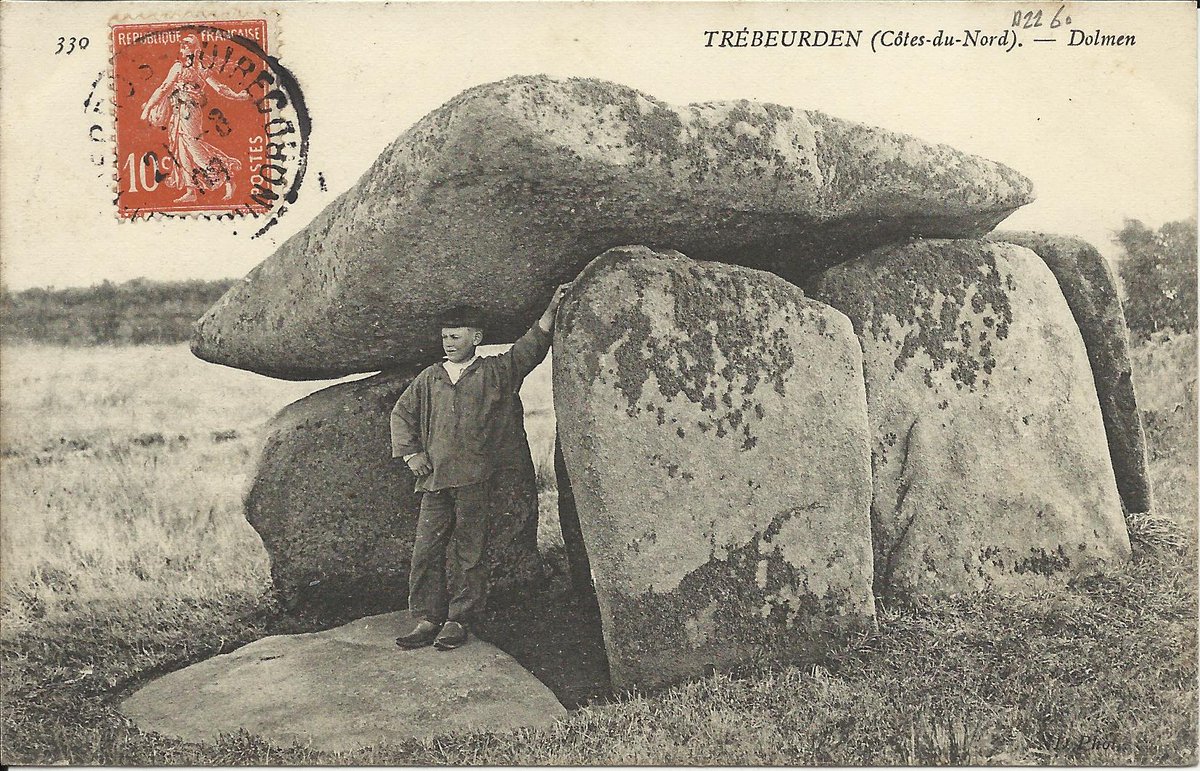
The dolmen of Lan-Kerellec in Trébeurden (Côtes-d’Armor) has a capstone on 5 orthostats and is the remains of an allée couverte or passage grave. It was inhabited by beings known as Gorrikets hence its other name of Ty-Lia. #TombTuesday. Card by Neurdein 1905 or earlier.
Just one day after ending "The Late Show" on CBS, Stephen Colbert returned to TV — to host a public access show with rocker Jack White in Monroe, Michigan.
Appearances by Jeff Daniels, Eminem and Steve Buscemi.
The menhir of Kermarquer in Moustoir-Ac (Morbihan) is 6.7m tall and 3 of its faces have crooks carved in relief. Card by David in Vannes, who over-estimates the height, c.1905. #StandingStoneSunday.
The dolmen of Kerivoret in Porspoder (Finistère) has a 4.5x4m capstone on 5 orthostats; it may be the chamber from a passage grave, the passage lost due to agricultural clearance. A 3.5m tall menhir stands 35m away. Card by Le Bourdonnec in Brest c.1905.
Pierrefitte in St-Sulpice-de-Faleyrens (Gironde) is the biggest menhir in SW France at 5.2m tall, 3m wide and 1.5m thick. A regular hole was bored into one face 70cm from the base at an unknown date said to be used for offerings. Card by Dando in Blaye 1918 or earlier.
The Seine-Oise-Marne type allée couverte in Vaudancourt (Oise) had a 3.3m long vestibule separated from the 14.7m chamber by a porthole slab. It was excavated in 1918/19 but backfilled in 1948 and cannot be seen today. This card was published shortly after the excavation.
The site of Les Mousseaux in Pornic (Loire-Atlantique) has 2 transepted passage graves set into a 15x13m oval cairn. This c.1905 card shows the site before its restoration in the mid 1970s. #TombTuesday.
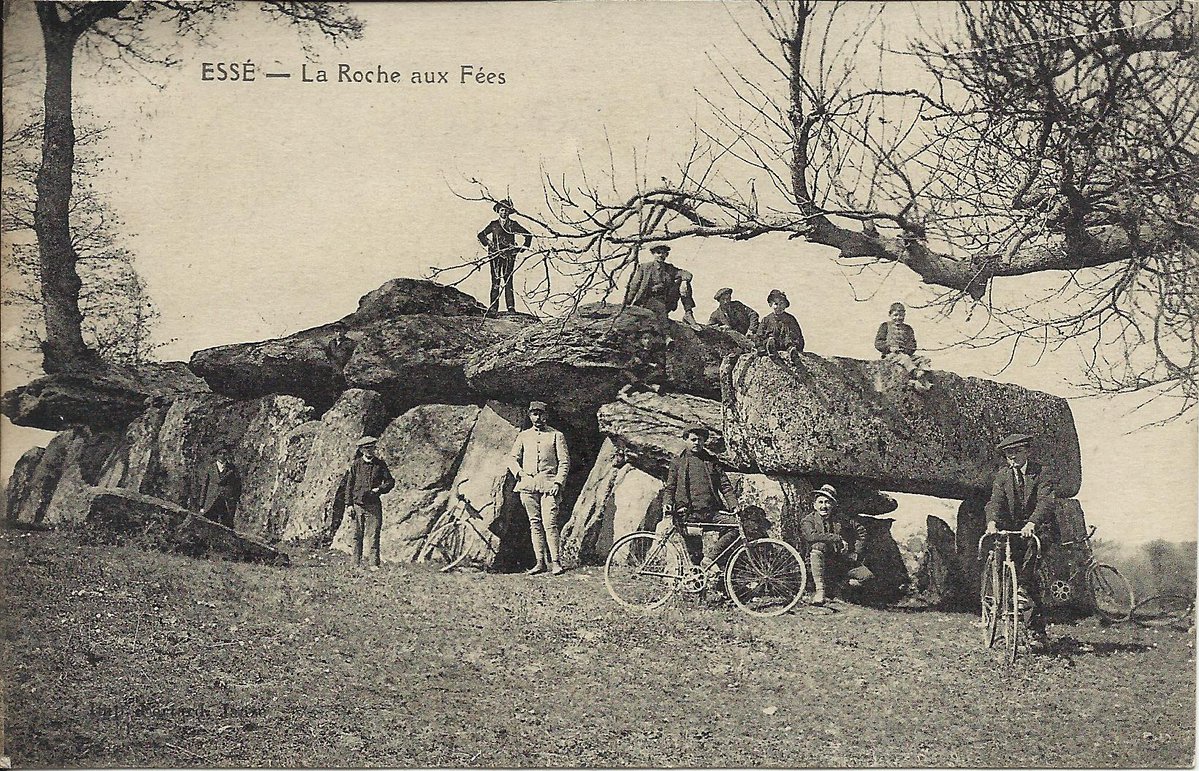
This is the magnificent dolmen of La Roche aux Fées in Essé (Ille-et-Vilaine) made from 41 blocks of schist from a source 4km away. There is a 3.5m long antechamber leading to the main chamber which is 14m long, 4m wide and 2m high.
Most of the passage of the dolmen of Kergavat in Plouharnel (Morbihan) was lost to road building in C19 leaving the chamber with its single large capstone perched above the verge. This 1905 card taken from the road has the track of the Etel to Trinité tramway in the foreground.
It is hard to capture a full view (except from the air) of the 12 rows of over 1,000 menhirs stretching for a kilometre at Menec in Carnac (Morbihan) on film. Even this panoramic card by Denot in Lorient c.1905 only manages to take in part of the site.
The dolmen of La Pierre aux Fées in Reignier (Haute-Savoie) has a 4.9x4.5m capstone on 3 orthostats. It was built overnight by just one fairy who carried the capstone on her head, an orthostat under each arm and the third in her apron pocket. Card by Pittier in Annecy pre-1904.
There is a pair of menhirs known as La Mère et La Fille in St-Jean-de-la-Motte (Sarthe). This is the taller Mother which is a thin triangular slab 4m tall and 2.5m wide at the base of the broad faces. Card by Letessier using a negative by Amiet c.1913.
La Pierre Levée is one of 2 dolmens now in the grounds of the military airbase in Soubise (Charente-Maritime); it is of type angoumoisin about 3m long and 2m wide. In this 1905 card by Braun a woman reclines somewhat ungraciously, almost certainly uncomfortably on the capstone.
This is the 2.9m tall menhir known as La Pierre Attelée in St-Brevin-les-Pins (Loire-Atlantique). A tradition from 1884 records that every year in spring people would surround the top of it with garlands of flowers. Card by Chapeau c.1911. #StandingStoneSunday.
The 11m long chamber of the allée couverte at Mougau-Bihan in Commana (Finistère) is covered by 5 capstones and has an open terminal cell at the end; six of the orthostats are decorated. Card by Léon, a jeweller in Landivisiau.