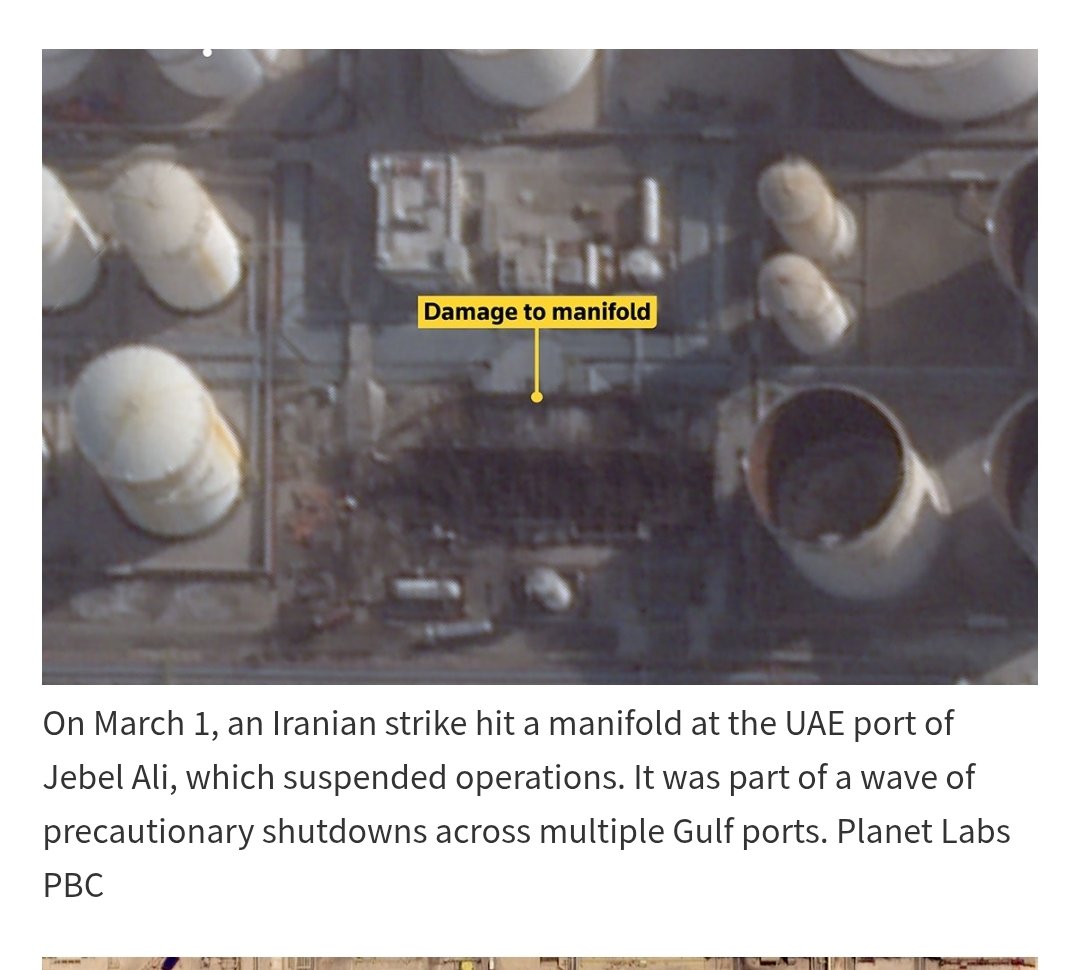
👇This remarkable Reuters investigation published today reveals the extraordinary damage inflicted by Iran's precision strikes on critical Persian Gulf infrastructure, how regional governments have concealed its true extent, and lends strong credence to longstanding reports that the UAE effectively paid Iran to ward off further attacks.
On the last point, Reuters reports that Abu Dhabi agreed to unlock at least $10 billion in frozen Iranian funds, with $3 billion reportedly released, in exchange for Tehran halting attacks on Emirati infrastructure.
The UAE denies any such deal, but notably, no further strikes on UAE infrastructure have been reported since May 17.
Other major findings:
• Scale and precision: Reuters documents at least 135 attacks on 84 infrastructure sites across seven Persian Gulf Arab countries, often striking indispensable components whose destruction crippled entire facilities for months or even years.
• Concealing the damage: Persian Gulf Arab governments repeatedly attributed damage to falling debris from intercepted Iranian missiles and drones.
Reuters identified at least 34 official statements making such claims. But 14 specialists who reviewed the evidence considered it “highly improbable” that debris accounted for the systematic destruction of critical equipment across so many facilities.
• Restrictions on reporting: The UAE, Saudi Arabia, Qatar, Kuwait, and Bahrain have restricted the photographing and sharing of images from attack sites, making independent assessments difficult and obscuring the true extent of the damage.
• Sophisticated Iranian targeting intelligence: Iran repeatedly struck critical equipment concealed inside buildings or otherwise difficult to identify from satellite imagery.
Three officials told Reuters that Tehran relies on networks of informants with access to sensitive facilities, helping explain the extraordinary precision of some attacks.
The broader strategic implications are enormous. Iran has demonstrated an ability to inflict substantial economic damage across the Persian Gulf despite overwhelming US conventional military superiority.
And this is precisely why renewed all-out fighting, particularly an escalation into more extensive infrastructure warfare, carries such enormous risks.
The destruction could trigger even greater economic shocks far beyond the Middle East.
https://t.co/hiWNsRldTl
🚨BREAKING: Iran has begun deploying air defense systems, ballistic missiles, and other ground forces over the last 24hrs.
Reports claim Israeli & US officials are concerned that Iran may launch a preemptive strike.
BREAKING: US intelligence has detected "extreme" new Iranian military moves, per Israel's Channel 12.
Netanyahu has briefed Trump on the movements, who has not decided when to strike. Israeli officials believe any new attack should target Iran's energy, missile and nuclear infrastructure.
Fresh Israeli security assessments now say Iran has restored its missile capabilities to roughly 400 active launchers, close to pre-war level, contradicting Trump's earlier claims of destroying the program.
Iran's IRGC exercises today ran for a fifth consecutive day with ballistic missile test launches from multiple cities, the most intense so far.
BREAKING: Donald Trump is reportedly considering firing Defense Secretary Pete Hegseth after the November 3 midterms, potentially turning his own Pentagon chief into the fall guy for the unpopular Iran war as he seeks to protect his political legacy and anti-war image, per Dominic Michael Tripi and multiple reports.
The precedent is George W. Bush, who fired Donald Rumsfeld one day after Republicans suffered major losses in the 2006 midterms over the Iraq war. With the Iran conflict dragging on and fuel prices rising, Trump could now be preparing a similar political sacrifice — distancing himself from the war by removing the man leading the Pentagon.
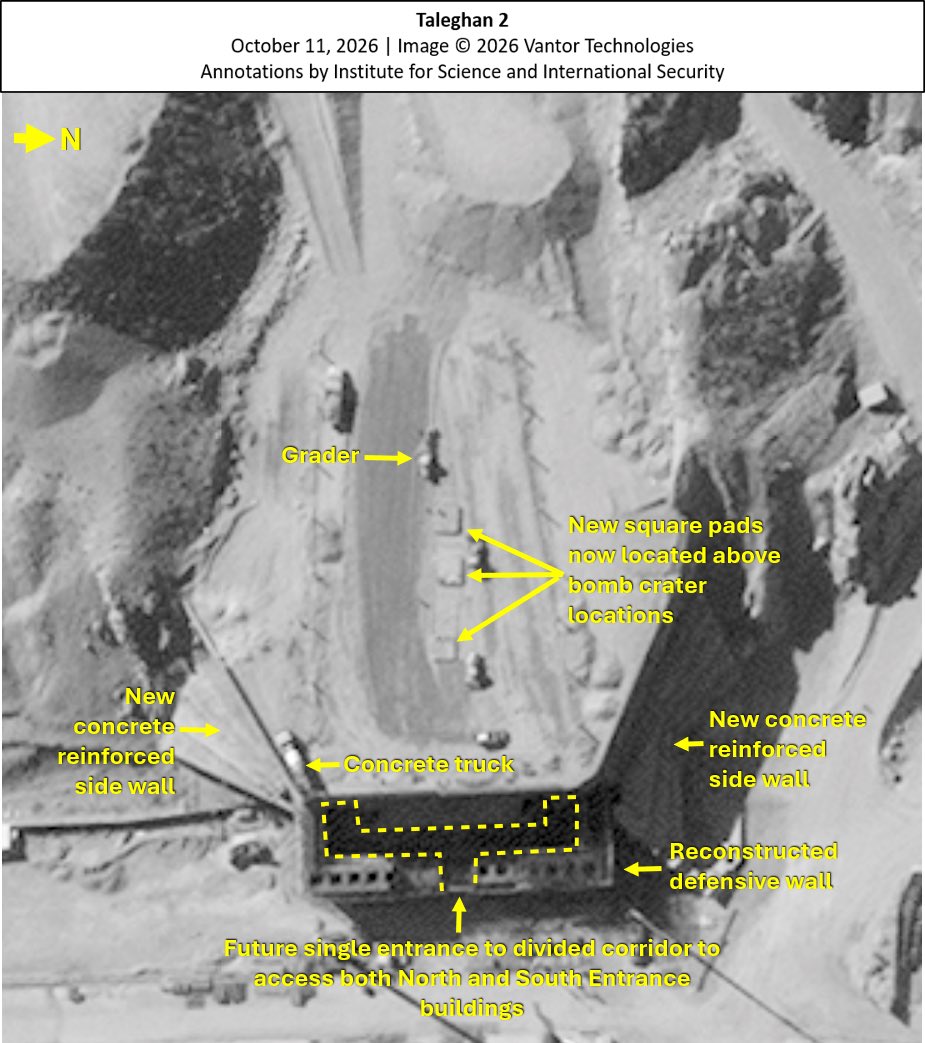
Recent @vantortech satellite imagery from October 2026 of the second reconstruction effort at the Taleghan 2 nuclear weapons related R&D facility shows that this effort is progressing rapidly. The facility was first bombed by Israel in October 2024. Despite Iran having expanded and hardened the facility after the first bombing (REF 1), Israel used bunker buster bombs to again attack the facility as well as destroy additional structures around the site (REF 2). Since March 2026, Iran has repaired the roof covering, most recently adding three concrete pads directly over the penetration holes, possibly to serve as hatchways or vents. Whatever their function, associated construction activity was concealed by temporary tarp coverings in September (REF 3). Other work included reinforcing the structure with two stepped concrete side walls, and completing a new hardened entrance way that was damaged in the last bombing. This effort has been an intensive undertaking by Iran to reconstruct the facility, but when it could become operational is unclear. The reasoning why Iran is reconstructing a well known and well characterized facility is perplexing, but, at a minimum, it shows that Iran wants to reestablish its lost capabilities there. Below are several images showing the current state of construction since the facility was destroyed by an airstrike in March 2026.
REF 1: https://t.co/I6TMkFnvvK
REF 2: https://t.co/jLeqHsFHRf
REF 3: https://t.co/0j4sJwBMlB
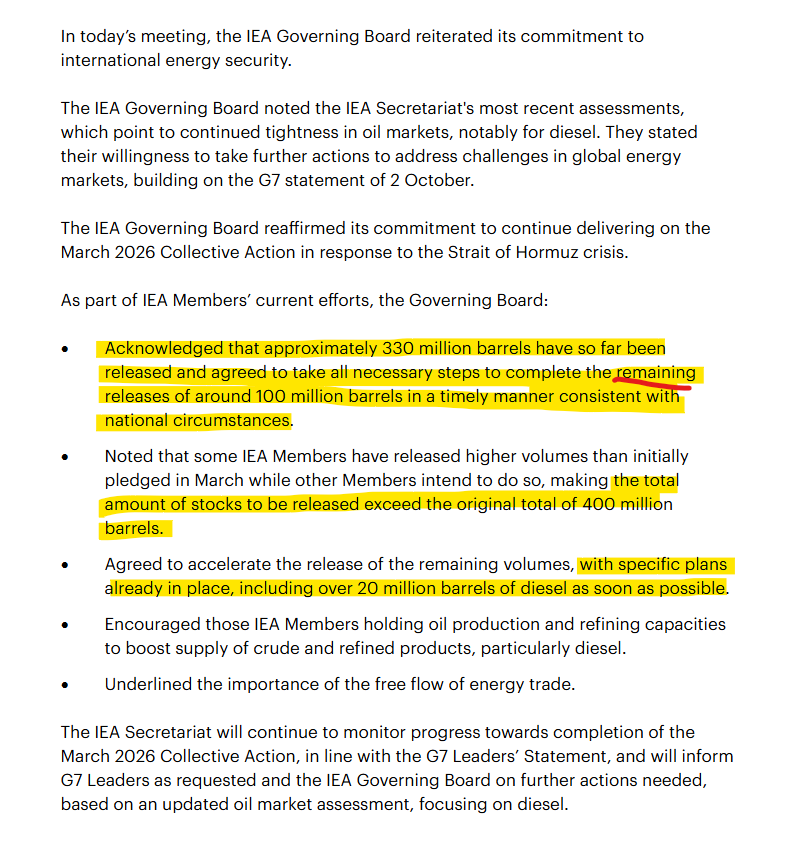
FULL STATEMENT: @IEA communiqué on strategic oil reserves. The US isn't getting the additional 100m barrels it requested, only a vague mention that total amount of stocks released would exceed the original total (approved in March) of 400m. But that excess isn't quantified.
BREAKING: Ukraine to restart major strikes on Russia's oil refineries, with Zelensky declaring "The block on attacking refineries is out. We're done," per the FT.
Zelensky says the reason for the restart is Trump lying to him by deliberately blocking Starlink but presenting it to Kyiv as a "technical glitch," as well as telling Ukraine that the missed ballistic missile warnings earlier this week was due to "bad weather," which killed 6.
"It was not a technical problem, it was the will," from Trump, he says.
He also slammed Trump's eagerness to strike a diesel deal with Russia and Trump's apparent admiration for Putin, saying Trump has an instinctive affinity for autocrats and the super-wealthy. "He speaks about it openly and loudly that he loves such people and he respects such people," Zelensky says.
NEWS: Top Pentagon officials have expressed their intention to hold off on releasing an internal report into the attack on Shajarah Tayyebeh Elementary School in Minab, Iran until after the US midterms at the earliest. https://t.co/N8sxNWLOLk @business
❗️Republicans are demanding an investigation into the Starshield restrictions in Ukraine and are accusing Trump of supporting Putin. Senator Tom Tillis suggested that the problem originated within the Pentagon’s systems, not with Starlink or SpaceX, and could have been either a mistake or a deliberate decision that cleared the way for a Russian attack. Congressman Don Bacon accused Trump of supporting Putin and speaking out against Ukraine, emphasizing that Ukraine is fighting for freedom and independence, which Americans value, while Putin hates them. Why does Trump love Putin?
🇮🇷🇸🇦CONFIRMED: Houthi media has released footage purportedly showing last night’s SAM engagement against a Royal Saudi Air Force (RSAF) Eurofighter Typhoon.
The video appears to show the missile detonating near the aircraft, potentially damaging it and causing what appears to be fuel leaking from the wings.
SITREP 15/10/2026: TRUMP ORDERS MOTHER OF ALL BOMBS TO FORCE IRAN CAPITULATION
Events accelerated overnight. President Donald Trump has ordered the US military to prepare additional attack plans against Iran centered on one of the most destructive conventional weapons in the American arsenal. Officials familiar with the planning have spoken to CNN. The question is no longer whether major options are being drawn up. The question is when the order to execute will be given.
THE MOAB ORDER
➡️ Trump has directed additional strike packages that include Iranian energy facilities and nuclear-program sites.
➡️ At the center is the GBU-43/B Massive Ordnance Air Blast, known worldwide as the Mother of All Bombs.
➡️ CNN reports US officials and people familiar with the planning confirmed the weapon is part of the options under consideration.
➡️ One official described the planned military options as a “real fireworks spectacle.”
THE WEAPON ITSELF
➡️ The bomb weighs roughly 21,600 pounds, about 10 tons.
➡️ It was built to create a massive blast over a large area rather than to penetrate deep into solid rock.
➡️ Unlike precision weapons that hit individual buildings, it generates an enormous pressure wave that can cause devastating damage across a wide radius.
➡️ Test recordings show effects that resemble a nuclear blast: buildings shattered, people killed by the explosion and its immediate effects, and large stretches of ground devastated.
➡️ High tunnels and deep systems can be heavily damaged by the pressure.
➡️ It has been used in combat only once: on 13 April 2017 against an ISIS tunnel complex in Afghanistan during Trump’s first term.
THE LIMITS AND THE REAL AIM
➡️ Sources familiar with the planning state clearly that the MOAB can destroy large areas but was never designed as a deep-penetration bunker-buster for underground nuclear facilities.
➡️ One source told CNN it is not configured for deep rock the way weapons intended for buried nuclear sites are.
➡️ The assessment in the briefing is that the weapon is intended to wear down military leadership and the civilian population into capitulation.
➡️ An attack with this bomb would not automatically equal the complete destruction of Iran’s nuclear program.
➡️ The enormous blast radius raises the risk of numerous civilian casualties if it is used against energy plants or infrastructure near inhabited areas.
➡️ Destruction can easily reach far beyond the stated military target.
THE FORCE BUILDUP
➡️ Flight-tracking data show a sharp surge in US C-17 military transports over the past 36 hours.
➡️ A large share of the aircraft is landing in Israel after Iranian attacks damaged American facilities across the region.
➡️ The Pentagon is moving a third aircraft-carrier strike group into the Middle East.
➡️ An estimated 9,000 to 10,000 additional American soldiers are being ordered there.
➡️ The USS Theodore Roosevelt and the amphibious assault group with Marines (including the Makin Island group) are expected to take part.
➡️ Carrier groups allow large numbers of combat aircraft to operate from the sea; amphibious forces expand options for ground operations on islands or coastal sites.
➡️ The result is a stronger American military presence in the region than ever before.
THE IRANIAN RESPONSE
➡️ Iranian officials now regard a joint US-Israeli attack as unavoidable.
➡️ The leadership has already announced a massive retaliation to any new attack.
➡️ The stated intention is to put the entire Middle East out of action, destroy all oil refining, and cut undersea cables, which would produce large-scale chaos in the IT sector.
➡️ Iran has also said it intends to preempt US and Israeli strikes.
➡️ The Revolutionary Guard has obtained information on Ramstein and on Fairford in Britain and has threatened every military base in Europe if the White House proceeds with the announced plans.
➡️ The idea that a large-scale campaign can remain confined to Iranian territory is described as a complete illusion.
THE THREE-DAY CAMPAIGN
➡️ Trump has also called on Arab states to prepare for war with Iran.
➡️ CENTCOM has finalized preparations for a possible three-day military campaign against rebuilt Iranian forces.
➡️ A source told CNN the president ordered additional attack packages covering extensive Iranian energy infrastructure and possibly the strongest and most destructive weapons in the US arsenal.
➡️ Another source confirmed that plans for attacks on Iranian nuclear sites, including Pickaxe Mountain, explicitly include the MOAB.
➡️ The plans are described as finished and awaiting Trump’s final approval.
➡️ The White House is not commenting on sensitive military planning whose existence remains uncertain.
➡️ The United States is assessed to lack the capacity for a long attritional war, and the conflict is already unpopular at home.
➡️ The calculation is therefore to deliver a short, devastating blow that forces capitulation, comparable to the atomic bombs used against Japan.
➡️ That calculation is expected to fail.
THE BOTTOM LINE
The Mother of All Bombs, a third carrier, thousands more troops, and a three-day campaign are now on the table while Iran prepares to hit energy infrastructure, cables, and bases beyond its borders. Every sign points to a rapid expansion rather than a contained strike.
The window for a limited conflict is closing fast.
#SITREP1510 #MOAB #IranWar #MotherOfAllBombs #USMilitary #ThreeDayCampaign #HormuzRisk
Reuters has released new images from hits on energy and power sites across the middleeast mainly by iran and other actors.
Qatar Ras Laffan lng plant
UAE Barakah nuclear plant
Saudi aramco abqaiq refinery
Uae fujairah.
Reuters: In at least 34 official statements following strikes, governments emphasized that any damage was caused by falling debris from successful interceptions, the damage shows otherwise. Gulf military air defenses are located near some of the most sensitive sites, including what Janes, the defense intelligence company, confirmed as American-made Patriot missile defenses visible by satellite that were positioned about 3 kilometers north of Fujairah.
Gulf states are suppressing information about the toll. It is illegal in the United Arab Emirates, Bahrain, Qatar, Kuwait and Saudi Arabia to take or distribute certain photos or video of the aftermath of strikes. The countries also routinely cite laws against the spread of rumors and misinformation when restricting reporting about strikes. Reuters and other international media have published verified visual evidence of strikes during the war.
“Gulf states now treat damage assessments as if they were state secrets,” said Matthew Reed, president of the oil consultancy firm Foreign Reports. The US and Israel have also kept damage to US bases and Israeli sites under wraps, but many details have emerged through reports by governments and media, including Reuters.
Reuters: Iran’s missiles and drones have hit Gulf infrastructure sites at least 135 times, causing cascading failures that Gulf states have often concealed. Despite repeated official statements that the damage came from debris, Reuters found the equipment struck was, time and again, exactly what mattered most.
🛰 Aramco Headquarters in Dhahran, Eastern region.
At least one building was partially destroyed as a result of a direct hit, and not shrapnel.
*sentinel-2 imagery October 13th & 15th.