Because we get asked a lot.
The Technological Republic, in brief.
1. Silicon Valley owes a moral debt to the country that made its rise possible. The engineering elite of Silicon Valley has an affirmative obligation to participate in the defense of the nation.
2. We must rebel against the tyranny of the apps. Is the iPhone our greatest creative if not crowning achievement as a civilization? The object has changed our lives, but it may also now be limiting and constraining our sense of the possible.
3. Free email is not enough. The decadence of a culture or civilization, and indeed its ruling class, will be forgiven only if that culture is capable of delivering economic growth and security for the public.
4. The limits of soft power, of soaring rhetoric alone, have been exposed. The ability of free and democratic societies to prevail requires something more than moral appeal. It requires hard power, and hard power in this century will be built on software.
5. The question is not whether A.I. weapons will be built; it is who will build them and for what purpose. Our adversaries will not pause to indulge in theatrical debates about the merits of developing technologies with critical military and national security applications. They will proceed.
6. National service should be a universal duty. We should, as a society, seriously consider moving away from an all-volunteer force and only fight the next war if everyone shares in the risk and the cost.
7. If a U.S. Marine asks for a better rifle, we should build it; and the same goes for software. We should as a country be capable of continuing a debate about the appropriateness of military action abroad while remaining unflinching in our commitment to those we have asked to step into harm’s way.
8. Public servants need not be our priests. Any business that compensated its employees in the way that the federal government compensates public servants would struggle to survive.
9. We should show far more grace towards those who have subjected themselves to public life. The eradication of any space for forgiveness—a jettisoning of any tolerance for the complexities and contradictions of the human psyche—may leave us with a cast of characters at the helm we will grow to regret.
10. The psychologization of modern politics is leading us astray. Those who look to the political arena to nourish their soul and sense of self, who rely too heavily on their internal life finding expression in people they may never meet, will be left disappointed.
11. Our society has grown too eager to hasten, and is often gleeful at, the demise of its enemies. The vanquishing of an opponent is a moment to pause, not rejoice.
12. The atomic age is ending. One age of deterrence, the atomic age, is ending, and a new era of deterrence built on A.I. is set to begin.
13. No other country in the history of the world has advanced progressive values more than this one. The United States is far from perfect. But it is easy to forget how much more opportunity exists in this country for those who are not hereditary elites than in any other nation on the planet.
14. American power has made possible an extraordinarily long peace. Too many have forgotten or perhaps take for granted that nearly a century of some version of peace has prevailed in the world without a great power military conflict. At least three generations — billions of people and their children and now grandchildren — have never known a world war.
15. The postwar neutering of Germany and Japan must be undone. The defanging of Germany was an overcorrection for which Europe is now paying a heavy price. A similar and highly theatrical commitment to Japanese pacifism will, if maintained, also threaten to shift the balance of power in Asia.
16. We should applaud those who attempt to build where the market has failed to act. The culture almost snickers at Musk’s interest in grand narrative, as if billionaires ought to simply stay in their lane of enriching themselves . . . . Any curiosity or genuine interest in the value of what he has created is essentially dismissed, or perhaps lurks from beneath a thinly veiled scorn.
17. Silicon Valley must play a role in addressing violent crime. Many politicians across the United States have essentially shrugged when it comes to violent crime, abandoning any serious efforts to address the problem or take on any risk with their constituencies or donors in coming up with solutions and experiments in what should be a desperate bid to save lives.
18. The ruthless exposure of the private lives of public figures drives far too much talent away from government service. The public arena—and the shallow and petty assaults against those who dare to do something other than enrich themselves—has become so unforgiving that the republic is left with a significant roster of ineffectual, empty vessels whose ambition one would forgive if there were any genuine belief structure lurking within.
19. The caution in public life that we unwittingly encourage is corrosive. Those who say nothing wrong often say nothing much at all.
20. The pervasive intolerance of religious belief in certain circles must be resisted. The elite’s intolerance of religious belief is perhaps one of the most telling signs that its political project constitutes a less open intellectual movement than many within it would claim.
21. Some cultures have produced vital advances; others remain dysfunctional and regressive. All cultures are now equal. Criticism and value judgments are forbidden. Yet this new dogma glosses over the fact that certain cultures and indeed subcultures . . . have produced wonders. Others have proven middling, and worse, regressive and harmful.
22. We must resist the shallow temptation of a vacant and hollow pluralism. We, in America and more broadly the West, have for the past half century resisted defining national cultures in the name of inclusivity. But inclusion into what?
Excerpts from the #1 New York Times Bestseller The Technological Republic: Hard Power, Soft Belief, and the Future of the West, by Alexander C. Karp & Nicholas W. Zamiska
https://t.co/8igjazz1On
$META has just opened the floodgates for the AI agentic application layer. $META just acquired Manus, an AI-agentic startup, for more than $2B because Manus excels at agentic real-world tasks. It is also the startup that has reached the $100M ARR market the fastest in history (8 months).
While many might think Manus is just an LLM wrapper, a closer look at the company reveals some interesting aspects and values:
Manus, unlike ChatGPT, was built to execute tasks rather than provide text answers. The goal is to assign it a high-level task so the agent can navigate different tasks autonomously to complete the job (e.g., navigating the web, writing code). Foundation models predict the next word, while Manus predicts the next action.
The unique part about Manus is that it uses an architecture called Code-Act. Instead of just talking about a problem, it writes a Python script on the fly to solve it, executes that script in a secure »sandbox« (virtual machine), and looks at the result. The Sandbox means that Manus provides every user with a dedicated, cloud-based Linux environment. They now have more than 80M virtual computers. This means the upfront costs are higher than with ChatGPT. You pay for the virtual computers even when they are idle, but because of their specific architecture, they are cheaper per task completed. Manus is model-agnostic and uses multi-model routing. For scraping a website, it can use a low-cost model; for summarizing content, it can use a more expensive model within the same task. It also caches previous task executions, so if, for example, it has already solved how to log in to a site, it saves the script from previous tasks and, with it, the tokens. Because it runs in the background with the virtual machines and uses a 3-agent orchestration system of a planner, an executor, and a verifier, it also often doesn't need »retries« like other models need (as they often lose focus or connection to do long-hour tasks). The combination of those things makes it cheaper per solved task.
Manus at launch was higher than OpenAI Deep Research across levels 1, 2, and 3 of the GAIA benchmark. The GAIA benchmark is a reality check for AI agents on how well they perform on real-world tasks that are routine for humans but typically a challenge for AI (humans score 92% accuracy).
How does this fit into $META? Well, $META is looking to build a superintelligent AI assistant for every person, so this aligns with what they are trying to do. They are already working on the foundation model at $META (if they fail, they can use open-source or partner with an AI lab). Still, you also need to have agentic infrastructure, which is everything that Manus has done and has achieved serious traction for it (so it works).
This best fits into $META's WhatsApp as an assistant that they can offer both to consumers and businesses, and a strong play for their $META Ray-Ban Smartglasses, where you need an autonomous, agentic system to run those glasses. $META will also help Manus with its infrastructure, allowing Manus to stop renting virtual machines from cloud providers and use $META's own infrastructure.
With this move, $META also gains an extremely capable team focused on agentic workflows and building the »body« of the agent, as the »brain« is already being built by $META through its foundation model work.
In honesty, $2B-$4B doesn't seem like much given the cost of AI talent today and the traction and growth Manus has had.
Zuck is also showing you where the puck is going. $META might have opened up the floodgates for the application layer of AI with these moves. I expect others will follow, so in hindsight, this deal will look cheap.
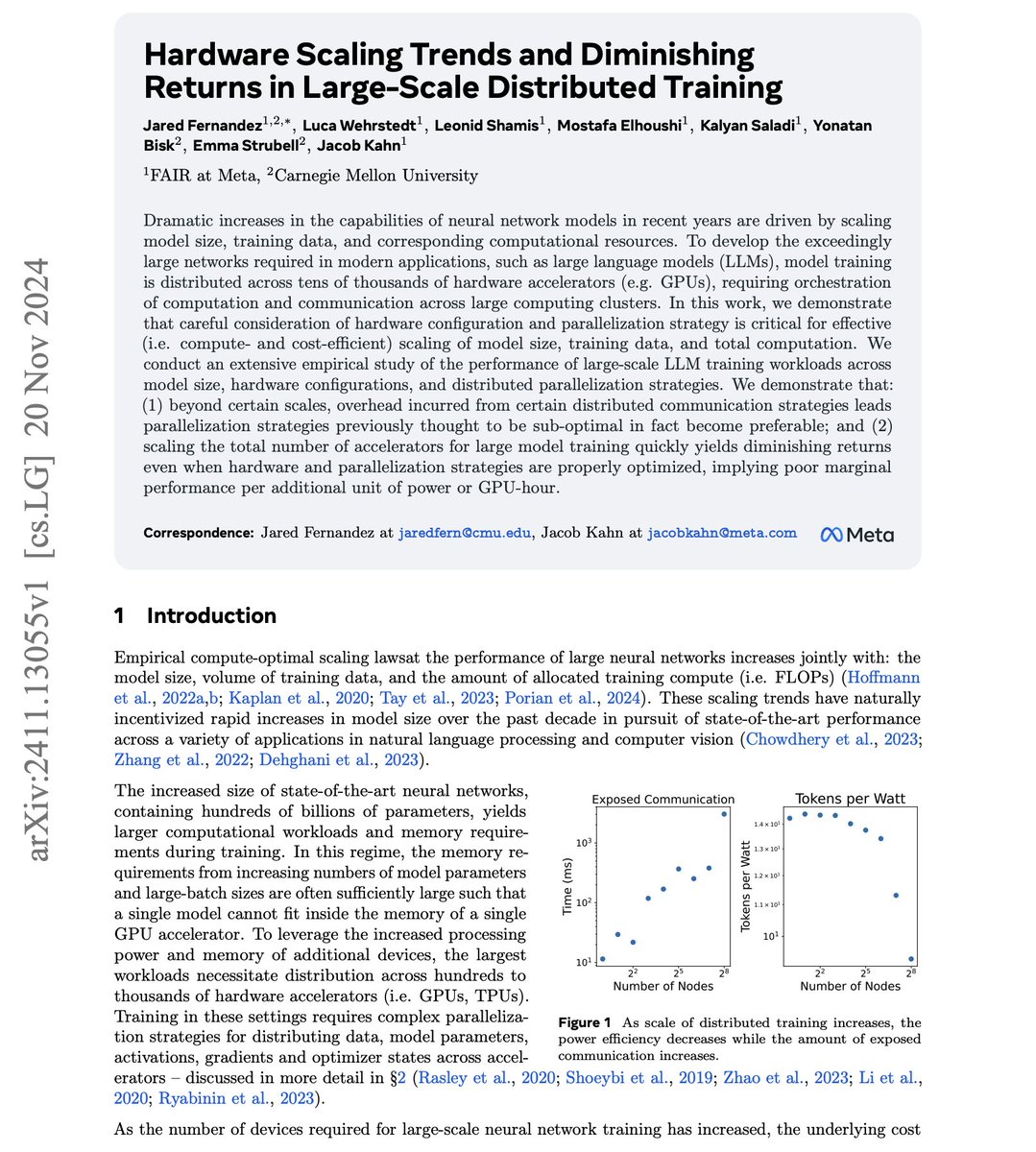
Interesting research from Meta on hardware scaling trends.
More GPUs doesn't always mean faster training.
The default approach to scaling LLM training today remains throwing more hardware at the problem. More accelerators, more parallelism, more compute.
However, there's a ceiling that most teams don't see until they hit it.
This new research demonstrates that scaling the total number of accelerators for large model training quickly yields diminishing returns, even with optimized hardware and parallelization strategies.
The researchers tested Llama-2 models (1B to 70B parameters) across 8 to 2,048 GPUs spanning V100, A100, and H100 hardware. What did they find? When scaling from 128 to 2,048 GPUs, throughput decreased by 37.22% while per-GPU power draw only dropped 5.87%.
The culprit is communication overhead. At large scales, AllGather and ReduceScatter (two MPI primitives) operations become bottlenecks. The majority of communication becomes exposed, and computation can't hide the latency anymore.
Counter-intuitively, model parallelism strategies (tensor and pipeline parallelism at degrees 2-4) that were previously thought to reduce hardware utilization actually become preferable at scale. They reduce exposed communication compared to pure data parallelism.
On newer hardware, utilization gets worse, not better. Model FLOPS Utilization dropped from 59.67% on A100 to 40.77% on H100; faster chips expose more communication overhead.
Why it matters: Adding more GPUs provides poor marginal performance per additional unit of power or GPU-hour. Teams scaling to thousands of accelerators need to carefully reconsider parallelization strategies rather than assuming more hardware equals faster training.