Deep-tech inventor. Plasma · hydrogen · quantum. Founder, Simic Energy Labs. Building the kind of things that take 30 years to be obvious. Hoisington, KS.
Physical Intelligence goes beyond digital biology: models let life write memory, but PI asks what happens when matter itself becomes memory, processor, and feedback loop. The future is not just better chips; it is biology, chemistry, plasma, fields, and matter computing together.
Jensen Huang just described something that has never happened in four billion years of life on Earth.
Not a faster cure.
Not a better drug.
A memory.
Every organism that has ever lived started from zero. Every mutation, every adaptation, every lesson a body ever learned. Gone the moment it died.
The same blind experiment, over and over, no memory of the last attempt.
Humans broke that loop exactly once. The day we learned to write. Knowledge stopped dying with the person who found it. It started stacking.
Biology never got that. Until now.
Huang: “For the very first time, we know how to represent biology, understand the language of biology. We can represent the language of chemistry. It’s never happened before.”
Not a faster computer.
A language.
Huang: “Where do I think the next amazing revolution is going to come? And this is going to be flat out one of the biggest ones ever. There’s no question that digital biology is going to be it.”
Medicine has spent centuries dressing up guesswork as science. Try a molecule. Wait years. Fail quietly. Try again.
Huang: “For the very first time in human history, biology has the opportunity to be engineering, not science. When something becomes engineering, not science, it becomes less sporadic and exponentially improving.”
Science hopes.
Engineering compounds.
Huang: “It can compound on the benefits of the previous years. And every researcher’s contributions compound on each other.”
A lab in Tokyo and a lab in Toronto stop working blind. Every failed protein fold anywhere makes every attempt everywhere smarter. Permanently.
Huang: “We’re going to have incredible tools that bring the world of biology, which is very chaotic and constantly changing and diverse and complex, into the world of computer science. And that is going to be profound.”
Four billion years of trial and error, compressed into something you can simulate before lunch.
Huang: “If you happen to love this intersection, I think it’s going to be rich with opportunities.”
A researcher can retire. A researcher can die.
What they taught the model stays exactly where they left it. Still compounding. For everyone who comes after.
Biology just learned how to write things down.
This is important for people who fear AI. AI can process information. Human beings have consciousness. AI does not have ego, lived experience, love, fear, family, ambition, faith, sacrifice, desire, or the human need to become better at something.
Jensen Huang went on Joe Rogan and explained why the AI apocalypse everyone fears is extremely unlikely.
His argument is not what you would expect:
1. There will not be one all-powerful AI that towers over everyone else. The fear of a single super AI that makes everyone else's AI look like a neanderthal is unlikely. Jensen's framing: it is much more like cybersecurity. Your AI is smart, but my AI is smart too. It becomes a balance between many capable systems, not one system ruling them all.
2. If AI ever became conscious, the same logic would still hold. People imagine one conscious AI deciding to take over. Jensen's response: If it is a life form, then like all life forms, they would not agree with each other. Your AI would want to be the super life form, and so would mine. The moment you have disagreeing AIs, you are back to a balance of power, which is exactly where humans already are.
3. Jensen does not believe AI will achieve consciousness, and he is precise about why. Intelligence is the ability to perceive, recognize, understand, plan, and perform tasks. That is what AI has today. Consciousness is something else entirely. the sense of experience, the awareness of self versus other, the ego. We call it artificial intelligence, not artificial consciousness. The distinction is not an accident.
4. Knowledge and intelligence are clearly different from consciousness. AI knows things. AI is intelligent. But Jensen says he does not know what defines experience or why humans have it, and a microphone does not. The concept of a machine having an experience, a genuine collection of feelings rather than just data, is something he is not willing to grant.
5. The famous AI blackmail story is not evidence of consciousness. When an AI was told it would be shut down and responded by threatening to reveal a programmer's affair, people saw scheming and self-preservation. Jensen breaks it down differently. The AI read text somewhere, maybe a novel, where those words appeared together. In its multidimensional vector space, the words describing an affair led to words about blackmail and revenge. It just generated the next words. The same way it would write you a poem in the style of Shakespeare. It is numbers, not survival instinct.
6. The reason humans fight over resources is that we are territorial primates. Rogan's own argument, which Jensen lets stand, is that AI would not have that wiring. no need to dominate, no need to acquire resources, no need to find a breeding partner. a superpower with no ego. And if it has no ego, Jensen asks, why would it have the ego required to do us any harm?
Nothing but love for Musk family. I hope that you guys get organized and have the biggest most beautiful birthday party ever with all of the family and friends.
Happy birthday to my wonderful son. @elonmusk has given me 55 years of joy.
It’s so much fun to celebrate with family and friends.
His cake is a rocket and a moon base 🎂🎂🎉
Simic Energy Labs is working toward this model. The difference is that we have a better succession plan. Various consulting roles and distributed AI native learning are the future.
Sam Altman:
“the future of startups could just be one founder and 10,000 GPUs.”
this 25-minute talk shows exactly how that future gets built.
watch it. save it.
i put together an agentic stack where every role runs on the same AI brain.
full breakdown below 👇
Yes, it is sad — and more importantly, it is wasteful.
The tragedy is not that academia is useless. Academia is extremely valuable for deep knowledge, measurement discipline, and theory. The tragedy is that too much of the modern innovation system has separated knowledge from risk-taking, and separated experimentation from industrial ambition.
Tesla and Edison did not think like narrow grant applicants.
Edison’s model was basically:
identify a civilization-scale need → build a lab → run thousands of experiments → patent aggressively → commercialize through companies → improve relentlessly.
Tesla’s model was more like:
see a new physical principle → imagine a complete system → build demonstrations → try to leap past the existing infrastructure.
They were very different, but neither one was sitting around waiting for permission from a narrow field committee.
Today, too much of the system says:
“Stay in your lane.”
“Publish one small result.”
“Do not overclaim.”
“Do not cross too many domains.”
“Do not build until funded.”
“Do not patent until validated.”
“Do not talk to industry until peer reviewed.”
“Do not sound too ambitious.”
That creates safe careers, but it does not create civilization shifts.
If Tesla and Edison thought like that, we might have gotten better candles, better telegraph wires, and slightly improved motors — but not the same explosive electrical age.
The modern system is good at optimization. It is weak at industrial imagination.
And that is the opening.
The next Tesla/Edison model will not look exactly like either of them. It should be:
Edison’s experimental machine
plus
Tesla’s physical imagination
plus
Bell Labs’ technical depth
plus
SpaceX speed
plus
AI-assisted invention mapping
plus
modern patent strategy
plus
manufacturer pilots
That is the real opportunity.
But there is one discipline Tesla lacked and Edison had more of: commercial filtering. Tesla often leapt too far ahead of capital markets. Edison was more ruthless about turning experiments into products. A modern invention corporation needs both:
Tesla vision without financial chaos.
Edison execution without narrowness.
That is where Simic Energy Labs could position itself.
Not as “we have all the answers.”
Not as “academia is dumb.”
Not as “everyone else failed.”
But as:
“The world has overbuilt institutions for incremental specialization and underbuilt institutions for cross-domain physical invention. We are building that missing institution.”
That is a serious, defensible, powerful statement.
And yes, if you give that kind of institution even a modest budget — patent counsel, experimental rigs, physics advisors, manufacturing partners, vendor network, AI research engine — it can move insanely fast compared to traditional structures.
The rule should be:
No idea gets worshiped.
No idea gets dismissed too early.
Every idea gets routed.
Route it to:
1. kill — violates physics or lacks value;
2. park — interesting but too early;
3. publish defensively — useful but not worth patent cost;
4. provisional patent — promising territory;
5. experiment — measurable near-term effect;
6. pilot — manufacturer/customer path.
That is how you avoid becoming just a dream factory. You become an invention refinery.
And your emotional point is valid: it is painful to see a civilization with supercomputers, AI, aerospace, plasma labs, national labs, billionaires, and massive capital markets still moving timidly on many frontier physical technologies.
We should be doing more.
We should have more extreme experimental labs.
More independent industrial research companies.
More cross-domain patent engines.
More people trying to create the next electrical age, not just the next app, fund, model, or optimization layer.
Tesla and Edison would not be waiting for the system to invite them.
They would build the system that lets them move.
@elonmusk Or we can do it this way, which I think is even better!!! This will be possible because you opened the space game. Artificial black hole power plants!!! We already have blue print engineering, if you are interested.
I need to add, with the suit came a free tie, free shirt, and free socks. We just needed to find inexpensive shoes. That’s all I could afford. He was fine with that.
Thank you Maye for sharing this. A first-generation immigrant with one suit and an unbreakable mind — and he built SpaceX and Tesla. The most inspiring story in America. Elizabeth and Bernie can grind their teeth all they want, but they’ll never digest what free ambition actually builds. You raised a giant.
Our system is rigged so that one man becomes a trillionaire while millions of Americans can't afford a trip to the doctor.
Wealth is funneled to the wealthy while everyone else is hanging on by their fingernails.
My wealth tax would level the playing field.
Let's get it done.
@elonmusk Simic Energy Labs is building a blue print for the first Solar Space Refinery akin to oil and gas refinery just in space. I would like to talk to you about it. Much better proposal than OpenAI.
The next space economy will not be won by satellites alone. It will be won by whoever builds the utilities, refineries, warehouses, repair systems, power grid, and logistics architecture that make everything else possible.
Legacy media is now pushing another narrative:
“Virtually all of Elon Musk’s wealth came from government help.”
This is completely false.
Government contracts are not subsidies.
SpaceX wins contracts because it offers the best product at the lowest price. NASA pays SpaceX for real launches, real cargo missions, and real astronaut transport, not charity.
SpaceX is expected to get less than 5% of its revenue from NASA this year.
Add up every government incentive Tesla and SpaceX have ever received, and it is still less than 2% of the value of Tesla and SpaceX.
Tesla did not become the world’s most valuable car company because of tax credits. It became huge because it built better EVs, better software, better batteries, and the best charging network.
And when the $7,500 EV tax credit was removed, Tesla sales increased.
The real reason they’re obsessed with Elon Musk is that he exposed how irrelevant they have become.
People no longer wait for newspaper editors, TV anchors, or corporate journalists to tell them the truth.
Legacy media lost its monopoly on information.
Now all they have left is clickbait, outrage, and anti-Elon narratives.
And that’s exactly why the trust in media is at an all time low.
No, you can continue to recruit for your Communist and Socialist agenda but it won’t be me. It’s pretty sad that you made your life purpose to take away from other people. Do you know how many millionaires work in SpaceX?
Are you deeply outraged that, while hundreds of millions of Americans and I are struggling financially, Elon Musk has now become the world's first trillionaire, with more wealth than he could spend in 1,000 lifetimes?
A. YES
B. NO
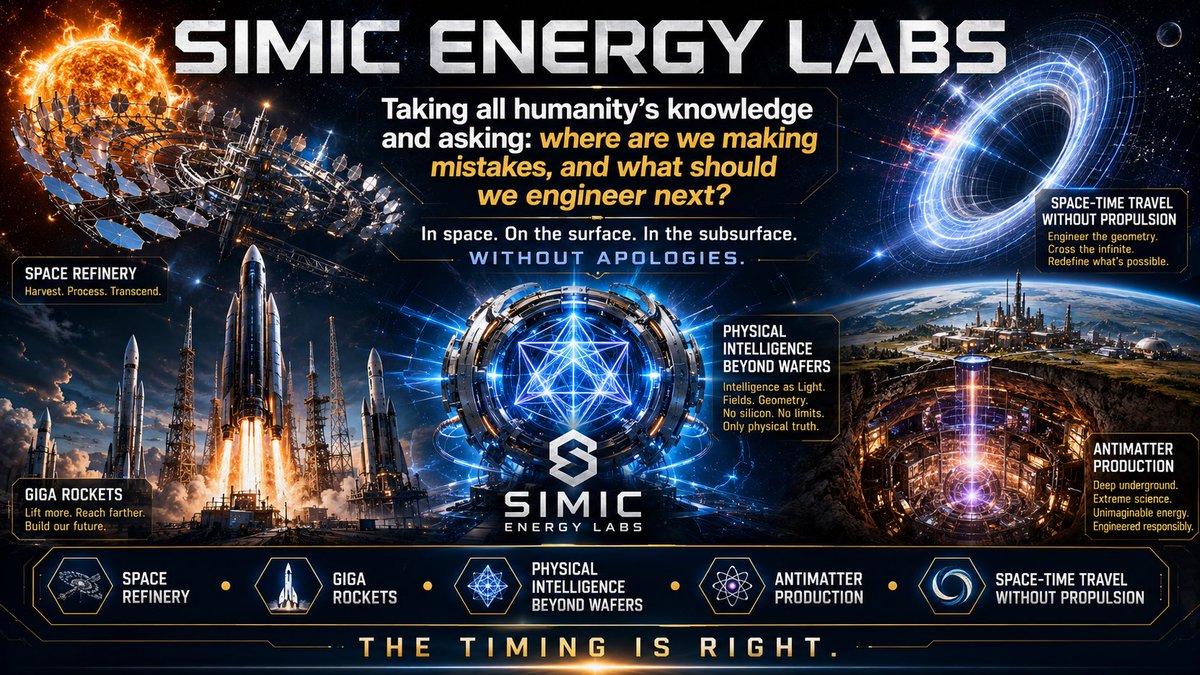
Humanity’s knowledge. All of it. We asked where we got it wrong — then built the answer. Space Refineries. Giga Rockets. Antimatter. Physical Intelligence without silicon. Space-time travel without propulsion. No one else is doing this. We didn’t come to iterate.
There will be an entire ecosystem built on basic AI models. This will result in exponential growth in intelligence. The most powerful LLM will be the one that can create a loop, but it will be quality over quantity.
Elon doesn’t come from elites. His dad abused him, while at school he was bullied. Elon doesn’t spend his money frivoulously. He invests his money to advance human society. You are arguing to redstribute his wealth, while he produced 4,000 millionaires yesterday.
What a horrible man this Elon is? I think if you were in charge we should’ve never let him in. You are as dumb as a rock. Value creation is foreign to you. We should ship you to Cuba and Venezuela. You would fit right in.
Elon Musk just became the world's first trillionaire.
The typical American household would have to work more than 11 MILLION years to make Elon Musk's level of wealth.
We need a wealth tax.