A 20-year nuclear power agreement can be announced in a day. Getting a retired plant ready to deliver that power takes years of inspections, repairs, testing, and regulatory work.
Constellation’s deal with Microsoft makes the scale clear. The company estimated roughly $1.6 billion to restart Three Mile Island Unit 1, now called the Crane Clean Energy Center. The agreement covers 20 years of power purchases. Constellation originally targeted 2028 for the restart and has since moved that target forward to 2027, subject to the remaining approvals and project work.
Palisades in Michigan is another example of what a restart involves, though it has a different customer base. Holtec secured a federal loan of up to $1.52 billion to help restore the 800-megawatt plant. Its announced long-term buyers are Wolverine Power Cooperative and Hoosier Energy.
Both projects started with plants that had been shut down for years. Bringing them back means establishing what condition the equipment is actually in, then repairing, refurbishing, or replacing what is needed.
At Palisades, that has included reactor vessel inspections, steam generator tube repairs, piping and weld inspections, and extensive work on the turbine-generator. Each of its two steam generators contains more than 8,000 tubes. Inspection findings have to be evaluated, repairs completed, and the equipment shown to be fit for operation. Holtec reported in July 2026 that the major refurbishment projects had been completed, with maintenance, testing, inspections, and operational readiness work still ahead.
Specialized equipment adds procurement work too. Finding a replacement part is only part of the job. The supplier, manufacturing process, documentation, and installation have to meet the requirements for that component.
The schedule also depends on the NRC. Returning a plant from decommissioning status to operation involves licensing actions, safety reviews, environmental review, and verification of emergency preparedness. Palisades received major licensing approvals in 2025, but those approvals were one step in a larger restart process. Engineering work and regulatory review have to come together before the plant can operate.
Buying a plant’s output through the grid and putting a data center next to the plant also raise different questions.
A campus behind the meter can still depend on the wider grid. If hundreds of megawatts of generation are committed to an adjacent data center, the grid operator needs to understand the resulting power flows, what happens when the reactor goes offline, and what transmission or backup service the campus needs.
That is why co-location has been contested in PJM. Utilities have argued that some arrangements could reduce supply available to other customers or leave those customers paying for services the data center still uses. Those are issues to evaluate for each configuration, rather than automatic consequences of every project. FERC’s December 2025 order directed PJM to establish clearer rules for co-located loads, including transmission service and cost allocation. A direct connection to the plant does not settle those questions.
The financial question lasts much longer than the restart.
A long-term purchase agreement gives the generator revenue it can plan around. The buyer has to make that commitment work across multiple generations of computing equipment. Assuming servers are replaced every three to four years, a 20-year agreement can span five or more hardware generations.
That can work if demand continues and the power remains useful. The risk is what happens when those assumptions change. Inference prices could fall, workloads could move, or more efficient hardware could change how much power a particular campus needs.
If the contract requires minimum purchases or payments, those obligations can remain even when the original workload becomes less profitable. The exposure depends on the actual terms: whether power can be resold, commitments transferred, volumes adjusted, or electricity used elsewhere.
Nuclear offers firm power with no carbon emissions during generation. For a developer or buyer making a decades-long commitment, the underwriting needs to explain who keeps paying through hardware replacements, tenant departures, and changes in demand. A strong compute margin today is not enough to answer that.
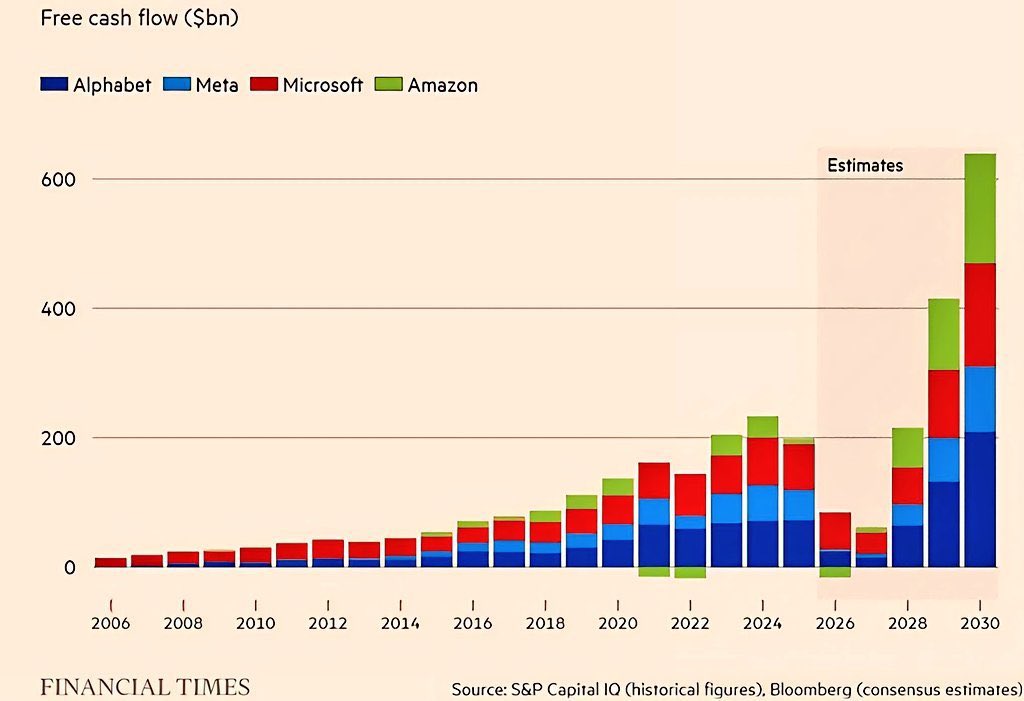
this chart is the whole ai trade in one picture.
left of the shaded box: 20 years of the biggest cash machines ever built.
inside it: 2026 and 2027, where the cash nearly disappears. amazon's free cash flow is already -$42B over the last 12 months. alphabet went negative two quarters in a row.
right of it: a tripling to ~$600B by 2030. that bar is an estimate. it's also what every one of these stocks is priced on.
so the question for the next three years isn't "is ai real." it's "does the money come back on schedule."
every dollar of capex gets to be genius or a mistake depending on which bar you believe.
how a lot of ai data centers actually get built:
$40M of gpus. $8M is the company's own money. $32M is a loan.
the loan gets paid back by one customer paying ~$15M a year for 5 years.
so nobody's really asking "is there ai demand" anymore. they're asking: will that customer still be paying in year 4, and what's a 4-year-old gpu worth if they're not?
that's the bet underneath this whole selloff.
would you make that loan?