Our analysts at Milk Road find underrated gems before the market catches on.
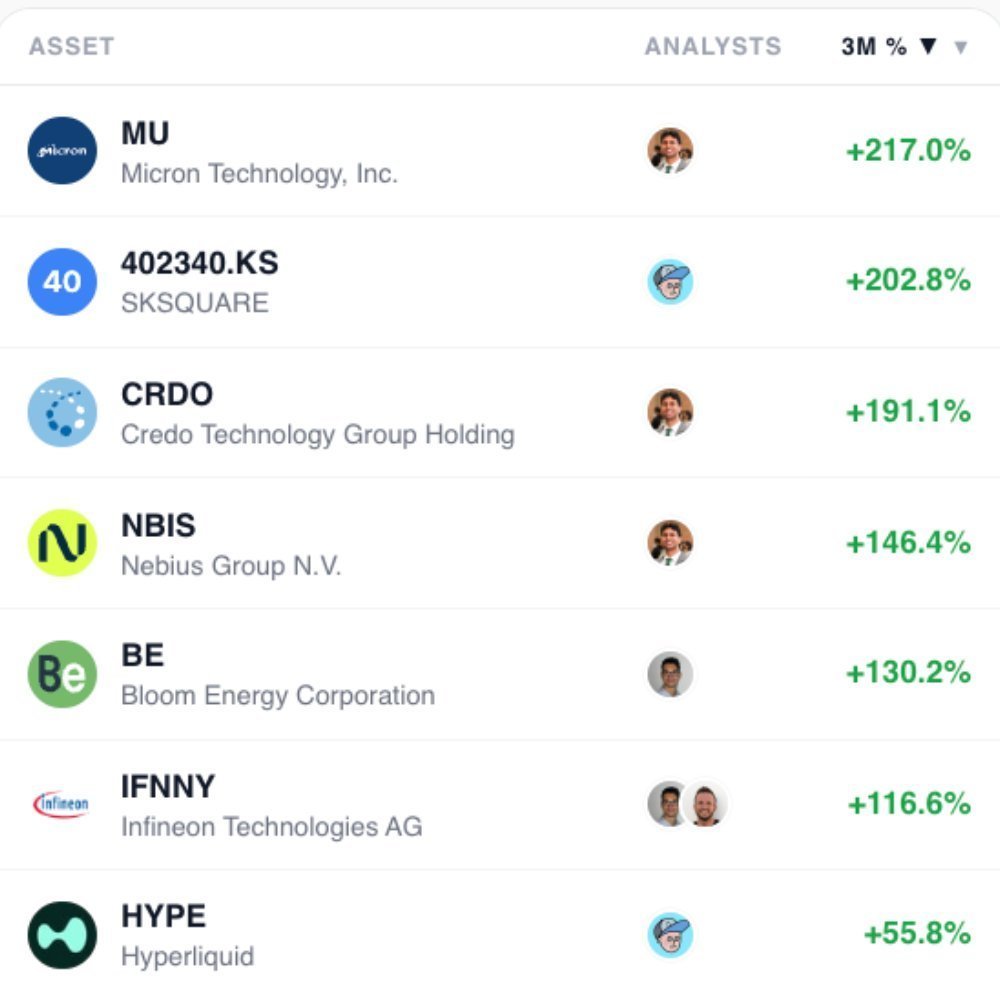
We called names like MU, CRDO, NBIS and BE over the last 3 months.
Join for $1 👇
$AMD just locked up power across five different data centers in one deal (Save this).
$CORZ and $AMD announced a partnership giving AMD access to more than 500 megawatts of AI ready data center capacity starting in 2027.
This is anchored by 15 year leases across five sites with the relationship able to scale up to 2.5 gigawatts over time.
AMD also holds a reservation right on up to 1,925 additional megawatts of capacity through December 2028.
That is effectively first right of refusal on Core Scientific's next wave of buildout, locked in years in advance.
There is real skin in the game behind the lease terms too.
Core Scientific issued AMD a warrant for up to 30 million shares at $23.47 tying AMD's upside directly to Core Scientific's stock on top of the lease relationship itself.
Core Scientific says its total leased customer power capacity across all its data center deals now sits around 1.1 gigawatts.
This translates into more than $24 billion of potential contracted revenue.
Core Scientific started as a bitcoin miner. It has spent the past couple of years converting that power infrastructure into AI colocation capacity. Shares jumped more than 10% premarket to around $22 on the news.
In this cycle, the constraint was never finding a GPU customer.
It is finding the power and the shovel ready sites to plug them into. That is exactly what Core Scientific just sold AMD a long term claim on.
$AMD is just one piece of the AI infrastructure puzzle.
Inside Milk Road PRO, our analysts are tracking the companies building the entire AI stack from GPUs to power providers to data centers.
Unlock our analyst portfolios and research for just $1.
Link in first comment below.
$AMD and $CORZ have signed an AI infrastructure agreement giving AMD access to more than 500 MW of U.S. data center capacity beginning in 2027.
AMD can expand the deal to 2.5 GW and will receive warrants to purchase Core Scientific shares.
$AMD just locked up power across five different data centers in one deal (Save this).
$CORZ and $AMD announced a partnership giving AMD access to more than 500 megawatts of AI ready data center capacity starting in 2027.
This is anchored by 15 year leases across five sites with the relationship able to scale up to 2.5 gigawatts over time.
AMD also holds a reservation right on up to 1,925 additional megawatts of capacity through December 2028.
That is effectively first right of refusal on Core Scientific's next wave of buildout, locked in years in advance.
There is real skin in the game behind the lease terms too.
Core Scientific issued AMD a warrant for up to 30 million shares at $23.47 tying AMD's upside directly to Core Scientific's stock on top of the lease relationship itself.
Core Scientific says its total leased customer power capacity across all its data center deals now sits around 1.1 gigawatts.
This translates into more than $24 billion of potential contracted revenue.
Core Scientific started as a bitcoin miner. It has spent the past couple of years converting that power infrastructure into AI colocation capacity. Shares jumped more than 10% premarket to around $22 on the news.
In this cycle, the constraint was never finding a GPU customer.
It is finding the power and the shovel ready sites to plug them into. That is exactly what Core Scientific just sold AMD a long term claim on.
$AMD is just one piece of the AI infrastructure puzzle.
Inside Milk Road PRO, our analysts are tracking the companies building the entire AI stack from GPUs to power providers to data centers.
Unlock our analyst portfolios and research for just $1.
Link in first comment below.
Why is $NBIS up 155% this year but $CRWV down 10%?
They both have the same product, same GPUS, similar customers so why the discrepancy?
A potential reason is that CoreWeave carries roughly $25 billion of debt.
They key difference in the favour of $NBIS is that it builds and owns the data centers those GPUs sit in, covering roughly 75% of its contracted capacity.
CoreWeave leases its data center space from landlords instead.
CoreWeave's cost of revenue has been climbing as a share of sales, largely rent and power flowing out to those landlords.
Own the building instead and that cut disappears which is why the long run margin ceiling is genuinely higher for Nebius even though it costs more upfront.
Another point in favour of $NBIS is their balance sheet.
Nebius holds $9.3 billion in cash against a few billion of mostly low interest convertible debt today and it just guided 2026 capex to $20 to 25 billion. By late 2027, Nebius's balance sheet could look a lot like CoreWeave's does today.
Our PRO analysts hold both $NBIS & $CRWV in their portfolios.
Try Milk Road PRO for $1 for 7 days to view their entire portfolios. (link in bio)
One of the most common objections for $BE:
Can their boxes actually match the scale a data center needs?
The answer is yes and it's simpler than you'd think.
"The boxes are modular. They can bring as much power to a certain site as you actually need. When you need more energy, they just bring more boxes."
The biggest bear case on $BE is scandium.
This a rare earth they need to produce their fuel cells and short sellers say there won't be enough by 2027.
But here's the counter:
Oracle, Morgan Stanley, and JP Morgan are all financing these deals.
"They're doing commercial due diligence before giving a lot of money away and they are aware of that risk."
If the scandium problem was fatal, those deals don't get done.
There is a new bear case on $BE but we disagree (Save this).
A recent Invest Like the Best episode argued the US natural gas market could tighten materially starting in 2028.
He framed that as bearish for Bloom Energy specifically.
Our read is different.
The real risk to $BE is that higher prices bring more production online and reduce marginal LNG exports well before physical scarcity actually hits.
The real risk is that gas becomes more expensive or harder to secure on a firm basis in the specific regions where Bloom wants to deploy.
Our analyst is not selling $BE for three reasons:
1. Efficiency.
Bloom's fuel cells run at roughly 54% lifetime electrical efficiency and use less gas per unit of power than most modular engines and simple cycle turbines. As gas gets more valuable, that efficiency edge is worth more, not less.
2. Fuel flexibility.
Bloom has longer term paths through renewable natural gas, hydrogen blends, and pure hydrogen. None of those realistically replace conventional gas at gigawatt scale in the near term.
3. Project selection.
Bloom can prioritize deployments in regions with strong existing gas infrastructure and customers who can lock in reliable fuel at competitive prices. That directly reduces exposure to the exact regional bottlenecks this thesis is worried about.
The stock has already had a rough stretch, down sharply over the past month. But we remain bullish on $BE.
Our analysts at Milk Road find underrated gems before the market catches on.
We called names like MU, CRDO, NBIS, and BE over the last 3 months.
Don't miss the next call, join us for $1 (link in first comment below).
There is a new bear case on $BE but we disagree (Save this).
A recent Invest Like the Best episode argued the US natural gas market could tighten materially starting in 2028.
He framed that as bearish for Bloom Energy specifically.
Our read is different.
The real risk to $BE is that higher prices bring more production online and reduce marginal LNG exports well before physical scarcity actually hits.
The real risk is that gas becomes more expensive or harder to secure on a firm basis in the specific regions where Bloom wants to deploy.
Our analyst is not selling $BE for three reasons:
1. Efficiency.
Bloom's fuel cells run at roughly 54% lifetime electrical efficiency and use less gas per unit of power than most modular engines and simple cycle turbines. As gas gets more valuable, that efficiency edge is worth more, not less.
2. Fuel flexibility.
Bloom has longer term paths through renewable natural gas, hydrogen blends, and pure hydrogen. None of those realistically replace conventional gas at gigawatt scale in the near term.
3. Project selection.
Bloom can prioritize deployments in regions with strong existing gas infrastructure and customers who can lock in reliable fuel at competitive prices. That directly reduces exposure to the exact regional bottlenecks this thesis is worried about.
The stock has already had a rough stretch, down sharply over the past month. But we remain bullish on $BE.
Our analysts at Milk Road find underrated gems before the market catches on.
We called names like MU, CRDO, NBIS, and BE over the last 3 months.
Don't miss the next call, join us for $1 (link in first comment below).
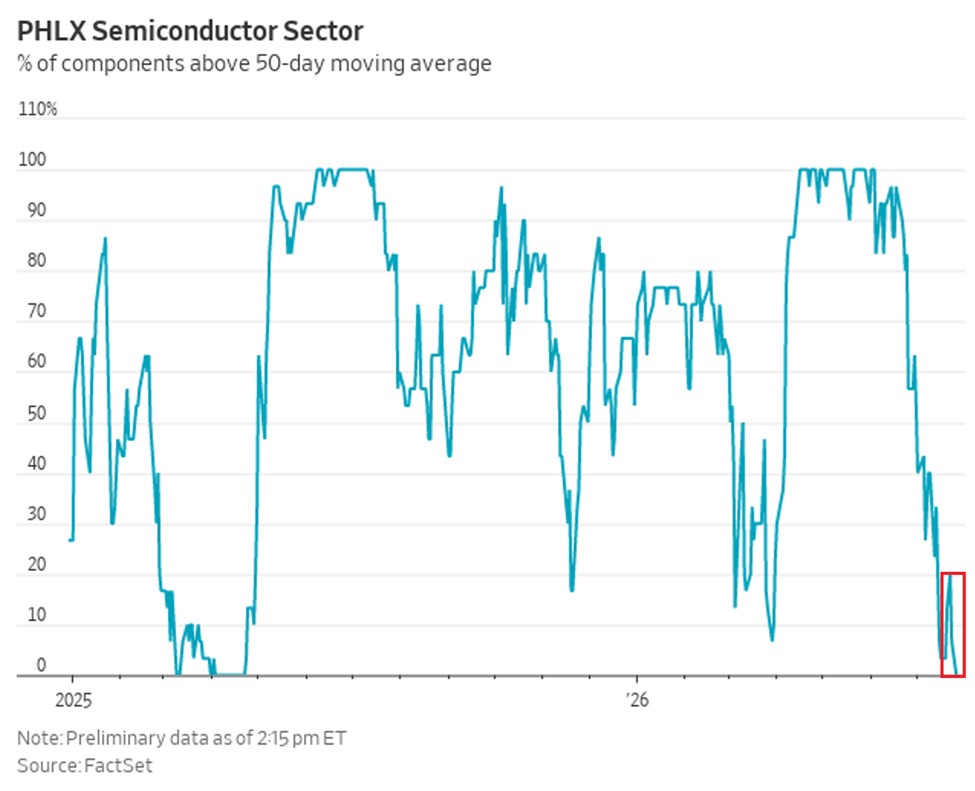
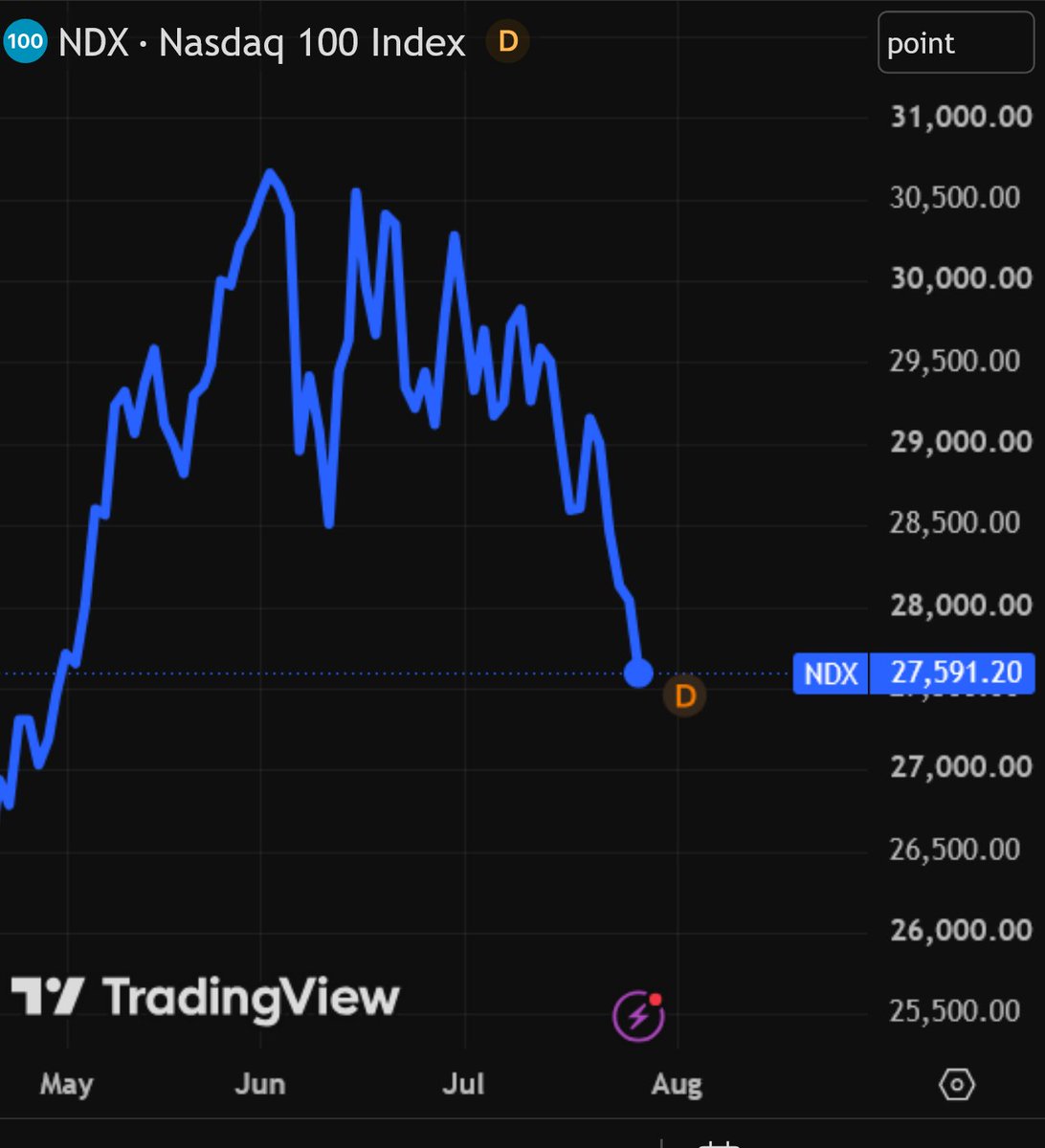
Look at this chart and tell me it's not the most obvious time to buy Semi's?
It's like the market forgot we are in the middle of the biggest technological revolution in history
And how much infinite intelligence is going to change the world and how much silicon is needed for it to happen
"Be greedy when others are fearful and fearful when others are greedy"
You've heard this line many times before as an investor, yet you struggle to buy assets when they are being sold off and showing deep in the red
It's ok, we all get this feeling. But the best investors are those who put the emotions aside and buy great assets that are getting sold off anyway
This is one of those moments where its time to buy, not let the fear get to you and run away from the market
Bookmark this post and then come back and thank me in December when the market is much much higher
ps. if you're not sure what to buy you can track mine and 4 other analysts real-time portfolios in Milk Road PRO (see link in bio to join). We were super early to the AI infra stocks and have been buying the dip / putting capital into the next big sectors too
Don't miss these live trade signals, it puts the bull market on easy mode for you
Hyperscaler capex just crossed $700B combined and it's not slowing down.
Morgan Stanley is now projecting for $1.23T in 2027 and $1.44T in 2028:
$GOOGL: $360B
$MSFT: $350B
$AMZN: $330B
$META: $250B
$SPCX: $110B
For context, these five companies spent a combined $30 to $40 billion a year back in 2018.
By 2024 that number had grown to roughly $261 billion. This year it's already past $700 billion, more than doubling in two years.
Inside that spending, networking, the wiring and switches connecting GPUs together, is already eating 15% to 18% of total cluster capital cost.
Break that down at the hardware level:
In a 200,000-GPU cluster today, optical transceivers alone consume roughly 17 megawatts with total networking power draw around 435 megawatts.
Milk Road PRO analysts are tracking the full networking and optical supply chain.
Come join Milk Road Pro for the full breakdown and the rest of our AI trades for just $1.
Link in bio.
We called Nebius, Credo, Bloom Energy, AAOI, and AMD before their big run ups.
Don’t miss the next one, come join us for just a $1.
https://t.co/JxtApjqPci
$MRVL might be the unnamed partner behind Google's next AI chip (Save this).
Nobody has confirmed it yet but the signs are there.
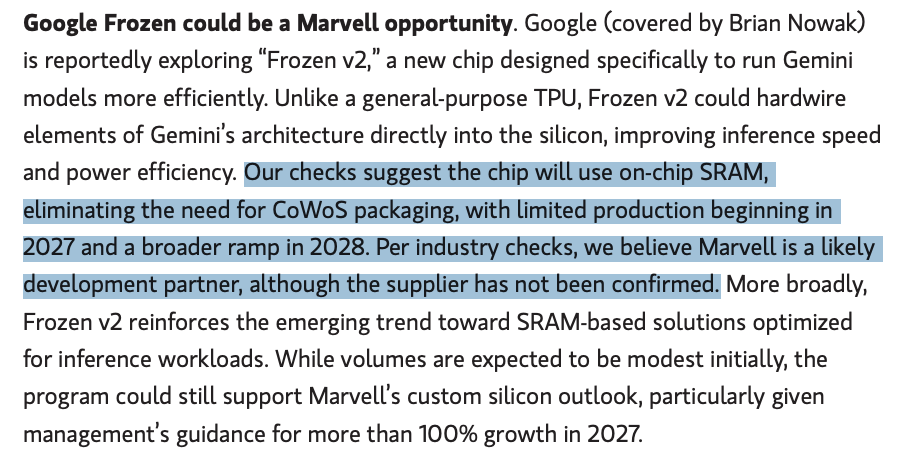
Morgan Stanley's Brian Nowak reports Google is developing a chip called Frozen v2, built specifically to run its Gemini models.
Here's where $MRVL comes in:
Per Morgan Stanley's industry checks, Marvell is believed to be a likely development partner on this chip.
The supplier has not been confirmed by either company.
Even unconfirmed, it fits a trend that is already showing up across the industry. There's a shift toward SRAM based, workload specific silicon built purely for inference instead of general purpose chips.
Marvell's own custom silicon business is already guided for more than 100% growth in 2027. So, even a modest initial program here would layer onto a base that is scaling fast regardless of this one deal.
Initial volumes on this specific chip are expected to be modest. This is not a business changing catalyst by itself.
Engineers on the project reportedly estimate the design could deliver 6 to 10 times the token output per watt compared to Google's current TPUs with limited production starting in 2027 and a broader ramp in 2028.
We remain bullish on $MRVL.
Marvell is just one of our highest-conviction AI infrastructure plays.
Inside Milk Road PRO, you'll get access to our exact portfolios, every buy and sell, detailed investment theses and weekly market updates.
If you want to invest alongside our team instead of chasing headlines, join Milk Road PRO today for just $1.
Link in first comment below.
$MRVL is where $MU was a year ago.
Jordi Visser thinks Marvell has a chance to be a Micron-type name over the course of the next two years.
To understand what that means, you have to understand what Micron was.
A year ago, Visser wrote a paper on inference demand and the amount of memory that AI chips would need relative to GPUs.
He flagged a handful of names, most of them are now up 4x-8x.
$MU was the clearest expression of that thesis.
When a generalist investor can identify the constraint and write a paper about it, it usually means there's still runway left.
When everyone knows, the trade is over.
Memory is now in that second phase. The DRAM ETF pulled in six billion dollars in a short window, one of the fastest ETF inflows in history. Retail is heavily involved so the near-term risk-reward has changed and Jordi has trimmed accordingly.
$MRVL is where memory was a year ago.
It only broke out two months ago.
The optical interconnect thesis is less crowded and harder for competitors to replicate.
Marvell is also directly tied to the Vera Rubin architecture that hasn't launched yet.
The comparison to Micron is about the stage of the trade.
Milk Road PRO has been in $MRVL since before the breakout.
Start your $1 trial and see the full setup.
Link in bio.
The market is NUKING, don't make this mistake (save this)
Semis, neoclouds and energy are down 25-40% since June
Meanwhile, we're literally building infinite intelligence, adoption is growing, and earnings are at records across almost every sector
Someone's wrong here, and it's not the fundamentals
What to do:
First, understand WHY the market is down, because it's not the businesses. This selloff is mostly FUD from China and open-source AI models, deleveraging in Korea force-selling the whole trade, profit taking after a massive run, and honestly just summer lulls ("sell in May and go away" strikes again)
None of that changes the fundamental picture. AI adoption keeps increasing, earnings are crushing almost everywhere, and inflation is surprising to the downside (my guess is the Fed doesn't cut tomorrow either, but let's see)
We're in one of those moments where the market's moves don't reflect reality
And don't forget what's actually being built here. We are in an incredible adoption moment with one of the greatest technologies of our lifetime
We're building infinite intelligence, and I don't think people realize how big that is for markets. Companies in the buildout, in the application layer, or simply using AI to improve their products will keep printing record earnings year after year for the foreseeable future
This is a structural bull market, and the world is still extremely early in learning how to deploy AI across every business and sector globally
So if you have cash: a lot of the bottleneck trade (semis, neoclouds, energy) is oversold and deeply red right now. And even the application layer names having big moves recently, like $NOW and $CRM, are still early, they sold off 50%+ in the last year before this bounce
Here's the part that matters most
If you found yourself buying tops back in May and now you're afraid to buy the same assets down 20-40%, you need to rethink your strategy. The REAL money is made buying when markets are red. The more pain and fear, the better the entry, especially during a technological revolution that's structural and not a fad
Personally, it sucks seeing my portfolio red, but it happens. You can't always pick the best assets at the best times. But you CAN be consistent about buying good assets when they sell off, and over time that wins
I have no idea when this selloff ends. But I know it WILL end, and the great companies our analysts hold will be much higher, and everyone who didn't buy down here will chase it much higher and be pissed they waited
Don't do that (again). This time, buy when others are fearful
You can see exactly what I'm buying on these dips in real time inside Milk Road PRO (see link in bio)
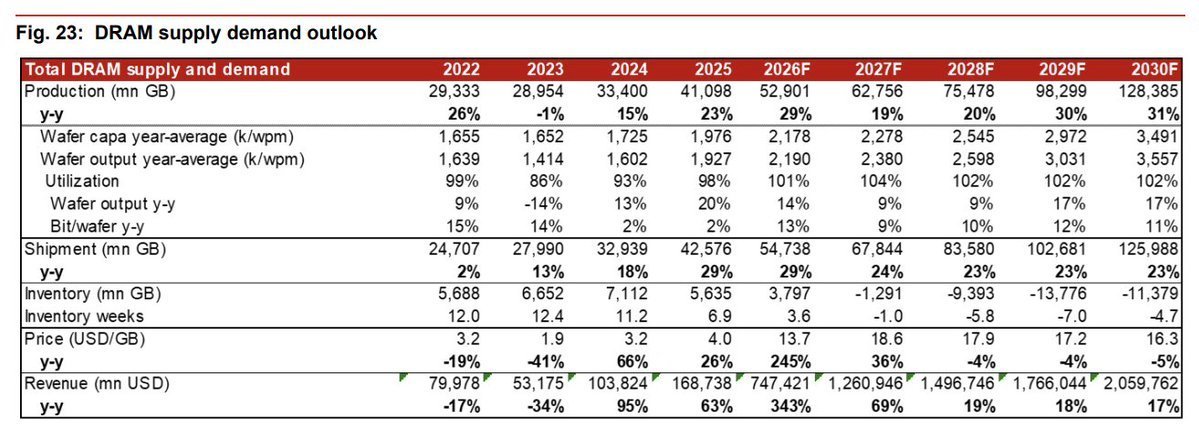
Nomura thinks the DRAM market is about to grow 25x by 2030 (Save this).
The latest DRAM forecast projects industry revenue exploding from around 80 billion dollars in 2022 to more than 2.06 trillion dollars by 2030.
This is good news for $MU & $SKHY.
Production rises from 29.3 billion GB in 2022 to 128.4 billion GB by 2030. Shipments climb from 24.7 billion GB to almost 126 billion GB over that same stretch. Utilization holds above 100% in the back half of the forecast, and inventory actually goes negative in absolute terms.
The price side is just as aggressive.
After DRAM crashed to 1.90 dollars per GB in 2023, Nomura sees prices at 13.70 dollars per GB in 2026, peaking near 18.60 dollars in 2027, then settling around 16 to 17 dollars through 2030.
Volume and price both staying elevated at the same time is what produces a revenue number this large.
Most mainstream long term forecasts still put the entire DRAM market under 300 to 400 billion dollars by 2030.
Nomura is saying it could run 5 to 7 times larger than that if AI infrastructure spending keeps going at the current pace. Treat this as the aggressive end of the range, not the consensus case.
This projection is aimed squarely at the big three: Samsung, SK Hynix and Micron.
If even part of it plays out, memory could become one of the largest profit pools in the entire semiconductor industry.
Our PRO team has already been positioned in this exact trade, buying Micron through the memory drawdown earlier this cycle and holding SK Hynix exposure through SK Square.
A forecast like this is the kind of setup that thesis was built around.
Our analysts at Milk Road find underrated gems before the market catches on.
We called names like MU, CRDO, NBIS, and BE over the last 3 months.
Don't miss the next call, join us for $1. (link in first comment below)
Our analysts at Milk Road PRO called multiple AI stocks before their massive runs.
Their recent winners were:
1. MU (217%)
2. SK Square (202%)
3. CRDO is up (191%)
Don’t miss the next call, come join us for just a $1: https://t.co/JxtApjqPci
Hyperscaler capex just crossed $700B combined and it's not slowing down.
Morgan Stanley is now projecting for $1.23T in 2027 and $1.44T in 2028:
$GOOGL: $360B
$MSFT: $350B
$AMZN: $330B
$META: $250B
$SPCX: $110B
For context, these five companies spent a combined $30 to $40 billion a year back in 2018.
By 2024 that number had grown to roughly $261 billion. This year it's already past $700 billion, more than doubling in two years.
Inside that spending, networking, the wiring and switches connecting GPUs together, is already eating 15% to 18% of total cluster capital cost.
Break that down at the hardware level:
In a 200,000-GPU cluster today, optical transceivers alone consume roughly 17 megawatts with total networking power draw around 435 megawatts.
Milk Road PRO analysts are tracking the full networking and optical supply chain.
Come join Milk Road Pro for the full breakdown and the rest of our AI trades for just $1.
Link in bio.
One of the most common objections for $BE:
Can their boxes actually match the scale a data center needs?
The answer is yes and it's simpler than you'd think.
"The boxes are modular. They can bring as much power to a certain site as you actually need. When you need more energy, they just bring more boxes."
There is a new bear case on $BE but we disagree (Save this).
A recent Invest Like the Best episode argued the US natural gas market could tighten materially starting in 2028.
He framed that as bearish for Bloom Energy specifically.
Our read is different.
The real risk to $BE is that higher prices bring more production online and reduce marginal LNG exports well before physical scarcity actually hits.
The real risk is that gas becomes more expensive or harder to secure on a firm basis in the specific regions where Bloom wants to deploy.
Our analyst is not selling $BE for three reasons:
1. Efficiency.
Bloom's fuel cells run at roughly 54% lifetime electrical efficiency and use less gas per unit of power than most modular engines and simple cycle turbines. As gas gets more valuable, that efficiency edge is worth more, not less.
2. Fuel flexibility.
Bloom has longer term paths through renewable natural gas, hydrogen blends, and pure hydrogen. None of those realistically replace conventional gas at gigawatt scale in the near term.
3. Project selection.
Bloom can prioritize deployments in regions with strong existing gas infrastructure and customers who can lock in reliable fuel at competitive prices. That directly reduces exposure to the exact regional bottlenecks this thesis is worried about.
The stock has already had a rough stretch, down sharply over the past month. But we remain bullish on $BE.
Our analysts at Milk Road find underrated gems before the market catches on.
We called names like MU, CRDO, NBIS, and BE over the last 3 months.
Don't miss the next call, join us for $1 (link in first comment below).
$MRVL is the biggest position in Jordi Visser's portfolio.
He believes that Marvell is going to significantly benefit from Nvidia's Vera Rubin platform.
Right now, Marvell has 18 active custom chip programs and a dozen of them sit inside the four biggest hyperscalers on the planet.
Management just guided fiscal 2027 revenue to $11.5 billion, up 40% year over year.
Revenue moves from $8.7 billion over the last twelve months to $16.7 billion by fiscal 2028 and $23.3 billion by fiscal 2029, nearly tripling in three years.
Jensen Huang thinks $MRVL will become a trillion dollar company in the next 3 years.
Valued at $225B today, that's 4x trade for everyone who gets in now.
Jensen has also invested $2 billion into Marvell in March.
When a hyperscaler hires Marvell to build its AI accelerator, Marvell also sells the switches, the optical interconnects, the memory fabric and the retimers that go around it.
One customer win turns into four or five revenue streams.
Our analysts remain bullish on $MRVL.
Jordi Visser's two biggest positions are $MRVL and $LLY. Our analysts hold both assets in their portfolios.
Start your $1 trial and see the full portfolio of each of our five analysts.
Link in first comment below.
The rotation into the AI Application Layer is here and it was driven by open-source models (save this)
Semis are down 24% since the June top, while $NOW, $CRM and Apple are UP 15% over the same stretch
The money is moving from AI infrastructure to the AI application layer
The trigger is the open-source wave. Kimi K3 and models like it keep shipping frontier-level capability for free, and token prices keep collapsing. The market's first reaction was to read that as "bad for the whole AI trade" and sell everything with a chip in it
That's the wrong idea and you have to think about AI in three layers, because cheap open models hit each one completely differently
1. The MODEL layer is the only one that actually gets hurt. When a free model is 80-95% as good, the closed labs lose pricing power on everyday work. But the model layer doesn't die, it keeps growing, all models grow from here because total token demand is exploding. The frontier labs just keep the hardest, highest-value work instead of all of it
2. The BOTTLENECK layer (chips, memory, power) actually WINS. A free model still needs ~1.4TB of memory and a rack of GPUs to run, and open weights mean thousands of companies now stand up their own inference clusters instead of renting one API. That's a demand multiplier, which is exactly why the semi selloff makes no sense. That part is flows and fear, not fundamentals
3. And the APPLICATION layer is the winner. Cheaper tokens means it's cheaper to build better products, which means wider adoption, which means net-new use cases that simply weren't economic when tokens cost 10x more. Falling input costs are pure margin and pure reach for whoever builds on top of the models
The big unlock here is agents. Always-on AI workers burn 10-100x the tokens of a chat question, so they only work when tokens get cheap. Cheap tokens turn agents from demos into deployable products, and that's where the next leg of value goes
Which tells you who wins:
$NOW and $CRM become the coordination layer, the platforms that deploy, govern and route agents through the workflows they already own. The receipts started printing this week: a $1.6B government agent deal for Salesforce, ServiceNow AI crossing $1B in contracts
$AAPL likely becomes the aggregator, the device 2 billion people end up using agents through. It doesn't need to win the model war or spend on Capex, it just generate a new revenue stream from taxing agent txns or token spend
And it's bigger than software of course. Look at what else held up through the selloff: Eli Lilly sits near its all-time high, because pharma is an AI application layer too
I own both ends of the barbell: my portoflio consists of both the bottleneck assets and the application layer assets. It provides some diversification, yet at the same time will both go up in the long run
Follow me @kylereidhead for more AI and markets insights and track my real-time portfolio inside Milk Road PRO for $1 (link in bio)
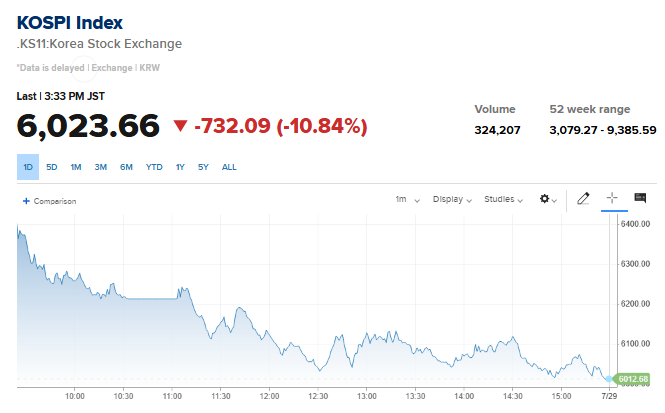
Why does the Korean stock market continue to sell off and hurt US stocks?
The KOSPI is down 36% in a MONTH (10% last night) from its ATH, and it keeps dragging our semis down with it
Here's what's actually happening (and why it's a flows problem, not a demand problem)
First, Korea ran the most leveraged AI rally on earth. Retail investors borrowed a record 60+ trillion won in margin loans to chase the boom, retail was ~35% of all market activity at roughly 3x leverage, and 2x leveraged ETFs were selling out the day they listed
Second, all that leverage was concentrated in basically two stocks. Over a third of the entire market's margin debt was sitting in Samsung and SK Hynix, the national champions of the AI memory trade. Everyone borrowed to buy the same thing
Third, the unwind got forced. The Bank of Korea hiked rates for the first time in 3 years and regulators jacked up margin requirements at the same time. Prices dipped, margin calls hit, forced selling pushed prices lower, which triggered more margin calls. Over 1.2 MILLION accounts got margin called and ~350K were forcibly liquidated. SK Hynix fell 15% in a single day, its worst ever
So why does that hit US stocks? Because it's the same trade. SK Hynix and Samsung are two of the three companies on earth that make HBM (Micron is the third), so when Korea force-sells its memory leaders, the entire global AI complex reprices with them. And forced sellers don't sell what they want, they sell what they can, which includes their US holdings like NVIDIA and Micron
But here's the thing, this is a financing event, not a fab event
Nobody's order book changed. HBM is still sold out through 2027. Samsung and Hynix's chips are still spoken for, and a stock market crash in Seoul doesn't produce a single extra wafer of supply or remove a single dollar of hyperscaler demand. If anything, stressed Korean suppliers get MORE disciplined on capacity, which keeps memory pricing tight for longer
This is also ontop of some of the China fears from yesterday around increased supply of chips (see thread below on those details)
Meanwhile Meta, Microsoft and Amazon all report this week and are all expected to RAISE capex again, right as the market is force-selling the companies that supply them
I think these dips are meant for buying because forced sellers are the best people to buy from, they aren't selling because anything broke, they're selling because they have to
Follow me @kylereidead for more insights on AI and markets. You can also track exactly what I've been buying in real time inside Milk Road PRO (see link in bio)
Thanks for reading!