A substantial part of my work as the Last Hope is to speak for other Advocates. Applications for stay/injunction pending appeal should be heard expeditiously otherwise the appeal might not only be rendered nugatory but academic. The lamentations of Akanga Solomon exemplify the concern.
I agree with you. Though this may be a mirage in a country that allows individuals to kill local production and economic growth. An example is the sugar industry. Cartels import sugar while local cane gets wasted leaving our farmers to languish in poverty. This affects price too
We’re still economic slaves first to the West, now to the East. Driving 8year-old ex‑Japan and clinging to mitumba because punitive taxes killed RIVATEX, KICOMI and our own industries. Time for a U‑turn: Kenya First. We must now Cut taxes on NEW locally assembled vehicles, revive our textile mills, and phase out used imports so Kenya stops being a dumping ground and becomes a nation of producers, not dump sites.
Under Article 25 of the Constitution of Kenya (2010), there are four rights the State can NEVER suspend, limit, or justify violating; not even during a State of Emergency. These rights are absolute. No claim of public interest, national security, or executive convenience can override them:
1️⃣ Freedom from torture and cruel, inhuman, or degrading treatment or punishment
2️⃣ Freedom from slavery or servitude
3️⃣ The right to a fair trial
4️⃣ The right to an order of habeas corpus
The Constitution is not a suggestion. It is the supreme law of the Republic and the final restraint on abuse of power.
These rights are not privileges granted by the State, they are inherent, inalienable, and form the bedrock of our human dignity and constitutional democracy.
If we allow even one of these non-derogable rights to be breached, we do not merely lose a protection, we surrender the Republic itself.
Eternal vigilance is the price of freedom. ⚖️🇰🇪
#ReKe #Article25 #CoK2010
#KnowYourConstitution
Willis Evans Otieno, Auditor-General Nyanza Province. Those diminutive, effeminate, mandevu wash-wash, body builders who cannot develop their Constituencies have nowhere to hide as their asses are blown open by the wind.
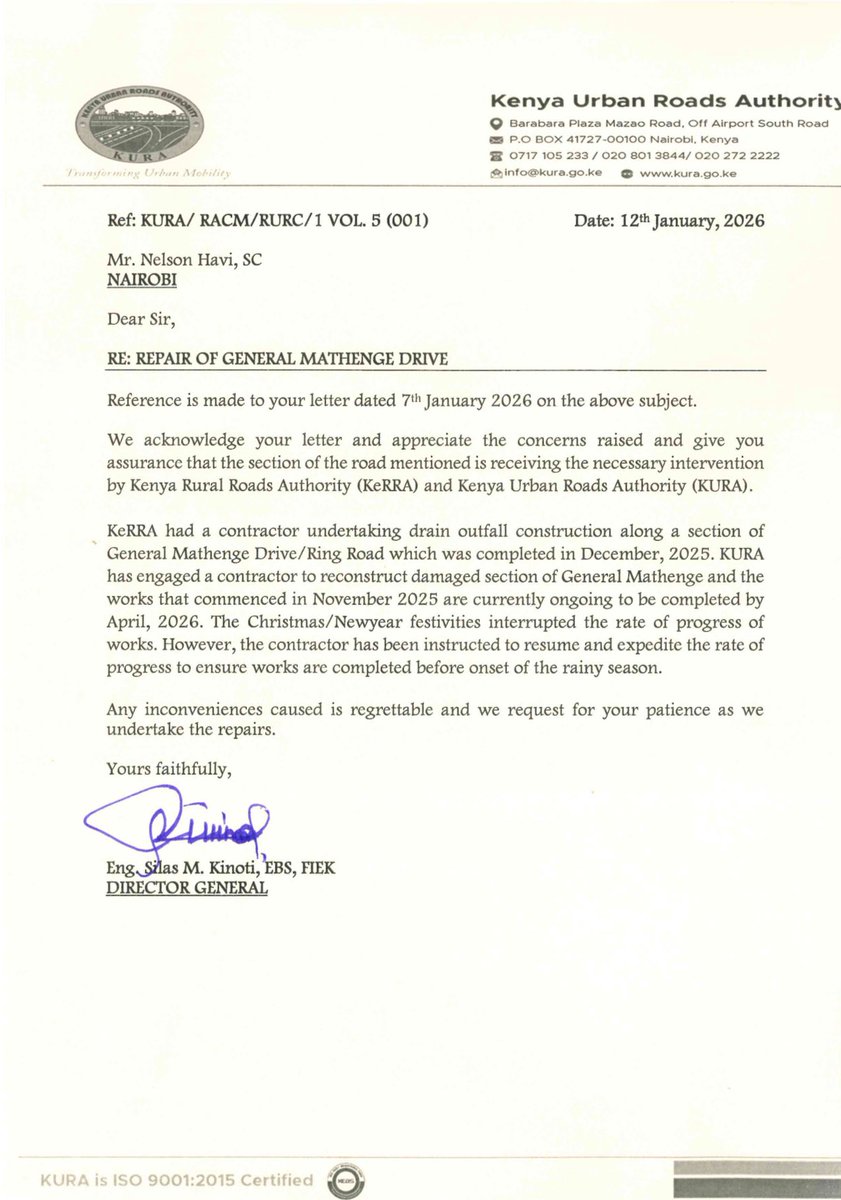
The Director General of @KURAroads, @MuriraKinoti has confirmed that the repair of General Mathenge Drive will be completed by April, 2026. Thank you so much. I will continue engaging the Government and its agencies in a collaborative approach to resolve the problem of infrastructure in Westlands Constituency.
@Dr_OOwiso@CecilYongo Thanks. I only needed to be clear on that. This country has quite a number of "professionals" practicing all manner of things, including law. I know of others who disparage KSL coz they fear going there or have failed severally. I can now take your solid advice gladly.
Dear Colleagues,
Dr. Magare Gikenyi, Laban Omusundi, and Okiya Omtatah have made significant contributions to entrenching the rule of law and promoting constitutionalism in Kenya through the public interest cases they handle. They often collaborate with the Law Society of Kenya (LSK) in these efforts. However, there is a concerning aspect to their 'practice.' They sometimes operate under the guise of public interest litigation (PIL), effectively using their prominence to address specific public issues for certain 'litigants' who instruct them to file cases.
The issue of preventing law firms from representing public entities has been on their radar for some time, influenced by powerful forces. While there are legitimate concerns regarding unsustainable legal fees, it is important to recognize that not all law firms should be condemned. Many do not charge exorbitant fees, and in cases where fees seem high, the fees are justified and are often subject to scrutiny and review by Deputy Registrars, the High Court, and sometimes the Court of Appeal.
Moreover, it is noteworthy that many law firms that represented the Independent Electoral and Boundaries Commission (IEBC) in the 2017 and 2022 general elections have not received payment. The IEBC frequently caps legal fees to minimal amounts, which remain unpaid. Handling a Presidential election petition is one of the most demanding assignments for any lawyer, yet those who acted in the 2022 Presidential election petition have not been paid. The Nakuru Court order prevents payment of their fees
In countries like the US, UK, and South Africa, legal fees are substantial, and lawyers charge accordingly. The petitioners who sought to prevent public entities from hiring law firms in Nakuru failed to do so in a Petition that they presented in Parliament, as it would breach the Constitution. Their attempts to file a case in Nairobi were unsuccessful, leading them to seek orders in Nakuru.
We must remain vigilant to protect our practice. If we do not, our profession may face significant challenges. We will perish. When elected LSK President I will do what it takes to protect our practice. We must be vigilant and address all .existential risks to our practice. I will not be afraid to take the lead on your behalf.
Peter Wanyama,
Candidate LSK President 2026
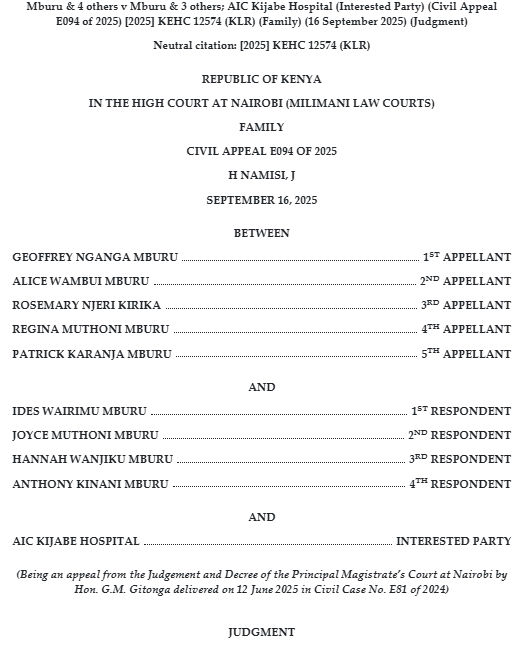
🚨 BREAKING: WHERE YOU LIVED, WHO YOU LOVED, AND THE LIFE YOU BUILT MATTERS MORE IN BUARIAL THAN TRIBE – HIGH COURT RULES 🚨
This judgment is for every Kenyan family that has ever torn itself apart over a grave. In Mburu & 4 Others v Mburu & 3 Others, the High Court was asked a painful question many families dread: Where should a man be buried when his life no longer fits neatly into ancestral custom? Mburu Kinani had lived in Gilgil for over 40 years. He built a home there, raised a family there, buried his second wife there, and spent his final years there. Yet after his death, one side of the family insisted he must be buried in Gatanga, Murang’a, because that is where his ancestors and first wife were laid to rest. The other side said no. This was his home. This was his life. The magistrate’s court sided with ancestry and ordered burial in Gatanga. The Gilgil family appealed.
The High Court asked a deeper question: What does justice look like in modern Kenya? Justice Namisi said burial disputes are not won by shouting custom louder than reality. The court examined the evidence carefully and found that the alleged burial wishes were not clearly proven. But that was not the end. Where wishes are unclear, the court said, the law looks at proximity. Not just blood. Not just tribe. Legal proximity. Emotional proximity. Physical proximity. The judge noted that Mburu Kinani had chosen Gilgil as his home for decades, entered into a Christian statutory marriage there, buried his wife there, and deliberately walked away from his ancestral home due to a broken relationship with his first family. Letters written years before his death showed that separation clearly. The court refused to pretend that a life lived for 40 years can be erased by custom alone. Custom, the judge said, must bend where it offends dignity, fairness, and constitutional values.
This decision quietly but firmly moves Kenyan law forward. It tells families that burial disputes are not about winning power over the dead. They are about respecting the life the deceased actually lived. It tells Kenyans that ancestral land is important, but it is not a prison. People are allowed to choose where they belong. And most importantly, it tells courts and families alike that dignity does not end at death. The High Court ordered that Mburu Kinani be buried in Gilgil, next to the wife he lived with and loved, while allowing both families to participate. This ruling will unsettle many long-held assumptions, because it finally says this out loud: your life choices matter, even in death.
#kkseason3loading First World Roads #DigitalAccessForAll first world stadium Maasai Nairobi ksh 3,000 The Government ksh 173.2 Xabi Alonso
THIS YEAR we are going to be a serious pain to greedy developers, phony professionals, unscrupulous contractors, and corrupt regulatory agency officers in the construction sector. We shall contribute to their grief and shed no tear.
We want a better construction and real estate sector for our country.
@CLE_Kenya Kindly respond to enquiries channelled to you via email in the interest of fair administrative action please. It's almost a week since I made enquiries but I haven't received response as at the time of this post.
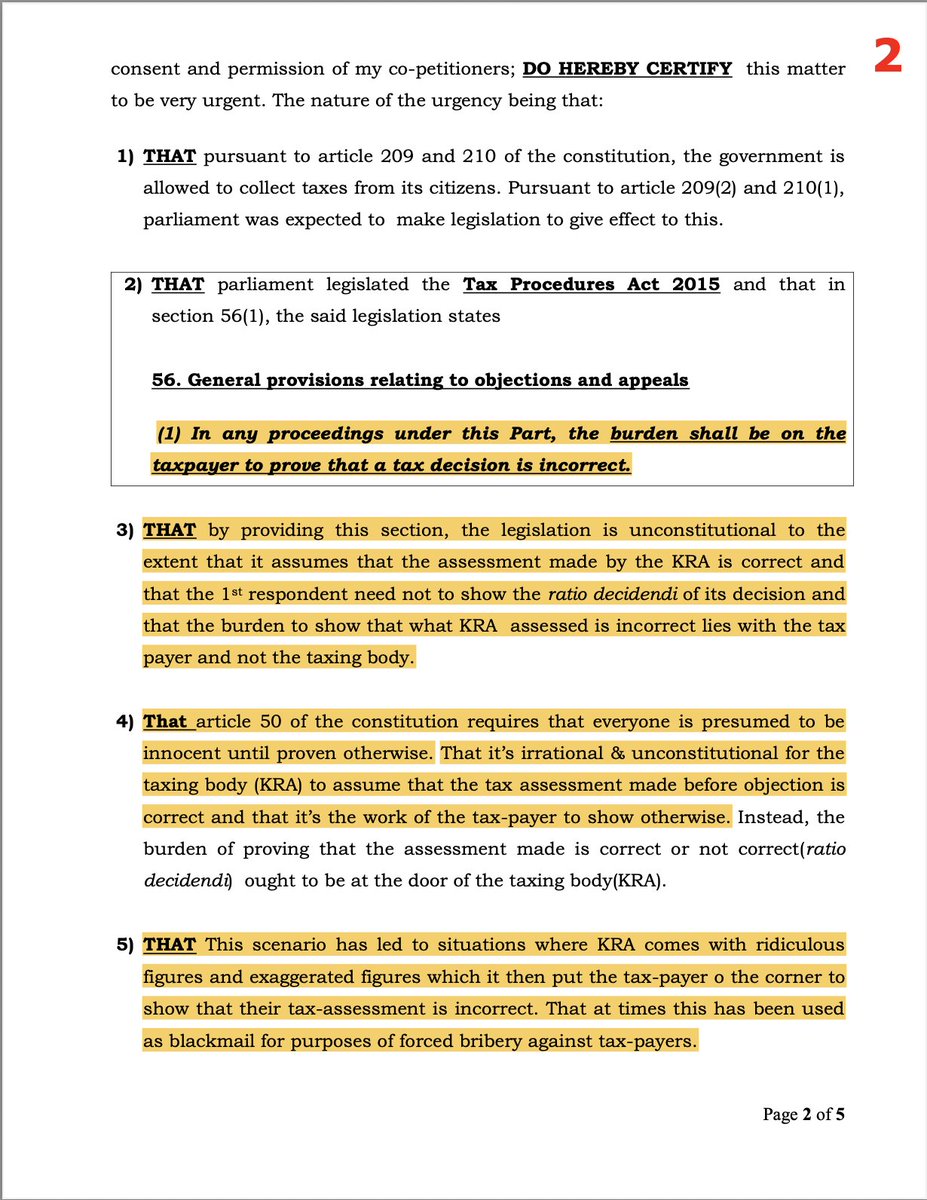
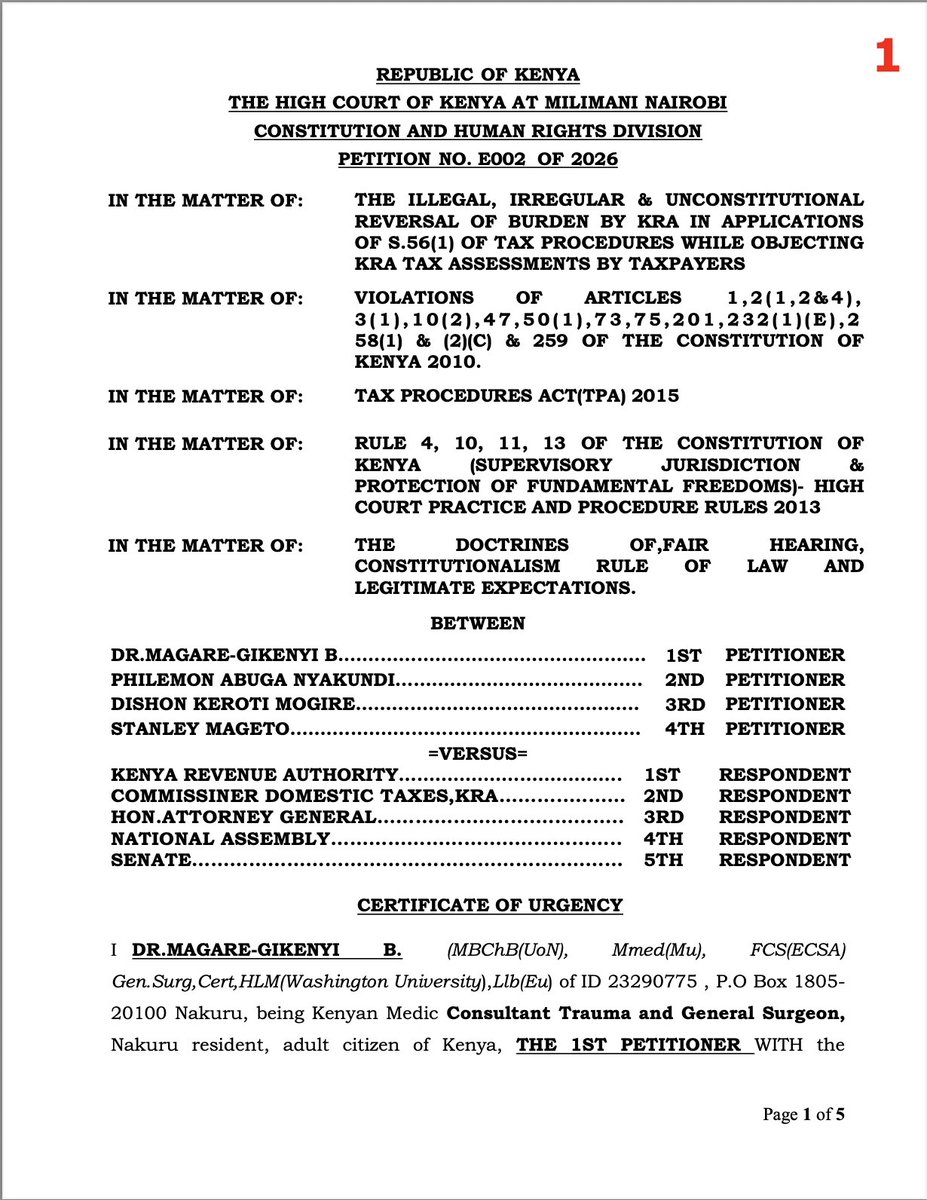
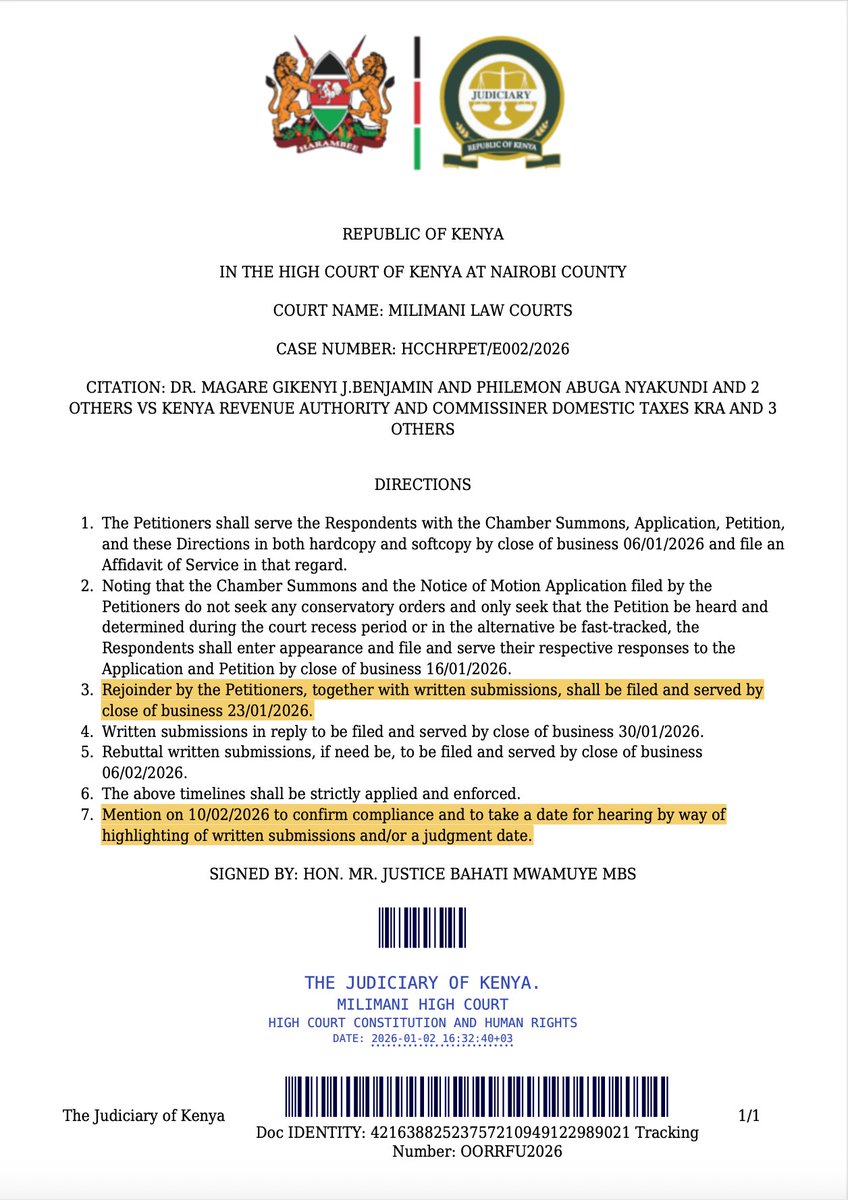
There's a very interesting petition before the High Court.
Dr. Magare Gikenyi is challenging Sec56(1) of the Tax Procedures Act & the fact that by law, the burden of proof is placed on the taxpayer.
In essence, Dr. Gikenyi is challenging the fact that KRA assessments are presumed correct unless the taxpayer provides contrary evidence.
Dr. Gikenyi is arguing that this provision is unconstitutional to the degree that Article 50 of the constitution requires that everyone is presumed to be
innocent until proven otherwise & in effect, it deems the taxpayer guilty until the prove otherwise.
Dr. Gikenyi is arguing that this provision has created window for KRA to come up with "ridiculous
figures and exaggerated figures" which create enormous burden on the taxpayer to counter.
Musings:
· I am keenly waiting to read KRA's responses on this petition. The National Assembly's will be equally interesting. The traditional "presumption of correctness" hinged on the view that the taxpayer is the final repository of all information regarding their compliance is being challenged
· Jurisdictions such as Austria & France are often considered to provide the gold standard when it comes to saddling the Authority with the burden of proof
· Could a split burden of proof regime be the way to go. There will be key lessons here from the likes of Finland & Sweden
· Finally, may Justice David Majanja continue resting in peace. This one would have been fun if it went before him
There is a level of charlatanry and audacity that social media gives many wannabes, ignoramuses and never-do-well know-it-alls. The arrogance of a carpenter to publicly chide an engineer. The nerve of a paralegal (or someone with no legal training) to publicly rebuke a senior counsel. The audacity to express a strong professional opinion or criticism on a matter that requires professional expertise despite not being a member of the relevant profession. The nerve of a toddler in purporting to teach a venerated and decorated elder the ways of life. The audacity of someone who has never vied for a village cattle dip post to insult a seasoned politician. The type of audacity that encourages a riffraff or plebian to insult or berate nobles and highly accomplished men and women. The audacity of a grade school dropout to belittle a professor. The audacity of a boy scout in purporting to correct the strategies of a military general.
I could go on and on. The point is, let us know our place, and be humble.
~Muthomi Thiankolu, SC