Every thought-seed sown or allowed to fall into mind, and to take root there, produces its own, blossoming sooner or later into act, and bearing its own fruitage (fruits) of opportunity and circumstance. Good thought bear good fruit; bad thoughts bad fruit - As a Man Thinketh
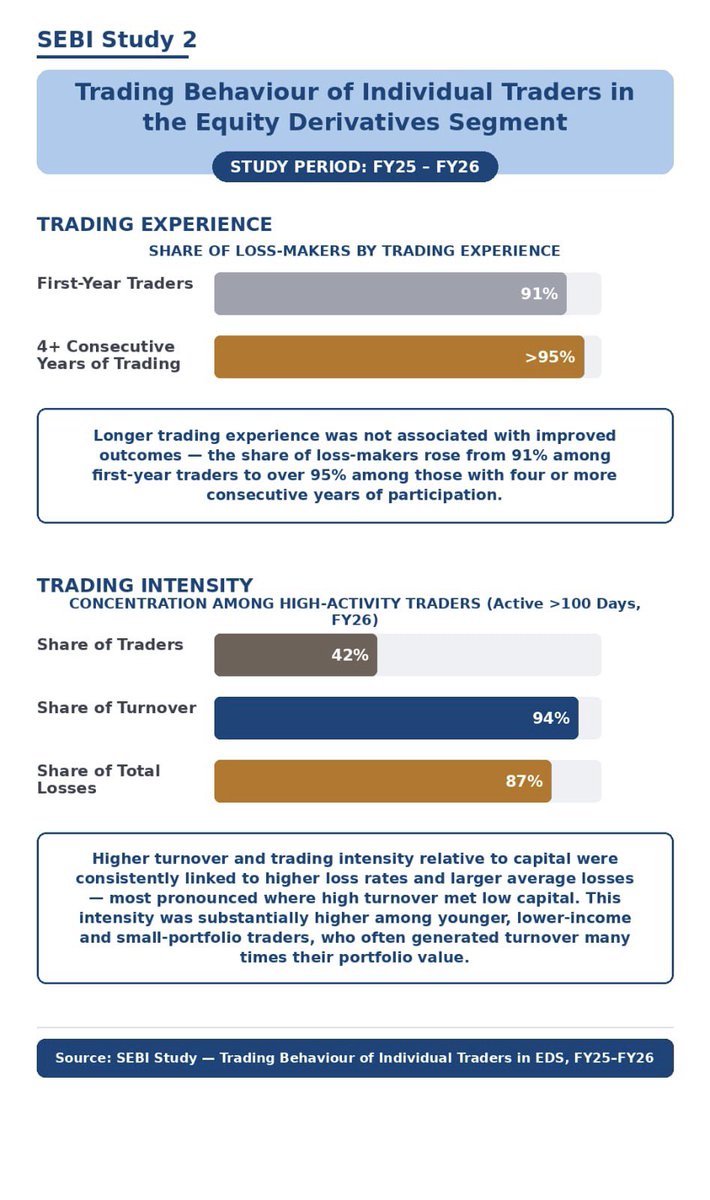
SEBI has released a study on “Trading Behaviour of Individual Traders in the Equity Derivatives Segment (FY25–FY26)”.
The study examines trading strategies, trading intensity, capital employed, trading experience, persistence and other behavioural patterns among individual traders.
Key findings include:
∙97% of individual traders predominantly followed options-buying strategies.
∙Higher trading intensity was associated with higher loss rates.
∙Around 90% of traders who incurred losses in the previous two consecutive years and continued trading incurred losses again.
∙Trading experience did not necessarily translate into better trading outcomes.
The study provides insights into the behavioural characteristics associated with trading outcomes in the equity derivatives segment.
More details on SEBI website at: https://t.co/QMNstXuA9q
#SEBI #EquityDerivatives #InvestorProtection #InvestorBehaviour #FuturesAndOptions
#FNO
(1/2)
【No Chart Ever Appears Twice. That Is Exactly Why You Can Repeat The Same Trade】
"No chart ever appears twice.
So repeating the same trade is impossible."
You have heard this claim somewhere, and you almost nodded along once.
But think back.
This morning, you said "good morning."
The weather was different from yesterday, the time was different, your mood was different.
It was a unique morning that will never come again in your life.
And still, you greeted the day the same way you did yesterday.
The same morning never comes twice, yet the same greeting can be repeated.
The people who make this claim are focusing on the wrong place.
■ What You Are Betting On Is Not The "Shape" Of The Chart
First, let me make clear what this claim misunderstands.
Trading is not predicting the future of the market and calling it correctly.
It is not searching for a chart identical to the past and recreating the same scene.
What you are betting on is not the surface shape of the chart.
It is the reason behind it, the reason that created that shape.
Let me give one example, purely as an illustration.
A double bottom that puts in two lows at a specific support line.
What you are trading looks like the shape itself, but it is not.
The fact that the market refused twice to trade below that line.
The stop loss orders of those who sold expecting a breakdown, and the new buy orders of those who confirmed the line did not break.
The reason an imbalance of orders is born in that moment, where buying overwhelms selling.
You keep betting on this "reason" with the same rules.
Each individual double bottom has a strictly different shape.
But the reason your rules are capturing is the same.
To be clear, this is only an example for the sake of explanation.
Which support line carries meaning, and how you identify it, depends on each trader's own definitions.
Not every double bottom carries the same reason.
■ Inside A Stream That Never Repeats, Your Sample Builds Up
Why can you repeat it if you bet on the reason?
If you keep following the same rules, scenes carrying the same reason appear again and again inside a stream of charts that never repeats itself.
Each trade on those scenes accumulates as the record of a single set of rules.
This becomes a large sample size, the law of large numbers begins to work, and only then does an edge appear as a statistical property.
Think about history.
No two days are ever the same, yet people say history repeats itself.
What repeats is not the dates or the characters.
It is the structure.
Charts are the same.
The surface is different every time.
But the structures created by human orders appear again and again.
And here is the important part.
Precisely because no chart ever appears twice, you use probability instead of prediction.
Since every moment is unique, nobody knows how the next single trade will turn out.
And because nobody knows, you stop demanding meaning from a single result and wait for the advantage built into that reason to appear inside a large sample size.
Uniqueness is not proof that trading is impossible.
It is the very reason you use probability.
■ "But The Details Are Different Every Time"
This is what you will probably think.
"But the details really are different every time.
The position of the highs, the angle, all different from last time.
Is it not sloppy to treat them as the same scene?"
The fact that details differ every time is something your rules have accounted for from the start.
Do the conditions your rules define get met, or not.
That is the entire judgment.
The differences in details outside your conditions are processed as variance inside the sample.
Because at the testing stage, you confirmed the expectancy of the whole, with those differences included.
Only someone who misunderstands the object of the bet as the "shape" demands identical details.
If you are betting on shapes, then yes, the same trade can never be done twice.
If you are betting on reasons, the differences in details were never a problem to begin with.
■ "The Same Chart Never Comes" Is Correct
Finally, let me make this clear.
The claim itself, that the same chart never comes twice, is correct.
What is wrong is the part that connects it to "so the same trade is impossible."
The true meaning of these words is not proof that trading is impossible.
It is an instruction.
Bet on the reason, not the surface.
Why do you trade that chart?
Why does an edge exist there?
If your rules are capturing that reason, the answer becomes this.
Inside an endless stream of market moments that will never return, you can repeat the same trade again today.
📚 Content for serious traders
https://t.co/ZxU7qo6RTO
Thank you for reading.
When I first started trading I was completely lost
I soon realized that the best traders in the world all focus on 1 thing:
Tight price action or the VCP (Volatility contraction pattern)
When I discovered this concept everything changed..
I stopped chasing random moves.
I started searching for tightness.
Price is like a spring:
-It compresses
-Volume decreases
-Higher lows are made
This builds energy for the next move up
the tighter the coil, the bigger the potential release, and our job as traders is to recognize that energy building.
Then position yourself when the spring explodes.
Train you eyes to search for this tightness and it will change the way you trade
If you want to make money from all kind of market try to focus on small velocity cycles.
3 to 5 day cycle has potential to make tons of money for you and you can find them all the year.
I see traders all the time put > focus on lower TF precision while completely ignoring higher TF positioning.
They obsess over entries down to the penny...but fail to ask whether the stock is even sitting in a favorable higher TF structure to begin with.
In my experience, a mediocre daily setup inside a powerful weekly structure often outperforms a “perfect” daily setup sitting inside weak higher-timeframe conditions.
The weekly = the real institutional battle.
The daily = helps refine execution around larger ideas.
This is why I always start top-down:
- Weekly/monthly first.
- Daily second.
- Execution timeframe last.
That framework has helped me simplify trading so I don't end up micromanaging every candle on the lower timeframes.
This is what's worked for me!
The majority of the people I see are addicted to education and not execution.
I spent years reading every book, watching every YouTube video, and following every market guru's advice.
but the moment I stopped overconsuming and actually started executing consistently, everything changed.
In both trading and business, execution is the real differentiator.
In trading, this means putting yourself in positions where your rules and edge are in play, even if it’s uncomfortable.
It’s about taking the setups you’ve studied hundreds of times, sticking to your risk, and actually pressing the button when your system says “go.”
I’ve blown many trades in the past because I hesitated or overanalyzed, and I’ve seen firsthand that all the education in the world won’t make up for a lack of execution.
The same applies to business.
I’ve launched multiple ventures, some of which made six figures, others that burned capital and taught me brutal lessons.
All the knowledge in the world didn’t help me until I executed... until I actually put my work into the real world. Execution forces feedback, and feedback is where growth happens!!
and something I constantly remind myself is that learning without action is a trap that keeps you comfortable...
whether it’s trading or entrepreneurship, success is built on doing, failing, adjusting, and doing again.
I'd encourage you to dive deep into your own process, recognize your tendencies, and commit to disciplined execution.
Knowledge alone is useless if it never translates into "real world" action!
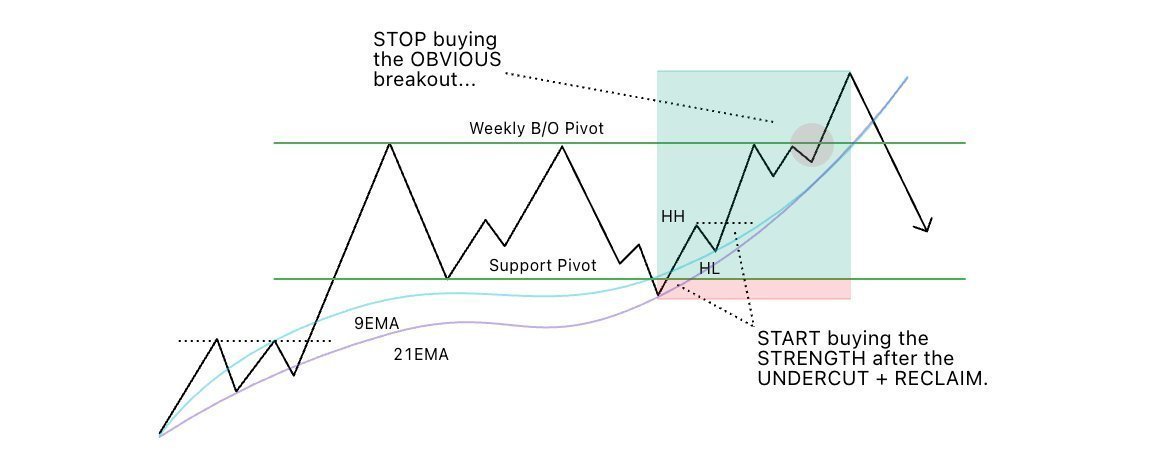
These 2 graphics have stood the test of time for a reason.
This is how real trends develop + where the best r/r is if you’re patient enough to wait for it.
Train your eyes to recognize this structure, and I promise you’ll look back wondering how you ever traded without it.
Improvement does not mean changing your rules.
It means becoming the kind of person who can follow them.
Once you are able to think this way, you will understand that consistency exists only beyond your edge.
Consistency exists only after you have come to trust your edge through testing and practice.
It is precisely because you do not trust your edge that you cannot stay consistent, and the emotional battle begins.
But in the consistency reached through the right path, there is no emotional battle to begin with.
I have been saying this here again and again for a long time.
🟩Trading "BRAHMASTRA GYAN " - MASTERY IN ONE SETUP
📢You don’t need new knowledge — you need discipline to use what you already know.
💡Most traders aren’t lazy — they’re stuck in the illusion of progress.
💡Most trader keep learning instead of applying.
🟢They read, watch, and take notes… but never define one clear system.
🟢Each new setup feels like “the missing piece.”
🟢They confuse more input with more control.
🟢Real progress starts when you say: “This is my system — and I’ll master it.”
🟢Less learning, more repetition.
This is the exact entry model I used to add 2 new swing positions in $PL and $UAMY today.
I waited for the 15/30 min pivot to reclaim against the 9EMA, entered as momentum started turning back up, and kept my stop tight at LOD.
That gives me immediate invalidation, and if the setup works, I’m quickly sitting in the trade with cushion instead of chasing strength later.
Same process every single day.
The real challenge usually isn’t the entry, but it’s knowing which names deserve attention and which ones should be ignored.
That’s where stock selection, group strength, and relative strength against the overall market become very important.
And if I’m focused on the right names, execution becomes much simpler!
$UAMY + $PL:
My stock selection "cheat sheet" is honestly very simple.
I mentioned that I’m not trying to trade every chart that looks decent. I’m trying to trade the names where multiple layers of probability are lined up at once. The easier I can make the selection, the easier execution becomes.
That means I’m always judging three things first:
- The stock itself
- The group/sector it lives in
- Its relative strength vs the overall market
If those three align, that’s where I get aggressive.
1. Strong name + Strong group + RS > market = Primary Focus
This is where most of my money is made.
If the stock is acting well, the sector is leading, and it’s outperforming the market, that immediately goes to the top of my list. These are the names institutions usually keep supporting on pullbacks!
Think names like $ARM when semis are hot, or $WULF when data centers/power themes are moving.
That’s where I’m looking for:
> Weekly breakouts
> Pullbacks into the 9/21 EMA
> Tight consolidations
> 15/30 min sniper entries
This is where I press when conditions are good.
2. Weak name + Strong group + RS > market = Watchlist
This one is underrated.
Sometimes the group is strong, but an individual name hasn’t gone yet. It may look sloppy, be basing, or still digesting prior gains. Those are names I keep close because laggards can quickly become leaders once money rotates.
I’m not forcing entries there yet, but I’m watching for similar action...
- Tightening price action
- EMA reclaims
- Volume anomalies
- Character changes
Ex: $ONDS is one I'm currently watching, clearly not a leader making new highs every day, but one worth watching!
Half of my trades come from names that were “boring” for two weeks and then exploded once they woke up.
3. Strong name + Weak group = Smaller Size/Tactical Only
Yes, some stocks can outperform weak groups for a while. But if the tide is going out, I’m more cautious. I may trade it tactically, but I’m not treating it like an A+ setup.
I know the group pressure can eventually catch up.
I’d rather size big with the wind at my back than fight current for scraps.
4. Weak name + Weak group + weaker than market = Don’t Touch.
This is the easiest filter in trading.
If the stock is weak, the group is weak, and it’s underperforming the market… why am I wasting mental energy there?
Too many traders spend hours trying to bottom fish garbage.
I’d rather spend that time studying leadership,because if my focus is there, then there is no shortage of opportunity.
I’m flipping through charts asking simple questions:
- Where is the money rotating right now?
- Which sectors are waking up?
- Which names refuse to go down?
- Which pullbacks are getting bought?
- Which stocks are tightening near highs?
That narrows everything fast.
Then I wait for entries.
The goal is to put myself in names where...
1) Demand is obvious
2) Risk is definable
3) Momentum can expand
4) Institutions are likely involved
That’s why I preach trade with the tide, not against it.
At the end of the day, the majority of the money you make is whether you can manage risk in the right stock! And you don’t need the perfect chart.
You need the right stock, in the right group, at the right time!
I hope this helps with how I think through things :))
Inconsistency is not a discipline problem.
It is not an emotional problem.
It is a trust problem.
Discipline and emotion are surface level symptoms, not the cause.
Trust makes discipline natural and eliminates emotional issues at their root.
Build that trust through thorough preparation.
If this has been your focus over the last month and you’ve been positioned in leaders with tight risk:
It’s probably not a bad time to start taking off small profits & sit.
This has been the play all year (buying strength the right way), now it’s about managing it just as well.
Did price keep running after you took profit?
That is not missed profit.
It is not a problem at all.
Your exit rules are what create the edge.
Profit is not something to be maximized on a single trade.
It is maximized across a large sample.
That is what your exit rules are there for.
A single trade means nothing.
The moment you think, “I could have taken more,” you are denying the exit rules you trusted before the trade.
That contradiction is what breaks consistency.
You are only feeling as though you lost profit that never existed in the first place.
Trust your testing.
And keep testing properly until you become able to trust it.