Enes Kanter is listed around 250 pounds.
And this is exactly why the number on your scale can lie to you.
250 pounds sounds "overweight" to most people.
Until I tell you he's a former NBA center listed at 6'10".
Same number.
Completely different meaning.
This is where weight-loss culture gets people obsessed with the wrong thing.
Your goal shouldn't simply be to weigh less.
Muscle matters.
Height matters.
Body composition matters.
Health matters.
How you feel and function matters.
Yet millions of people wake up...
Step on a scale...
See one number...
And let it decide whether they're "winning" or "failing."
The scale measures your weight.
It doesn't measure your worth.
And it certainly doesn't tell the whole story about your body.
Stop chasing a number.
Start chasing better habits.
That's the conversation weight loss needs more of.
Agree or disagree?
Everyone is talking about John Goodman's 200-pound weight loss.
They're looking at the wrong part of the story.
People want ONE answer.
What diet?
What supplement?
What trick?
What did he stop eating?
But Goodman started changing his life back in 2007.
Read that again.
This wasn't some 90-day transformation.
He has talked publicly about cutting alcohol and sugar and exercising consistently.
And that exposes something uncomfortable about the weight-loss industry:
We are obsessed with the transformation.
But bored by the behaviour that created it.
Everyone wants the before-and-after photo.
Almost nobody wants to hear:
Repeat better decisions for years.
That's not sexy.
It doesn't sell a miracle.
But maybe that's exactly why so many people keep searching for the next diet.
The most interesting part of John Goodman's transformation isn't that he lost around 200 pounds.
It's that he stopped treating weight loss like a temporary project.
Agree or disagree?
Most people who keep failing diets don't need a better diet.
They need to stop dieting.
Yes, I said it.
Because if you've tried 5 diets...
Lost weight...
Gained it back...
Tried another...
And repeated this for years...
Food knowledge probably isn't your biggest problem.
You already know vegetables are better than cookies.
You already know soda has a lot of sugar.
You already know overeating can make weight loss harder.
Knowing isn't the problem.
What nobody taught you was why you open the fridge after a terrible day...
Even when you're not hungry.
Stress.
Boredom.
Loneliness.
Habit.
Comfort.
Another meal plan doesn't automatically fix those patterns.
So maybe the question isn't:
"Which diet should I try next?"
Maybe it's:
"Why do I keep eating when my body isn't asking for food?"
That's where the interesting work begins.
Agree or disagree?
You can eat a full dinner...
And still feel "hungry" 20 minutes later.
But then something strange happens.
You don't want another plate of dinner.
You want chocolate.
Chips.
Ice cream.
Something specific.
That's a clue worth noticing.
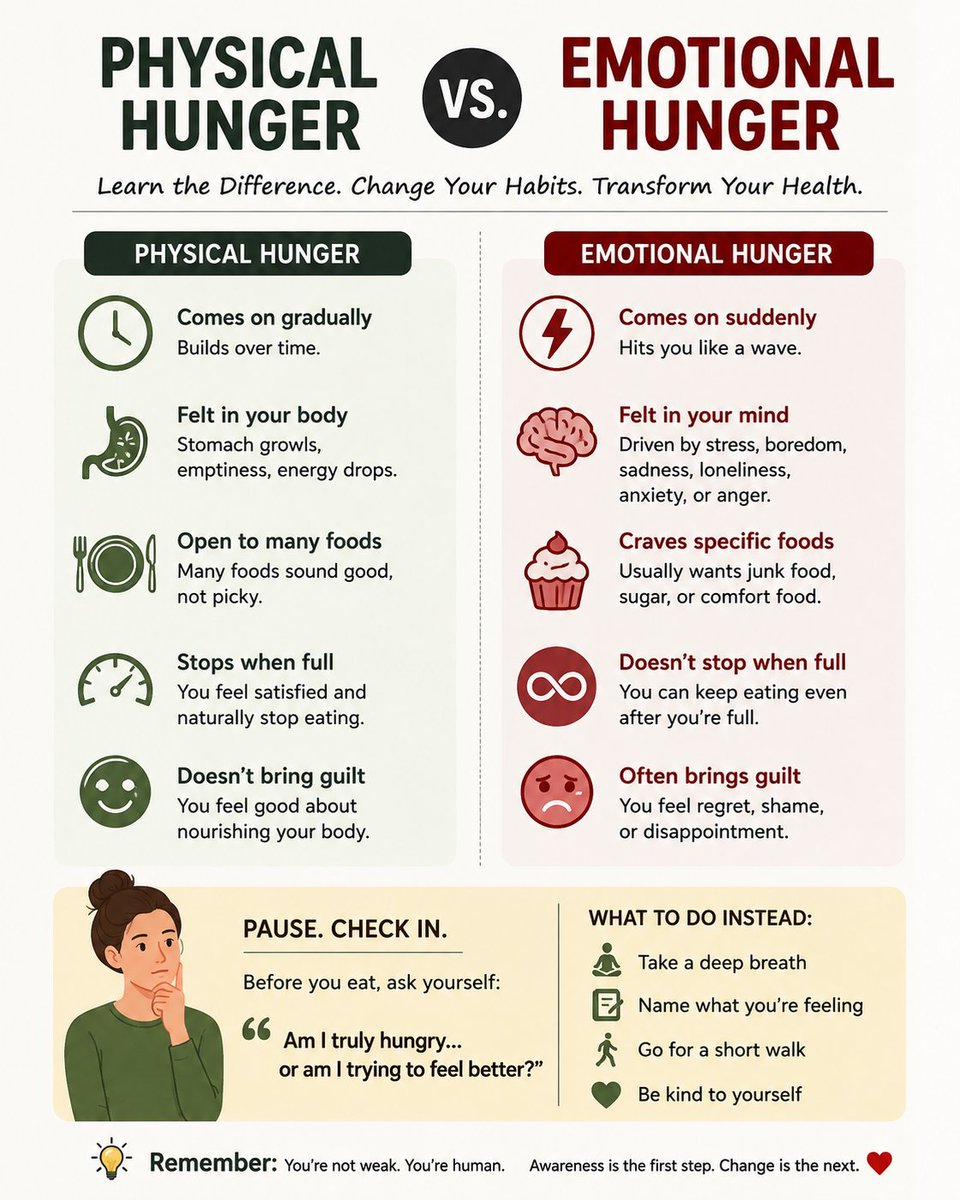
Physical hunger usually builds gradually and can be satisfied by different foods.
Emotional eating can feel sudden and may be tied to stress, boredom, sadness, or other emotions. Your own Mind Over Meals material emphasizes the role emotions and stress can play in eating behavior.
So before automatically reaching for the snack, try this:
Wait 60 seconds.
Then ask:
"Would I eat a normal meal right now?"
If the answer is yes, you may genuinely be hungry.
If the answer is:
"No... but I REALLY want cookies."
Pause and check what you're feeling.
You may not need more willpower.
You may need to understand what triggered the urge.
Because sometimes the craving isn't asking:
"What can I eat?"
It's asking:
"How can I feel better?"
Follow for more psychology-based weight loss insights.
The biggest mistake people make with cravings...
They try to fight them.
That usually makes them stronger.
Think about it.
If I tell you:
"Don't think about chocolate."
What's the first thing that pops into your mind?
Exactly.
Your brain doesn't like being told what not to do.
That's why many diets fail.
They create constant mental resistance.
A better approach is to get curious.
Instead of saying:
"I can't have this."
Ask:
"Why do I want this right now?"
Are you actually hungry?
Or are you tired...
Stressed...
Bored...
Avoiding something?
A craving is often a message.
Not an emergency.
The moment you become curious instead of reactive...
You create space to choose.
And that's where lasting change begins.
Follow for psychology-based weight loss insights.
You don't overeat because you're hungry.
You overeat because your brain is trying to solve a problem.
Here's the difference most diets ignore:
Physical hunger builds slowly.
Emotional hunger appears instantly.
Physical hunger is satisfied with almost any meal.
Emotional hunger demands something specific.
Usually foods high in sugar, fat, or salt.
And here's the biggest clue:
Physical hunger stops when you're full.
Emotional hunger often continues even after you're full.
That's why so many people say:
"I wasn't even hungry."
They were telling the truth.
The food wasn't feeding the body.
It was calming the mind.
The next time you feel an urge to eat, pause for 60 seconds and ask yourself:
"Is my stomach asking for food...
...or is my mind asking for comfort?"
That one question won't solve emotional eating overnight.
But it will help you notice the pattern.
And you can't change a pattern you never see.
Follow for psychology-based weight loss insights.
Most people think emotional eating means...
"You love food too much."
That's almost never the real reason.
Here's what actually happens.
You have a stressful day.
You don't crave broccoli.
You don't crave chicken.
Your brain asks for the fastest source of comfort it remembers.
Ice cream.
Pizza.
Cookies.
Chips.
The food isn't the reward.
The feeling is.
That's why the craving disappears after a good conversation...
A walk...
Or even a laugh.
Your brain wasn't asking for calories.
It was asking for relief.
This changes everything.
Stop asking:
"How do I get more willpower?"
Start asking:
"What emotion am I trying to escape right now?"
That one question can break years of emotional eating.
Follow for psychology-based weight loss insights.
Everyone keeps blaming "lack of discipline."
But what if discipline isn't the reason you're stuck?
Think about it.
You can ignore your phone for hours.
Show up to work every day.
Keep promises to other people.
Yet somehow a bag of chips wins every night.
That isn't a discipline problem.
It's a psychology problem.
Most people eat for one of only two reasons:
Their body needs energy.
Or their brain wants relief.
Stress.
Boredom.
Loneliness.
Anxiety.
The food isn't solving hunger.
It's solving a feeling.
That's why another diet usually works...
Until life gets hard again.
Because diets change your menu.
They don't change the reason you reach for food.
Here's a simple test:
The next time you want a snack, wait 60 seconds and ask yourself:
"Am I feeding my body...
...or calming my mind?"
That one question can change how you eat forever.
Follow for psychology-based weight loss insights.
If this changed how you see food, comment MIND and I'll send you something that helps you break the emotional eating cycle.
The biggest lie about weight loss isn't "eat less."
It's that if you just had more willpower...
...you'd finally succeed.
If that were true, every diet you've ever started would have worked.
But think about what happens after a stressful day.
You tell yourself you won't snack.
Then one bite turns into ten.
Not because you're weak.
Because your brain isn't chasing food.
It's chasing relief.
Most people try to control the behavior.
Very few stop to change the pattern creating the behavior.
That's why motivation fades.
That's why diets fail.
And that's why the same cycle repeats.
The people who keep the weight off don't have superhuman discipline.
They build a relationship with food that doesn't depend on willpower in the first place.
Change your psychology.
The behavior follows.
If this shifted your perspective, like this post and comment "MIND." I'll DM you my Emotional Eating Checklist for free.
Most diets fail because they fight cravings with willpower instead of changing the emotional pattern behind them. Change the pattern, and weight loss becomes easier.