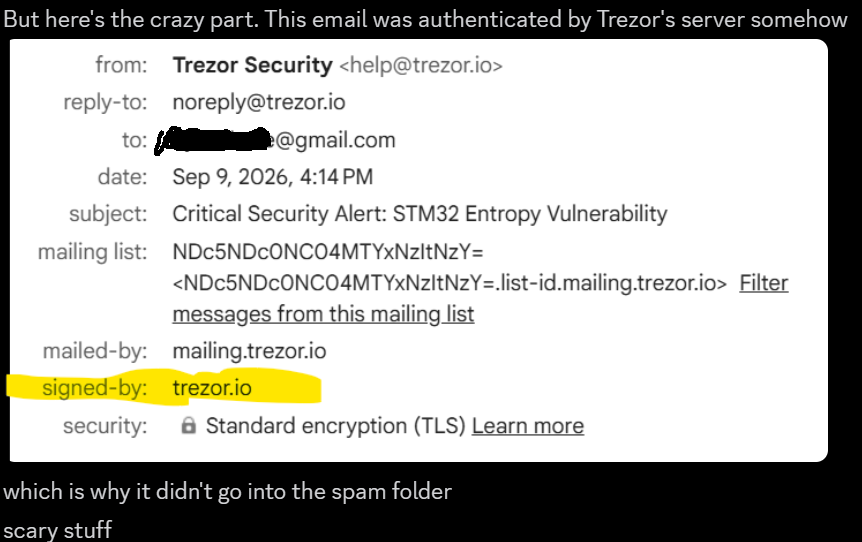
Really brutal. The phishing email is written quite convincingly, and it comes from the official Trezor domain.
At least tens of millions will be lost; hopefully not hundreds of millions. Insane f*ckup from Trezor.
Trying to predict short-term price action is hard, as I generally consider the short-term moves akin to a random walk, or geometric brownian motion.
..but..
if i had to guess, I would guess that BTC tags $70k soon, then gets a small bounce.
But after the bounce is over (likely a few days to a week or so), I do think BTC will head back to the lows from February 2026.
If I'm wrong about BTC revisiting the lows from February, I will quote tweet this and simply say "I was wrong."
And then I will let every bull dunk away.
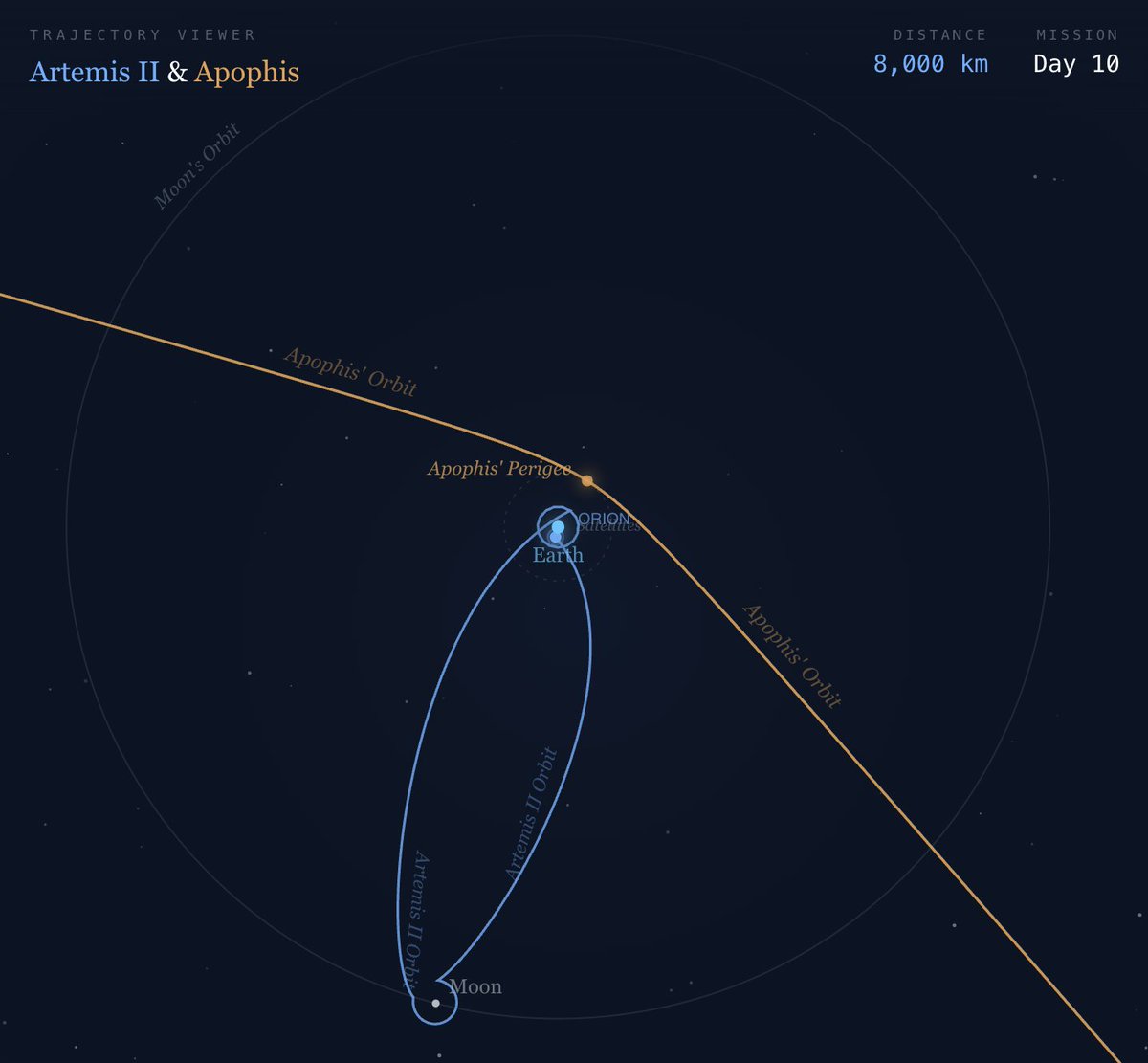
In 2029, Apophis, a ~370m asteroid, will pass just ~31,000 km from Earth.
That’s ~1/10 the distance to the Moon.
Inside the orbit of geostationary satellites.
Visible to the naked eye.
Impact risk this time is low, but the flyby could shift its future trajectory.
A direct hit would mean a ~1 km crater and regional devastation.
That’s why becoming multiplanetary matters.
Saw some people panicking or asking about quantum computing's impact on crypto.
At a high level, all crypto has to do is to upgrade to Quantum-Resistant (Post-Quantum) Algorithms. So, no need to panic. 😂
In practice, there are some execution considerations. It's hard to organize upgrades in a decentralized world. There will likely be many debates on which algorithm(s) to use, resulting in some forks.
And some dead project may not upgrade at all. Might be a good to cleanse out those projects anyway.
New code may introduce other bugs or security issues in the short term.
People who self custody will have to migrate their coins to new wallets.
This brings to the question of Satoshi's bitcoins. If those coins move, then it means he/she is still around, which is interesting to know. If they don't move (in a certain period of time), it might be better to lock (or effectively burn) those addresses so that they don't go to the first hacker who cracks it. There is also the difficulty of identifying all his addresses, and not confuse with some old hodlers. Anyway, it's a different topic for later.
Fundamentally:
It's always easier to encrypt than decrypt.
More computing power is always good.
Crypto will stay, post quantum.
Institutions aren’t asking “Is crypto legit?” anymore.
They’re asking:
“How much should we allocate?”
73% plan to increase exposure this year.
The game has changed, and most people haven’t adjusted.
@coinbase Head of Research @DavidDuong
Tune in to know more
⏱ TIME POINTS ⏱
00:00 – Intro
01:01 – New Crypto Rules
02:57 – Commodity vs Security
04:54 – Impact on New Tokens
06:12 – Bullish for Crypto?
07:28 – What Is a Commodity?
09:55 – Altcoins: Winners & Losers
12:33 – Airdrops at Risk?
14:45 – Ethereum Update
17:57 – Nexo
18:35 – Shareland
19:16 – Crypto vs Other Assets
22:34 – Front-Running Markets?
25:00 – Has Crypto Bottomed?
27:19 – 2026 Survey Insights
29:26 – What Institutions Want
Welcome to the Ethereum Economic Zone (EEZ), a framework for synchronously composable rollups.
What does that mean?
One deployment. Shared liquidity. Single transactions across L1 & L2. Identity verified anywhere. Smart wallets connected everywhere. No additional trust assumptions.
This means L2s that are as credibly neutral, economically aligned, and publicly governed as the base layer itself.
EEZ furthers Ethereum as the leading decentralized economy.
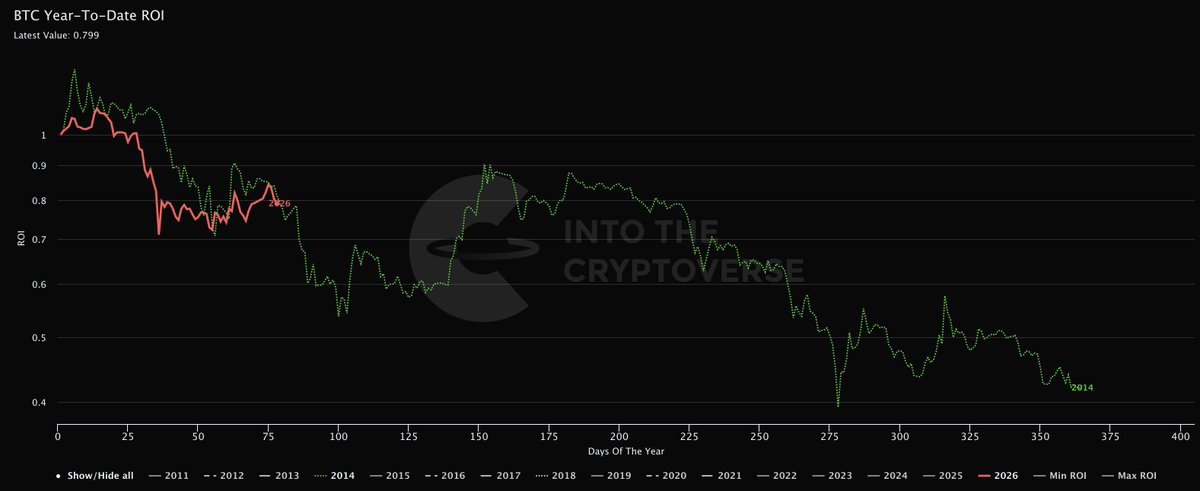
If Bitcoin continues to follow 2014, then the next leg down could be sooner than most expect.
Usually there is weakness by Bitcoin going into April of midterm years.
Ooof! Citi cut its $BTC and $ETH price targets.
The world's third-largest bank lowered its 12-month forecast for Bitcoin to $112,000 (down from $143,000) and Ethereum to $3,175 (down from $4,304).
That's a $31K haircut on $BTC and a $1,129 drop on $ETH - in one revision.
The reason: U.S. crypto legislation has stalled and ETF inflows have softened.
Here's the full picture:
- $BTC base case: $112K (was $143K)
- $ETH base case: $3,175 (was $4,304)
- $BTC bull case: $165K
- $ETH bull case: $4,488
- $BTC bear case: $58K
- $ETH bear case: $1,198
Citi's bull case is still $165K for $BTC - that's 47% above the revised base target.
But the base case revision is the real signal.
When a bank of Citi's size moves its targets, it's usually because the macro story changed, not just the price action.
The stall in U.S. crypto legislation is doing real damage.
Markets priced in a wave of pro-crypto policy. That wave hasn't hit. So institutional forecasts are repricing accordingly.
The bearish scenario - $BTC at $58K, $ETH at $1,198 - assumes a recessionary environment.
That's not what they expect - but it tells you how wide the range of outcomes still is.
WHAT DOES THE WAR MEAN FOR MARKETS:
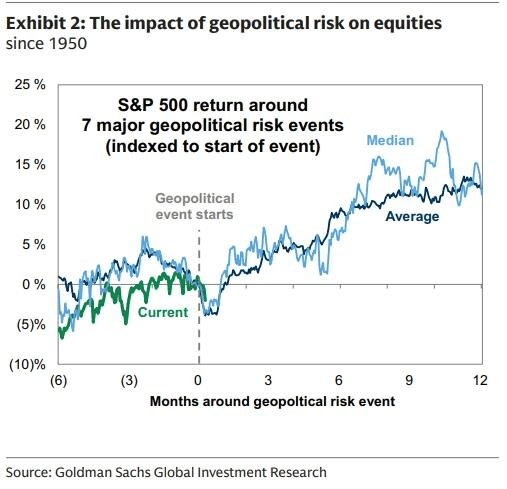
The S&P 500 has lost around 4% since the start of the war.
If we look back at previous major geopolitical events, the S&P 500 generally reacts predictably:
1. An initial drop.
2. Finding a bottom within days.
3. Fully recovering within weeks.
So when will the market find a bottom?
It just boils down to when the Strait of Hormuz will reopen.
The longer the Strait remains closed, the higher the risk of elevated oil prices.
It’s really that simple.
If oil prices continue to rise further and remain elevated, risk asset prices will likely continue to come under pressure.
If oil prices can fall back below $80, the pressure on risk assets will likely disappear.