ADHD or ADD?
People use both words all the time, so let’s clear it up.
Both are about attention. The real difference is hyperactivity.
ADD is the inattentive one, with no hyperactivity. It is the quiet, dreamy type: trouble focusing, getting distracted, forgetting things, drifting into your own thoughts. Because it does not disrupt anything on the outside, it often gets missed, especially in girls and in adults who can wait years for support.
ADHD adds hyperactivity and impulsivity: restless, always on the go, acting before thinking.
And the part most people miss: today, many clinicians see ADD as the inattentive type of ADHD. Same roots, different shape. Neither one is “worse.” They are two ways the same difference can show up.
Shared by many, lived differently by each.
For understanding, not diagnosis.
🖼️ Image description: A wide sage green banner. On the left, cream text: a small line reading “LET’S CLEAR THIS UP”, a large title “ADHD vs ADD”, and below it “People use both words all the time. Here is what actually makes them different.” On the right, the purple MindyCore mascot, wearing headphones and a white t-shirt with a rainbow infinity symbol, standing in a thinking pose with one hand on the chin.
Play should be for everyone.
Play is one of the first ways we connect as humans, long before words. It is how we learn, bond, and feel safe. It leaves a deep mark.
So play should be a right, not a privilege. But mainstream games leave so many people out: too fast, too loud, too much, made without neurodivergent players in mind.
That is why MindyPlay exists. Play that is accessible, calm, and yours.
Come and play: https://t.co/HhzwPehIy4
🖼️ Image description: Cover on a cream background with a purple border, in MindyPlay colours. Smoke black text reads “Play should be for everyone”, with a subtitle “Play is a right, not a privilege”. The MindyPlay logo in the bottom corner
@ashleyann_atx And knowing why it’s happening doesn’t make it less intense, it just stops you adding “and something is wrong with me” on top of it. That second layer was always the heavier one.
@libriscent There’s something in this, though I’d be careful with where it goes. Being wired for honesty isn’t a moral upgrade, and framing it that way makes the hard days feel like a personal failure rather than a hard day.
@SensoryRebels Same mechanism behind both. The cost of spotting the ending early is that you never get the surprise and you don’t get to rest in the meantime either.
@AutivisTdah Lo de “funcional” es una palabra que mide lo que sigues produciendo, no cómo estás. Por eso aguanta tanta gente años sin que nadie mire: mientras el rendimiento no baje, se da por hecho que no pasa nada.
El punto que más me importa de esto es el del burnout, que se confunde con depresión constantemente y entonces lo que se propone es más actividad y más estructura, que es justo lo contrario. Más que descartar enfoques, yo diría que el problema está en aplicarlos sin adaptar y sin saber distinguir qué se tiene delante.
@Autistic_Lauren Agreed on the last line. And rejecting the word is a lot cheaper for people who currently have what they need than for people who are still trying to get it.
When media gets autism wrong.
It started when I rewatched Rain Man. Then I thought about The Big Bang Theory, Atypical, shows I had watched for years that quietly teach you a message about autism.
Like the idea that autistic people are all geniuses. They are not. Autism is not one thing, and it is not a superpower.
It is time to name these things so we can leave them behind. And if you make a character like this, ask the community first.
Have you ever had a show shape how you saw people, before you really knew them?
Mindy update
An honest update on the testing we had planned for this month.
We have decided to keep this first round small. Instead of a big open call, we will invite a limited group of people and reach out to them in the coming days. They will get a private access to try NeuroMindy and share their feedback.
Two reasons. We want NeuroMindy to answer in a way that truly meets what you expect, not just to tick a box, and a small, focused round lets us get the most out of it. And these past days, a key member of our MindyMinds team has been unwell. We care about our people, and we will not push anyone into burnout. That slowed us down, so a smaller group is the right call for now.
Thank you for your patience and for staying with us. We know you want it all ready now, and so do we. But we would rather do this well, steady and done right. We are past the prototype stage. Now it is about quality.
Your mind works differently.
Your technology should too.
(SPA)
Actualización de Mindy
Una actualización honesta sobre el testeo que teníamos planeado para este mes.
Hemos decidido hacer esta primera ronda pequeña. En vez de una convocatoria grande y abierta, vamos a invitar a un grupo limitado de personas, y les escribiremos en los próximos días. Tendrán un acceso privado para probar NeuroMindy y darnos su opinión.
Dos razones. Queremos que NeuroMindy responda a la altura de lo que esperáis, no solo por cumplir, y una ronda pequeña y enfocada nos deja sacarle el mayor partido. Y estos últimos días, una persona clave de nuestro equipo de MindyMinds ha estado enferma. Cuidamos a nuestra gente, y no vamos a llevar a nadie al agotamiento. Eso nos retrasó, así que un grupo pequeño es lo más sensato ahora.
Gracias por vuestra paciencia y por seguir ahí. Lo queréis todo ya, y nosotros también. Pero preferimos hacerlo bien, con constancia. Ya pasamos la fase de prototipo. Ahora se trata de calidad.
Tu mente funciona diferente.
Tu tecnología también debería.
#Neurodiversity #NeuroMindy #MindyCore
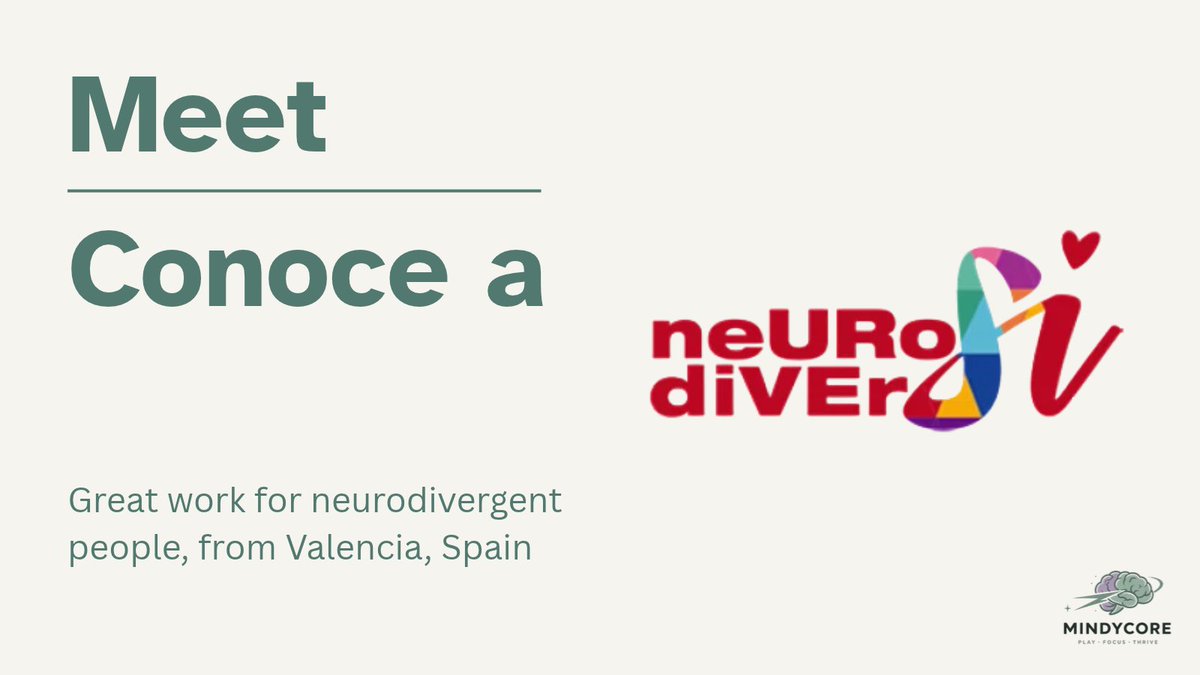
We had the pleasure of meeting NeurodiverSí, an organization from Valencia, Spain, working for equal opportunities for neurodivergent people.
We love this kind of work.
Go say hello!
NeurodiverSí: https://t.co/CxvY4n5uCK
🖼️ Image description: Cream background. On the left, sage text reads “Meet / Conoce a”, with a subtitle below “Great work for neurodivergent people, from Valencia, Spain”. On the right, the NeurodiverSí logo. The MindyCore logo small in the bottom corner.
(SPA)
Tuvimos el placer de conocer a NeurodiverSí, una organización de Valencia que trabaja por la equidad de oportunidades para las personas neurodivergentes.
Nos encanta este trabajo.
¡Pasad a saludar!
NeurodiverSí: https://t.co/CxvY4n5uCK
🖼️ Descripción de la imagen: Fondo de color crema. A la izquierda, texto en color verde salvia: «Conoce a», con un subtítulo debajo: «Un gran trabajo para personas neurodivergentes, desde Valencia, España». A la derecha, el logotipo de NeurodiverSí. El logotipo de MindyCore aparece pequeño en una de las esquinas inferiores.
@NoahRyanCo Those aren’t the two options. Plenty of us are good at the thing we’re good at and still can’t answer a phone call, and pretending it’s one or the other is how people end up thinking they’ve failed at their own brain.
Why we don’t use the word superpower.
And why we don’t use the opposite either.
“Superpower” is meant to be kind. It tries to push back against years of describing people only by what they lack. The intention is good.
But if your brain is a superpower, you are expected to perform. Hard days, needing support, or simply being average, start to feel like failing at your own gift. And our community told us something important: the word makes it harder to ask for help. Real needs get hidden behind a nice label.
The deficit frame is no better. Describing people only by what they cannot do turns differences into defects, and puts the problem in the person instead of the world around them.
So here is what we say instead. Different, not better or worse. A mind that works in its own way, with strengths, needs, and days that change. Support is built for that, not for a label.
You are not a label. Which words feel right to you?
🖼️ Image description: cover on a cream background. Ornella, founder of MindyCore, on one side. Sage green text reads “Why we don’t use the word superpower”, with a line below in smoke black “And why we don’t use the opposite either”