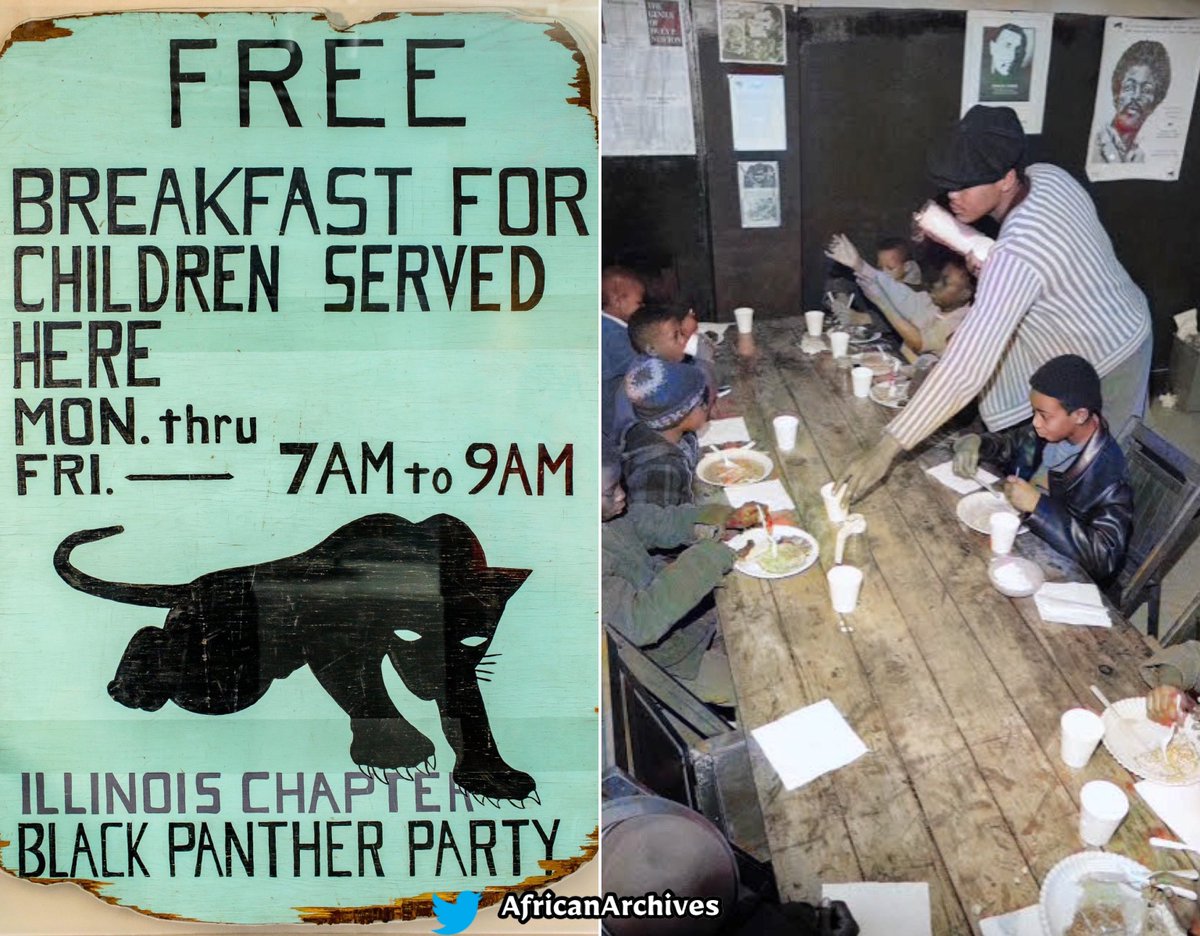
The Black Panther Party first & most notable community program was the Free Breakfast for Children Program.
The program began in January 1969 because poverty forced families to send their children to school hungry.
—By the end of 1969, the Black Panthers were serving full free breakfasts (including milk, bacon, eggs, grits, and toast) to 20,000 school aged children in 19 cities around the country, and in 23 local affiliates every school day. The breakfast program was just one of many programs the Panthers ran to address the needs of the poor. In fact, they developed more that 60 Serve the People programs, including efforts to provide free clothing and shoes, medical services —including drug and alcohol awareness, —legal aid education, and what was thought to be some of the first true early childhood education programs in the nation, preceding Head Start. But the Panthers’ image and focus on self-determination drew the attention of then FBI chief, J. Edgar Hoover. He singled out the Black Panthers as national hate group, and the breakfast program as an act of subversion. Once Hoover went after the Breakfast Program, the handwriting was on the wall. Even though the organizers were careful to consult with nutritionists to make sure the children got high quality, balanced meals, and made sure they had the necessary permits from the health and fire departments for the kitchens and halls where they served meals, they became regular targets of local officials. The children they served were caught in the middle.—
Why does his mom call him “Austin 350”?
Austin was in the gym sitting in the fetal position with his hood pulled completely over his head. He was non-responsive and would not budge.
After a few minutes, I convinced him to come with me to the office with the promise that I would not bother him. I just wanted him to be safe. He sat in the office in that same state for about ten minutes.
Finally, Austin stood up and sat in a chair across from me. He asked me if he could just stay at school and not go home. I was puzzled and asked Austin some questions. He said that his home life sucked and that nobody loved or even liked him. He also said he was tired of his mom yelling at him for no reason. Austin said the worst thing is that his mom calls him "350." I tried to get him to explain what this meant, and he clammed up. I figured I would not push my luck. I was very happy to get him talking at all. I planned to inquire again about this once I had the chance to build some more trust and rapport with him.
I wanted to keep him talking so we talked about things that he liked. After some prodding, he said that he really liked superheroes and turtles. I shared with him that I had collected turtles since I was a young child. I showed him the dozen or so turtles in my office. He thought they were really cool. Austin told me that he liked turtles because he used to have a turtle as a pet when he was younger until the turtle died and his mom would not replace it. He asked me why I liked turtles. I told him that someone told me as a kid that they were good luck and I began collecting them and never really stopped acquiring them. I gave him one to take with him. He asked if I thought it might bring him good luck and I told him that I bet it would.
Before he left for the day, I asked if he would like to check-in with me each day to just see how we were doing and to see if the turtle brought him any good luck. Austin smiled and said that he would really like that. I sent an email out letting his teachers know that we would be meeting for a few minutes each day for a check-in.
Over time, Austin began to open up. He shared bits and pieces of things from his days. During our check-ins, the conversations expanded to other interests, some of his dreams for the future, and other random things. Austin wanted to be a comic book artist or a video game creator. I told him that those sounded like some pretty amazing jobs! I tried to get him to talk about home life and his family. These questions were usually met with a quick change of subject or redirection. Austin was a master of these moves.
I am not sure when things changed or how Austin's guard dropped, but one morning we were having our regular check-in and he seemed a bit down. He initially said that he really did not want to talk about why he was down. Finally, he blurted out that he hates it when his mom calls him 350. I guess he read my face and realized that I didn't understand this reference. Austin then said, my mom calls me 350 because she has told me that she only keeps me around because she gets paid $350 a month in government support for him. Additionally, he said that each time mom gets mad at him, she continues by saying if the money goes away, so do you, 350.
My heart sank and I felt so bad inside. I really didn't know the right thing to say. All I could think to do was to tell him that I thought he was pretty amazing and that it is really important to continue to hope for the future, work hard, and follow your dreams so he can be a comic book artist or video game developer.
The year ended and Austin moved up to the middle school. I periodically checked in on Austin through the middle school principal and the reports were positive. He was still laser-focused on his career dreams.
Do you know an “Austin”?
#maslowbeforebloom
Join the “Maslow Before Bloom” Facebook group:
https://t.co/015cLKjJ1m.
In one of the most notable moments in sports history, Kenyan runner Abel Mutai was just a few feet from the finish line, but became confused with the signage and stopped thinking he had completed the race.
A Spanish athlete, Ivan Fernandez, was right behind him, and after realizing what was happening, he started shouting at the Kenyan for him to continue running; but Mutai didn't understand his Spanish.
Fernandez eventually caught up to him and instead of passing him, he pushed him to victory.
A journalist asked Ivan, "Why did you do that?"
Ivan replied, “My dream is that someday we can have a kind of community life where we push and help each other to win.” The journalist insisted “But why did you let the Kenyan win?" Ivan replied, "I didn't let him win, he was going to win.” The journalist insisted again, “But you could have won!”Ivan looked at him & replied, “But what would be the merit of my victory? What would be the honor of that medal?
What would my Mom think of that?”
Values are transmitted from generation to generation.
What values are we teaching our children?
Let us not teach our kids the wrong ways to WIN.
Today marks the first day of #TeacherAppreciationWeek and to appreciate and celebrate our teachers, we need to listen to our teachers. Teachers, I have an open-door policy. Tell me what you wish you had more of in your classroom ⬇️
Last call for Monday’s Webinar…
"Why are my kids so stressed, anxious & depressed?"
Featuring: Dr. Bryan Pearlman
May 1, 2023 06:00 PM Central Time (US and Canada)
Register in advance for this webinar:
https://t.co/nJq9u7O8tZ
Any long-time educator like me can tell you: standardized testing is failing out students. It does not truly measure their learning, or prepare them for the real world.
But there are other options—one of which is performance-based assessments. https://t.co/Yz7NMUenaq
Happy #InternationalWomensDay! Today and every day, we honor the AANHPI women who came before us, many of whom are not taught in schools or acknowledged in our cultural consciousness. We celebrate these activists, past and present, who help pave the way for the work we do today.
I’m glad to hear that the American Bar Association voted to support implementing a binding code of ethics for Supreme Court justices. And I’ll continue fighting to root out corruption and restore public trust in our courts.
https://t.co/hlsvXDk9y6