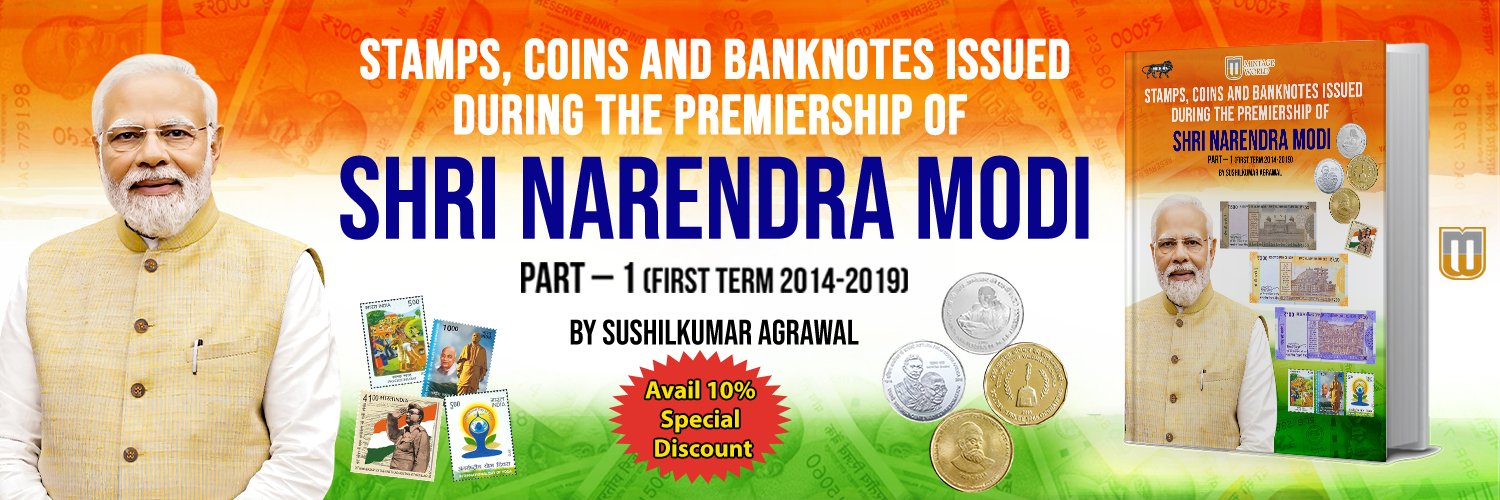
Stamps, Coins and Banknotes Issued during the Premiership of Shri Narendra Modi Part - I (First Term 2014-2019) by Sushilkumar Agrawal
Shri Narendra Modi is currently serving his third term as Prime Minister of #India. During his previous two terms, India witnessed a remarkable shift in its philatelic journey. Moving beyond personality-centric issues, the Department of Posts embraced a vibrant celebration of #Indian #culture, #arts, #Crafts , #textiles, #flora & #fauna, often through stunning miniature sheets in innovative shapes and sizes. This beautifully curated two-part book captures the golden era of philatelic and numismatic issues (including banknotes).
With inspiring forewords from esteemed dignitaries such as Shri Nitin Gadkari, the Hon’ble Minister of Road Transport and Highways, and Shri Devendra Fadnavis, the Hon’ble Chief Minister of #Maharashtra, the Part I of this book is out! It’s perfect for hobbyists, collectors, and all Indians who wish to honor and relive these transformative years through the lens of #history preserved in stamps and coins.
Order your copy today and claim your piece of contemporary Indian history! Don’t wait; click the link in our bio now!
#modi #Philately #Numismatics #coin #Stamp #Collectibles #BookLaunch #Banknote
🌸 India’s cultural renaissance is reclaiming civilizational glory - restoring heritage, repatriating antiquities, digitizing ancient wisdom & rejuvenating sacred sites.
As Union Minister Shri @gssjodhpur writes, Bharat blends tradition with modernity! 🇮🇳
#VirasatBhiVikasBhi
Lead Coin of Vasisthiputra Kura of Kolhapur
The Kura dynasty was an ancient ruling family in the early historic Deccan. The Kuras were primarily associated with the Kolhapur-Belgaum region. They flourished roughly from 30 BCE to 65/100 CE during the post-Mauryan / early Satavahana period.
Their territories were extended to Brahmapuri and Madhavpur. Coins have also been found in Vadagaon, Shimoga, and Chandravalli, indicating their influence extended across these regions.
More at... https://t.co/hDSoYX6Leh
#CultureUnitesAll #coin #money #numismatics #12YearsOfVikasBhiVirasatBhi #ancientindia #LivingIndianHeritage
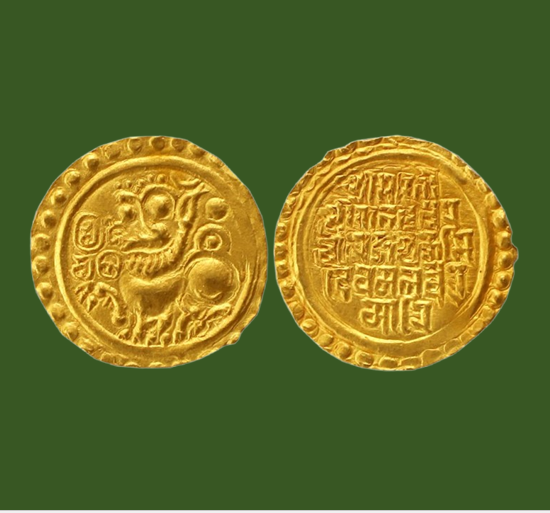
Debased Gold Dinara of Karakotaka King Vigraha
The Karakotakas/Karkota dynasty were a powerful Hindu dynasty that reigned over Kashmir for 230 long year - from approximately 625 to 855 CE. They presided over the Golden Age of Kashmir. The illustrious kings of the dynasty expanded their kingdom by military conquest and brought renewed prosperity to their kingdom. Their rule was marked by rich cultural flourishing, and building of grand temple renowned for impressive architecture.
The Karakotaka dynasty was founded by Durlabhavardhana who was also known as Prajnaditya, c.. ~625–661 CE. The name "Karkota" derives from this serpent lineage, common in Kashmiri lore, due to their association with Nagas.
More at... https://t.co/4LJQTKhsZZ
#CultureUnitesAll #coin #money #numismatic #12YearsOfVikasBhiVirasatBhi #ancientindia #LivingIndianHeritage
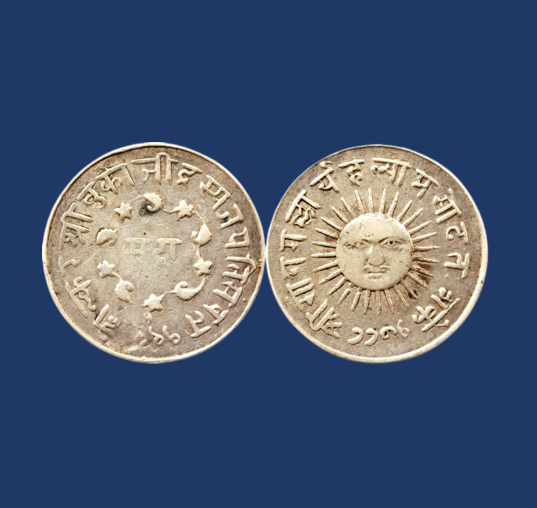
Nazarana Mudra of Indore Ruler Tukoji Rao II
Tukojirao Holkar II (Tukoji Rao II Holkar) was the Maharaja of Indore from 1844 to 1886. He belonged to the Maratha Holkar dynasty, which ruled the state of Indore in central India. The Holkars were of Dhangar = shepherd Maratha origin, traditionally linked to a village called Hol (or Hal) in Maharashtra near Jejuri, Pune district. The family name derives from "Hol-kar" (inhabitant of Hol). Malhar Rao Holkar, the founder, was born in 1693 (or 1694) in a Dhangar family. He rose through military service under Peshwa Baji Rao I.
more at...
https://t.co/igb6qriRsQ
#coin #money #numismatics #mudra #nazarana #indore #sun #india
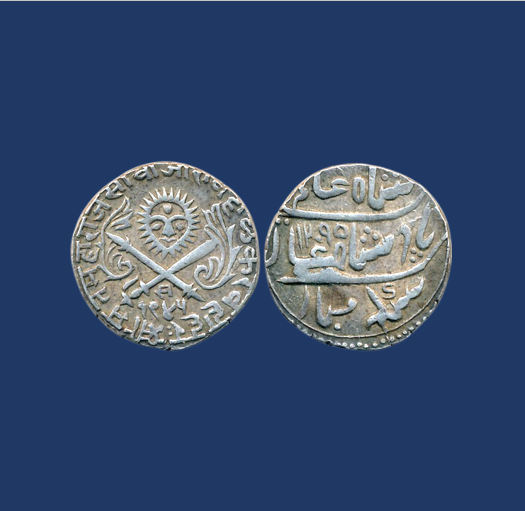
Indore King Shivaji Rao-III's Silver Rupee with Dual Date - FE and VS
Shivajirao Holkar - Shri Sir Shivaji Rao Holkar Bahadur XII was the Maharaja of Indore Holkar State from 1886 to 1903. He was the son of Tukojirao Holkar II.
Interestingly the above silver rupee depicts two different date system and dual script - devanagari and persian.
The obverse depicts sun in centre with legend in devanagari around and date in Vikram era Samvat 1945. The reverse mentions Fasli date 1295. To arrive at gregorian date from Vikram Samvat (VS) date, deduct 56 from VS date.
more at...
https://t.co/6jGm7pixSX
#coin #money #numismatics #indore #holkar #india
This is Shanti Swarup Bhatnagar.
He is the "Father of Research Labs" in India.
He helped set up 12 labs.
Developed in these labs:
- Saheli: World's first non-steroidal oral contraceptive pill
- India's first biofuel-powered flight
- India's first commercial continuous paracetamol plant
@Abhinav1893751@sanjeevku Interesting take. Samudragupta's undefeated conquests in the 4th century built a lasting empire, unlike Napoleon's eventual defeat. Reversing the label to call Napoleon the "Samudragupta of Europe" could better honor ancient Indian achievements over colonial-era framing.
The Great Emperor Samudragupta (AD 344-378), has been referred to by historians as “Napoleon of India”.
I have thought about this label often, especially after the last book launch and feel it is time to revise this very old (colonial mindset) reference. Instead it would be more appropriate to refer to Napoleon as the Samudragupta of his times.
Attached is a Gold coin showing the King killing a Tiger with his bow and arrow and a page from the book -Treasures of the Gupta Empire) discussing this coin which was issued by a young Samudragupta while he was just starting to expand the Gupta Empire.
Over 5,000 years ago, the people of the Indus-Saraswati Civilisation developed extensive methods of cultivation and processing cotton. Archaeological evidence from Mehrgarh, Mohenjo-daro, Lothal, and Rakhigarhi including charred seeds, delicate woven threads, and production tools highlights a specialized, region-wide textile economy.
This ancient expertise continues unbroken in India’s rich handloom traditions from Khadi and regional weaves to the timeless beauty of cotton sarees and fabrics used across the country every day. The thread of innovation and craftsmanship from the Indus-Saraswati Civilisation remains woven into the very fabric of Bharat’s living heritage.
#IndusSaraswatiCivilisation #LivingIndianHeritage #CivilisationalContinuity
Interesting Copper Coin of Panchala King Bhanumitra
Bhanumitra was a king of North Panchala centered at Ahichhatra, in present-day Uttar Pradesh, India. He ruled around the early 1st century CE . He belonged to the post-Mauryan dynasty of Panchala rulers.
After the Mauryan Empire's decline, North Panchala Ahichhatra region became an independent kingdom issuing its own coins. Bhanumitra was one of the prominent rulers in this series, alongside kings like Agnimitra, Suryamitra, and others. The kingdom maintained local autonomy in the Ganges-Yamuna Doab.
more at...
https://t.co/oGySh6aKBT
#coin #money #numismatics #Panchala #UP #Bhanu #sun #ancient #India
Copper Punch Marked Coin of Satavahana King Satakarni - Vidisha Series
The Satavahana dynasty (c. late 2nd century BCE to early 3rd century CE) was an ancient Indian empire consisting of the area of Deccan region (Andhra Pradesh, Telangana, and Maharashtra), with the capitals at Pratishthana (Paithan of Maharashtra) and Amaravati (Dharanikota/Dhanyakataka of Andhra Pradesh). Under the rulers like Satakarni I, Satakarni II, and Gautamiputra Satakarni they extended control northward into parts of modern Madhya Pradesh (including the Malwa region), Gujarat, and Karnataka.
more at...
https://t.co/bOx06Lqjcc
#coin #money #numismatics #ancient #India #satavahana #vidisha #deccan
The 4,000-year-old Sinauli chariot, excavated in 2018 from the ancient burial site of Sinauli, stands among the most significant archaeological discoveries in recent decades.
Buried in a ceremonial grave and richly adorned with copper, the chariot reflects the sophistication of a warrior elite that flourished around 2000–1900 BCE. Crafted from wood and sheathed in copper sheets, it features two solid wheels mounted on a fixed axle and connected to a yoke by a central shaft. The wheels are embellished with striking copper triangular inlays arranged in concentric circles, showcasing remarkable craftsmanship.
Its semi-circular seat is supported by a framework of copper pipes, while the front structure rises into a distinctive canopy-like form. Excavations at Sinauli also uncovered copper weapons, shields, helmets, and other elite grave goods, underscoring the site's importance as a ceremonial and martial center.
#12YearsOfVikasBhiVirasatBhi #CultureUnitesAll #ASI #asi #SinauliChariot
You probably have no idea who Salim Kumar is, but every Indian should read all about him today.
Salim Kumar was a Malayalam actor who passed away on Saturday night in Kochi at the age of 56. If you don't watch Malayalam cinema, strap in because his story is one of the most remarkable careers Indian cinema has produced, and it deserves to travel beyond Kerala.
He came from nothing. Born in North Paravur, a small town in Ernakulam, into a family that struggled with money. Government school. Graduated from Maharajas College.
So, no film connections, no family wealth, no shortcuts.
He started as a mimicry artist with Kalabhavan, a performance troupe in Kochi that has been the launchpad for dozens of Malayalam actors. Stage shows, comedy routines, television spots.
He was funny in a way that was impossible to ignore, the kind of performer who could make a room laugh in an instant.
His first film was Ishtamanu Nooru Vattam in 1997, a small role nobody remembers. For years he played supporting parts & background comedy.
Then the 2000s happened. His role as Mattancherry Mammathu in Satyameva Jayathe gave him his first real recognition, and after that the comedy roles started coming fast.
Pulival Kalyanam. Thuruppugulan. Kunjikkoonan. Marykkundoru Kunjaadu. If you grew up in Kerala in the 2000s, his face was in half the films you watched. He became the comedian audiences showed up for, the one whose scenes people replayed and quoted at family gatherings.
What separated him from most comedians was precision. He did not rely on volume or slapstick. He used his face, his body, his pauses.
He could get a laugh from the way he blinked. Directors started writing characters specifically for him, because they knew he would take whatever was on the page and make it three times funnier than they imagined.
For over a decade, he was the biggest comic face in Malayalam cinema.
Then came 2010 and a film called Adaminte Makan Abu.
A quiet, small-budget film directed by Salim Ahamed. The story follows an aging Muslim couple in a Kerala village whose only dream in life is to go on Hajj, the pilgrimage to Mecca.
They save every rupee. Things keep falling apart. The film is about their dignity, their patience, and their faith through one disappointment after another.
Salim Kumar played Abu. The man who owns nothing except his wife and his belief, and holds onto both with everything he has.
There is no comedy in the role. No punchlines, no funny faces, no playing to the gallery. It is the complete opposite of everything audiences had ever seen him do.
The entire performance is built on stillness, restraint, and pain carried quietly behind the eyes.
He won the National Film Award for Best Actor for it. That is the highest acting honour in Indian cinema. The film was also selected as India's official entry for the Best Foreign Language Film at the Academy Awards (Oscars) that year.
In one role, Salim Kumar went from "the funny guy from Malayalam films" to one of the most respected actors in Indian cinema.
He simply disappeared so completely into a character that you forgot you were watching a comedian at all.
He followed it with more serious work. Achanurangatha Veedu, which won him the Kerala State Award. Traffic, still considered one of the finest ensemble films in Malayalam cinema. Perumazhakkalam.
Each time, he proved the National Award was not a fluke. The man had range that most actors who only do drama cannot match.
Unfortunately, Salim Kumar suffered from liver cirrhosis, a condition he said was hereditary in his family and not related to alcohol. His brother had the same illness. He underwent a liver transplant a few years ago. He tried naturopathy. He talked about all of it openly, without shame, without self-pity.
He kept working between treatments. He kept being funny. He kept showing up, even when his body was failing him.
He was also fearlessly outspoken about politics and social issues, which in any film industry can cost you work. He did not care. He said what he believed and lived with the consequences.
He passed away Saturday night at a hospital in Kochi. He was 56. The Kerala government bore the funeral expenses and gave him police honours.
The Chief Minister paid homage personally. Mammootty, one of the biggest names in Indian cinema, mourned him publicly. Thousands of people lined up at the North Paravur Town Hall on Sunday to say goodbye.
350 films in three decades. A National Award for Best Actor. An Oscar entry. A career that started from mimicry stages and ended at the very top of Indian cinema.
The reason most of India does not know his name is because Malayalam cinema, despite being one of the best film industries in the country, still does not get the national attention it deserves.
Actors like Salim Kumar live and work in a language bubble, and their stories rarely cross over the way a Bollywood career would.
This is a loss for everyone who never got to watch him. A man who came from poverty, made millions laugh, then proved he could make them cry just as hard, and fought his own hardest battle with utmost dignity.
If you watch one film after reading this, make it Adaminte Makan Abu. It is a masterpiece.
Kadambas of Goa - Gold Gadyana of Jayakeshi Deva
Kadambas of Goa were a prominent medieval dynasty that ruled Goa / parts of the Konkan coast from approximately c. 960 CE to 1340 CE. They were a branch of the ancient Kadamba dynasty of Banavasi of Karnataka. They are credited with making Goa a major maritime trading power and contributing significantly to its cultural and architectural heritage.
Kadmbas of Goa developed a strong navy and expanded maritime trade with regions like Zanzibar, Bengal, Gujarat, Sri Lanka, and beyond. They promoted Shaivism while also patronizing Jainism. They built impressive temples, including the famous Mahadev Temple at Tambdi Surla - 12th century, one of Goa's best-preserved ancient temples.
more at...
https://t.co/qCrfQLyqxL
#coin #money #numismatics #goa #Kadamba #gadyana #gold
Gold Half Dinar of Chamhana Shakambhari King Vigraharaja Depicting Lord Rama
Chahamanas of Shakambhari refers to the prominent medieval Indian Chauhana dynasty, popularly known as the Chauhans of Sambhar or Chauhans of Ajmer. They ruled parts of present-day Rajasthan and adjacent areas from approx 6th to 12th centuries CE. Their original capital was Shakambhari and later Ajayameru = Ajmer.
Vigraharaja IV or Visaladeva (c. 1150-1164 CE) was known as a great Chauhana warrior, poet, and patron of arts. He expanded the kingdom of Shakambhari significantly and built structures like the Adhai Din Ka Jhonpra in Ajmer. He transformed the kingdom into a powerful empire through military conquests, cultural patronage, and resistance against invasions.
more at...
https://t.co/vecEY7XWZz
#coin #money #ancient #india #chauhan #shakambhari #ajmer #rajasthan