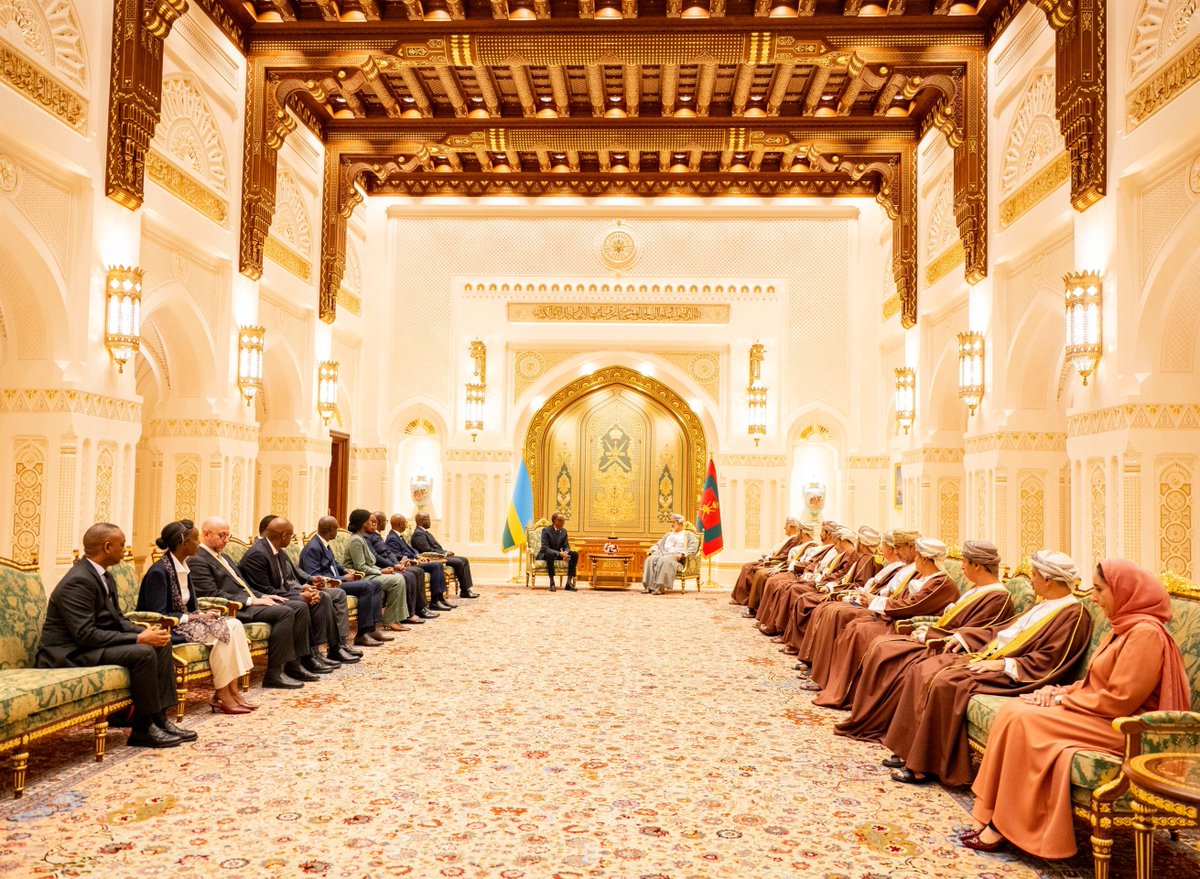
His Majesty Sultan Haitham bin Tariq bid farewell to President Kagame and his delegation at Al Mamurah Palace, marking the conclusion of President Kagame’s two-day official visit.
The look in Kagugu wallai! Construction to start next year.
The Kabuhunde Rehousing Project will cover about 33.7 hectares and feature G+6 multi-storey residential blocks with elevators and dedicated parking.
The project will also include internal asphalt roads, a wastewater treatment plant, landscaped public spaces, a market, and a pharmacy/clinic.
(TNT)
Managing each stage helps reduce costs, extend asset life, and strengthen data security.
Learn how to maximize the value of every device.
🔗 Read the full article: https://t.co/6EF59sDwd9
#Rwanda among the favorites to host Formula 1 races in 2028.
Formula 1 CEO Stefano Domenicali has revealed that talks are progressing well on the possibility of Rwanda, South Africa, Argentina and Thailand being added to the countries that will host Formula 1 races in 2028. Read details👇
https://t.co/FWuy2tOPC0
Saw a tiktok of someone complaining ngo why are Ishyo yoghurts so small - ngo they are selling samples!🤣
After banning ibyuma, people’s focus has shifted to other important goodies like yahurute. Muraza kuba sober kungufu!🤣
When the warning signs are in plain sight!
There is an ongoing national conversation about youth delinquency. Government leaders have been meeting citizens across the country to discuss the issue and explore possible solutions. That is encouraging. But i sometimes wonder whether we are paying enough attention to what is happening right in front of us.
Yesterday, one of Rwanda’s biggest artists performed at Kigali Arena. Looking around, i would estimate that nearly two-thirds of the audience were young people between the ages of 17 and 35. Many were students, while others were already working. One observation stood out to me. Those below 18 were mostly with friends and peers, not with their parents. That is understandable, as parents cannot be everywhere.
What concerned me more was what happened after the concert. Many young people walked away carrying heniken and petite mizing bottles and cans of alcohol, while others had alcoholic syrups. It raised a simple question: should alcohol be sold inside venues that attract such a large number of young people?
In many countries, alcohol is consumed in controlled environments like homes, bars, restaurants, hotels, or private events. Some even prohibit people from openly carrying alcohol in public spaces. Yet at large entertainment venues where thousands of young people gather, access can be remarkably easy.
At the same time, we cannot ignore another reality. In many rural communities and urban suburbs, the bigger problem is not commercially sold alcohol, but illicit and unregulated brews. These products continue to harm lives and, in some cases, cause permanent damage to people’s health. Addressing youth substance abuse therefore requires looking at both ends of the problem: what happens in our cities and what happens in our villages.
Youth behaviour also reflects changing social and economic realities. Many of us grew up in households where resources were scarce. Our parents, relatives, and neighbours expected us to study hard, work hard, and contribute to lifting our families out of poverty. That responsibility shaped our choices.
Today’s young people face different circumstances. Some from middle- and upper-income families grow up without the same economic pressures, so social recognition can easily become a substitute for purpose. Others, especially those from disadvantaged communities, face unemployment, limited opportunities, and inadequate guidance, making them far more vulnerable to alcohol and drug abuse. These are different backgrounds, but they present equally critical challenges.
This is why I believe we need a deeper societal conversation. During Umuganda, citizens’ assemblies, parents’ evenings at schools, youth forums, and even meetings of registered political parties, how much time do we actually spend discussing the issues quietly shaping the next generation?
Rwanda does not lack spaces for dialogue. What we sometimes lack is the willingness to use those spaces to confront the real issues affecting our communities. Preventing youth delinquency is not only the responsibility of parents or the police. It requires families, local leaders, schools, religious institutions, businesses, and communities to work together. When warning signs are visible but go unaddressed, we should all pause and ask whether we are paying enough attention to the future we are shaping.
Botswana did everything right: they put their diamond money in a sovereign wealth fund, funded education, successfully fought corruption, and tried to diversify their economy. And it hardly made a difference. Growth still reversed when the diamond market went bust. The education spending produced hardly any improvement in student performance. Turns out “good institutions” are not, in fact, the secret sauce, at least not on their own. This is not at all surprising if you have the right priors, but it’s very interesting to see it documented and quantified. Great article
“As young people, we need you. We love you. But first and foremost, take care of yourselves.
This religion of alcohol, I think people even recruit others into it. Alcohol is killing you. It’s killing young people. The older ones are already gone. It has killed so many older people like us. Others are already on that same path and seem unable to stop.
But I want to warn you and beg you: everything we have been talking about, what brought you here, and the plans we have for our country, this thing will kill you before you realise your ambitions.” President Kagame |#MeetThePresident Indangamirwa 16th Cohort
𝐈𝐧𝐭𝐫𝐨𝐝𝐮𝐜𝐢𝐧𝐠 𝐔𝐠𝐚𝐧𝐝𝐚’𝐬 𝐍𝐚𝐭𝐢𝐨𝐧𝐚𝐥 𝐂𝐥𝐞𝐚𝐧𝐢𝐧𝐠 𝐃𝐚𝐲𝐬 𝐈𝐧𝐢𝐭𝐢𝐚𝐭𝐢𝐯𝐞
Starting this Saturday, Ugandans across the country will come together to participate in community cleaning activities.
The National Cleaning Days Initiative will be observed on the last Saturday of every month, and all Ugandans are encouraged to take part. This will help us keep our communities clean, healthy and safe.
𝐀 𝐜𝐥𝐞𝐚𝐧 𝐞𝐧𝐯𝐢𝐫𝐨𝐧𝐦𝐞𝐧𝐭 𝐟𝐨𝐫 𝐚 𝐜𝐥𝐞𝐚𝐧𝐞𝐫 𝐧𝐚𝐭𝐢𝐨𝐧
#OPMUganda
Decentralization must evolve with Rwanda’s economic transformation: The case of Bugesera district
Rwanda’s decentralization model has delivered significant progress in bringing services closer to citizens. However, the country’s rapid economic transformation requires us to periodically reassess whether our administrative structures still match emerging realities.
Bugesera District is a good example. Over the past decade, Bugesera has evolved from a predominantly rural district into one of Rwanda’s fastest-growing economic corridors. With the development of the new international airport, expanding industrial investments, logistics facilities, commercial agriculture, and increasing residential developments, the district is experiencing unprecedented demand for public services.
One indicator of this transformation is the volume of land administration work. Today, Bugesera processes land title transactions comparable to those handled across the entire Western Province. Yet, despite this enormous workload and strategic importance, the district operates with an administrative structure and staffing levels that are largely similar to districts such as Gakenke, whose economic activities, investment volumes, population dynamics, and urbanization pressures are significantly different.
This raises an important policy question: should decentralization continue to allocate resources primarily based on the number of districts, or should it increasingly reflect economic activity, population growth, service demand, and strategic national priorities?
As Rwanda pursues Vision 2050 and the implementation of NST2, administrative capacity should become more responsive to changing development patterns. Districts that are emerging as major economic hubs require stronger institutional capacity, additional technical personnel, expanded land management teams, urban planners, engineers, environmental specialists, and digital service infrastructure. Without these adjustments, service delivery risks slowing down precisely where the country’s economic growth is accelerating.
This is not about creating inequality among districts or reducing support for less-developed regions. Rather, it is about recognizing that different districts face different responsibilities. Just as national infrastructure investments are targeted according to strategic priorities, administrative capacity should also be calibrated according to workload and complexity.
Bugesera’s growth presents an opportunity to rethink how decentralization can evolve alongside Rwanda’s economic transformation. The same principle may eventually apply to other fast-growing districts as they become centers of investment, innovation, and urban expansion.
Effective decentralization is not only about bringing government closer to the people; it is also about ensuring that government institutions have the capacity to respond to the realities on the ground. As Rwanda continues to grow, our governance structures must grow with it.
Periodically reviewing staffing, institutional mandates, and resource allocation based on objective indicators such as population, investment, land transactions, and service demand will help ensure that decentralization remains efficient, responsive, and fit for the country’s next stage of development.