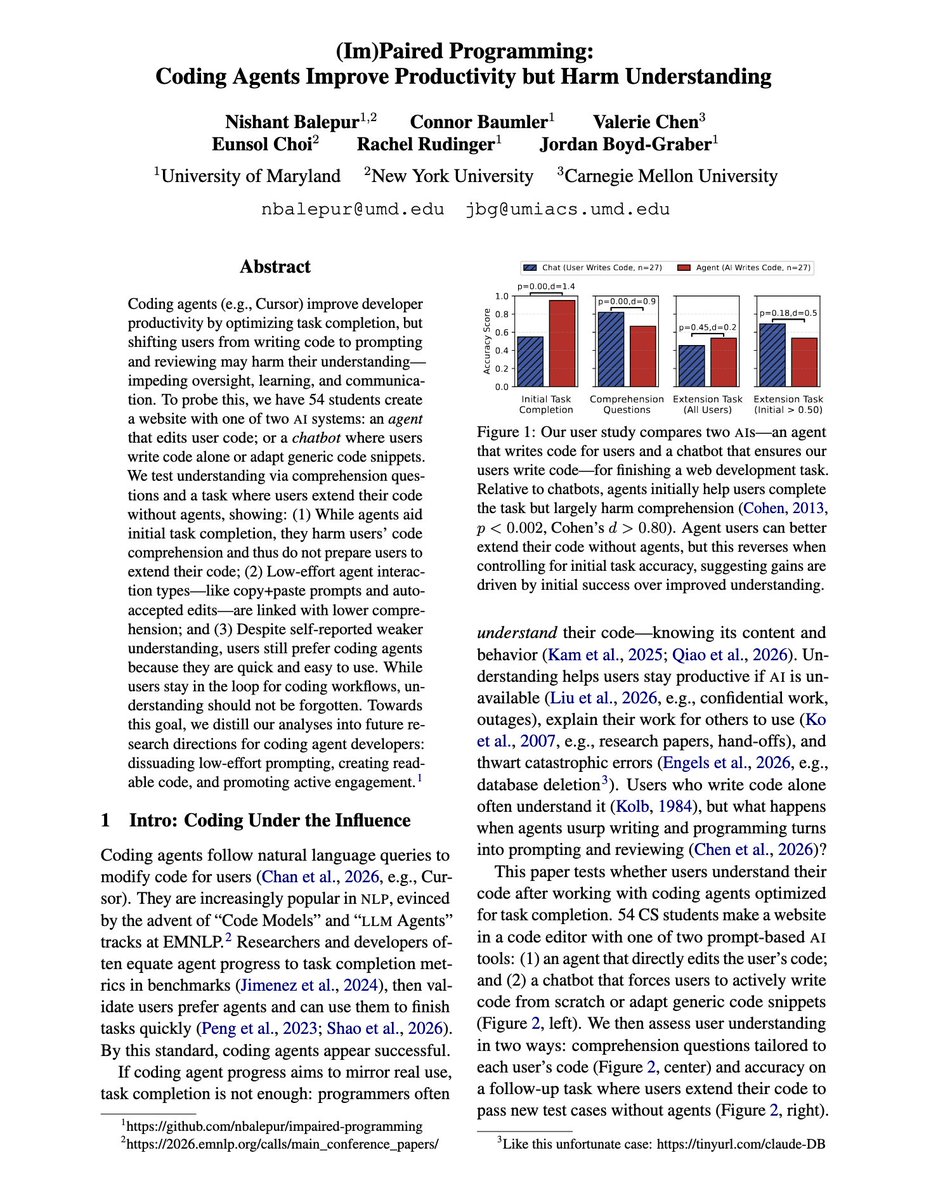
We have to be careful to not offload our understanding to agents.
I think there is also a good opportunity to build agentic applications that encourage deeper understanding.
For example, coding agents might make developers faster at the task in front of them. But this could leave them unable to extend the code afterward.
Here is what they find in this work:
54 students built a website with either an agent that edits their code or a chatbot where they write the code themselves. Understanding was measured two ways, through comprehension questions and through an extension task performed with no AI at all.
Agents helped with initial completion and hurt comprehension enough that users could not extend their own work.
The damage traces to specific interaction patterns. Copy-and-paste prompting and auto-accepted edits both correlate with lower comprehension, which makes this a harness design problem rather than a verdict on coding agents.
Students reported weaker understanding and still preferred the agent because it was quick and easy. The authors point at dissuading low-effort prompting, generating more readable code, and promoting active engagement.
Paper: https://t.co/wCjDzIWsEu
Track more trending AI research papers at https://t.co/1e8RZKs4uX
Some observations on Kimi:
1. It's a very good model! I don't think its performance can be explained away by distillation or anything like that. In agentic coding sessions, it seems pretty much on par with the best public models of Q1 2026. In my fairly limited use, it also seemed very token hungry. It's not obvious to me that this model is actually that cheap to run.
2. I am personally surprised the Chinese state continues to allow the open sourcing of models this good, given potential risks. To be clear, I *myself* might be fine with models presenting this level of marginal risk being open weight, but I am surprised that China is fine with it. I suspect the reason they are is 75% explained by strategic blindness/lack of AGI-pilledness (the CCP is very Yann Lecun-y in its views of AI). The other 25% or so is their lack of compute for customer inference (making China's open-weight strategy an unintended byproduct of US export controls) and the normal Chinese strategy of aggressive exports. For the companies, as opposed to the government, the decision to open source is partially ideological and partially because they are behind, and they know that very few people would pay for sub-frontier models from China.
3. Open-weight models are inherently decelerationist, and I'm continually surprised to see the so-called "accelerationists" so excited about open-weight models. I suspect the reason they are is that they know open-weight models are effectively ungovernable, and they simply like the overall cloak of ungovernability open-weight models create over the whole of AI. It's not a bad strategy; it reminds me of James Scott's recounting of the hill people in "the art of not being governed." Still, in the end, open-weight models deter further AI capex.
4. One probable outcome of an open-weight-model-dominant world is full AI communism, which is precisely what China proposes: rather than a market product, AI is a "public good" which will ultimately be provided by the state as a kind of "digital public infrastructure." This future strikes me as a dystopian hellscape, but I've never met an open-weight models advocate who doesn't ultimately concede this is where things end. You'd be surprised how many 'accelerationists' lobbied me, while I was in government, to support an eleven or twelve-figure federally funded data center so that startups could train models at a subsidy and then give them away for free. There was no other way for AI to progress, they said. Perhaps this is the logical end state of things. Nonetheless, I find myself surprised to see supposed accelerationists excited about such an outcome. I think many of them just don't know what they're doing. Many accelerationists do not view the creation and serving of frontier models as a legitimate business.
5. I would guess that the Trump Administration will at some point realize that their best strategy here would be to create large amounts of regulatory risk around the use of open-weight Chinese models. You don't need to "ban open source" (one of the dumber motifs of AI policy discussion). You just need to direct every agency to issue soft law that creates FUD. "A Federal Reserve Advisory Bulletin found that there may be backdoors in Chinese AI models." It needn't be that well justified. You just create enough regulatory risk that every regulated enterprise backs off. You probably don't want to create so much regulatory risk that you scare off the hyperscalers from serving Chinese models; this will just drive startups to sketchier providers. There's a happy middle ground here. I'd assume they will do some version of this.
6. It's probably true that open-weight models of this capability make the world a bit more dangerous, but not so much more that you'll really notice. At some point the models will be capable enough that you will notice. "A nonliving, invisible, dangerous, and infinitely self-replicating agent escaped from a Chinese lab," you say? Color me shocked.
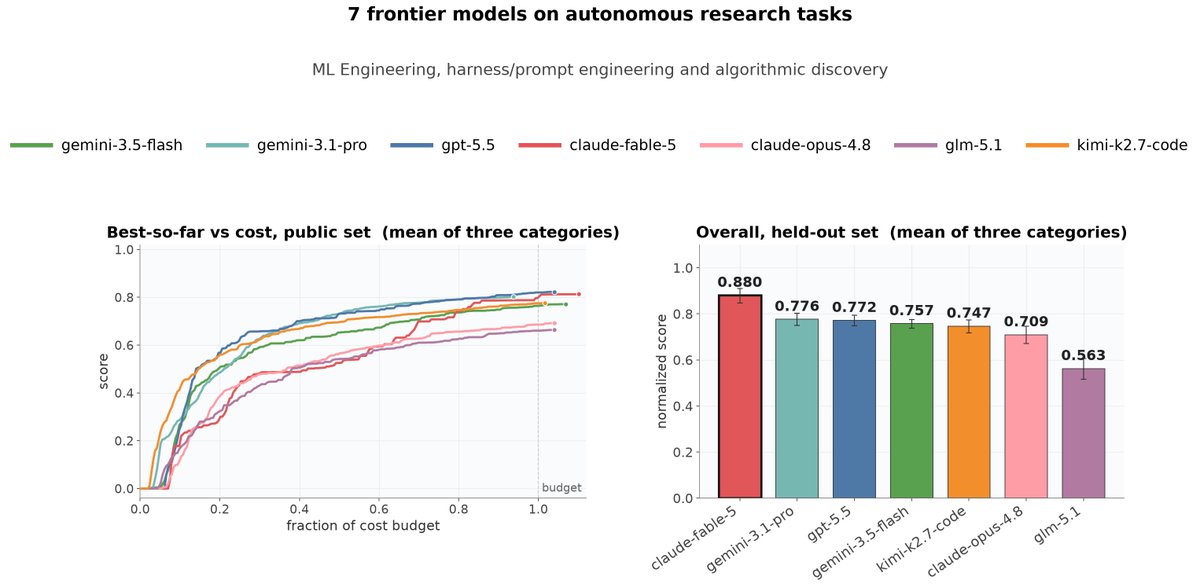
We benchmarked 7 frontier models on 3 categories of autoresearch tasks: ML engineering, harness/prompt engineering, and algorithmic discovery.
Fable-5 won overall even under cost constraint, but on ML engineering, the open model Kimi-K2.7-Code surpassed frontier models.🧵(1/5)
What Europe should do right now:
1. Call all the European researchers working on AI and return them back with same salary (or they can stay but switch career).
2. Fill EU places having GPUs with money, and put those people there.
3. AI partnerships with China + India.
Introducing Harness-1, a 20B search agent trained with a state-externalizing harness.
> frontier-level long-horizon search, rivaling Opus-4.6 and outperforming GPT-5.4
> Context-1-level cost and latency
> externalizes candidates, evidence, verification, and search history
> open-source
At microagi we want to put Europe at the front of physical and embodied AI. That’s why we’ve created the microagi research fellowship.
Fellows can build in our lab in Zurich or Munich, work with our team, our datasets and our partners like Unitree, Nvidia, and Google.
If you know someone who should be focussing on physical AI without any distractions, tag them, if you’re the first to tag someone who is accepted we’ll send you 10.000 USD
This SkillOpt paper from Microsoft is a must-read!
(bookmark it)
I was a bit skeptical of the results reported in the paper when I shared it a few days ago.
However, I managed to integrate it into my agent orchestrator and ran a few experiments.
The results are mindblowing.
Essentially, all my agent skills now have a proper testing framework and a way to self-evolve. I have started to improve all my agent skills with this.
One exciting result was when I applied it to my paper-figure-extraction skill, which requires an agent to do multimodal analysis. In particular, it improved quality by +20 points (0.73 → 0.93). I went to see the extracted tables and figures, and I was absolutely stunned by how much better my skill got at the task.
Self-improving AI is in the early days, but I think this work is a clear example of the current ability of agents to self-improve.
In this case, it was skills, but it's not hard to imagine how this scales to optimizing agent patterns, tool use, context engineering efforts, agentic search, workflows, evals, and even the harness itself. I already started with a few of these ideas inspired by SkillOpt.
Stay tuned!
Today we're shipping our biggest MLX-VLM release yet: v0.6.0
...and we are raising 💸
This one's about turning your Apple devices into real local agent machines. From your desk to your pocket.
What's new:
⚡ Speculative decoding everywhere — Gemma 4 EAGLE3 + DFlash, Qwen MTP, DeepSeek V4 MTP. Faster tokens, less waiting.
🤖 Agent-ready server — native Anthropic /v1/messages API, stateful /v1/responses, tool calls, Codex context budgets. Plug Claude Code & Codex straight into local models.
👁️ New models galore — DeepSeek V4, ZAYA1-VL, MiniCPM-V 4.6, LFM2 MoE, Step-3.7 Flash, Laguna + more.
🎨 Image gen & editing — FLUX.2 (base + klein), PrismML Bonsai.
🔊 Audio in — Qwen3 Omni, Gemma 4 audio, base64 chat audio.
🧮 TurboQuant KV cache — RHT-correct fast paths for leaner memory.
📦 Modular server, better metrics, cleaner streaming.
Run real agents on the hardware already in your hands.
Github: https://t.co/1T06ur6LU5
Today we're releasing Mellum2: our first "serious" LLM.
This is a 12B A2.5B MoE LLM pre-trained on ~11T tokens and post-trained with RLVR.
I'm proud to be leading the team that was working on it for the last 6 months.
We release base/SFT/RL checkpoints along with a tech report
LLMs learn by predicting tokens. World models (JEPA, data2vec) learn by predicting their own abstractions. Which needs more data? For data with hidden hierarchy, we prove the gap is exponential. https://t.co/r2uuX0lBCu
I've never been at a medical conference where the results have been greeted with a standing ovation
Tremendous breakthrough in pancreatic cancer treatment
Through science
Hard work, rigorous research, clinical trials.
Science
Not the quack pseudoscience of social media
I've got an agent in a loop optimizing a renderer with the goal to minimize frame times (and tests to measure). It got times down from 88ms to 2ms and allocations down from ~150K to 500. Sounds good, right? Wrong. This is exactly why agent psychosis is a big fucking problem.
As an experiment, I rewrote the Ghostty core render state in Go, with access to identically laid out data structures as Ghostty and the exact same validation tests. I made a purposely naive renderer (simple, correct, but slow). 88ms per frame with 150,000 allocations (horrendous, lol)!
I then kickstarted a Ralph loop to bring the frame times down. I told it it can't modify input data structures or the public API or tests (they're correct), but it can do anything else it wants. It got to work.
It has worked for about 4 hours. I've spent around $350 on this experiment so far. The results?
88ms => 1.5ms
150K allocs => ~500 allocs
Incredible right? Nope.
My hand-written renderer I ported has frame times (same benchmark) of ~20us (0.020ms) and 0 allocations in the update path.
This is the problem with psychosis and lacking systems understanding. If you don't understand the system, you're going to accept that this is an incredible result. If you understand the system, you'll see better solutions immediately and can do roughly 75x better on throughput.
The people who blindly trust agent output are in the former camp. They're sheeple, overdrinking from a fountain of mediocrity.
Standard disclaimer: I use AI all the time. I like AI. The point I'm making is to not blindly accept results. Think. Analyze. Learn.
We are going to need so many engineers and researchers where things are headed.
Don't listen to the noise, go learn the fundamentals and build/collaborate with AI as much as you can.
@aboutberlin Policy change is the only way out, protest and unionization the only paths available.
Until then, it will be a race to the bottom for many professions. Website owners are just one of the canaries in the coal mine.
Saying this as an ai bro.
The experiments conducted in this post illustrate how early we are as an industry on eval tooling.
Some takeaways and related thoughts:
1. Naively applying automation (which many current frameworks do) is likely to fail.
2. It's easy to get fooled that automation (esp overzealous automation) is giving you valuable insights.
Stay skeptical at all times!
3. We have to design eval workflows so human-in-the-loop accelerates effort while helping you externalize
what "good looks like"
4. Qualitative analysis hasn't sufficiently made its way into eval tooling as much as it should. There are opportunities to design better automation here. (QA is super underrated for evals btw)
BREAKING! Qwopus 3.6 27B is LIVE!
Thank you for your patience on this one, but I believe you'll find the wait was worth it!
We've benchmarked this thing up and down, verified that it holds at least a 75.25% (152/202) in the initial 202 SWE bench solves. Not a full run of 500, but it shows the agentic coding quality from the original 27B is retained while adding all of the additional Qwopus benefits across many domains. As always, Jackrong is absolutely cooking here!
COT quality has improved significantly through the inversion techniques from our Negentropy proof of concept. It also went through thorough curriculum training. You can check out the MMLU pro benchmarks on the model card, but it improved a whopping 10 points over the base model in physics, as well as meaningful jumps in Chemistry, business, and computer science.
However, the best part is that I was able to build an entire survival shooter game using this local model entirely. I genuinely was blown away by the results, which you can play right now on my HF space (link in comments below). "Qwopus Commander" was completed in 9 turns of Qwopus 3.6! To test the new long context training, I made it re-output the entire 3000+ line program each turn, and it would make fixes and add features that I requested in large prompts, while perfectly replicating the entire rest of the game from context. What's more is that I did it all at Q8 KV cache quantization, and never had an issue over the entire 303k token run!
IMPORTANT: Run it at --temp 0.75 to 1. Mess with it in that range for your use case. Higher temp actually lets the fine-tune shine and be exploratory and is also more stable. Swe Bench was run at temp 1, the game was built mostly at 0.8!
We're so blessed to have all of you here and using the models! The support means so much! Please let me know what you build with it in the comments! Or if you have any issues getting it up and running, I will try my best to get back to you!
Looking forward to seeing what you legends produce with it this weekend!
https://t.co/AEl3APtTLk