Introducing Harness-1, a 20B search agent trained with a state-externalizing harness.
> frontier-level long-horizon search, rivaling Opus-4.6 and outperforming GPT-5.4
> Context-1-level cost and latency
> externalizes candidates, evidence, verification, and search history
> open-source
Introducing Harness-1, a 20B search agent trained with a state-externalizing harness.
> frontier-level long-horizon search, rivaling Opus-4.6 and outperforming GPT-5.4
> Context-1-level cost and latency
> externalizes candidates, evidence, verification, and search history
> open-source
Introducing Harness-1, a 20B search agent trained with a state-externalizing harness.
> frontier-level long-horizon search, rivaling Opus-4.6 and outperforming GPT-5.4
> Context-1-level cost and latency
> externalizes candidates, evidence, verification, and search history
> open-source
A real scientist doesn't look up how the world works — they intervene, observe, and revise until a theory holds for a case they've never seen.
CausaLab drops an LLM agent into a lab where memorized facts are useless ("Quantum Crystals on Planet X") and asks for the same.
https://t.co/uAIafaVXbW
@UseAllOverTools yep, any frontier models here are equipped with context-1's harness - the self-context-editing one - the best one we know so far for agentic search
// State-Externalizing Harnesses //
A new paradigm is emerging on how to effectively build agents and harnesses.
If there is a state that the environment can maintain reliably, it probably doesn't belong inside the policy. Move it into the harness, and a 20B model trains better and generalizes further.
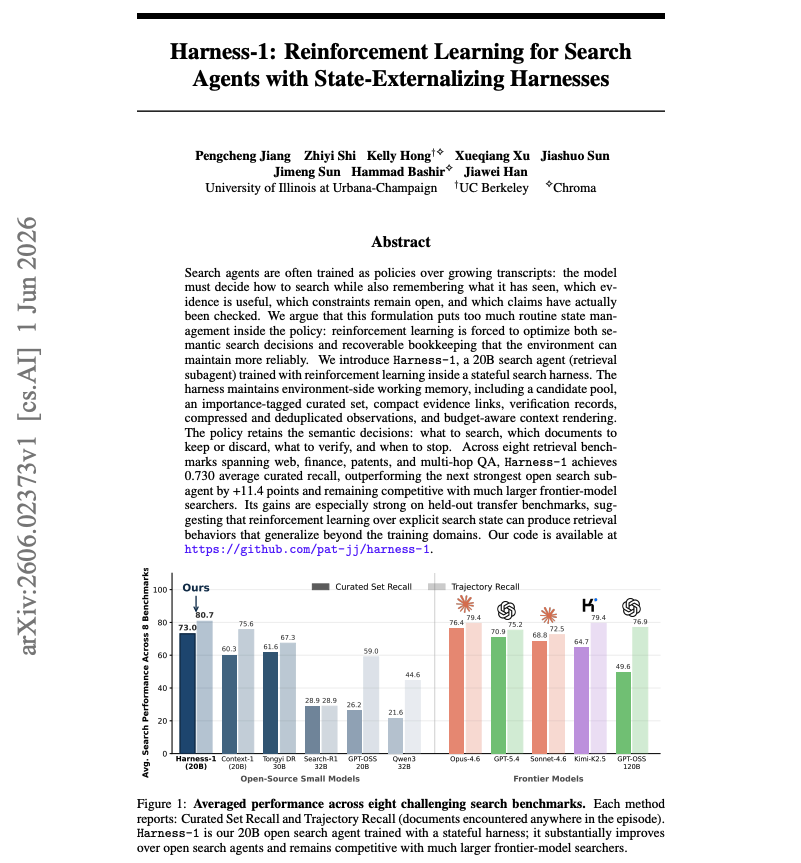
Search agents are usually trained on one policy over a growing transcript, so RL has to learn semantic search and routine bookkeeping at the same time. This model, Harness-1, splits those apart.
The harness keeps the working memory (candidate pool, evidence links, verification records, deduplicated observations, budget-aware context) outside the policy, and the 20B model only decides what to search, what to keep, what to verify, and when to stop.
Across eight retrieval benchmarks spanning web, finance, patents, and multi-hop QA, it reaches 0.730 average curated recall, beating the next-best open search agent by 11.4 points and staying competitive with much larger frontier searchers. The gains are largest on the held-out transfer.
Paper: https://t.co/8DOQtsLsp2
Learn to build effective AI agents in our academy: https://t.co/LRnpZN7L4c