If you watch only one investing video this year, make it this one.
Warren Buffett. 1998. 84 minutes.
He explained how to never lose money.
That framework is now worth $1 trillion.
The best investing course you'll never pay for.
Even 5 minutes can shift your investing mindset more than hours of market noise.
Save it.
China has successfully tested a sea-based rocket booster recovery system, a breakthrough for the country’s space programme that could help Beijing challenge US dominance in reusable rocket technology led by SpaceX and Blue Origin.
*FIFA 2026 Argentina vs Egpyt*
It would be such an embarrassment for FIFA if Argentina didn’t win.
But far more embarrassing is when a 3-3 game becomes 3-2 in a match that just concluded ARG3-EGY3.
Don't always FIX Match!
#FrancoisLextexier@FIFAWorldCup#VARwentOnTeaBreak
STEVE JOBS GOT FIRED FROM APPLE.
Then he walked straight into MIT and dropped the most raw, unfiltered 60-minute business masterclass ever recorded.
Zero PR bullshit. Zero image to protect.
Just pure, brutal honesty from the man who built Apple once and was about to rebuild it even bigger.
Stop scrolling.
Watch this tonight instead of Netflix.
Bookmark it. Come back to it.
In 1998, Warren Buffett gave a 1-hour masterclass on how to never lose money investing.
Here are the 22 most valuable lessons from his lecture:
1. You only have to get rich once. If you have $100 million and can make 10% unleveraged or 20% leveraged, the difference between $110 million and $120 million at year-end means nothing to your life, your family, or anything. But the downside, especially with other people's money, is disgrace, humiliation, and facing the friends whose money you lost. The equation never makes sense.
2. To make money they did not need, they risked money they did have and needed. That is just plain foolish, Buffett says, regardless of your IQ. If you hand him a gun with a million chambers and one bullet and offer him any sum to put it to his temple and pull once, he will not do it. There is nothing on the upside that justifies the downside. People do this financially all the time without thinking.
3. The smartest people in finance went broke, and that is the most fascinating story Buffett knows. Long-term Capital Management had 16 people with possibly the highest average IQ of any business in the country, 350 to 400 combined years of experience, and most of their own net worth in the firm. They still went bankrupt. Buffett says if he ever wrote a book, it would be called why smart people do dumb things.
4. Beta and sigmas tell you nothing about the real risk of going broke. The LTCM team relied heavily on mathematics and believed a six- or seven-sigma event could not touch them. They were wrong. History does not tell you the probabilities of future financial events. The real risk is not volatility. It is a permanent, irreversible blind spot in something crucial, often caused by knowing a great deal about something else.
5. Invest only in businesses you can understand. That one rule narrows the field by about 90%, and that is fine. Buffett can understand Coca-Cola. he cannot value an internet company, and he says if a student handed him a valuation of one on a final exam, he would flunk them. People thought Enron was incredible because it had a good track record, but almost nobody understood how it made money. That was the signal to avoid it.
6. You want a business that is a castle with a wide moat around it. Inside the castle, you want an honest, able, hard-working duke. The moat can be low cost, like Geico in auto insurance, or brand, or patents, or location. But a wonderful castle will always be attacked, so the job of every manager Buffett owns is one thing: widen the moat. Throw crocodiles and sharks into it to keep competitors out.
7. Moats change slowly and invisibly, but they change. Thirty years ago, Kodak's moat was as wide as Coca-Cola's. They had share of mind; the little yellow box meant best in everyone's head. Then they let Fuji into the Olympics and narrowed their own moat. Coca-Cola's moat, by contrast, is wider now than 30 years ago. Every time infrastructure gets built in a country that is not yet profitable, the moat widens a little. You cannot see it day by day, but in 10 years, the difference is enormous.
8. Share of mind beats share of market. When you say Disney, every person in the room has something in their head. Say Universal Pictures or 20th Century Fox, and you have nothing. A mother with two kids will pick the $17.95 Disney video over the $16.95 alternative because she knows it will be fine and does not want to preview ten videos to decide. That little bit of certainty in the customer's mind is worth a fortune.
9. The best businesses have pricing power and require little capital. see's candy sold 16 million pounds at $1.95 when Buffett bought it for $25 million. The entire thesis was whether the price could go to $2.25 without hurting sales. It could, because nobody wants to hand their valentine a box of candy and say, "This year I took the low bid." Today, See's makes $60 million on the same formulas and still takes almost no capital. Compare that to GM, which had to reinvest every dollar into better factories and whose stock barely moved over 50 years.
10. The best businesses earn a royalty on other people's capital. Coca-Cola sells a formula and collects a royalty on every drink. American Express takes a few percent of every dollar you spend. You put up the capital, they take a cut. Low capital intensity is one of the most underrated qualities in a business and one of the surest paths to durable wealth.
11. Define your circle of competence and stay inside it. The size of the circle does not matter. Staying inside, it does. If you know which 30 companies out of thousands you actually understand, you are fine. Buffett understood H.H. brown shoes and Frank Rooney, so he closed that deal in five minutes. If you do not know enough to understand a business instantly, you will not understand it in a month either.
12. Ignore the macro entirely. Buffett has never bought or skipped a business because of a feeling about interest rates, the economy, or any macro forecast. If Alan Greenspan and Bob Rubin both whispered exactly what they would do for the next 12 months, it would not change what he pays for anything. You want to focus on what is important and knowable. The macro is important but not knowable, so you ignore it.
13. Inactivity is the strategy, not a flaw. Wall Street makes money on activity. You make money on inactivity. A broker is like a doctor paid by how often he changes your pills. If everyone in a room trades their portfolio with everyone else every day, they all end up broke, and the intermediary keeps the money. Buffett looks for one good idea a year and rides it to its full potential. He measures Berkshire by how little turnover there is, like a church where the same people fill the seats every Sunday.
14. If you understand businesses, diversification is a mistake. For the 99% who will not evaluate businesses, Buffett recommends a low-cost index fund and extreme diversification. But if you bring real intensity to evaluating companies, owning more than six is a terrible idea. Very few people got rich on their seventh best idea. A lot of people got rich on their best one. Buffett keeps about half his money in what he likes best.
15. Buffett's biggest mistakes are mistakes of omission, not commission. The times he understood a business well enough to act and instead sat there sucking his thumb. He passed on healthcare stocks during the Clinton plan and on Fannie Mae in the mid-eighties, each a multi-billion-dollar miss. Accounting never captures these. The $2,000 he put into a Sinclair service station as a young man, money he lost, has an opportunity cost of about $6 billion today.
16. Focus on what will happen, not when. Coca-Cola went public in 1919 at $40 a share and dropped to $19 within a year. There was always a reason not to buy: the great depression, world war, sugar rationing, thermonuclear weapons. But one share bought then and reinvested would be worth about $5 million. If you are right about the business, you will make a lot of money. The timing is the tricky part, so do not focus on it.
17. When hiring, look for integrity, intelligence, and energy. But if the person lacks the first one, you actually want them dumb and lazy. Because a person with intelligence and energy but no integrity will destroy you. Buffett borrowed this from Pete Kiewit. The trait everyone screens for last is the one that matters most.
18. Here is a thought experiment Buffett gives students. Imagine you could own 10% of one classmate for the rest of their life. You would not pick the highest IQ or the best grades. You would pick the person you respond to best, the one who is generous, honest, gives credit to others, and has leadership qualities. Now imagine you also had to short one classmate. You would pick the egotistical, greedy, slightly dishonest one. The qualities that decide both are not talent. They are character.
19. Every quality on the admirable side is achievable, and every quality on the repellent side is removable. The things that make you want to own 10% of someone are not the ability to throw a football or run fast; they are behavior, temperament, and character, all of which anyone can choose. Buffett's point: you already own 100% of yourself, so you might as well become the person worth betting on.
20. The chains of habit are too light to be felt until they are too heavy to be broken. Buffett sees people in their forties and fifties trapped by self-destructive patterns they can no longer change. At a young age, you can choose any habits you want. Ben Franklin and Ben Graham both did exactly this, looking at people they admired and simply deciding to behave like them. There was nothing impossible about it.
21. Take a job you would take if you were already independently wealthy. Buffett told a 28-year-old at Harvard who wanted a consulting job "to look good on his resume" that it was like saving up sex for your old age. There comes a time to just start doing what you love. Buffett offered to work for Ben Graham for free, was told he was overpriced, and kept pestering him for years. Take the job you would jump out of bed for. You cannot miss.
22. You won the ovarian lottery, and that should shape how you think. Buffett imagines a genie 24 hours before your birth letting you design the world's rules, with one catch: you do not know which of 5.8 billion balls you will draw. Born here or in Afghanistan, with an IQ of 130 or 70, male or female, able-bodied or not. If you could put your ball back and draw one of 100 random others, most people would not, because they are already in the luckiest 1%. Buffett knows he is perfectly wired for a market economy that pays him like crazy, while an equally good citizen leading scout troops and teaching Sunday school is not, purely by luck.
Heroic act at Almaty Airport, Kazakhstan:
52-year-old former boxer Musa Abdraim volunteered to take the place of a 21-year-old flight attendant who was being held at knifepoint by a 67-year-old man.
He then grabbed the knife with his bare hands and helped subdue the attacker with police assistance
True bravery
A man spends 50 years teaching at MIT.
He knows his time is running out.
So he records one last lecture — everything he knows, distilled into a single hour.
He died 5 months later.
This is that lecture.
The most important hour you'll watch this week. 👇
Bookmark it for later
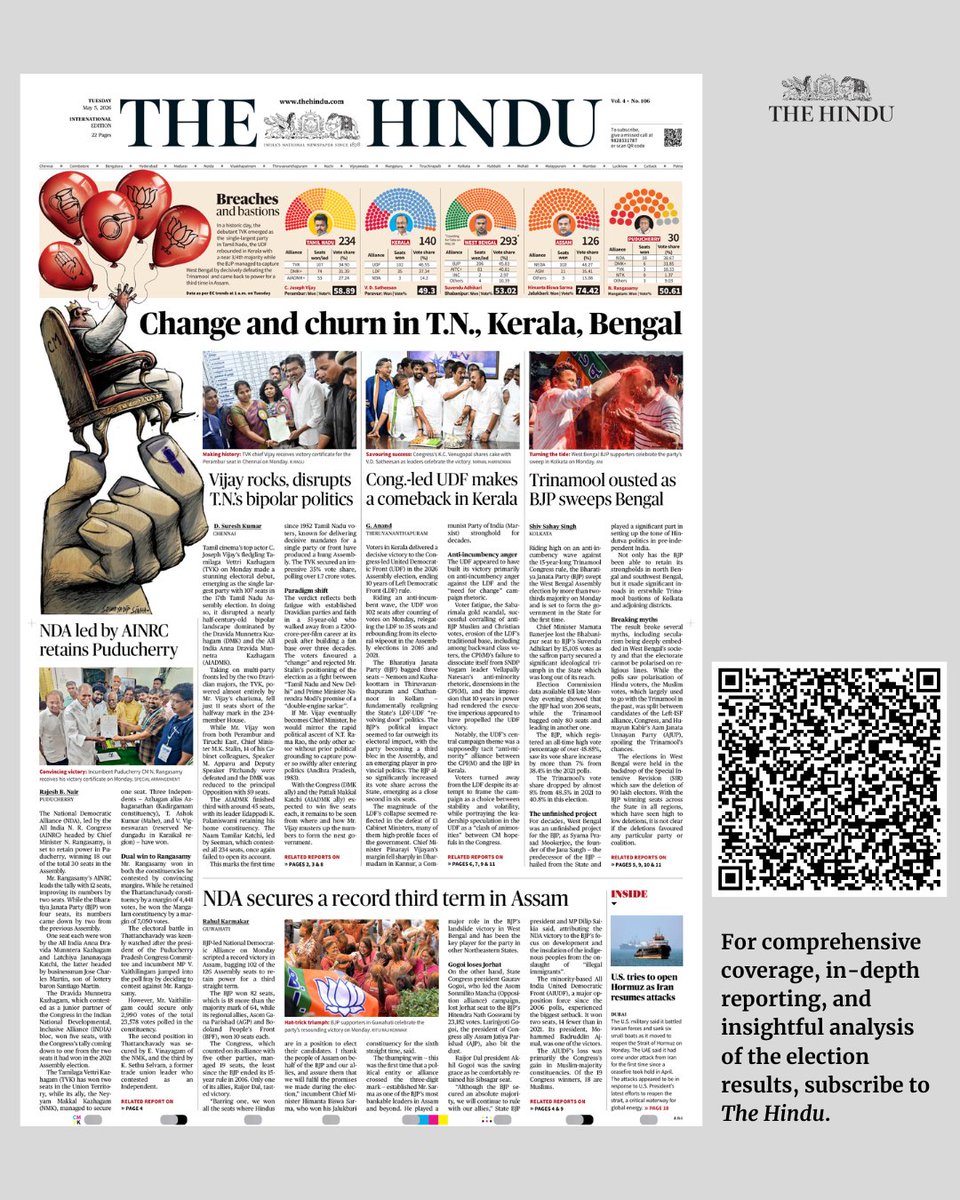
#ElectionsWithTheHindu | On May 4, 2026, a historic day marked by change and churn in Tamil Nadu, Kerala, and West Bengal, while Assam remained with the party already in power.
For comprehensive coverage, in-depth reporting, and insightful analysis of the election results, subscribe to The Hindu.
https://t.co/iBEECqnGic
IMPORTANT Data point:
49 constituencies in West Bengal had winning margins lower than number of electors deleted in SiR
26 won by BJP, 21 by TMC, 2 by Cong
Average victory margin of BJP in 207 seats was an impressive 27,805 ,
Note: total of 90 lakh names deleted during electoral rolls. Over 34 lakh appeals pending before tribunals which is a sizeable number.
Net net: SIR may have affected marginal seats BUT did NOT influence final verdict in WB. It was HIGH ANTI INCUMBENCY in several regions that cost TMC after 15 years in power .
More details here: https://t.co/R44Xdn3STH
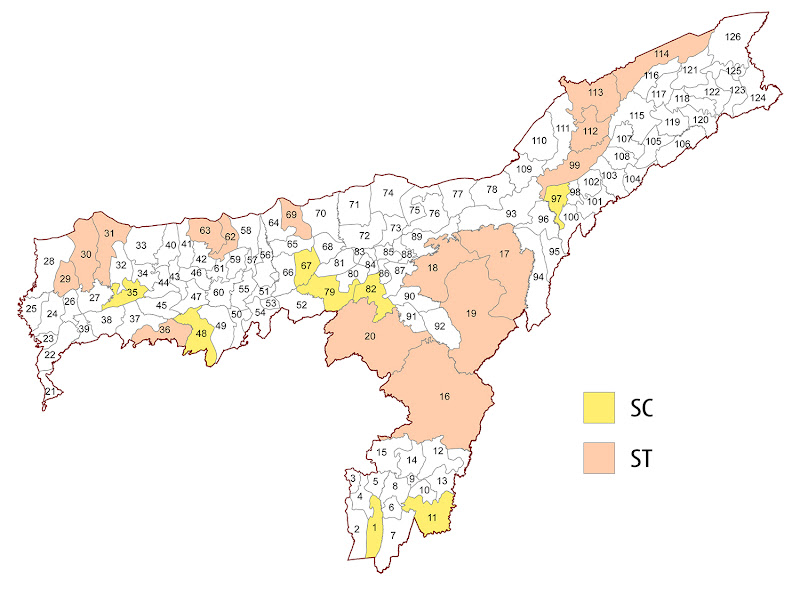
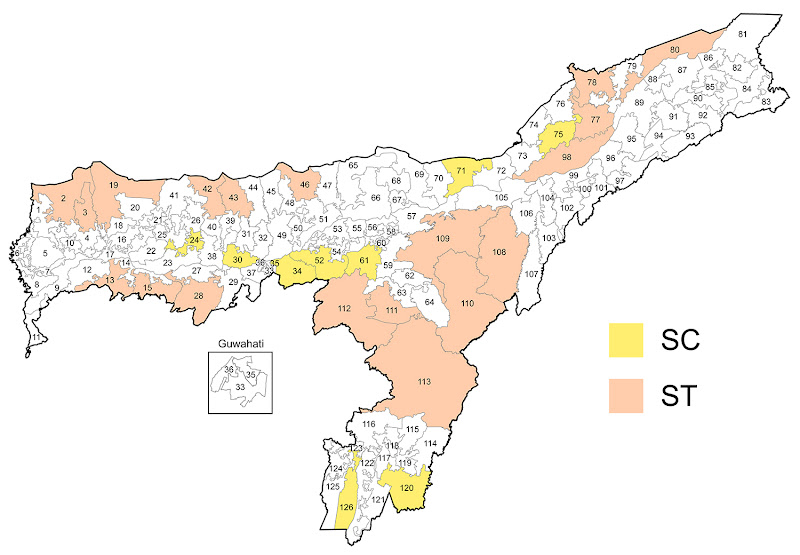
The constituency boundaries of Assam in the post-delimitation map (right) were rather byzantine, violating the principle of compactness and indicating an attempt at gerrymandering.
The 2026 Assam assembly election explained by Ajachu Chakrabarti (@marcopolar) with interactive maps: https://t.co/pYheDHLQai
Dear @narendramodi your party has the lowest percentage of women among all parties in Lok Sabha . Implement Women’s Reservation NOW based on 543 seats - what is stopping you? Jumlabazi Nahi Chalegi
Deceptive/crafty/dodgy/foxy/guileful/knavish/slysy/tricky/tricksy/clever/ingenous/innovative/craftiness...
And what more adjectives do you have besides the above synonyms?
In 1999, Ratan Tata flew to Detroit with his team.
The Tata Indica had just been launched. Sales were poor. The board wanted to sell the passenger car division to Ford to cut losses.
Ford agreed to a meeting.
What happened in that boardroom was recounted by Pravin Kadle, who was present that day.
Ford executives told Ratan Tata this.
You do not know anything. Why did you even start a passenger car division?
Then they said they were doing Tata a favour by considering buying the struggling business.
On the 90-minute flight back to New York, Ratan Tata sat in silence. He spoke almost no words.
He returned to India and cancelled the sale.
Tata Motors would not be sold. Not to anyone.
For nine years, he said nothing publicly about what happened in Detroit. He simply got to work.
In 2008, Ford was on the verge of bankruptcy. The Great Recession had broken them. They needed to sell their most prized assets urgently.
Jaguar. Land Rover. Two of the most iconic British car brands in the world.
They called Ratan Tata.
Tata Motors bought both for Rs 19,000 crore. All cash.
When the papers were signed, Ford chairman Bill Ford flew to Mumbai and sat across from the same man he had humiliated nine years earlier.
He said this.
You are doing us a big favour by buying Jaguar Land Rover.
Ratan Tata made no reference to 1999. No speech. No dig. He simply said he was looking forward to supporting both brands.
He never needed to say anything else.
India walked into that room in 1999 as a seller being insulted.
India walked out of that room in 2008 as the buyer being thanked.
Nothing changed except who needed whom.
Follow for real stories about Indians who made the world take notice.
#WATCH | Delhi | Congress MP Shashi Tharoor says, "It has been a very convincing victory. The BJP fell 52 votes short of the two-thirds they needed to pass the constitutional amendment... We are feeling a certain sense of triumph. this is not a vote against women's reservation, but against delimitation and the mischief that delimitation and the dramatic expansion of Parliament would do to our democracy, so we voted to save our democracy..."
"We have said even in our speeches, that we will vote for women's reservation if you will delink it from delimitation. It is against their refusal to delink this that we have voted..."