Aaron delivers a master class in CEO communication. Speaks w/humility, confidence + clarity on a wide range of topics, is appreciative + complimentary of his competition + the market overall while clearly bullish in his own biz. Thx @ceo_clickhouse@HarryStebbings
Dyson trained an AI on 470,000 dental images and put it inside a toothbrush. With a camera. That flosses for you. In real time.
It's called the CameraJet for $499. Launched today.
A 100,000-pixel macro lens sits inside the brush head. It takes 28 images per second while you brush. The AI detects gaps between your teeth and within 100 milliseconds fires a precision jet of mouthrinse directly into the gap.
It's computer vision doing your flossing. While you brush. Automatically.
Only Dyson would look at a toothbrush and think it needs a camera, a machine learning model, and a jet engine.
The story of ClickHouse is truly insane.
Started as an open-source project; scaled into the fastest-growing database product ever.
Year 1: $0
Year 2: $12M
Year 3: $50M
Year 4: $200M
Year 5 (not complete): My bet is $450M.
My notes from our discussion with @ceo_clickhouse below 👇
1. Are Large U.S. Enterprises Scared to Work With Frontier Model Providers?
Large enterprises remain skeptical of “zero data retention” claims and wary of sending proprietary source code to frontier labs due to IP indemnification and data leakage concerns. Rather than exposing production code, companies may limit frontier model usage to less sensitive workflows like code review while turning to open-weight alternatives for critical data.
2. How Do You Assess Defensibility and Moat in Companies That Scale Faster Than Ever Before?
When an application scales from zero to $100M in ARR in a single year, investors must rigorously question its underlying moat. Hypergrowth without high switching costs leaves companies vulnerable to rapid churn as customers move effortlessly to the next model or tool that leapfrogs the incumbent.
3. How Does This AI Cycle Compare to Prior Technology Shifts and Transitions?
Unlike the gradual adoption curves of the internet and mobile eras, the current AI wave is accelerating at an unprecedented pace. Agentic experiences are maturing rapidly, driving explosive revenue growth and placing historically unique performance demands on underlying data infrastructure.
4. What Job Does Not Exist Today That Will Be Very Prevalent in Five Years?
A critical new corporate role could be an AI finance function dedicated entirely to managing token consumption and resource allocation across the enterprise. But the role may ultimately be short-lived as autonomous AI agents increasingly manage their own infrastructure spend and budget execution.
5. What Should Investors Be Worried About Today That They Are Not?
The biggest overlooked risk in AI today is revenue durability. While infrastructure software benefits from high switching costs, agentic applications can have exceptionally low barriers to switching, raising questions about long-term retention as models and products continually leapfrog one another.
6. Why Revenue Concentration Is a Real Concern
Operators and investors should treat revenue concentration as a critical risk, with any single customer or vertical accounting for more than 10% of revenue representing significant exposure. Sustainable enterprise value requires a diversified customer base so losing one account never threatens the company’s overall growth trajectory.
(links in comments)
I didn’t think autonomy would get nationwide-scale this fast... but here we are 📷!
Our work with @HUMAIN and @TareqAmin_ will bring thousands of trucks to KSA. But this is just the start – followed by robotaxis, ports, mining, construction, and more.
The size, scale and scope is unprecedented! Letssss go! 🚀🚀🚀
Think big. That’s always been a driving motivator for us, and now we have a partner to match our ambition. Today, we’re proud to announce Applied Intuition’s strategic collaboration with HUMAIN to deploy physical AI across Saudi Arabia, starting with autonomous trucking. This is a major step toward our goal of making a billion machines intelligent.
Together, we will deploy thousands of autonomous trucks throughout key Saudi logistics corridors by 2030. This will make it the largest autonomous trucking network in the world, and our Self-Driving System and Vehicle OS technology will be the centerpiece of this collaboration with HUMAIN.
This is physical AI at national scale.
https://t.co/bpQlsUjwvJ
Starting using Instinct last night. Magical experience booking a flight for my son and making dinner reservations. As a consumer offering, I think it’s the best AI product since ChatGPT launched in 2022. Congrats @noahrshinn!
I’m Noah, the founder of Instinct.
Instinct is a personal agent that we’ve been building for the past few months. The interface is simple: there are no new interfaces. You can text or call it. It's trained to use a phone and a computer in the same way that humans do. Instinct combines simplicity with extreme capability.
I’m thrilled with everything our early users are doing with Instinct. They’ve told us they’ve planned cross-country road trips, bought weekly groceries and concert tickets, and cancelled hundreds of dollars of subscriptions. Someone’s even planning their wedding with Instinct.
We want to make Instinct the best personal agent for all of you. It’s available in an invite-only beta program while we’re actively bringing up more compute. I’m excited to see what you all do with it.
https://t.co/lVra3kd4TT
We are going to see a lot of vertically focused AI native companies accelerate.
Routers, open-source models and specialized post-training enabled by companies like @FireworksAI_HQ have all made dramatic advances and the combination of the three is driving accelerating growth.
Companies like @wearelegora can now use their data to post-train an open-source model and then combine it with frontier models behind a router to get the same or better outcomes at lower costs than the frontier alone.
This dramatically improves the business model for all these companies. @cognition seeing similar trends.
AI is driving a historic surge in investment:
High-tech capital spending accounted for 55.2% of total nominal capital spending in the US economy in Q2 2026, the highest proportion on record in data going back to 1960.
High-tech spending includes expenditures on equipment, software, and R&D.
This percentage has surged +12 points since the 2020 pandemic.
By comparison, this metric peaked at ~44% after the 2000 Dot-Com Bubble burst.
To put this into perspective, high-tech spending did not exceed 25% of total capital spending until the 1980s.
Meanwhile, combined CapEx across Amazon, $AMZN, Google, $GOOGL, Microsoft, $MSFT, and Meta, $META, is projected to surpass $1.1 trillion by 2027, exceeding total annual US defense spending of ~$900 billion for the first time.
The AI revolution is transforming the US economy.
New: Ramp's top SaaS vendors for August 2026
1/ This month, we saw continued growth in model serving / routers as more firms shift spend to cost-saving + open source AI.
2/ A few underrated areas of growth: a lot of competition for AI customer service / sales / voice agents, and seemingly no clear winner in this category given how many different competitors show up on this list month-over-month.
3/ Plus, 9% of firms are using AI to generate images and video for marketing and advertising.
That's about half the adoption rate of Figma, and growing quickly.
The Department of War awarded @hiddenlevelinc a $100 million Other Transaction Authority (OTA) contract to scale its passive sensing technology across the U.S. military.
The size of the OTA reflects a broader shift in defense procurement toward faster, more flexible pathways for bringing commercially developed technology into military use at scale.
Read the full announcement👇https://t.co/5WJDUFJUZq
New: Ramp's top SaaS vendors for August 2026
1/ This month, we saw continued growth in model serving / routers as more firms shift spend to cost-saving + open source AI.
2/ A few underrated areas of growth: a lot of competition for AI customer service / sales / voice agents, and seemingly no clear winner in this category given how many different competitors show up on this list month-over-month.
3/ Plus, 9% of firms are using AI to generate images and video for marketing and advertising.
That's about half the adoption rate of Figma, and growing quickly.
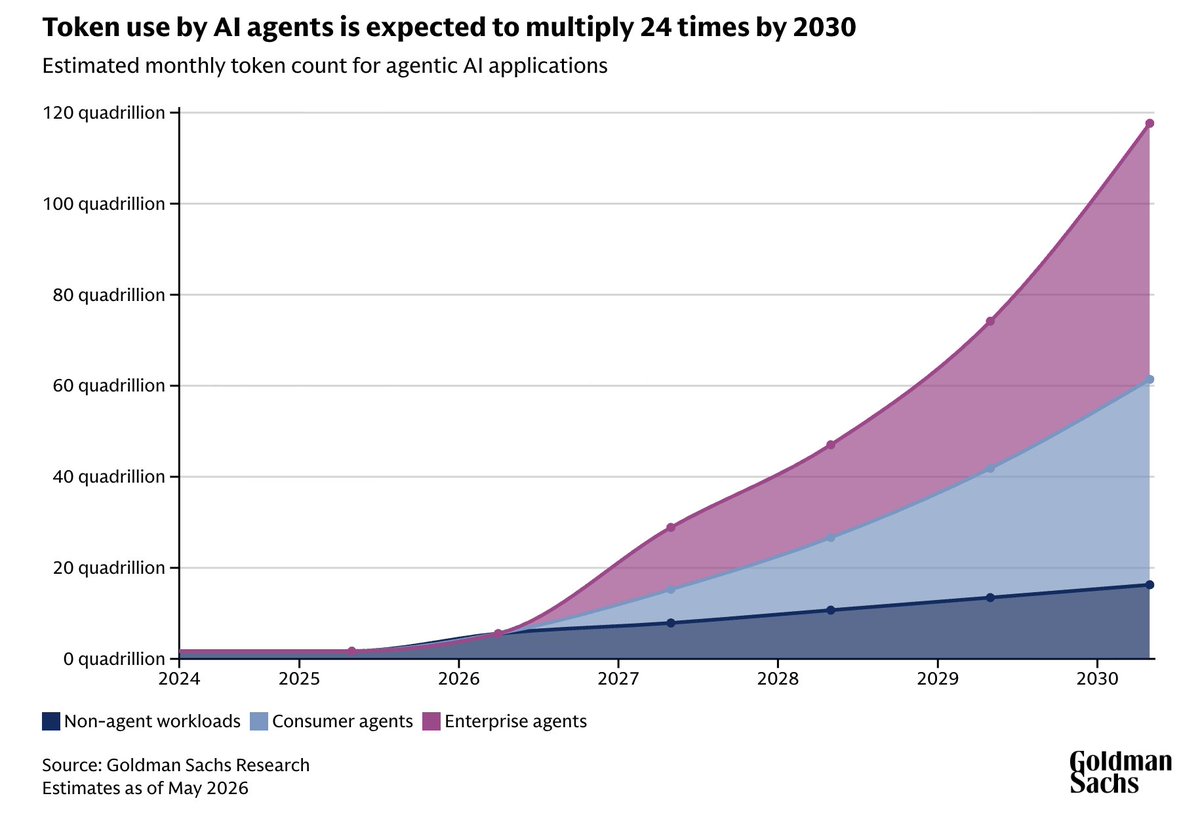
In my 30-year investing career, I’ve never seen the market underestimate a growth curve the way it’s underestimating AI token generation.
Late last year, Dell put out an estimate that inference would run about one quadrillion tokens a month by the end of 2028. Their current estimate for the same date is 57 quadrillion. That’s a roughly 57x change inside a single year!
And Goldman Sachs has since published projections that sit an order of magnitude above Dell's revised number.
In 2023, we met @MaintainX founder and CEO @CTurlica and invested alongside the company’s Series C. This week, @Autodesk officially completed its acquisition of MaintainX.
We’re thrilled for Chris and the entire MaintainX team and excited to see what they build with Autodesk!
Two of our Partners, @mkjung and Owen Van Arsdale, share their thoughts on the acquisition in our latest blog post: https://t.co/dCqIsBQ0Fd
Across every dimension, July was the strongest quarter-opening month in @WeAreLegora's history.
Net new ARR was 90% higher than April ‘26, our prior quarter-opening record. ARR grew more than 10x year-on-year. This reflects something specific: more in-house legal teams are choosing Legora, not just law firms.
But as always, what I care about most is customer love. Our MAUs now use Legora for 16 hours per month. Our gross retention is 95%+, against millions of dollars in upsold ARR. Retention at this level, while expansion is accelerating, is the hard thing to get right. It's the number that tells you customers aren't just buying Legora, they're building on it.
We're not slowing down from here.
LFG @MaxJunestrand
In the AI era, ten seconds is too slow.
Models and agents need fresh context in real time, making database latency a direct constraint on the quality of the products they power. @ClickHouseDB was built for this moment, returning answers across billions of rows in fractions of a second while often significantly reducing infrastructure costs.
@ceo_clickhouse, Alexey Milovidov, @izrailevsky, and the entire ClickHouse team are building the cloud-native data infrastructure behind some of the world’s most demanding AI applications, and we're proud to be part of their Circle! 👏
Read more from @mkjung and @DominickRichiu2 about why we invested and how the journey began with a conversation on a chairlift: https://t.co/XUC7nK1z1S