We are witnessing the end of once mighty @ZANUPF_Official. Political illegitimacy is now too heavy. Local & international community have rejected ED. The econ. crisis makes it impossible 4 patronage.
Tava kumagumo!
Pliz screen shot this.
Mai Mujuru vanoti 'Batai Mazwi aya"
To the CCC Progressive Caucus:
You were mocked, misrepresented and written off. Yet you stood firm and protected one of the last remaining zones of democratic autonomy in our constitutional order.
As CAB3 comes before Parliament, I have every confidence you will once again stand with the people of Zimbabwe and reject it in its entirety.
Country before expediency. Constitution before politics.
Together to the end.
#DefendTheConstitution
#RespectThePeople
Convenor of @cdfzim Advocate @BitiTendai is right now addressing a specially invited audience of ambassadors from Southern African countries, diplomats from other countries, senior UK government officials, representatives of business and civic organisations, as well as academics and researchers on Africa and Zimbabwe, at Chatham House in London.
It is important to present an accurate narrative to Zimbabwe’s diplomatic and business partners of Mnangagwa’s 2030 agenda and the #CAB3 power heist by which he seeks to bypass the sovereignty of the people of Zimbabwe to get his way.
From this high level, strategic briefing, Mr Biti will head to the Zimbabwean diaspora grassroots in Leicester on Saturday to deliberate with compatriots on the controversial constitutional amendments being driven by Mnangagwa’s government, and explore ways and means by which Zimbabweans can carry their struggle for constitutionalism and democracy in their country forward.
Join us in Leicester on Saturday!
CAB3 and Rural Zimbabwe: Whose Land, Whose Vote, Whose Future?
By Eddie Mahembe, PhD
Introduction
According to Zimbabwe’s 2022 Census, 61 percent of its 15.2 million citizens - about 9.3 million people, approaching 10 million by 2026 - live in rural areas.
Rural constituencies decided the 2023 election, with ZANU-PF averaging around 70 percent in rural assembly contests.
Whoever controls rural Zimbabwe controls the country.
That is not merely a political fact; it is the most important development economics statement about this nation.
While the Constitutional Amendment Bill No.3 (CAB3) is being debated as a legal and governance matter, at its core lies the critical question of rural development.
Furthermore, CAB3, in its current form, collides directly with President Mnangagwa’s own stated agenda and potential legacy.
In November 2025, President Mnangagwa launched the National Development Strategy 2 (NDS2, 2026–2030) at State House, serving as the blueprint for Vision 2030 to achieve a “Prosperous and Empowered Upper Middle-Income Society”. NDS2 explicitly commits Zimbabwe to inclusive growth, decent jobs, devolution, social protection, and strong institutions - commitments fully aligned with the UN Sustainable Development Goals (SDGs) and the AU Agenda 2063.
However, CAB3 pulls aggressively in the opposite direction, creating a profound internal contradiction.
You cannot reach the upper-middle-income society of Vision 2030 on a constitutional road that leads away from inclusive growth, devolution, and strong institutions.
CAB3 and Vision 2030 are travelling in opposite directions, and only one can define Zimbabwe’s future.
A History That Defines Today
The colonial Land Apportionment Act (1930) confined African communities to reserves and co-opted traditional leaders as instruments of dispossession. Independent Zimbabwe renamed these structures but preserved the underlying tenure system under the Communal Land Act (CLA, 1982). Under the CLA, communal land ownership - spanning roughly 16.4 million hectares and housing the majority of rural Zimbabweans - vests entirely in the President and is allocated locally through traditional leaders.
Four decades on, the rural smallholder still lives on land that is not legally theirs.
Yet, the liberation struggle was fought precisely to restore land, dignity, and agency to the African majority under the historic cry, “izwe lethu, ivhu redu, the land is ours”.
That promise must be measured not by who controls the rural areas, but by whether the rural African is genuinely empowered to build a future upon them.
When communal land belongs to the President, traditional leaders control access to it, and those leaders are stripped of political neutrality, the result is not administration - it is total control.
What CAB3 Does to Rural Zimbabwe
Section 281(2) of the current Constitution strictly bars traditional leaders from partisan politics.
Clause 20 of CAB3 repeals this protection, effectively politicising traditional leaders.
The bill's memorandum frames neutrality as a violation of leaders’ individual political rights, a dangerous argument that fundamentally confuses individual liberties with institutional roles.
A leader who controls land allocation and community resources wields systemic power that demands absolute neutrality, just as a judge must subordinate personal politics to the objectivity of the office.
Because communal land vests in the President and traditional leaders allocate it, Clause 20 allows those same leaders to openly campaign for the ruling party - the party of the President who holds their land in trust.
For any rural household perceived to back the opposition, the consequence is stark: insecure tenure, restricted access to basic resources, and a chilling effect on local enterprise.
Development economists recognize this as the political capture of local economic institutions, occurring simultaneously at the apex and the base.
Today CAB 3 was read for the first time in Parliament. The Bill represents a monumental regression and must be resisted by all patriotic Zimbabweans! It is wrong to push the country to the precipice in pursuit of a narrow selfish power retention agenda.
May God grant courage to all MPs across the political divide to prioritize the national interest over ego-trips!
May God bless #Zimbabwe!
#notocab3
#NoTo2030
@pmkwananzi@nelsonchamisa Maybe we need to move (or should have moved) from speaking with clarity to decisive steps. There is wisdom in this statement: action speaks louder than words!
Dear @ProfJNMoyo ,
What's the real motive behind all this? What's the end-game?
What's so special about the current crop of leaders (President, MPs, etc) that we cannot allow them 2 serve their terms and go home?
If they want another term (whether 5 or 7) they can contest in 2028
Closing Argument: 2/4
Under Clauses 4 and 9 of the Constitution of Zimbabwe (Amendment No. 3) H.B.1 Bill, 2026, the President and Members of Parliament will serve a seamless “Continuation in Office” from 2023 to 2030.
This is not a two-year term extension from 2028 to 2030. Since its gazetting on 16 February 2026, the Bill has been plagued by persistent misconceptions. Chief among them are the claims that:
• the Bill is allegedly being rushed into law before President Mnangagwa—who was sworn in on 4 September 2023—reaches the three-year mark on 5 September 2026 (the minimum deemed a full term under section 91(2)), so that the current 10th Parliament can elect him to a fresh seven-year term ending in 2033;
• alternatively, the Bill supposedly grants President Mnangagwa and sitting MPs a “top-up” of two years that would not count as a full term under section 91(2); and
• the Bill allegedly lacks any transitional provisions for the shift from a five-year to a seven-year electoral cycle.
All three claims are demonstrably false.
First, the Bill makes crystal clear that the transition to the seven-year national electoral cycle begins in 2023 and runs to 2030. There is therefore no urgent deadline of 4 September 2026 to beat, nor any need for the current Parliament to re-elect the President. His mandate rests squarely and exclusively on the harmonised general election of 23/24 August 2023. No rush is required or implied.
Second, the notion that the Bill confers a “two-year top-up” finds no support in any clause. It rests on a fundamental misreading of section 91(2), which states:
“A person is disqualified for election as President or appointment as Vice President if he or she has already held office as President under this Constitution for two terms, whether continuous or not, and for the purpose of this subsection three or more years’ service is deemed to be a full term.”
The phrase “three or more years’ service is deemed to be a full term” establishes a protective minimum threshold, not a flexible ceiling. The term limit provision regulates what constitutes a term and sets the maximum at two terms, with a ceiling of “…or more years.” The actual number of the ceiling is determined by the length of the term or electoral cycle, as regulated by the inextricably linked provisions of sections 95(2), 143(1) and 158, read with section 277(1)(a). Although these sections harmoniously relate to (and predate) section 91(2), they are not term limit provisions within the meaning of subsections (1) and (7) of section 328.
Once an incumbent has served three years or longer in any single term, that service counts as a full term for disqualification purposes. The actual length of a presidential term is governed exclusively by section 95(2), which currently sets it at five years.
Section 91(2) therefore provides no authority for a two-year “top-up” from 2028 to 2030 that would somehow evade the two-term limit. To read it otherwise would transform a constitutional safeguard into an open-ended licence for perpetual extension—an interpretation the Constitution simply does not permit.
Third, Clauses 4, 9 and 10 of the Bill contain an explicit and unmistakable transitional design. They create a single, continuous seven-year term commencing on 4 September 2023 and ending on 5 September 2030. This is not an extension tacked onto the end of the current five-year term in 2028; it is a reformed and restructured term from its very inception.
That is precisely why Clauses 4 and 9 include the transitional “continuation in office” provisions: they guarantee a seamless bridge from the old five-year framework to the new seven-year framework without triggering a fresh “third term” or the need for a referendum.
The arithmetic is straightforward and unassailable. Under the Bill, the President’s tenure runs from September 2023 to September 2030—one lawful term, lengthened by Parliament’s sovereign amending power. No separate sub-two-year fragment is being added in 2028. Section 91(2) fixes the minimum that counts as a term; section 95(2) fixes the full term’s length; and the Bill lawfully varies that length from its starting point in 2023.
In truth, the Bill does not tamper with the personal tenure of the President or MPs as individuals.
Through Clauses 4 and 9, it does something far more transparent, principled and profoundly in the national interest: it amends the electoral cycles of the Presidency and Parliament as institutions in sections 95(2) and 143(1), aligns them with the timing of elections (section 158) under clause 10, and lengthens the national electoral cycle from five years to seven years.
The Constitutional Court’s reasoning in paragraphs 52 to 55 of its judgment in Marx Mupungu v Minister of Justice, Legal and Parliamentary Affairs & 6 Ors (CCZ 7/21, 2021) provides an unassailable blueprint for exactly this kind of amendment. It is not advisory; it is binding, authoritative precedent that leaves no honest room for doubt or partisan distortion.
Clauses 4 and 9 of the Bill settle the matter beyond question. They deliberately mirror the Constitutional Court’s own language in Mupungu:
Clause 4: Amendment of section 95 of the Constitution
Section 95 (“Term of office of President and Vice-Presidents”) is amended—
(a) by deleting “five years” in subsection (2)(b) and substituting “seven years”;
(b) by inserting the following new subsection after subsection (2):
“(2a) Notwithstanding section 328(7), subsection (2)(b) shall apply to the continuation in office of the President.”
Clause 9: Amendment of section 143 of the Constitution
Section 143 (“Duration and dissolution of Parliament”) is amended—
(a) by deleting “five-year term” in subsection (1) and substituting “seven-year term”;
(b) by inserting the following new subsection after subsection (2):
“(2a) Notwithstanding section 328(7), subsection (1) shall apply to the continuation in office of the Senate and National Assembly.”
For completeness, and given the importance of the issue, the full text of subsections (1), (2), (3) and (4) of section 186 of the Constitution must be set out verbatim:
186 Tenure of office of judges
(1) The Chief Justice and the Deputy Chief Justice hold office from the date of their assumption of office until they reach the age of seventy years, when they must retire unless, before they attain that age, they elect to continue in office for an additional five years:
Provided that such election shall be subject to the submission to, and acceptance by the President, after consultation with the Judicial Service Commission, of a medical report as to their mental and physical fitness so to continue in office.
(2) Judges of the Constitutional Court are appointed for a non-renewable term of not more than fifteen years, but—
(a) they must retire earlier if they reach the age of seventy years unless, before they attain that age, they elect to continue in office for an additional five years: Provided that such election shall be subject to the submission to, and acceptance by the President, after consultation with the Judicial Service Commission, of a medical report as to the mental and physical fitness of the judge so to continue in office;
(b) after the completion of their term, they may be appointed as judges of the Supreme Court or the High Court, at their option, if they are eligible for such appointment.
(3) Judges of the Supreme Court hold office from the date of their assumption of office until they reach the age of seventy years, when they must retire unless, before they attain that age, they elect to continue in office for an additional five years: Provided that such election shall be subject to the submission to, and acceptance by the President, after consultation with the Judicial Service Commission, of a medical report as to the mental and physical fitness of the judge so to continue in office.
(4) Notwithstanding subsection (7) of section 328, the provisions of subsections (1), (2) and (3) of this section shall apply to the continuation in office of the Chief Justice, Deputy Chief Justice, judges of the Constitutional Court and judges of the Supreme Court.
The wording of Clauses 4 and 9 is therefore no political manoeuvre, personal favour or act of self-dealing. It is a deliberate, constitutionally compelled recalibration of Zimbabwe’s electoral framework, powerfully justified and directly enabled by section 181 (as amended by the Constitution of Zimbabwe (Amendment No. 2) Act 2021) and by the binding precedent of the Constitutional Court in the Mupungu case.
Continuation in Office of the President and MPs from 2023 to 2030
Clauses 4 and 9 contain a crystal-clear transitional provision that critics have strangely overlooked. On the back of the clarifying non-obstante clause, the new subsections expressly provide that the seven-year electoral cycles apply to the continuation in office of the current President and the current Parliament, notwithstanding section 328(7). The new cycle therefore runs from 4 September 2023 to 5 September 2030, and the sitting President and MPs will continue in office throughout that entire period.
Parliament used precisely this framing in the Constitution of Zimbabwe (Amendment No. 2) Act 2021 when it lengthened the retirement age of superior court judges from 70 to 75 under the amended section 186. In Mupungu, the Constitutional Court examined identical language and reached conclusions that now govern this Bill with irrefutable authority.
When the Court upheld Parliament’s lengthening of judicial retirement ages as lawful, it affirmed two bedrock principles of Zimbabwean constitutional law that apply with equal force here:
1. Every enactment is presumed to be “always speaking” unless the contrary is clearly stated—a rule codified in section 11 of the Interpretation Act [Chapter 1:01].
2. The plain, unambiguous words of a provision must be given their fullest possible effect, applying to all persons and circumstances—past, present and future—so that the law achieves perfect harmony and avoids superfluity.
This identical interpretive framework yields three conclusive implications for Clauses 4 and 9.
First, the continuation in office of President Mnangagwa from his swearing-in on 4 September 2023, and of the current National Assembly and Senate whose terms began on the same day, is squarely and lawfully justified by the Mupungu ruling.
Just as the ConCourt held that the amended judicial age limit applied to judges already in office before 2021, the plain language here applies the seven-year cycle to the public officials already serving. The ConCourt was emphatic: the “always speaking” doctrine and the explicit reference to “continuation in office” leave “no room” for confining the amendment to future office-holders only. Any narrower reading would render the new subsections meaningless—something the Court refused to countenance.
Because this is a matter of fundamental importance, the following excerpt from paragraphs 53 to 55 of the Mupungu judgment, delivered by Patel JCC, must be reproduced verbatim:
“I fully agree that different parts of the Constitution should, to the extent that it is possible to do so, be harmoniously construed so as to avoid any conflict between them. However, it is also an established canon of construction that every legislative enactment must be construed, unless otherwise expressed or necessarily implied, as one that is “always speaking”. In other words, the enactment must be construed and applied to all persons and circumstances that it governs, whether past, present or future, in order to give effect to the enactment according to its true spirit, intent and meaning. This time-honoured common law rule of interpretation is firmly codified in s 11 of the Interpretation Act [Chapter 1:01].
What this means in the context of subs (4) of s 186 is that the provisions of subss (1), (2) and (3) apply to the continuation in office of all the judicial officers referred to in those subsections, including those judges who were incumbents of their respective offices before s 186 was amended. The plain wording of s 186(4) makes it unambiguously clear that its scope of coverage cannot be confined to apply to only those judges who assume the offices in question after the amendment. This interpretation of s 186(4) does not, in my view, give rise to any inconsistency, absurdity or superfluity.
The only possible interpretive difficulty that might arise relates to the application of the non obstante clause in s 186(4), i.e. “notwithstanding subs (7) of s 328”. In this regard, I do not agree with the submission by Mr Dracos that this clause modifies and amends s 328(7). Nor do I accept the contention by Mr Uriri that it operates to supersede s 328(7), for that would result in a glaring conflict between the provisions of s 186 and those of s 328. Rather, I am inclined to construe subs (4) of s 186 as having been inserted in order to clarify and reinforce the position that subss (1), (2) and (3), in their amended form, do not constitute amendments to any term-limit provision. And that being the case, they remain applicable to the continuation in office of the incumbent judges identified in subs (4). This harmonised interpretation gives full meaning and substance to s 186(4), without occasioning any infringement of s 328(7) and the restrictions on continuation in public office that its provisions are designed to impose.”
Second, the “notwithstanding section 328(7)” clauses serve exactly the clarifying and reinforcing purpose the Court identified. They do not modify, amend or repeal the term-limit protections; they simply confirm that lengthening the national electoral cycle does not amend any term-limit provision. This construction ensures perfect constitutional harmony and gives full effect to the reforms in sections 95(2), 143(1) and 158 without the conflicts some critics imagine.
The Mupungu precedent forecloses an effects-based reading of section 328(7). Hence, the Constitutional Court’s reasoning is text-first: section 328’s entrenchment mechanisms are triggered only by amendment of protected text, not by every consequential, political or administrative effect that may follow from constitutional redesign. Accepting that argument would make section 328(7) unworkable, as almost any constitutional amendment could be restated as an indirect effect upon it. The Court rejected this reading, and the textual trigger remains the law.
Third, the “always speaking” doctrine directly authorises the application of the seven-year continuation in office from 4 September 2023 to 5 September 2030.This is not impermissible retroactivity; it is the ordinary, constitutionally mandated operation of an “always speaking” statute upon the living facts it regulates. The doctrine applies to President Mnangagwa and sitting MPs exactly as it applied to incumbent judges in 2021. The amendment lawfully recalibrates the entire ongoing term from the moment it began after the 2023 swearing-in.
Crucially, the Bill leaves section 91(2)—the presidential term-limit provision—completely untouched. President Mnangagwa’s maximum of two terms remains precisely as before. Three or more years still count as a full term.
Because the term-limit provision itself is not amended, there is no extension of personal eligibility, no breach of any undertaking, and no departure from the President’s declared constitutionalist stance. His continuation in office flows directly from these principled institutional reforms that promote stability, continuity and effective national governance.
The Constitutional Court’s guidance in Mupungu leaves no interpretive doubt. Once enacted, the Bill will lawfully establish seven-year electoral cycles for the Presidency, Parliament and local authorities, running fully and legitimately from September 2023 to September 2030. The Parliament elected in 2030 will be the first to serve entirely under the new framework.
Any narrower reading of these clauses would contradict the plain wording of the Constitution, defy the “always speaking” doctrine, and ignore the harmonious intent the Court has already declared binding.
The Bill rests on the solid, unshakeable foundation of established constitutional law. It is not expediency or self-dealing; it is an act of profound fidelity to the Constitution—guided, clarified and compelled by the very precedent the Court has laid down.
This is the Mupungu Precedent in action: lawful, logical, necessary, and vital for the continued democratic progress and stability of our beloved nation!
At times I close the door and cry, I ask myself if, I chose the wrong profession, would I not have been better as a teacher. Journalism has come with a heavy cost on my life, a burden that drains me, suffers my family and made me lonely. Yet I find myself unable to stop.
This week could become one of the most consequential moments in Zimbabwe’s post-independence history. Forty-six years after independence, Parliament is set to debate Constitutional Amendment Bill No. 3, a proposal that would fundamentally reshape Zimbabwe’s political system and alter the way power is exercised and transferred.
Among its most controversial provisions is the proposal to extend President Emmerson Mnangagwa’s term of office beyond 2028 to 2030, granting him an additional two years as president beyond the ten-year limit currently prescribed by the Constitution. The Constitution, as it stands, limits a president to two terms of five years each, a maximum of ten years in office.
This Bill will put an end to Vice President General Constantino Chiwenga's hopes of ever becoming President of Zimbabwe if it becomes law because his political pathway will have been closed.
The Bill also seeks to increase the presidential term from five years to seven years. Even more significantly, it proposes replacing the direct election of the president by the people with an indirect system in which the president would be elected by Parliament. If enacted, Zimbabweans would no longer cast ballots directly for their head of state. Instead, Members of Parliament would now choose the president.
The proposed amendments go further than that. They will expand the number of individuals entering Parliament through presidential appointment rather than direct election, increasing presidential influence over key institutions of the state. This would further concentrate power in the executive and reduce democratic accountability.
If this Bill becomes law in its current form, the consequences could extend far beyond President Mnangagwa himself. With the ruling ZANUPF party holding a dominant parliamentary majority and the opposition fragmented and weakened, the likelihood of meaningful resistance inside Parliament appears limited and academic, short of a miracle.
The mathematics of the proposal are straightforward, if the bill passes this year, ZANUPF will be assured of the presidency for the next 18 years without fear of any meaningful opposition.
If President Mnangagwa receives the additional two years, his tenure would extend to 2030. Under the proposed constitutional framework, a successor chosen in 2030 would serve a seven-year term until 2037. If re-elected for a second seven-year term by parliament, that president would remain in office until 2044.
In practical terms, this means that from 2028 onwards, Zimbabwe will go for sixteen years without a direct presidential election. The presidency would effectively be determined by Parliament rather than by the electorate. Given the current political realities, this would significantly strengthen ZANUPF’s ability to retain control of the presidency for decades to come and also control the fiscus, which is the feeding trough.
This concern is heightened by the effects of constituency delimitation carried out before the 2023 elections. The distribution of constituencies now disproportionately benefits ZANUPF strongholds while reducing the electoral weight of opposition areas.
The reality is that ZANUPF currently enjoys a substantial parliamentary advantage. If Parliament becomes the body that elects the president, that advantage becomes even more politically significant.
The debate therefore goes beyond Emmerson Mnangagwa. It is about the future architecture of the Zimbabwean state. It is about whether power should continue to derive directly from the vote of ordinary citizens or whether it should be transferred to a parliamentary process dominated by political parties.
For many Zimbabweans, this is not simply another constitutional amendment. It is a defining question about the future of democracy, accountability, and political competition in the country.
Those who believe the Bill will be stopped point to divisions within ZANUPF itself, particularly opposition from elements aligned with Vice President General Constantino Chiwenga. Yet even if internal resistance succeeds in blocking the proposal, the contest remains largely an internal ZANUPF struggle rather than a challenge emerging from a strong opposition movement. The political debate is taking place almost entirely within the ruling establishment.
That is why this week matters. The decisions taken in Parliament will shape Zimbabwe’s political landscape not merely for the next election cycle, but for a generation.
History often turns on moments that seem ordinary while they are unfolding. This may be one of those moments. If the amendments pass, Zimbabwe will enter a fundamentally different constitutional era. If they fail, it will represent one of the most significant setbacks to an attempt to restructure the country’s political system since the adoption of the 2013 Constitution.
Whatever one’s political views, this is a week that deserves the attention of every Zimbabwean. The choices made now may determine how political power is acquired, exercised, and transferred for many years to come.
In a week when Zimbabwe’s central hospitals do not have the most basic drugs, when roads are riddled with potholes, when unemployment remains estimated at well over 90% in the informal economy, when corruption and looting are rife, when many households go for days without running water, and when a dysfunctional government appears to be at war with itself, Parliament will be debating whether this record deserves an extension of power.
Instead of debating how to fix the healthcare system, create jobs, restore public services, tackle corruption, or provide clean water, legislators will be debating whether the political leadership responsible for this state of affairs should be given more time in office through Constitutional Amendment Bill No. 3.
The question before Parliament is simple. Does this record justify extending presidential tenure and changing the rules of the political game, or should they at least attempt to uphold the principle that Zimbabwe is a democracy and reject the Bill?
Any serious student of Zimbabwean politics understands the reality. With the opposition weakened and largely ineffective, the prospects of stopping the Bill through conventional parliamentary means appear slim. Short of a major political rupture within the ruling establishment, or some form of intervention from forces opposed to the extension project, many Zimbabweans are now hoping against hope.
This week may well determine whether Zimbabwe remains a country where citizens have a realistic opportunity to change their leadership through the ballot box, or whether the door closes even further on that possibility.
The tragedy for Zimbabwe is that there is no conventional opposition that is visibly strong enough to stop this Bill. The traditional opposition has been weakened to such an extent that many Zimbabweans who have never been members of ZANUPF now find themselves looking towards Vice President Constantino Chiwenga as the only figure within the system who might be capable of mounting any meaningful resistance.
Yet even if he were to prevail in this internal struggle, it would not represent a fundamental change of direction. It would still be ZANUPF. It would still be the same political system, the same party, and largely the same state architecture, only with a different face at the top.
That is the real tragedy of Zimbabwean politics in 2026. The destruction of a credible and effective opposition has left many citizens with no alternative centre of political power to rally behind. As a result, hopes that would ordinarily be invested in an opposition movement are now being placed in a faction of ZANUPF itself.
Zimbabweans are effectively watching an internal contest within the ruling party and hoping that one faction is strong enough to stop Constitutional Amendment Bill No. 3 from becoming law. That is how narrow the political space has become.
It is heads, you get ZANUPF. Tails, you still get ZANUPF.
It is also important to note that the Members of Parliament who will be debating this Bill have a direct personal incentive to support it. Under the proposed changes, they too stand to benefit from a two-year extension of their own terms in office. In other words, they are not being asked to make a decision that affects only the President. They are being asked to vote on a measure that could also prolong their own stay in Parliament.
This creates an obvious conflict of interest. The very individuals tasked with deciding whether the extension is in the national interest are themselves among its beneficiaries. For many Zimbabweans, this raises a fundamental question about whether Parliament can impartially adjudicate a matter from which its members stand to gain politically and financially.
Put simply, the Bill does not merely extend the tenure of the President. It also extends the tenure of many of the politicians who will be voting on it. That sweetener cannot be ignored when analysing the politics surrounding Constitutional Amendment Bill No. 3.
That is why it is important to understand why President Mnangagwa and his allies, are opposed to subject the bill to a national referendum.
For many citizens, the hope that this Bill can be stopped increasingly resembles the words spoken by Emperor Haile Selassie and later immortalised by Bob Marley, a fleeting illusion to be pursued, but never attained.
Whether that pessimism proves justified remains to be seen, but the fact that millions of Zimbabweans are now pinning their hopes on a battle within ZANUPF rather than on a democratic alternative tells its own story about the state of the nation.
𝗦𝗘𝗖𝗢𝗡𝗗 𝗥𝗘𝗣𝗨𝗕𝗟𝗜𝗖 𝗢𝗥 𝗧𝗛𝗜𝗥𝗗 𝗥𝗘𝗣𝗨𝗕𝗟𝗜𝗖: 𝗖𝗛𝗢𝗢𝗦𝗘!
Guys, let me tell you straight. This month, our parliamentarians and courts are going to decide the fate of this nation, and there are only going to be two scenarios:
1. The Parliament, President, and courts uphold the Constitution and the Second Republic continues to govern. Or
2. The Parliament, President, and courts undermine the Constitution with CAB3 and the Second Republic will be replaced by the Third Republic.
There is no middle ground, and there will be consequences for choosing the wrong side. To our courts and MPs choose wisely.
The Constitution endures longer than political expediency.
Those who gambled on CAB3 should reflect carefully. There is still an opportunity to correct course and stand with the citizens of Zimbabwe.
History remembers those who defended principle when it mattered most.
#DefendTheConstitution
#RespectThePeople
Proponents of indirect election of President didn't layout a good foundation for their proposal:
1. Weakened parliament by allowing Tshabangu to takeover opposition.
2. Ignored the 2023 @SADC_News SEOM report recommendations.
3. Elections are violent & rigged, eroding confidence
Hanzvadzi yangu Nick, Linda got recruited by the system when she worked for that NGO. All you have to say is that we have lost one of our own not zvekuti Ms Masarira wat wat. How could you all use Linda motadza kumubhadharira ma medical bills ake? Musadaro, u tell Paul Chikawa maiguru Marujata said u ought to do better, that organization needs cleansing and restructuring. Ipapa mari yechema ne fuel yekuendesa bhazi re CIO ne team re catering kunhamo haimboshaikwe asi mari ye scan akaishaiwa. Makashandisa mwana mahara. Anyway MHDSRIP my thoughts and prayers are with her family especially her children🙏🏿🕊️
I do want change in Zimbabwe, I'm yearning and praying for change day and night. But to say Chiwenga must be president is not fair at all. What Zimbabwe needs right now is free and fair elections without rigging, no intimidation of anyone, no press censorship, uninterrupted campaigns and an independent body to closely monitor the elections, accurately tabulate and announce election results right on time. That would be democracy in its full meaning.
The people of Zimbabwe deserve this. If its Chiwenga they want then okey. If its Chamisa or Linda Masarira so be it. Let us choose. One man one vote.
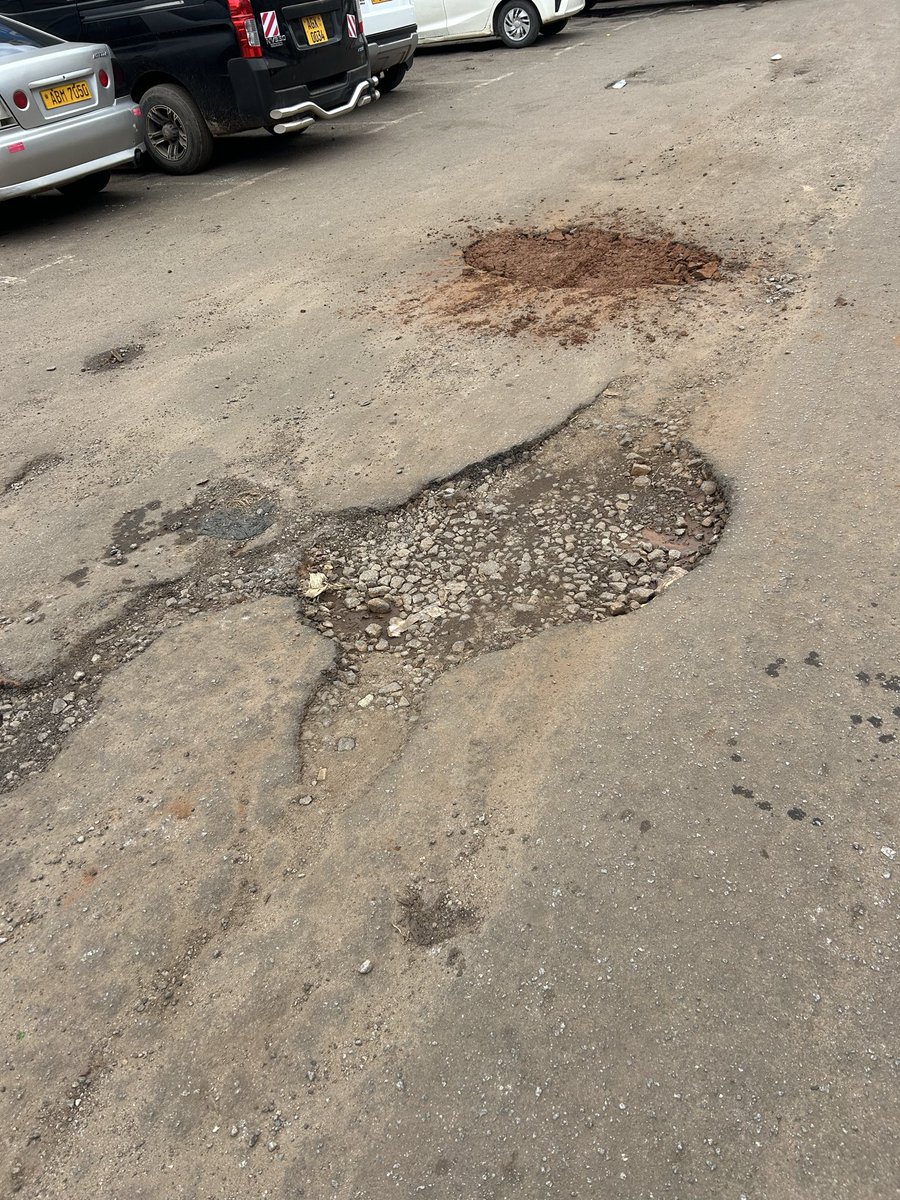
@MandazaDouglas@eddiemahembe@BigTimmz Mayor @JMafume I have noticed serious lack of supervision on teams deployed to do pothole repairs. Surely by now we should have registered good progress
@eddiemahembe@BigTimmz Along Kaguvi Street, a city council truck arrived with more than 10 workers, yet they only patched one pothole with mud and left the next one untouched.
A whole team, no equipment, no proper repairs, no accountability. This is why many citizens now describe Zim as a failed state
You are actually being lenient bamunini, Zimbabwe is not in the ICU, it's now interred, lying in the natural repose of death, somewhere in a cemetery in Glen Forest 🤣🤣🤣🤣