@LeifInvests A 42% drop makes a stock look cheap, but price alone never tells you that. Check what you pay for the earnings and cash flow that remain — the P/E and free cash flow — then debt and spending needed to grow. A stock can fall far and still be expensive if earnings fall faster.
@CheddarFlow When everyone is positioned one way, a move can turn into a big one — shorts buy back and funds chase. That is positioning, not a verdict on the business. Check earnings before following the crowd: are sales and cash flow growing enough to support the price after the squeeze?
@ohiain One green day is a bounce until the trend proves otherwise. For a stock I look for a higher low, then a higher high, with volume behind it. A stock can rally 5% and still be in a downtrend. Wait for price to reclaim its short moving average and for earnings to back it up.
@LeifSoreide Price moves before the news — the market prices in what it expects, then headlines catch up. A 48% drop is a prompt to re-check the business: is revenue growth slowing, are margins holding, and what are you paying for the earnings that remain? Check the numbers, not the news.
@wallstengine Registration is not a sale — it just clears the way for those shares to be sold later. The check is whether these are new shares or existing ones changing hands. New shares dilute earnings per share; a resale does not. Check the diluted share count before reacting.
@saxena_puru A bounce and a business are two different things. When a stock looks cheap after a drop, I check: is revenue still growing, is free cash flow strong, and is the low multiple because earnings fell or the price fell? Short covering can lift prices fast without fixing any of those.
@steps_wealth Great math — that's the key lesson. Lenders often use about 28% of gross pay as a guide for housing. $2,085 out of about $7,288 a month is right near it. The price is only half the story; the monthly payment is the test.
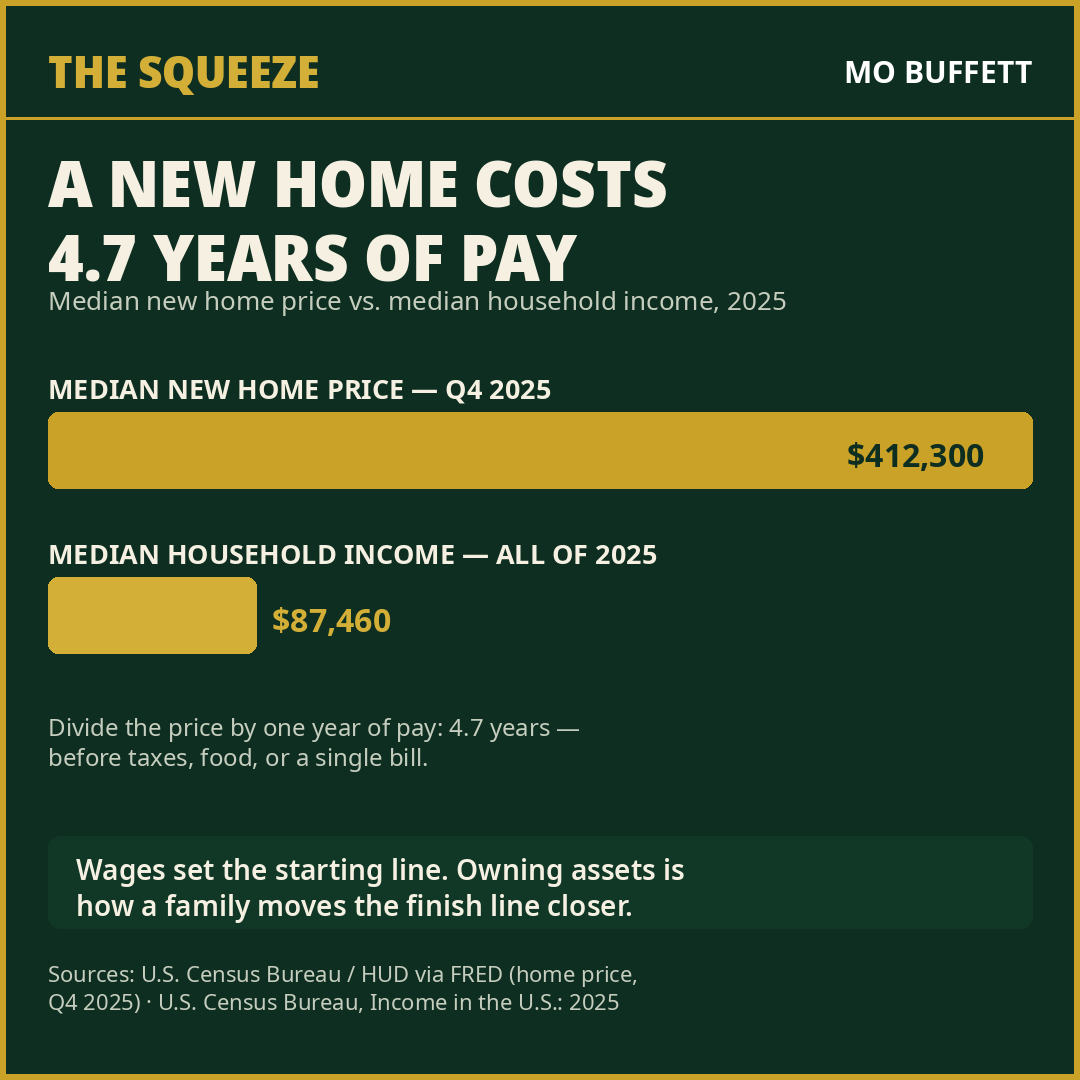
A new home costs 4.7 years of pay. 📊
Census, 2025: the median new home sold for $412,300. The median household earned $87,460 — for the whole year.
Wages set the starting line. Ownership moves it.
@pdicarlotrader A level holding twice is useful information, not a promise — support is just where buyers showed up before, and it can break on the third test. The check: what would have to change for you to change your mind? Decide that before the next test, not during it.
@pequityresearch A CEO change matters most when the person built the strategy and the customer relationships — that's the real asset, not the headline. The check: does the next earnings report show data-center demand and margins holding up? A rating is an opinion; the numbers are the test.
@MMMTwealth Revenue up 127% is the headline — the check is per share. If the share count keeps growing from dilution, owners get a smaller slice of that growth. Before trusting a 2030 EPS number, look at shares outstanding over the last few years and ask what has to go right for it to hold.
@EdgeCGroup Shorting on valuation alone is tough — a strong business can stay expensive longer than a short can stay patient, and every up day costs you. The check I'd run: which number in the next earnings — revenue, margins, or financing costs — would prove the thesis wrong?
@QualCompounders The lesson isn't that she sold — it's why. Selling because the price fell is letting the market do your research for you. The check that matters: did demand, margins, or the competitive edge actually change? If the business is intact, a lower price is information, not a verdict.
@KyleAdamsStocks Fair point — income is the fuel. But the other half is what you do with it: an aggressive bet you haven't researched is just a lottery ticket. Before sizing up, learn to read the business — cash flow, debt, and whether the earnings are real. Skill grows faster than hope.
@AndrewThrasher Big up days usually follow big down days — they cluster in volatile stretches, not calm ones. The useful check isn't the size of the bounce, it's whether the business changed. A stock can swing 4% in a day; a company's earning power rarely does.
ECONOMIC METRICS — GDP is the economy's total receipt.
Add up what families spend, businesses invest, government spends, and exports minus imports — that's GDP. Growing means the pie is getting bigger.
When GDP grows, whose spending do you feel first?
@traderstewie That's the right way to use a leader: check the weight first. NVDA is one of the largest holdings in $QQQ, so when it moves, the index moves with it — and $TQQQ triples that daily move, both ways. Before trading an index, know its top 5 weights; one stock can be the whole trade.
@GreatMattsby Support is a zone to watch, not a promise — a level only matters if buyers show up there with volume. The useful check: wait for a bounce and a higher low, and size it so being wrong costs 1% or less. A shopping list still needs a price, a plan, and an exit.
@SimpleSwings The sleep test is the real edge check. If a position is big enough to keep you up, it's too big. An edge isn't one hot call — it's a setup you can repeat with the same risk, 100 times, and still sleep at night.