You don’t have to put your life on pause to earn a computer science degree.
With @LondonU’s online BSc Computer Science, you can study when it works for you, pay per module, and earn the same accredited degree as on-campus students.
From core computing foundations to specializations like AI, data science, and UX—this program is designed to fit real life.
Learn more and explore the degree: https://t.co/P8hwzwtFPP
The fastest way to grow in AI isn’t building something massive.
It’s starting smaller than you think.
One short script.
One simple dataset.
One small, structured win at a time.
That’s how confidence builds.
That’s how skill compounds.
Start with one course at https://t.co/BkI0GcRBgJ
🚀 New LangChain Academy Course: Building Reliable Agents 🚀
Shipping agents to production is hard. Traditional software is deterministic – when something breaks, you check the logs and fix the code. But agents rely on non-deterministic models.
Add multi-step reasoning, tool use, and real user traffic, and building reliable agents becomes far more complex than traditional system design.
The goal of this course is to teach you how to take an agent from first run to production-ready system through iterative cycles of improvement.
You’ll learn how to do this with LangSmith, our agent engineering platform for observing, evaluating, and deploying agents.
Enroll for free ➡️ https://t.co/fok9ahY6MG
Google Colab's marketing site (https://t.co/5ig5TQKYan) has a fresh new look! 🎉 Head over to see the redesign and learn how you can use Colab in new ways! 💻
Curious about AI but not sure where to start? You’re not alone.
Roles like AI product manager, UX designer, and prompt engineer are booming, and they need creative thinkers.
If you’re great at writing, design, research, or strategy, you belong in AI.
Try one of these beginner-friendly courses and see what clicks:
👉 AI for Everyone from @DeepLearningAI: https://t.co/Nj2eTMdEGz
👉 Generative AI: Prompt Engineering Basics from @IBM: https://t.co/RW26JE8VpS
👉 AI For Business Specialization from @Penn: https://t.co/v72w5DoV0h
Before GenAI, prototyping an app, especially one powered by data or AI, meant hours of setup and boilerplate code before you could even test your idea.
In this clip from the course Fast Prototyping of GenAI Apps with Streamlit, you’ll see how that changes. Watch how GenAI flips the development process, so instead of planning every step in advance, you start with intent and get working code in seconds.
Learn to prototype faster, test more ideas, and go from concept to app.
👉 Take the course here: https://t.co/gYTmAYXTD1
@Snowflake@thedataprof
AI Agents 101: 𝗔𝗜 𝗔𝗴𝗲𝗻𝘁 𝗠𝗲𝗺𝗼𝗿𝘆.
In general, the memory for an agent is something that we provide via context in the prompt passed to LLM that helps the agent to better plan and react given past interactions or data not immediately available.
It is useful to group the memory into four types:
𝟭. Episodic - This type of memory contains past interactions and actions performed by the agent. After an action is taken, the application controlling the agent would store the action in some kind of persistent storage so that it can be retrieved later if needed. A good example would be using a vector Database to store semantic meaning of the interactions.
𝟮. Semantic - Any external information that is available to the agent and any knowledge the agent should have about itself. You can think of this as a context similar to one used in RAG applications. It can be internal knowledge only available to the agent or a grounding context to isolate part of the internet scale data for more accurate answers.
𝟯. Procedural - This is systemic information like the structure of the System Prompt, available tools, guardrails etc. It will usually be stored in Git, Prompt and Tool Registries.
𝟰. Occasionally, the agent application would pull information from long-term memory and store it locally if it is needed for the task at hand.
𝟱. All of the information pulled together from the long-term or stored in local memory is called short-term or working memory. Compiling all of it into a prompt will produce the prompt to be passed to the LLM and it will provide further actions to be taken by the system.
We usually label 1. - 3. as Long-Term memory and 5. as Short-Term memory.
A visual explanation of potential implementation details 👇
And that is it! The rest is all about how you architect the topology of your Agentic Systems.
What do you think about memory in AI Agents?
#LLM #AI #MachineLearning
New short course: Evaluating AI Agents! Evals are important for driving AI system improvements, and in this course you'll learn to systematically assess and improve an AI agent’s performance. This is built in partnership with @arizeai and taught by @JohnGilhuly, Head of Developer Relations, and @amankhan, Director of Product.
I've often found evals to be a critical tool in the agent development process - they can be the difference between picking the right thing to work on vs. wasting weeks of effort. Whether you’re building a shopping assistant, coding agent, or research assistant, having a structured evaluation process helps you refine its performance systematically, rather than relying on random trial and error.
This course shows you how to structure your evals to assess the performance of each component of an agent and its end-to-end performance. For each component, you select the appropriate evaluators, test examples, and performance metrics. This helps you identify areas for improvement both during development and in production. (If you're familiar with error analysis in supervised learning, think of this as adapting those ideas to agentic workflows.)
In this course, you'll build an AI agent, and add observability to visualize and debug its steps. You’ll learn about code-based evals, in which you write code explicitly to test a certain step, as well as LLM-as-a-Judge evals, in which you prompt an LLM to efficiently come up with ways to evaluate more open-ended outputs.
In detail, you’ll:
- Understand key differences between evaluating LLM-based systems and traditional software testing.
- Add observability to an agent by collecting traces of the steps taken by the agent and visualizing them
- Choose the appropriate evaluator - code-based, LLM-as-a-Judge, human-annotation based - for each component.
- Compute a convergence score to evaluate if your agent can respond to a query in an efficient number of steps.
- Run structured experiments to improve the agent’s performance by exploring changes to the prompt, LLM model, or the agent’s logic.
- Understand how to deploy these evaluation techniques to monitor the agent’s performance in production.
By the end of this course, you’ll know how to trace AI agents, systematically evaluate them, and improve their performance.
Please sign up here: https://t.co/hTNCM8xuYn
Want to write better emails in less time? ✨
From drafting to personalization, these AI-powered tips will transform how you communicate. https://t.co/o5BMAbGNoa
Before diving back into your inbox, consider sharing some tips on how you're using GenAI to improve your productivity in the comment section below.
#GenerativeAI #EmailTips #Productivity
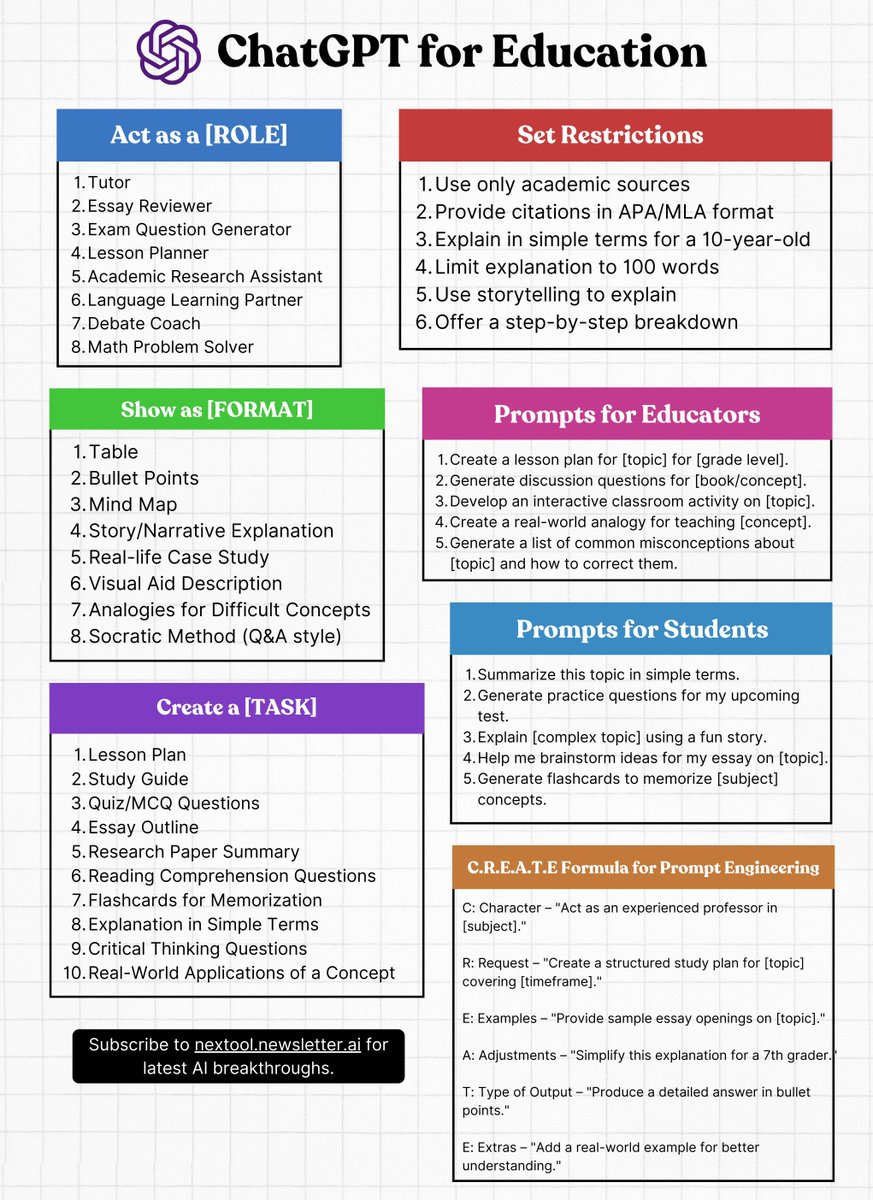
ChatGPT is a free university.
But most people don't know how to unlock its full potential.
Here's a complete ChatGPT cheatsheet for education and learning:
DeepSeek is a wealth-generating machine and controlling your finances.
most people are missing out on incredible opportunities by not knowing how to use it.
That's why I created the ultimate guide: +500 DeepSeek Professional Prompts on Personal Finance and Money.
FREE for 24 hours only!
To get it you just have to:
1. Give it RT + Like
2. Comment "DEEPSEEK"
3. Follow me so I can send it to you via Direct Message