MoatVault is where I do deep dives on high-potential public companies and turn the thesis into an assumptions-based valuation calculator.
Pick a company, adjust the scenario, see what has to be true.
https://t.co/YG6GwxQWPx
WHY $ASTS DOESN’T NEED TO OWN THE CUSTOMER
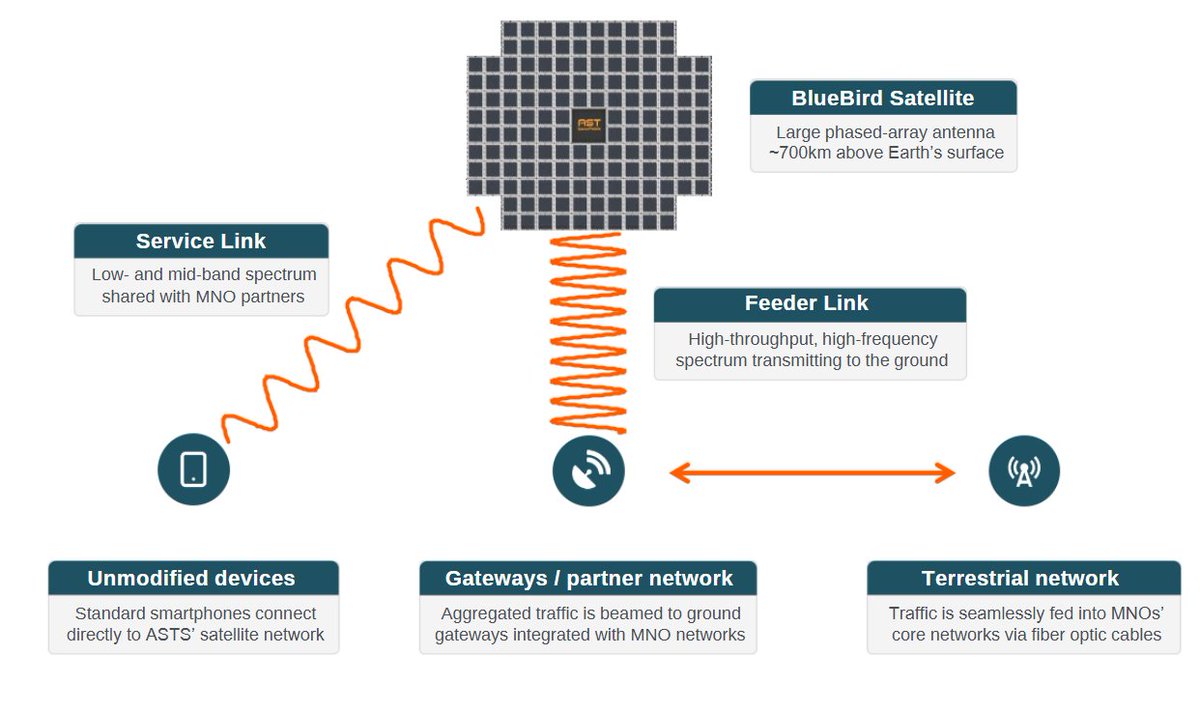
AST uses BlueBird satellites in low Earth orbit to connect ordinary smartphones directly to broadband at speeds up to ~200 Mbps then routes that traffic through ground gateways back into the carrier’s existing network.
That lets AST extend coverage for nearly 60 MNO partners covering 3B+ subscribers without requiring new phones, apps or billing while using the carriers’ spectrum and customer relationships.
The model is essentially a wholesale revenue share so AST keeps 50% of subscription and day-pass revenue with estimates scaling from ~3M subscribers and ~300M of subscription revenue in 2027 to ~30M subscribers, ~$2B of subscription revenue by 2030.
The technology is proven but the next phase is a lot of execution because reaching those estimates depends on launching enough BlueBirds, adding gateways and securing country-by-country approvals to turn intermittent coverage into a continuous commercial network.
$ASTS 🎯
Investors in $SPCX should ask themselves why Starlink stopped launching direct to device satellites beyond fielding an initial single sat tier. And why such sparse coverage needed a waiver:
Their tech suffers from law of diminishing returns and can not scale.
Mr. Farrar makes a great point here. ;)
Running Starlink's dish as a loaded femtocell to support/extend a cellular network means added monthly costs based on your electricity costs, but up to ~$30 per month in e.g. California.
So what's a better choice if you need decent broadband but you don't need or want the added costs and limitations of a dish?
$ASTS
Why?
Your smartphone's 5G modem uses less than 1/10th as much energy as a Starlink dish during heavy use.
And an ASTS broadband D2D connection likely costs you 1/10th as much (or less) as a Starlink dish connection.
You see how the math is starting to compound?
This is why I am confident that $ASTS will actually edge into some of Starlink's dish business.
Some people just need "good enough" and if AST can provide that, why would they pay so much more per month? They won't. They'll go with AST.
Cathie, it's an increase in aggregate bandwidth, not per-satellite bandwidth.
On a per-satellite bandwidth basis, though, let's talk about Direct-to-Device.
Because you know who wins that, by far? $ASTS
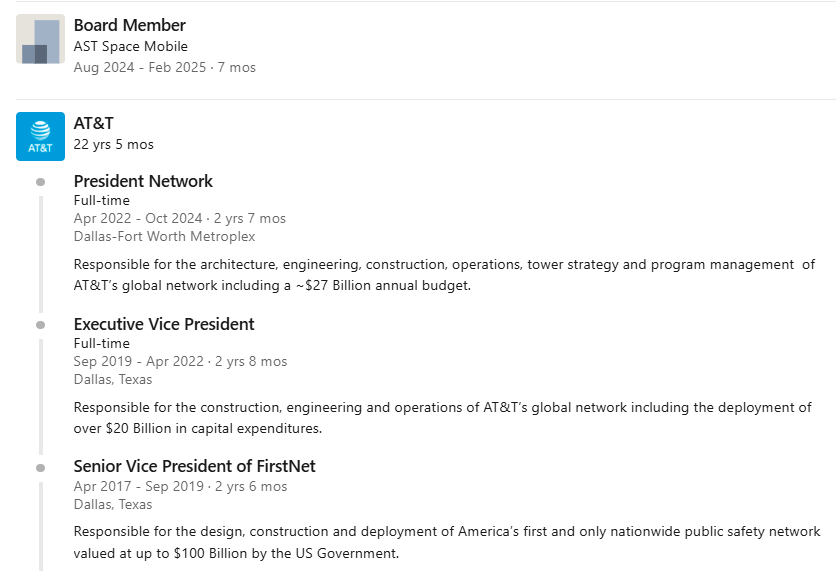
$ASTS: 🧩 Did you know that Chris Sambar is joining T-Mobile as Chief Enterprise Officer?
➡️ He is a former AST SpaceMobile Board Member and Network Planning and Spectrum Committee Member.
$ASTS - If a satellite broadband business gets talked about at trillion-dollar scale (reasonable), the question is what AST's direct-to-device layer with close to zero friction is worth.
https://t.co/rbYeDfJUKv
$ASTS $SPCX The 1000 IQ take here is Starship will only accelerate T1 MNO adoption of AST Spacemobile, but thats not obvious for most nor the market
The biggest argument to be made technology wise between AST and SpaceX is that they are fundamentally building different products. So even if SpaceX catches up technology wise it does not really matter.
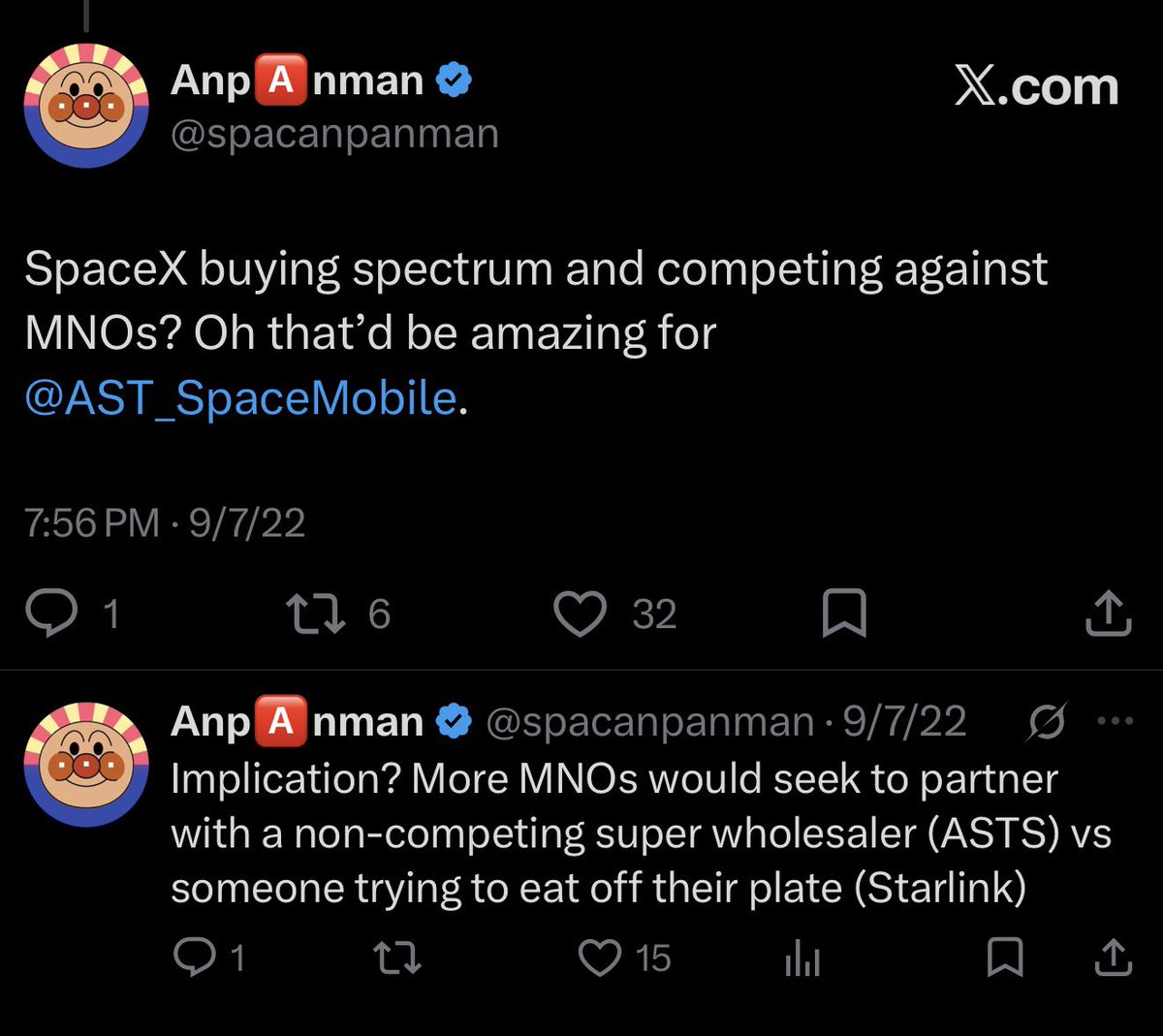
Starlink is building a global telecom company that wants to compete with the MNO’s. They want to be a terrestrial light, satellite heavy global MNO.
AST SpaceMobile is building a space-based cellular broadband network designed to connect directly to standard, unmodified mobile phones, with wholesale integration directly into the Mobile Network Operator (MNO) core network that treats its satellite constellation as a decentralized extension of the MNO’s existing terrestrial hardware.
Since these companies are building different goals, there are different optimal architectures. If you optimize for the global telecom operator architecture then you are automatically suboptimal for MNO wholesale and vice versa. Regardless of technology having the right architecture for T1 MNO’s will always be a major AST advantage.
On competition dynamics the bigger the threat of Starlink direct competition the more strategic leverage AST gets over MNO’s. Starship is the vehicle that makes the global telecom operator vison reality. The more credible the Starlink threat the higher the strategic leverage for AST.
Now let me expand in the posts below
$ASTS: US MNOs pay on average $400-$500 to acquire a subscriber. What will AST SpaceMobile's customer acquisition cost be?
$0
AT&T, Verizon & T-Mobile will actively promote AST's service to their existing subscriber base as an add on, day pass or include it in premium plans. That is the beauty of the 50/50 partnership model. No CAC, sales, support, marketing, network infrastructure investment, terrestrial spectrum investment, etc. Access to an install base that have existing phones that already work with Block-1 and Block-2 satellites. No upgrade, no new phones and a *seamless experience*.
🔥What's the US opportunity? The big 3 have 316M subscribers and 84M connected devices