2. Psychiatry Research Day at NYU: first time attending and presenting here too. Lot of amazing work on data-based methods for detection and classification of mental health conditions.
1. Society for Neuroeconomics conference: my first time attending and presenting at this. Have been interested in decision structuring for a long time and it was great to see the field’s growing attention to this question.
As an early-career scientist, this kind of practical knowledge has been useful to me, and I thought I would share what has emerged to me as important distinctions in our day-to-day writing! (n/n)
Writing papers and grants is a big part of doing research, with many of us also undertaking science communication. However, what I have realized through my experience with all three is - these writing projects demand very different things on specifically two dimensions (1/n):
Crystallizing this in the language of math in the image below! Weights are illustrative from my experience; yours may differ. Feel free to share your thoughts! (3/n)
#AcademicTwitter#GrantWriting#SciComm#WritingInScience
First time presenting at a philosophy conference and could not have asked for a better experience. Had an excellent time and conversations at #SPP2025.
Did you log in today out of your own 'free will'? I study what gives you that feeling - and what parts of your brain may be involved in creating it. Just presented my work on the neural correlates of the experience of free will at #SPP2025. Manuscript in preparation!
As a chess enthusiast, nothing could beat waking up to @DGukesh 's win at world chess championship today to also become the youngest to do so at 18!! This seems even more legendary as he played black with odds stacked against him from the start and won with it. From ChatGPT:
Excited to be attending #SFN24 starting tomorrow. I will also be giving a talk on Oct 7 (see below). Looking forward to exploring the latest in neuroscience and connecting with fellow researchers. Always happy to discuss my research or learn about yours - feel free to reach out!
TL;DR but only have three minutes? You can check out my talk in the Three Minute Thesis competition at IUB this year here: https://t.co/eKrzYcwrzq ... Please note that, as per the rules of 3MT, the talk was designed for a non-expert audience.
Excited to share that our paper on non-invasive temporal interference neuro-stimulation of orbitofrontal cortex in humans is out today in
@brainstimj You can check it out here: https://t.co/AN5c75Ywea
New paper out today - our work on non-invasive deep brain stimulation with temporal interference methods. TI can safely cause fMRI BOLD activation in human orbitofrontal cortex, without stimulating the overlying cortex. https://t.co/ox7nBdMxPx
Our first preprint on combined non-invasive deep brain stimulation (temporal interference) and fMRI. TI opens so many possibilities for causal inference and clinical treatments https://t.co/LG6FJWRM2M with @ModakPriyamvada@JustFineNeuro@Peter_Finn_911@SoterixMedical
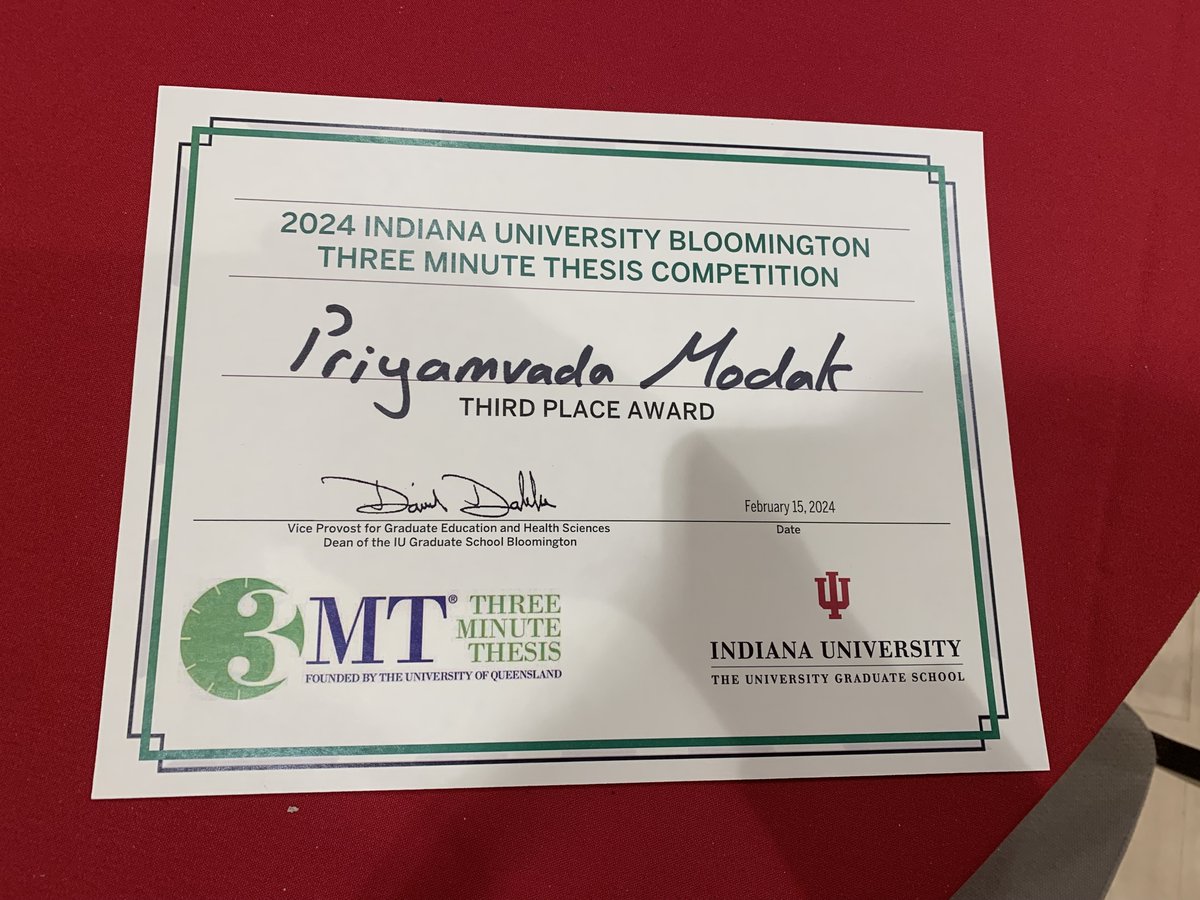
Congratulations to PBS graduate student Priya Modak (@ModakPriyamvada) on her 3rd place finish in the Three Minute Thesis Competition yesterday! She was recognized for her impressive work on deep brain stimulation.
Words have powerful affect the psyche beyond every day communication. #Neuroscience researcher @ModakPriyamvada of @IndianaUniv shares how in our latest Your Say Blog: https://t.co/qnc4fTyB8G