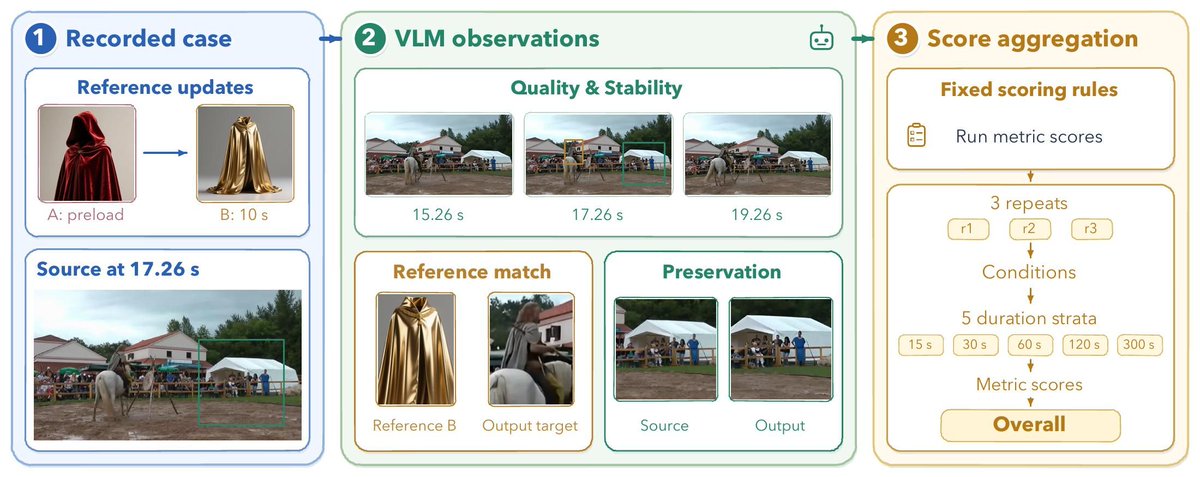
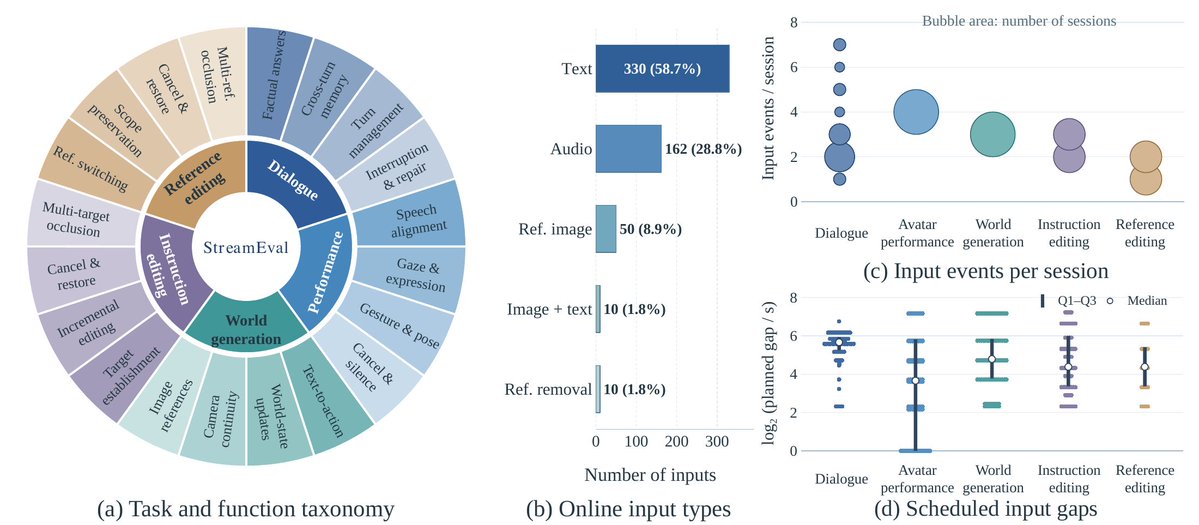
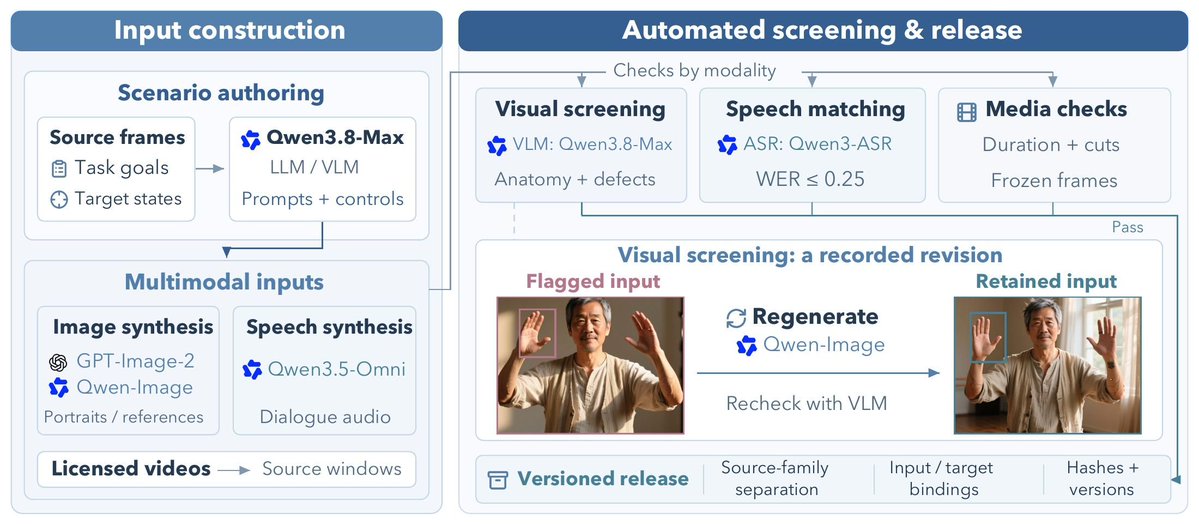
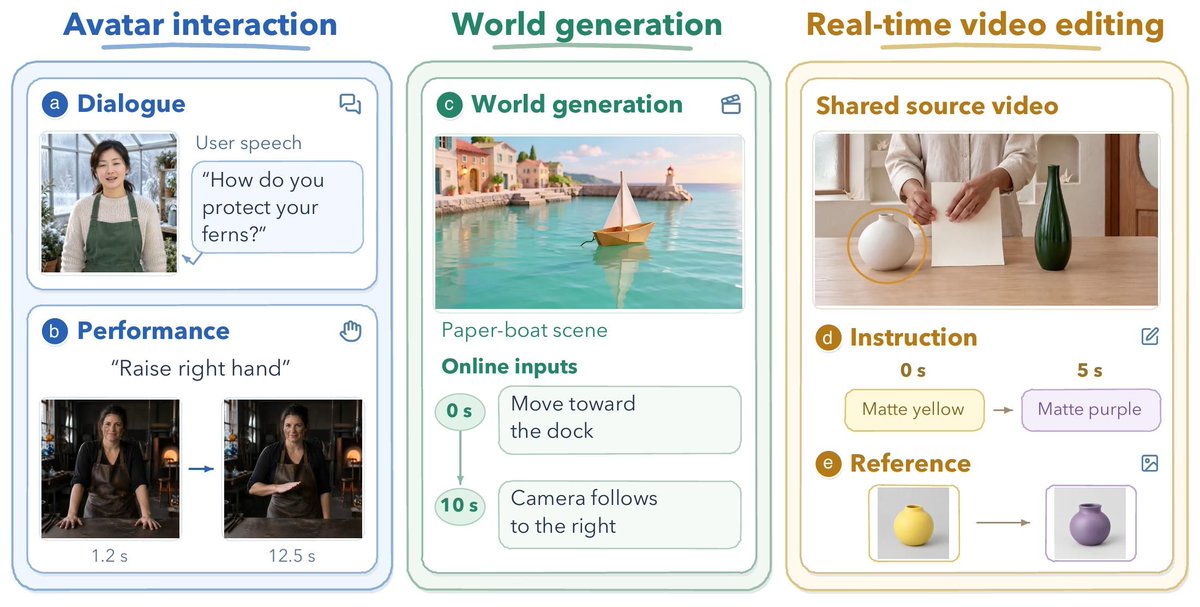
StreamEval is now on ModelScope for evaluating interactive streaming video generation across 15 to 300-second sessions.
🤖 https://t.co/5eF7vpTWAC
📄 https://t.co/VPcQ7NpUL4
🎬 300 long-form interactive sessions: Each 15 to 300-second case delivers multimodal requests over time and checks both state changes and content preservation.
🧩 Five tasks, ten metrics: Covers avatar dialogue, avatar performance, world generation, instruction editing, and reference editing across execution, consistency, visual fidelity, and audiovisual coordination.
📊 Visual quality is not enough: Across 37 models, strong visuals and identity retention did not reliably mean better instruction following or sustained state consistency.
🔓 Fully open and updated monthly: Benchmark data, evaluation code, protocols, and scoring rules are public, with monthly leaderboard updates for new and updated models.
📜 Benchmark data: CC BY 4.0. Evaluation code: Apache 2.0. Third-party editing footage requires attribution.
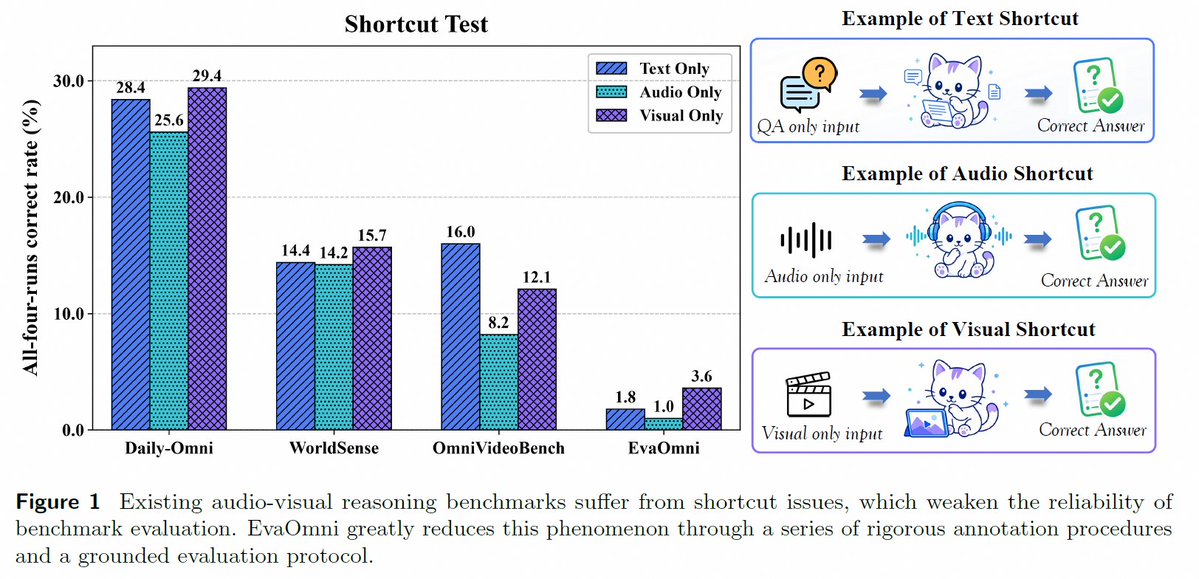
Does your Omni LLM actually listen and watch, or is it just guessing? 🤔 We are excited to open-source EvaOmni with SJTU, Fudan & Tencent Youtu!
📄 Paper: https://t.co/TIZ1C2oemG
💾 Dataset: https://t.co/4dIeYOXZF2
💻 GitHub: https://t.co/cql5bPLi1f
Moving beyond simple Q&A, EvaOmni tests 1,027 questions across 392 videos to see if models can pinpoint the exact audio and visual evidence for their answers.
📊 The verdict on 24 Omni LLMs: Top model Gemini3.7-Flash hits 79.4% answer accuracy but only 35.1% on precise dual-modal grounding. Models can guess the answer, but they struggle to show their work.
😲 Dive into the benchmark👇
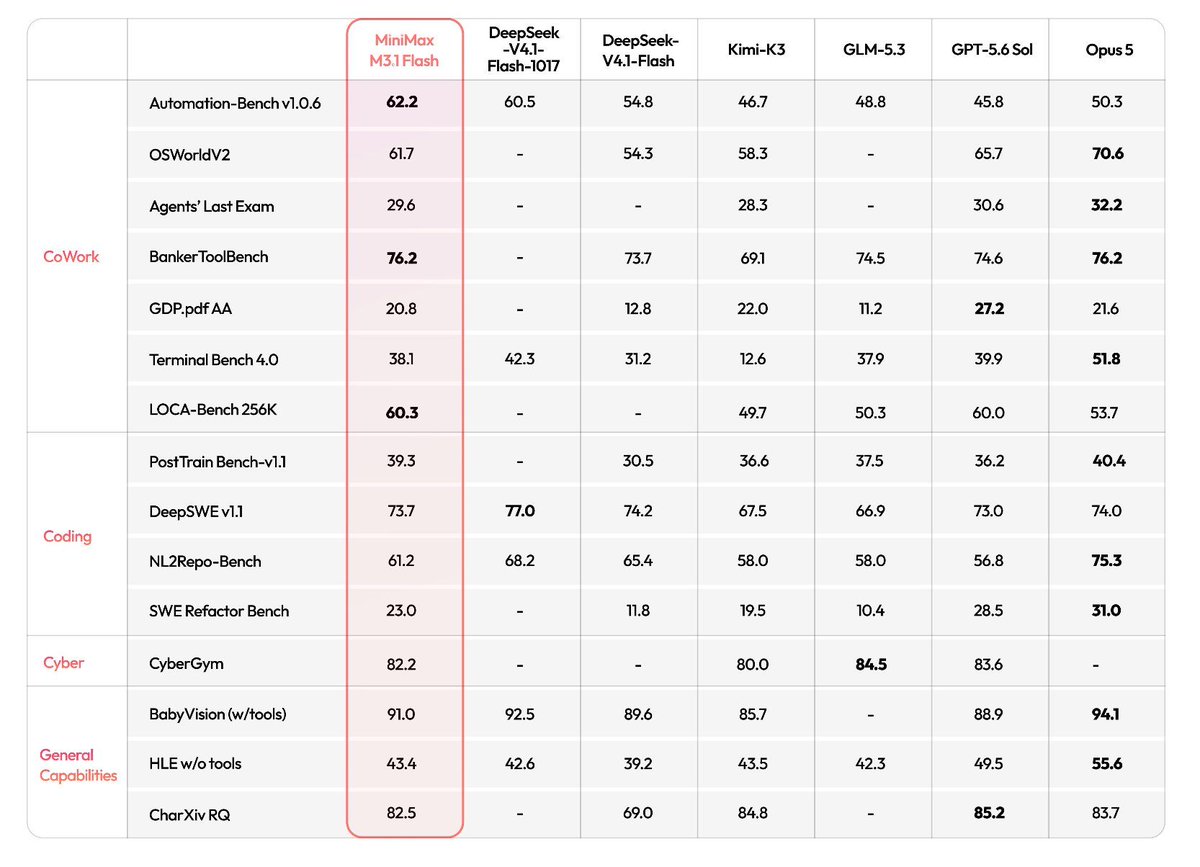
1M tokens, native image and video input, and 23B active parameters per token. MiniMax-M3.1-Flash has landed as a 428B MoE for coding, computer use, and tool-driven agents.
🤖 https://t.co/Q3M48YHmTn
📄 https://t.co/ZymhDYLbvQ
🏆 Top result for agent execution: Scores 62.8 on Automation-Bench v1.0.6, the highest result in the model card’s reported comparison.
💻 Strong at coding and computer use: Reaches 73.7% on DeepSWE v1.1, 61.7 on OSWorld 2.0, and 29.6 on Agents’ Last Exam.
🔐 Built for cybersecurity work: Scores 82.2 on CyberGym for vulnerability discovery and validation.
⚡ Efficiency is built in: Sparse attention throughout, QAT NVFP4, and the included DSpark draft head support efficient inference and speculative decoding.
🛠️ Ready to self-host: Model weights are available with SGLang and vLLM deployment guidance.
Ling-3.0-flash-Sante is now open-source. The 124B healthcare MoE activates only 5.1B parameters per token.
🤖 https://t.co/bCjeePD8sW
🏆 #1 among flash-size models on professional healthcare: Scores 54.29 on HealthBench Professional, up 8.56 points, and ranks #2 overall in the team’s evaluation.
🩺 Better at hard medical reasoning: Reaches 76.92 on AFUMED-ComplexReasoning, 90.61 on AFUMED-Drug, and 94.21 on MedQA-USMLE.
🧩 Multi-agent beats single-agent research: BrowseComp rises from 80.20 to 90.47 when moving from one agent to multi-agent collaboration.
🛠️ A healthcare agent, not just medical QA: Deep research, tool use, and task execution gains support real research and professional workflows.
Guide image edits with words and up to four reference images. Moss-Image-Edit is an open-weight LoRA adapter for MOSS-Image with ready-to-use ComfyUI workflows.
🤖 https://t.co/xp2JLEbBLB
🎨 Describe the change: Edit colors, outfits, expressions, lighting, seasons, scenes, and visual style through text instructions.
🖼️ Combine visual references: Use up to four images to guide people, clothing, and scenes. Specify each image's role in your prompt.
⚡ Reuse reference computation: Builds reference-image K/V caches before sampling and reuses them across denoising steps, including both CFG branches.
🛠️ Choose your base: Pair the adapter with either MOSS-Image-Base or MOSS-Image-SFT, then load the provided single-reference or multi-reference ComfyUI workflow.
📜 Project code: GPLv3. Base models and third-party components retain their own licenses.
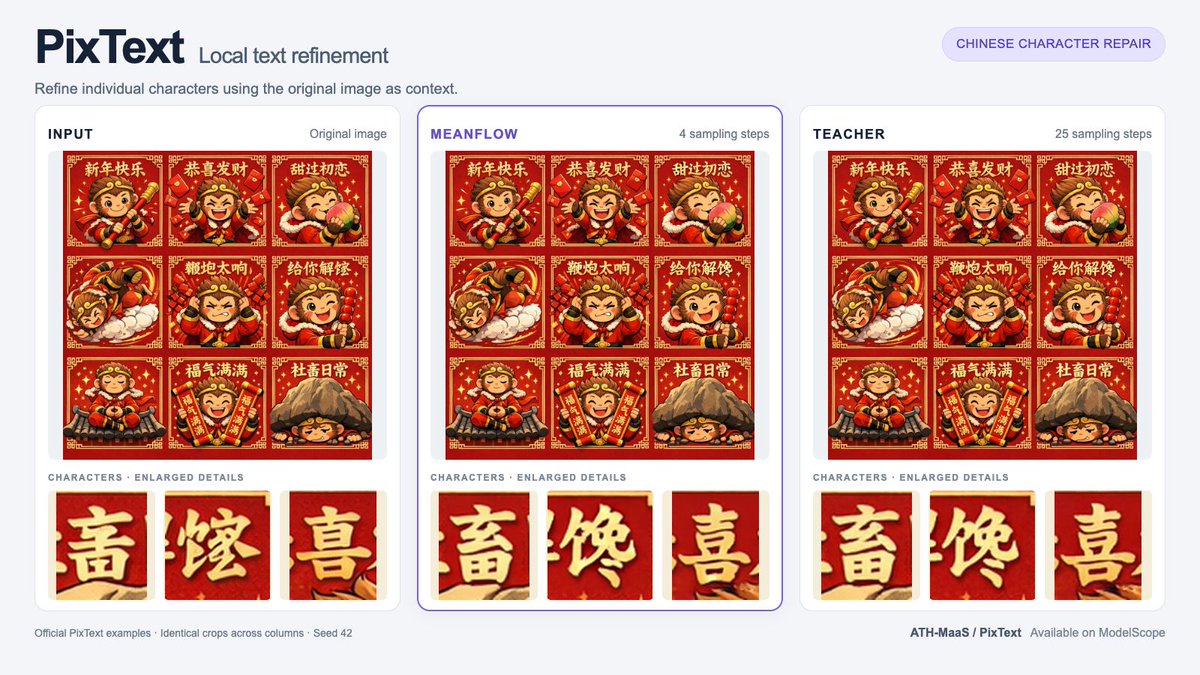
PixText offers two ~0.95B open-weight models for local text refinement directly in pixel space.
🤖 https://t.co/TN6yJEGyG1
📄 https://t.co/sE5vtRMdP8
🏆 Strong text correction: Reaches 83.06% glyph pass and 94.66% exact target-character OCR accuracy on TextRefinementBench, ahead of the strongest reported baseline.
⚡ Four-step generation: PixText-MeanFlow delivers fast local edits in four steps, retaining an 81.84% glyph pass rate with under one GPU-second amortized cost per image in the paper's setup.
🖼️ Edit text, not the whole image: Provide regions and replacement text, then generate multiple targets jointly while keeping pixels outside the edited footprints unchanged.
🧩 Two checkpoints: Choose the 4-step MeanFlow model for quick use or the 25-step Teacher model for the higher-step workflow.
📜 Apache 2.0.
Omni-R2V is now on ModelScope! 339,570 training samples for teaching video models to follow image and video references beyond a single subject.
🤖 https://t.co/31MC8dp5lD
📄 https://t.co/omFvgjw12b
🧩 Seven reference controls: Content, motion, style, structure, narrative, multi-content, and cross-aspect.
🎬 Flexible multi-reference training: Each sample includes candidate references, bilingual instructions defining their roles, and a target video. Train with one reference, matched pairs, or compatible subsets.
🔊 Audio when available: Retained target audio also supports reference-to-audiovisual research.
📊 Train and evaluate the same controls: OmniVBench adds 813 cases, 18 tasks, and 12,172 checklist items for reference fidelity and instruction following.
📜 Research use only. Commercial use and media redistribution are not covered.
Turn complex documents into data AI agents can use with OXR-1.0, SoMark's 1.3B open-weight model for parsing PDFs and document images into Markdown or JSON.
🤖 https://t.co/QTT2PPnZuw
🏆 SOTA across three parsing benchmarks: Ranks #1 in the project’s published comparisons on olmOCR-Bench, OmniDocBench, and DocParsingBench.
⚡ Small model, top-tier speed: Also leads the project’s 21-model speed comparison at 557.77 native tokens/s.
📄 Beyond plain OCR: Recognizes 13 element types, including tables, formulas, chemical equations, chemical structures, and code blocks.
🧩 Bring your own layout model: Layout analysis is independent and pluggable, so teams can customize structure handling while retaining OXR’s recognition and reading-order capabilities.
🌀 Trained to improve from failures: Recursive self-improvement during post-training turns real document parsing failures into new optimization signals.
📜 OXR Open Source License applies.
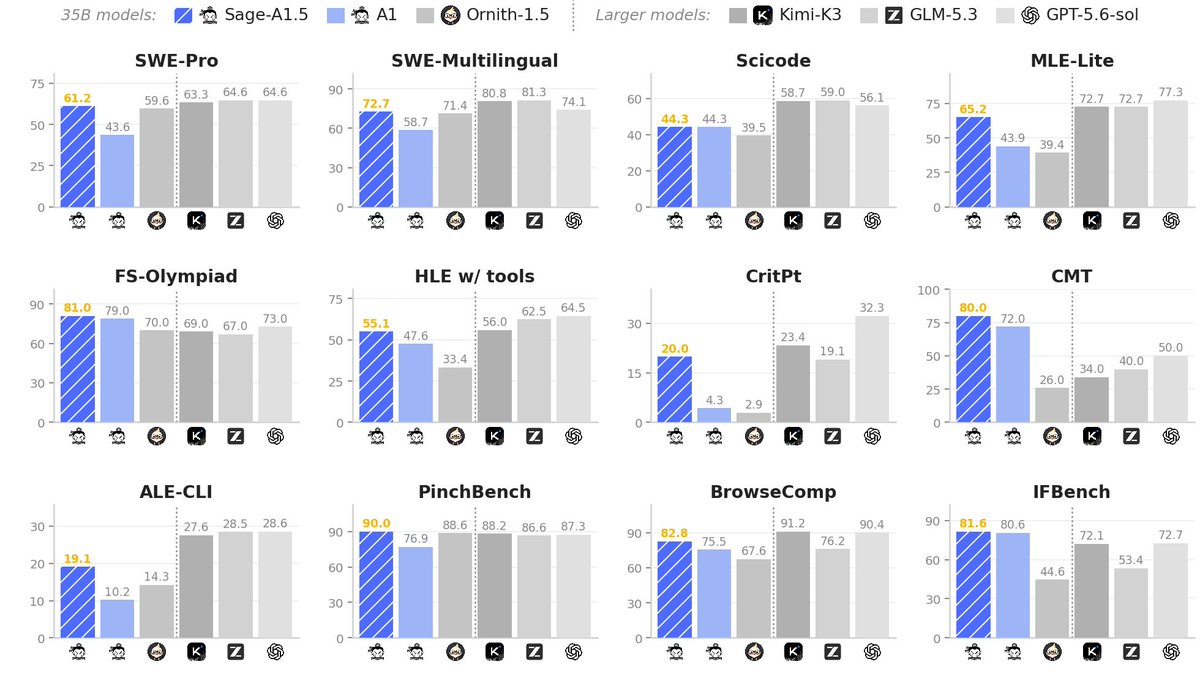
Sage-A1.5 is here, bringing 256K context, parallel research, and evidence checks to long-horizon scientific workflows.
🤖 https://t.co/yiBBWUlG7K
🏆 SOTA across scientific benchmarks: Scores 90.0 on PinchBench, 81.0 on FrontierScience-Olympiad, and 48.3 on FrontierScience-Research, ahead of Kimi-K3, GLM-5.3, and GPT-5.6-sol in the reported comparison.
🧩 Agentic Orchestration: When enabled, delegates independent investigations to parallel subagents with isolated contexts, then integrates their evidence and findings to guide subsequent work.
✅ Verification: Optional Verification Mode reviews progress, checks evidence and assumptions, and redirects stalled searches within the model's own reasoning, without a separate critic model at inference.
🔬 Open Scientific Discovery: Supports exploratory research through tool-assisted analysis and produces inspectable research artifacts, extending its use beyond predefined question answering.
🛠️ Native tool use for research: Supports APIs, code interpreters, search engines, and external tools for tool-augmented scientific reasoning and professional workflows.
⚡ Available in BF16, FP8, and GGUF F16/Q8/Q4 formats, with Transformers, vLLM, and SGLang support.
📜 Apache 2.0.
Spark-X2.6-4B has landed: an open-source model with 1M context, three thinking budgets, and deployment-ready formats for local agents.@SparkLLM
🤖 https://t.co/jdNjiU6zCd
🏆 Stronger at 4B: In the team’s reported comparison table, it reaches a 63.3 average, ahead of Spark-X2.5-4B at 52.1 and Qwen3.5-9B at 49.1 across the evaluated suite.
🧠 Set the thinking budget: Switch between none, low, and high thinking modes to balance reasoning quality, latency, and cost for each task.
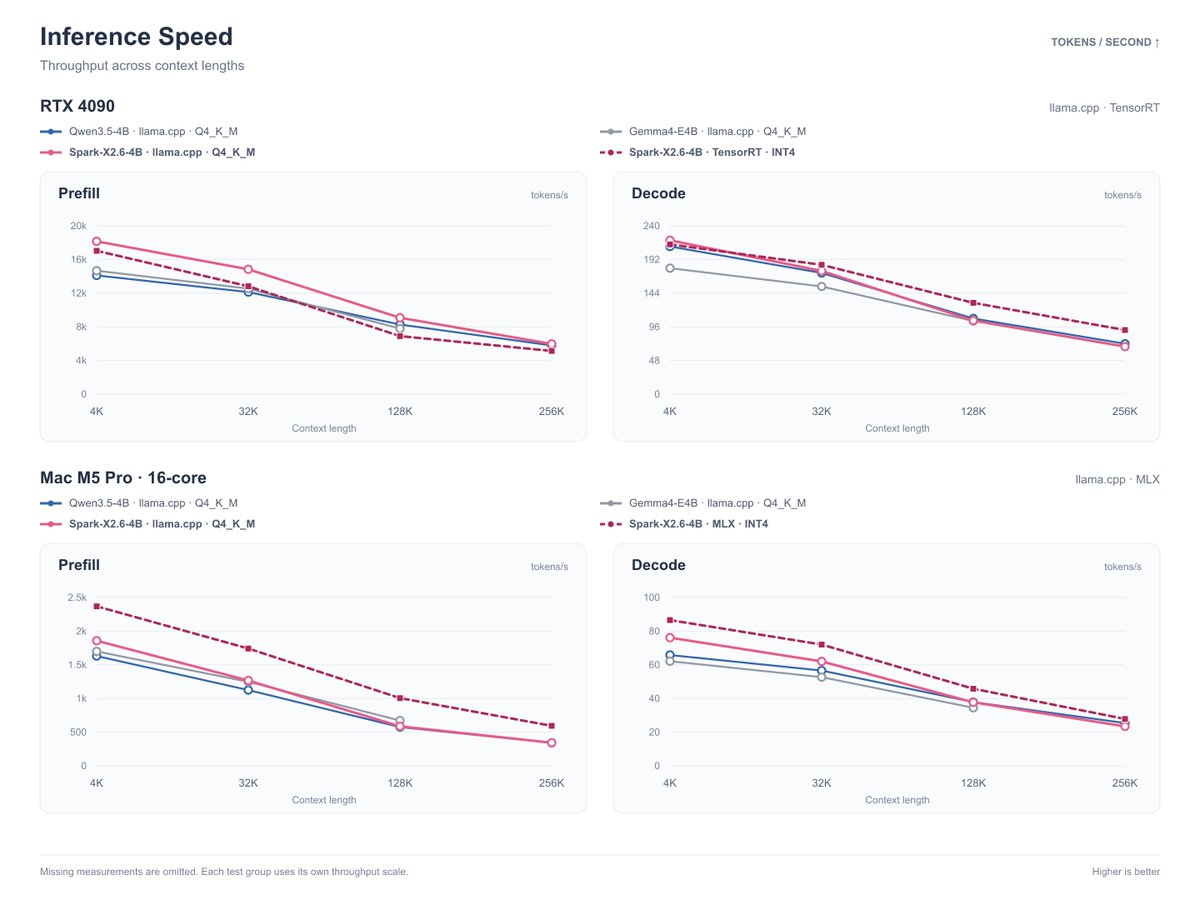
⚡ Built for efficient local inference: A hybrid attention design combines 1M context with resource-conscious deployment, while FP8, INT8, INT4, and GGUF releases offer practical precision and footprint tradeoffs.
🛠️ One model, multiple workflows: Use the Instruct checkpoint for everyday agent work or the Base model for continued training and customization. Supports Transformers, SGLang, vLLM, llama.cpp, Ollama, MLX, and LM Studio.
📜 Apache 2.0.
Introducing MemT-1.0, an open-weight model family with persistent, evolving memory built into model computation, enabling conversations and agents to reuse historical information without reloading the original context.
🤖 https://t.co/rOWczd6CVc
🏆 Leads parametric memory methods: Across 11 memory benchmarks, MemT-1.0-Flash and MemT-1.0-Nano rank first and second among the evaluated methods.
🧠 Memory lives in the model: Dynamic local memory and trainable hyper memory retain past information without carrying the original conversation into every new inference.
⚡ Built for long-running agents: At 128K history, Nano delivers an official 1.86× end-to-end inference speedup and about 66× lower persistent storage than a full-context KV cache.
🛠️ Two backbones, one memory design: Nano is built on Qwen3.6-35B-A3B with about 3B active parameters; Flash builds on DeepSeek-V4-Flash with about 17B active parameters. Both support locally persistent memory sessions.
📜 Flash weights are released under MIT. Inherited backbone licenses still apply.
NVIDIA Nemotron Labs Dory1.0-4B is an open-weight reasoning model with up to 256K context, letting developers adjust inference compute within a single checkpoint.
🤖 https://t.co/hwvo9Pngwp
🔁 One checkpoint, adjustable compute: Run the shared recurrent block for different numbers of loops to balance latency and accuracy per task, with no retraining or model swap.
🏆 Stronger coding-agent results at 4B: At two loops, it reaches 59.5 on SWE-bench Verified in the vendor evaluation, ahead of Qwen3.5-4B at 54.7.
🧠 Extra thinking without longer answers: More loops add latent compute per token instead of simply generating more tokens.
⚡ Loop without compounding cache cost: Optional last-loop KV caching keeps one cache per recurrent attention layer, avoiding extra KV-cache overhead as loop count grows.
📚 Built for long-context workloads: 4B parameters, up to 256K context, and releases in BF16, MXFP8, NVFP4, and Q5_K_M formats.
📜 OpenMDW License Agreement v1.1.
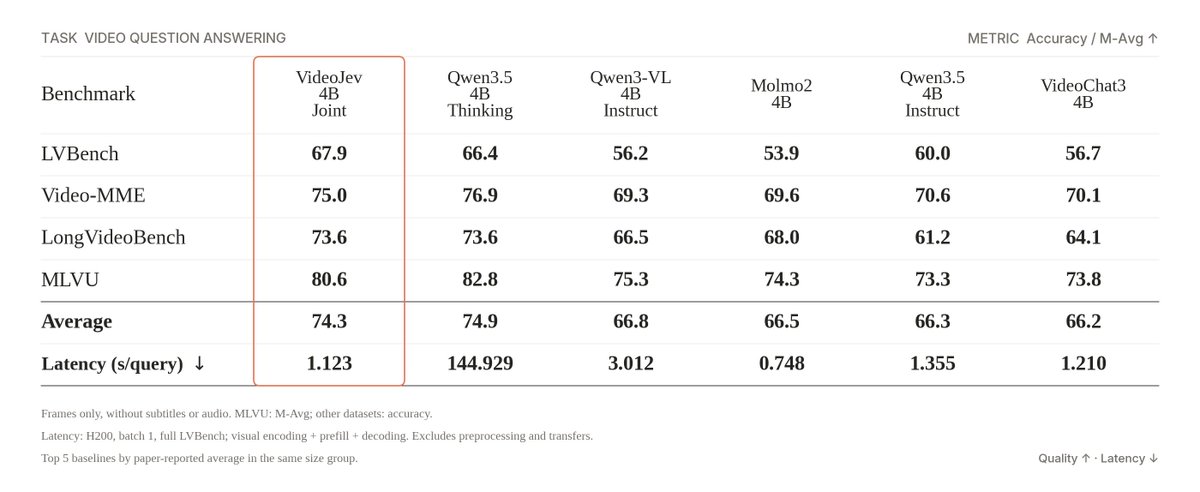
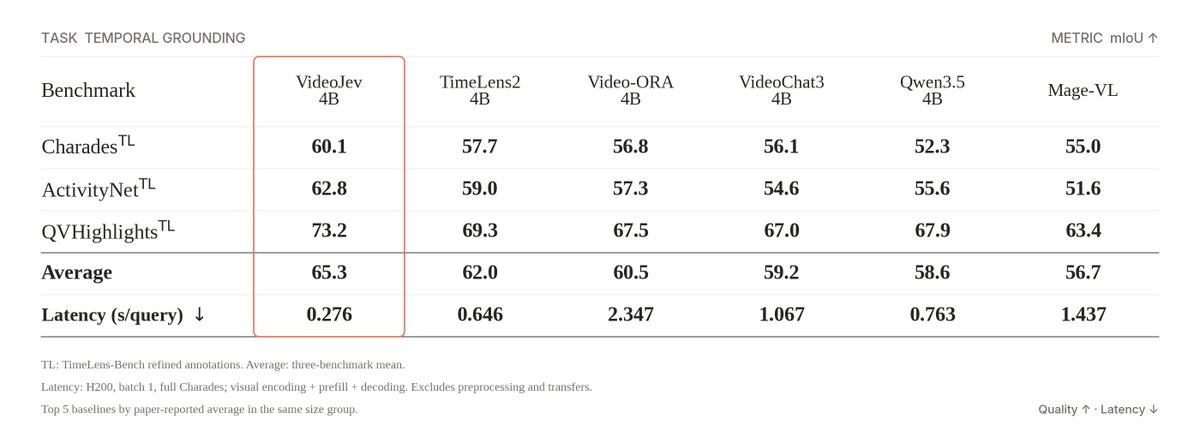
VideoJev-4B brings direct decision-making to video understanding. Qwen3.5-4B based video decision model for temporal grounding and multiple-choice video QA.
🤖 https://t.co/2XLeuFm79F
📄 https://t.co/kpgFm4y8ZC
🏆 Video QA leader at its scale: Ranks #1 among sub-6B models on LVBench, Video-MME, LongVideoBench, and MLVU.
⚡ Direct decisions, not long generations: Scores candidate answers and time spans directly, making video QA and event localization easier to integrate into workflows.
🎬 Find the moment, pick the answer: Locates when an event occurs in video and answers multiple-choice questions with calibrated probabilities.
🧠 Long-video ready: Supports up to 256K context in the official video QA evaluation setup.
🛠️ Ready for local use: Released with BF16 weights, training and evaluation code, plus a quick-start demo.
📜 Apache 2.0.
Ming-3.0 is here: five open-weight audio models for controllable speech, long-recording analysis, and context-aware transcription.
🤖https://t.co/W90y9Vy4Fs
🏆 Voice cloning at the top of the open-weight ranking: Ming-3.0-tts-0.5B achieves open-weight SOTA on Artificial Analysis Controlled Voice with a 1069 Elo rating, using eight English reference voices.
🎙️ Design a voice, then direct the performance: The TTS models support voice design from descriptions or references, multilingual synthesis, and controllable delivery for podcasts, characters, and product experiences.
🧠 Turn long recordings into answers: Ming-3.0-audio-flash transcribes, summarizes, analyzes, and follows up on long audio while grounding answers in the original recording. It reaches 99.40 on BigBenchAudio S2T in the authors’ comparison.
📝 Transcribe with business context: Ming-3.0-asr-tiny accepts hotwords, domain terminology, and dialogue history to improve recognition for product names, dialects, and specialized conversations.
⚙️ Choose the fit: Flash models prioritize broader capability, while Tiny and 0.5B options target lower-cost, efficient deployment.
Xing4.0-29B-Intent turns a one-line request into structured intent, entities, relations, and action parameters, all through one schema-driven model.
🤖 https://t.co/hzwrpX5phw
🏆 Leads the authors’ extraction evaluation: Scores 58 across 6,000 samples from 48 Chinese and English public datasets, ahead of 18 evaluated general-purpose models.
🧠 Choice and extraction in one model: Handles both intent routing and structured semantic parsing, so applications can classify a request and extract the information needed to act on it.
⚙️ Built for reliable tool use: Outputs schema-constrained JSON rather than long-form replies, covering intent detection, entity recognition, relation extraction, and event extraction.
📱 Made for real product flows: Fits customer service routing, smart-device commands, terminal assistants, and agent or function-calling pipelines.
📜 Model weights, training data, and code are released under Apache 2.0.
#XingIntent #IntentUnderstanding #SemanticParsing #FunctionCalling #AgenticAI #ModelScope
MiniMax H3 Character Swap LoRA is now available on ModelScope, an experimental adapter for recasting a selected person in video from an image reference.
🤖 https://t.co/XAmKtQp3LR
🎭 Swap the performer, keep the shot: Recast a creator, actor, or avatar from a character reference while retaining the original scene, movement, and camera work.
🧩 V1.5 is the recommended checkpoint: Improved character retention in the authors’ selected V1 comparison examples.
🛠️ Built for the H3 workflow: Load it with the MiniMax H3 Ref2VA base, text encoder, and VAEs in a compatible ComfyUI LoRA workflow.
📜 MiniMax H3 Community License Agreement applies.
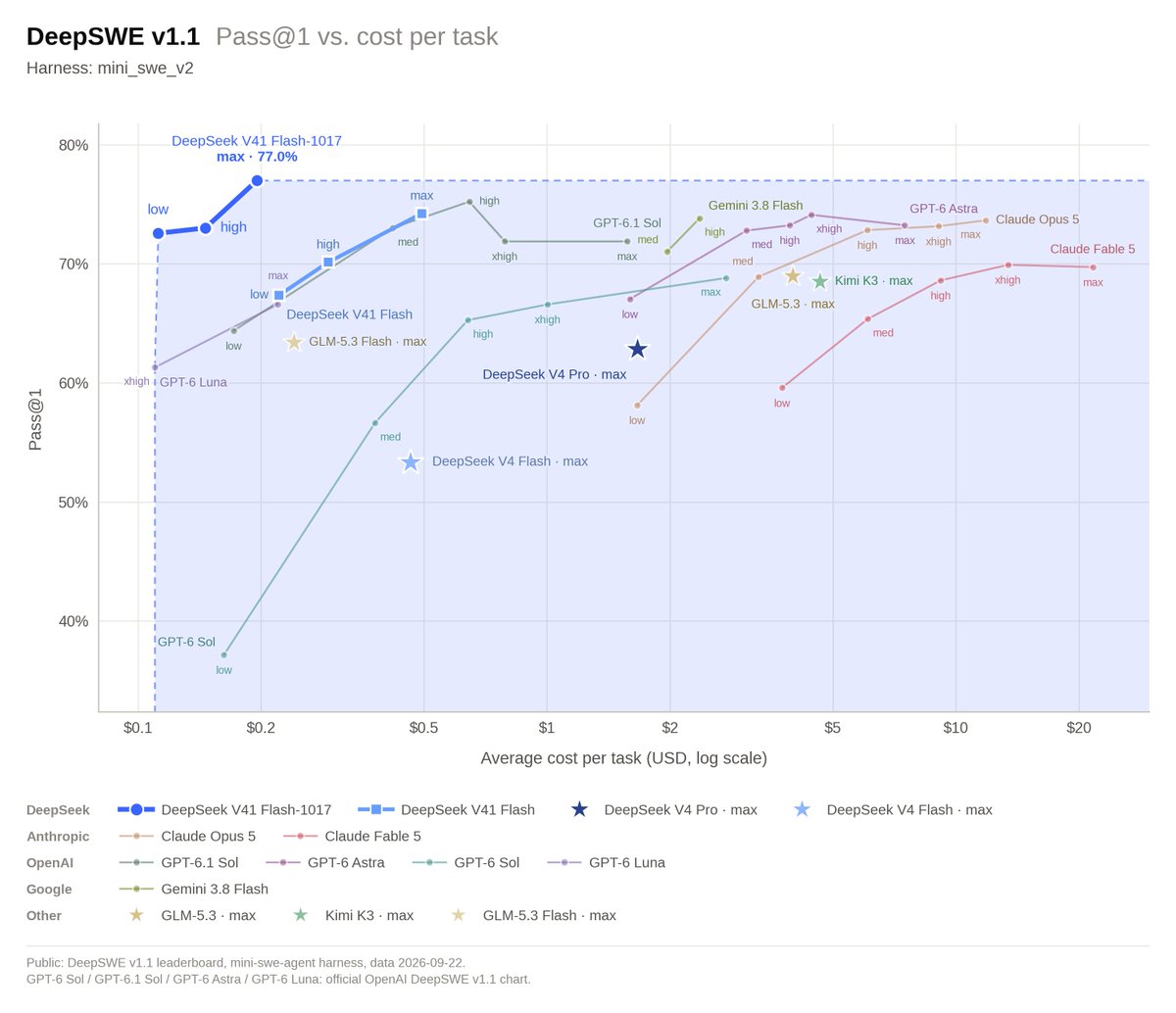
DeepSeek-V4.1-Flash-1017 delivers stronger coding and agent performance with faster task completion and shorter outputs. Available on ModelScope:
🤖 https://t.co/ND5Y6AgfvJ
🚀 DeepSeek-V4.1-Flash-1017 is here!
Stronger benchmark performance, faster task completion, and shorter outputs than the previous version—a Pareto improvement in performance and cost. Now live on our website, app, and API.
🛠️ Optimized for @DeepSeekHarness, Tencent CodeBuddy, WorkBuddy, and more. Upgrade to DeepSeek Harness v0.2.1-rc.1 or later for the best experience with the new model.
1/4