India surpasses USA & Russia to become the 2nd Largest Freight Carrier in the World 🚆🔥
🇨🇳 China ~4B+ MT
🇮🇳 India 1.67B MT
🇺🇸 USA ~1.5B MT
🇷🇺 Russia ~1.2B MT
Unstoppable Indian Railways! 💪🏼
🚨 BIG BREAKING
UPI is and will remain FREE for all Indian consumers.
PhonePe CEO confirms: Consumers will NOT be charged anything for making UPI payments. 🔥
Indian Railways is now the world’s second-largest freight-carrying network. This milestone reflects India’s expanding logistics strength and showcases a robust rail system driving the nation’s growth.
#IndianRailways#Hungry4cargo
Read more:
https://t.co/TE8kxgD8KL
Aap logo ne notice Kiya hoga , jo aj kal sabse zada reports or Articles publish kr rahe hain .
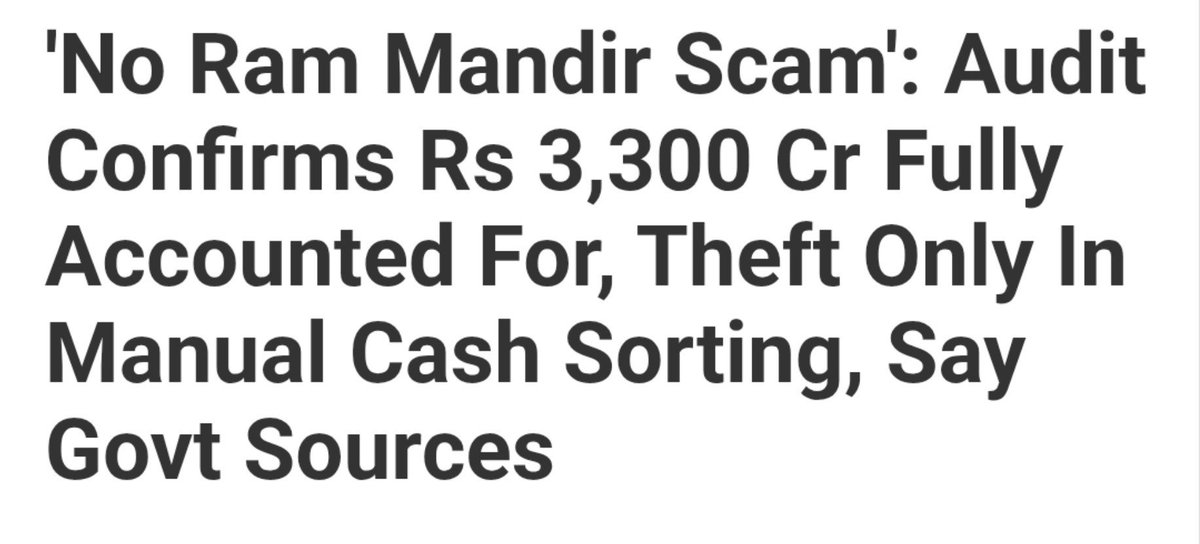
Unhone Ram Mandir ki audit report ab tk ap logo ko dikhai nahi hai
Five “rebuttals”, five evasions. Jairam Ramesh has merely repackaged his original canards.
1. Merchant or customer? Jairam deliberately hides the exemptions.
The Finance Minister stated the legal fact: MDR is charged to the merchant, not the customer. Jairam responds with speculation about indirect price effects. That does not disprove her.
More importantly, over 95% of UPI merchant transactions are below ₹2,000 and would remain exempt under the proposal being considered.
So there are two proposed safeguards that Jairam conveniently conceals:
- Transaction threshold: Payments up to ₹2,000 would remain exempt.
- Merchant threshold: Small merchants would remain exempt.
He is using a proposal that could potentially cover barely 4% of merchant transactions to frighten 100% of UPI users. That is deliberate political misinformation, not concern for small businesses.
2. Who should fund UPI?
A “public digital good” does not mean costless infrastructure. Banks and payment companies pay for servers, settlement, fraud prevention, and cybersecurity.
The RBI’s ₹2.86 lakh crore surplus was a one-time annual transfer, not an inexhaustible pot of free money. Jairam’s solution is that taxpayers should permanently subsidise high-value payments to large retailers—including transactions processed by Google Pay and Walmart-owned PhonePe, whose dominance he simultaneously complains about. Spectacularly self-contradictory.
3. Has MDR been imposed?
No. Jairam admits that the Steering Committee has not taken any decision and then declares future customer charges “inevitable”. That is fearmongering, not scrutiny.
The Bill creates room for a calibrated policy and empowers the Government to preserve specified transactions as free through a legally binding notification. “No proposal” in 2025 meant there was no proposal then; it was not a promise to freeze payment policy for eternity.
4. Jairam’s Trump conspiracy theory
Mastercard complained to the U.S. Government in 2018, and Visa followed in 2021. India responded by expanding RuPay and UPI domestically and internationally. India’s own payments industry sought reconsideration of zero MDR in January 2022, years before the 2026 USTR report.
His Brazil comparison is even more embarrassing. Brazil already permits financial institutions to charge businesses for Pix transactions from the very first transaction.
An MDR on UPI would finance the UPI ecosystem, not Visa or Mastercard. Making India’s payment infrastructure financially sustainable strengthens it; it does not surrender it.
5. Parliament was “not allowed” to discuss it?
The Bill was introduced on August 4 and passed by the Lok Sabha on August 6, not “within minutes of introduction”. The Opposition disrupted proceedings and prevented discussion. It cannot paralyse the House and then pose as the victim of insufficient debate.
Jairam’s position ultimately boils down to a demand for permanent public subsidies for large merchants, wrapped in a fabricated Trump conspiracy. It is economically incoherent, factually dishonest, and politically desperate.
Ethanol blended petrol – what the science really says https://t.co/Nckk0K6ze6
A must-read article by @Anjan3907, former Director of @CSIRIIP, in @NatureInd.
There is a huge disinformation campaign underway on this issue, by vested interests that do not want India to become less dependent on oil imports. I urge readers and citizens to spread awareness and correct information about this topic, defeat the disinformation campaign!
This is a great graph.
But let's dig a little deeper.
Apart from India's performance, this graph also tells you what the Commodity Boom Cycle can do to a country's Growth.
Russia, Indonesia, Argentina, Brazil (part of BRIC)- all enjoyed super growth in 04-14 due to the commodity boom. The moment it slowed down post 2014(along with demand destruction from China), every single nation got slowed down brutally. Fell from 10%+ growth to 2% growth.
Australia, Canada, and South Africa got hit by the same issue.
People really don't understand how superb the period of 2000 to 2014-15 was. This period has literally created generational wealth for many nations.
And in this period, we got NPAs, High CAD, High Inflation, Twin Balance sheet problem from MMS. That's why 2004-14 is our lost decade.
There has been considerable discussion around UPI and merchant charges. Here are the facts behind the conversation what it means for consumers, merchants, and India's digital payment ecosystem.
1. Will I have to pay to use UPI?
No. UPI has always been free for consumers since its launch in 2016. Every Indian can continue making instant digital payments without paying any transaction charges.
2. Will small shopkeepers or kirana stores be charged for accepting UPI?
No. Small merchants are not required to pay any charges (MDR) to accept UPI payments. UPI was designed to make digital payments accessible for even the smallest businesses across India, and protecting small merchants remains central to the ecosystem's inclusive growth.
3. Why is there a discussion around UPI charges now?
UPI has evolved from a new payment platform into the world's largest real-time payment system. As the ecosystem continues to expand, discussions are taking place on how to sustainably support the infrastructure that enables billions of secure transactions every month, while continuing to ensure that consumers and small merchants remain protected.
4. Who built and continues to invest in UPI?
For nearly 10 years, banks, payment companies, fintechs, NPCI and RBI have collectively invested in technology, cybersecurity, fraud prevention, innovation and customer support to build one of the safest and most reliable payment systems in the world.
These investments continue every day to keep UPI secure, resilient and available 24×7.
5. If UPI is free, who bears the cost of operating it?
Operating a national payment infrastructure involves continuous investment in technology, fraud prevention, cybersecurity, compliance, customer support and innovation.
These costs are currently borne by ecosystem participants including banks and payment service providers who continue to invest so consumers can enjoy a safe, secure and seamless payment experience.
6. Would consumers have to pay if large merchants pay for payment acceptance?
No.
Merchant service charges, where applicable, are commercial arrangements between merchants and payment service providers. They do not mean that consumers pay to use digital payments.
Across the world, merchant service charges are a standard feature of digital payment ecosystems, while consumers continue to enjoy convenient and secure digital payment experiences.
7. Why is sustaining the UPI ecosystem important?
UPI has become critical national digital infrastructure used by hundreds of millions of Indians every day.
As transaction volumes continue to grow, sustained investment in security, resilience, innovation, fraud prevention and infrastructure will remain essential to ensure that UPI continues to serve consumers and businesses reliably for years to come.
@FinMinIndia@DFS_India@nsitharamanoffc
I don’t get why people are crying over charges on UPI?
The infrastructure isn’t free for the govt to keep hosting it and as it gets bigger it’s only going to get more expensive.
Charging a really small MDR on transactions over 2k or 5k is totally valid keeping P2P nil.
ONE MORE FAKE NEWS BY CONGRESS BUSTED
Congress ecosystem led by @Jairam_Ramesh ran a smear campaign claiming that UPI transactions would be charged. They spread misinformation and created panic.
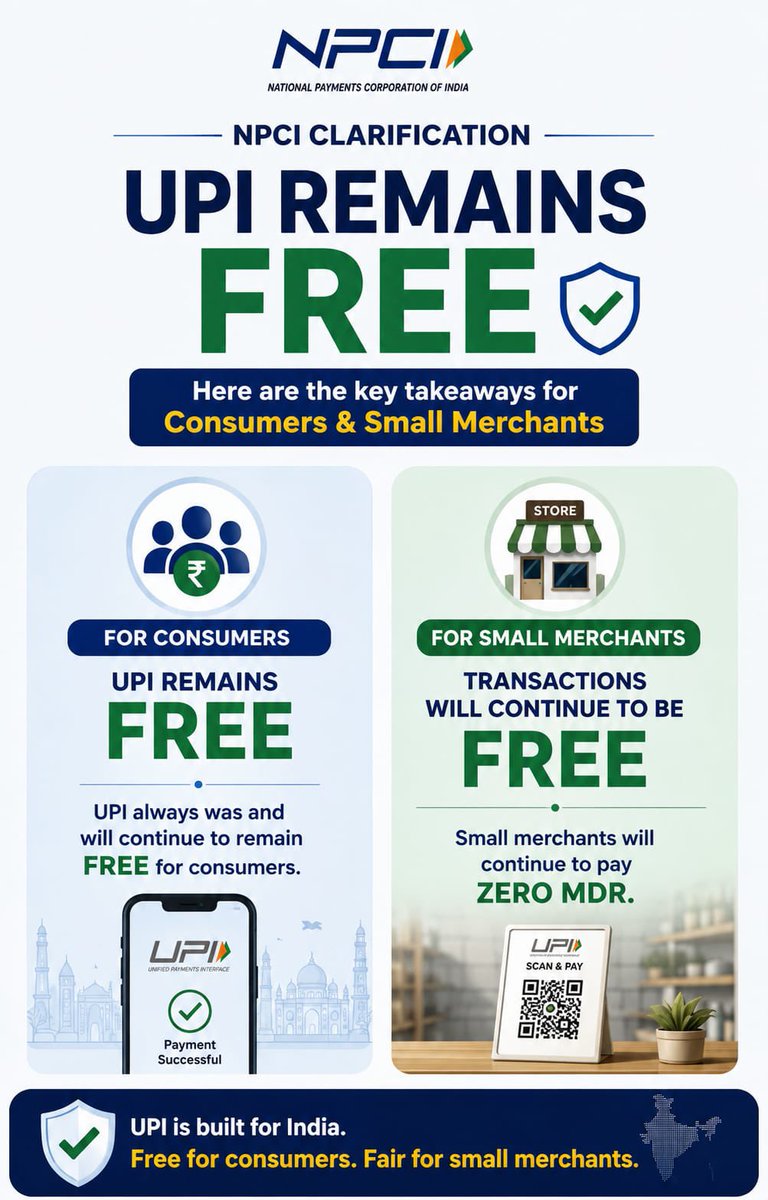
Now NPCI has made it crystal clear.
~UPI remains free for consumers.
~UPI always was and will continue to remain free for consumers.
Small merchants will continue to pay zero MDR.
The discussion is only about ensuring the long term sustainability of the UPI ecosystem, potentially through commercial arrangements involving large merchants, not by charging ordinary users.
Another Congress misinformation campaign has collapsed within hours.