FVG is filled on the weekly. If you felt like you missed the bottom and wanted to get more cheapies then you are rewarded a second chance to DCA more. No reason to get mad unless you was leveraging. $BTC $ETH #crypto
Crypto is having an absolutely brutal weekend.
Bitcoin is now down -$5,000 today and -$11,000 over the last 3 days, marking one of its steepest drawdowns in months.
Selling pressure is accelerating as crypto liquidations officially crossed $2 billion over the last 24 hours.
Over the last 4 hours alone, total levered crypto liquidations have exceeded $900 million.
And, since October 6th, crypto markets have now erased -$800 billion in market cap.
After an attempted rally into the end of Q3, Bitcoin is now back down to its lows of the year.
Since the record high in October 2025, crypto has officially over half of its total market cap.
Crypto is in desperate need of a new catalyst.
Crypto has been under intense selling pressure the last few weeks.
While crypto fundamentals have been mostly positive (many banks announcing use of crypto and blockchains), price not followed.
Here are some reasons we see potentially behind weakness:
- AI/semi/$NVDA selloff triggered margin calls (particularly Asia retail)
- coming @AnthropicAI IPO a supply shock for equities (selling ahead so investors fund IPO purchase)
- $ANT to have heavy retail allocation @RobinhoodApp $HOOD (selling crypto to fund)
- funds from recent $6.3B hack recently released to account holders
- these account holders converting holdings to cash/ stables
Secondary factors:
- Anthropic roadshow talk about AI ‘breaking’ everything, all cyber defense and every company
- creates existential fears of anything technology or digital
- DoJ/ USA 🇺🇸 scrutinizing chip sales to Asia/China 🇨🇳 triggers concerns of crackdowns
- crypto sells off on fears of more bad Asia headlines
Our take:
Crypto remains the future of finance
- the settlement layer for transactions
- digital assets transform capital markets
- adds up to a ‘supercycle’ for crypto
- bigger than past cycles
The headwinds 💨 shall pass
$ETH is the future of finance
ETH price is struggling. BUT its ONCHAIN economy tells a different story! 📈
Ethereum application revenue continues to show remarkable strength.
🔹 $28.94M in application revenue
🔹 Ethereum Mainnet: ~74.2%
🔹 Layer 2s: ~25.8%
🔹 Recent revenue spikes have exceeded $50M
And here's what I find particularly BULLISH.
Despite weak ETH prices, applications across Ethereum continue generating substantial revenue.
The long-term trend is clearly UP, even with significant volatility.
And I think that story is still massively UNDERAPPRECIATED. 👀
Great chart by @growthepie_eth.
ethereum:native | Monthly chart
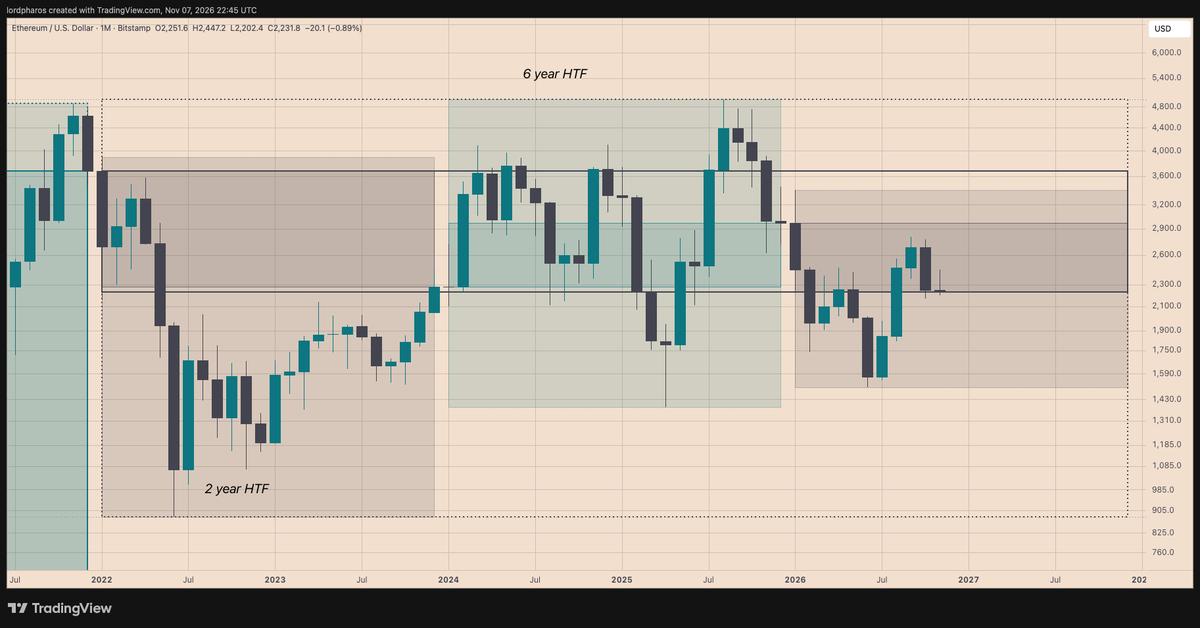
The six-year historical view shows repeated interaction with the highlighted zone, making it a key reference area within the broader market structure. The two-year view brings the recent swings into focus: price has rebounded toward this zone, but has yet to establish a sustained move above its upper boundary.
The distinction is between a recovery into resistance and a confirmed breakout. A monthly close above the zone, followed by sustained acceptance or a successful retest as support, would strengthen the case for upside continuation. Until then, the recovery remains within the broader consolidation—not yet a confirmed departure from it.
#Ethereum
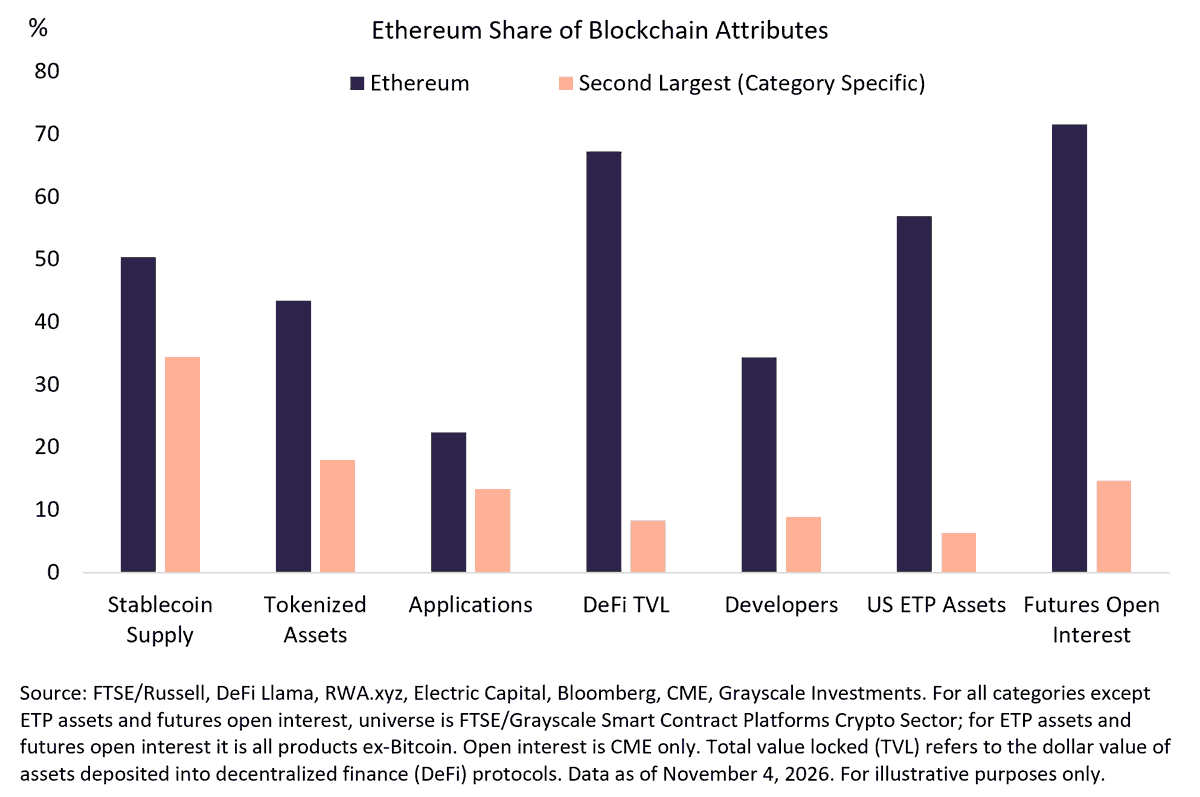
Among all smart contract platforms, Ethereum $ETH is #1 in stablecoins, tokenized assets, applications, developers, and investment products.
The financial system is being redesigned. Ethereum is leading it.
Read more on The Stack by @LowBeta: https://t.co/HHHzzQRafK
Not every financial asset needs the FASTEST blockchain.
Some need the MOST TRUSTED one.
And tokenized gold on $ETH is a great example for this!
🔹 Ethereum controls 95.5% of tokenized gold value
🔹 $5 BILLION secured on Mainnet
🔹 The remaining 16 chains share just 4.5%
That is an extraordinary concentration.
Why?
My theory is simple.
When institutions tokenize valuable assets, they don't necessarily optimize for the cheapest or fastest blockchain.
They optimize for SECURITY, LIQUIDITY, and TRUST.
Tokenized gold is showing us where Ethereum's competitive advantage may be strongest.
$35M → $50M → $70M.
Another month, another 40% MoM increase in annualized revenue across the Bittensor ecosystem.
When we published the first SubConnect Bittensor Revenue Index, we estimated that revenue-generating subnets were collectively doing around $35M in annualized revenue.
A month later, that number had grown to approximately $50M.
Today, we're estimating $70M in annualized revenue.
That's a 100% increase in just two months.
Of course, annualized revenue is a snapshot, and the real challenge is sustaining that growth while improving margins and reducing dependence on emissions, but the direction is clear.
Bittensor is growing from the inside out.
And our expectation of $100M+ in annualized revenue by the end of 2026 is getting closer.
We'll continue tracking the numbers every month through the SubConnect Bittensor Revenue Index.
Now official… Democrats just won every single statewide office in Texas:
Senate
Governor
Lt. Governor
Attorney General
Land Commissioner
Comptroller of Public Accounts
Agriculture Commissioner
Railroad Commissioner
All 4 Supreme Court Justices
Tokenization is the biggest bull market in crypto.
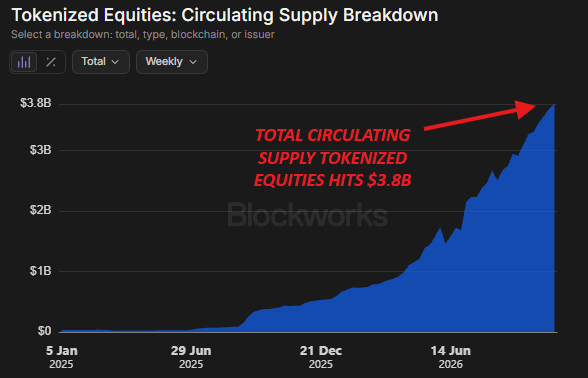
The total circulating supply of onchain tokenized equities just hit another record high, at $3.8 billion.
This metric has now reached a new record high for 10 consecutive weeks, up +590% year-to-date.
It has become increasingly clear that financial markets are moving toward tokenizing everything.
Investors are demanding 24/7 markets, and tokenized assets are increasingly fulfilling that demand.
Amid the shift, Jupiter, the largest onchain platform on Solana, reported that 70% of tokenized asset trading now occurs outside traditional market hours.
Amid this surge in demand, the NYSE is developing infrastructure for tokenized equities and perpetual futures.
The future of financial markets is onchain.
Quantum computing poses a serious threat to the cryptography blockchains currently rely on, while advances in AI compress best estimates for the threat's timeline.
That's why experts gathered in Cambridge to coordinate research upgrading our cryptography to be quantum-resistant.