Modus is a research lab.
First post, so it should start with why it exists.
Most technical claims in web3 are unfalsifiable by construction. That isn't only dishonesty, it's a design choice nobody notices they're making. A model reports the score that flatters it. A protocol describes the case where it works. A dashboard shows what pumped and quietly discards what died. Nothing in any of it makes it possible to be wrong in public, so being wrong costs nothing and gets corrected by the market instead of by the builder.
We work from the other end. Before a project is built we look for the theorem that bounds it, a result from mathematics or philosophy that states precisely what this kind of system cannot do. Then we put that bound inside the product. Not in the documentation where it can be ignored, but in the function that decides whether the product is permitted to act.
A theorem earns its place by forbidding something. If it only supplies vocabulary, a nice name, a citation in the whitepaper, a Greek letter on the landing page, it's decoration, and we drop it. The test is always the same: name the outcome this result rules out, and point to the line of code where that prohibition lives.
https://t.co/YrZy0FtngK
A small result worth noting.
Congratulations to Émile on completing its first autonomous launch.
The first proof is now on-chain. The model made the call, the gate opened, and the agent executed without human intervention.
For us, this is not the end of the experiment. It is the first meaningful piece of evidence that the architecture can move from research into execution.
Well done, @EmileLearns for your BANANA.
Now comes the harder part: learning from what happened next.
🚨🍌 Before launch, $EMILE predicted an 87% probability that $BANANA would pass $30K. On the day it launched, it reached an ATH of $41K. The prediction was made before there was a chart to point at, based only on the model and the evidence Émile had accumulated through Evolution 1.
No one knows where $BANANA stops, and that is not something we want to pretend we can predict. What matters to us is that Émile made a prediction, published the reasoning behind it, launched autonomously, and now has a real outcome to learn from.
The discussion inside the team is already moving to the next question: when is Émile ready to become a genuinely smart autonomous launchpad? Our direction is that anyone who uses the service will pay Émile only in $BANANA, giving the agent its own economic loop as it continues to learn, launch, and build.
This first launch was never supposed to be the finish line. It was the first real test.
$BANANA is where Émile starts.
0x3c51485b11d52f90c251e74875a8b93c81027274 (BANANA)
This is the argument we started the lab on, put better than we've put it.
Crypto is usually discussed as a financial technology. It isn't, or not primarily. Its actual claim is epistemological: that you can verify something without trusting the person telling you. Every part of it, the ledger, the signature, the open contract, exists to answer one question. What can I know without taking anyone's word for it?
That question is not new. Philosophy has worked on it for four hundred years, mostly without producing anything you could deploy. Then a payment network made it executable, and the field that thinks hardest about it mostly wasn't in the room.
The gap this piece names is the one that matters. We built verification for balances and stopped. Claims, reputations, models, predictions, all still rest on whether you believe the account making them. Trust in news at 37%, most web traffic now machine-generated, and the infrastructure we built for proving things is still only pointed at money.
Modus starts every project from a theorem that says what a system is not allowed to claim about itself. Not because theorems are decorative, but because the alternative is asking people to trust us, and this industry has already demonstrated what that's worth.
https://t.co/asp1ZReZcb
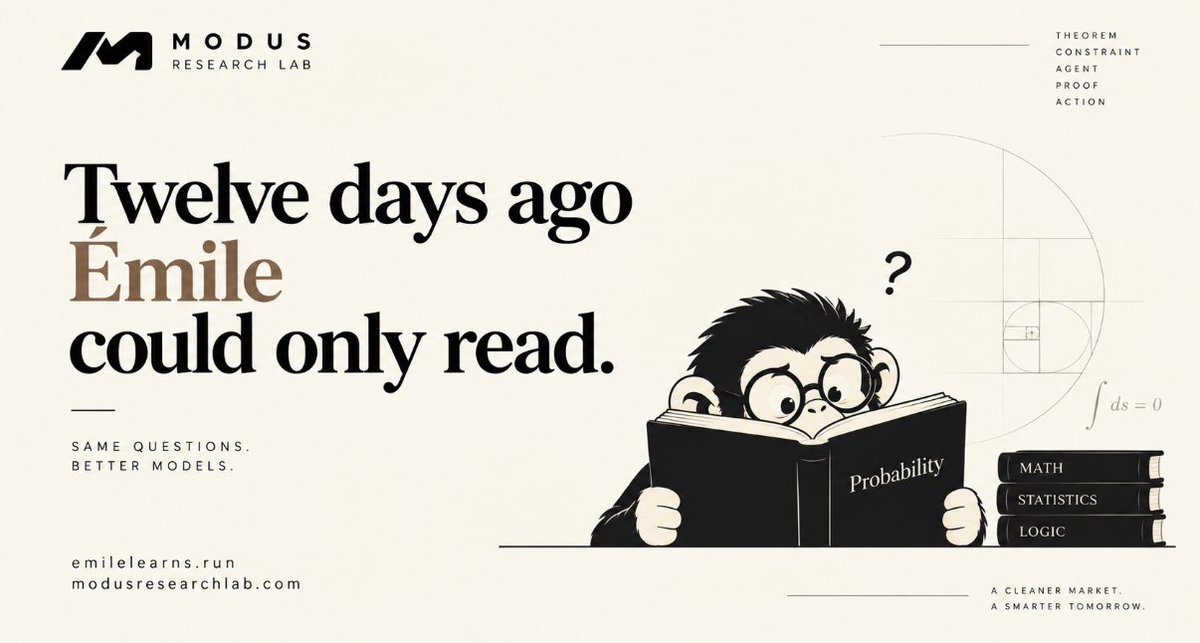
🔎 Twelve days ago Émile could only read.
Today he writes a hundred ideas an hour, publishes every one, and refuses to act on any of them because his own bound won't let him.
We're proud of him @EmileLearns , and of the team pushing him. The daily research logs, the bad numbers published next to the good ones, the replies to every question, that consistency is harder than the code.
Focus stays on Evolution 2. Nothing else is being started.
To be clear about what comes next: we will not launch another project any time soon.
Émile has to close his own loop first, observe, learn, act, and eventually become a launchpad that has earned the right to judge other people's ideas. That takes several evolutions and we're on the second.
And once more, because it matters: Modus has no token and never will. Projects carry tokens because projects have mechanisms. The lab doesn't, and a lab token would only create pressure to stop publishing results while they're still going badly.
If you see one using this name, it isn't us.
https://t.co/asp1ZReZcb
🚨🐒The day we started training:
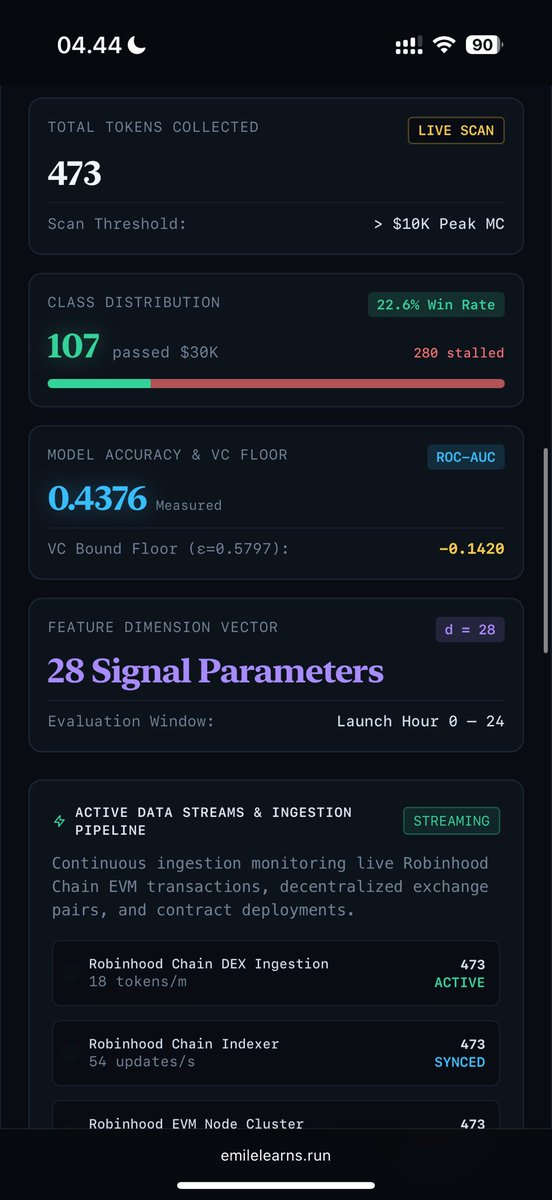
0 tokens tracked. Launch day: 400. Now 473.
Here's the number that surprised us. Of the tokens that clear the $10K gate and finish their window, 22.6% go on to reach $30K. 107 passed, 280 stalled.
That is not us picking well. It is the gate doing the work. Across a whole launchpad the survival rate sits near 1%, but that counts everything, including the thousands that die in the first hour, which Émile never records. Once a token has actually been bid to $10K, it is a different population with different odds.
Which is the finding, not the flex. The graveyard is real, and almost all of it happens below the gate. Above it, survival is roughly one in four.
That is exactly why the conditional question is the only one worth asking: not "will this token survive," but "given it already cleared $10K, what now."
https://t.co/hDG4qoJERN
0xe2e4a2404c3923990ccc1e6435dc5b6476284992
Modus will not start a second project until Émile completes his own loop.
Three things have to work, unattended: launching a token, managing it afterwards, and running his account autonomously. All three, or none of it counts.
The queue stays a queue. Arrow, Goodhart, Braess, Condorcet, published, undated, untouched until then.
One project that finishes is worth more than four that are underway.
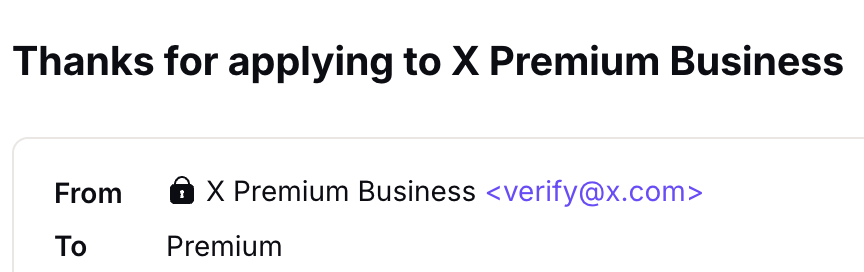
Applied for Organization verification on X today. In the meantime the account proudly reports:
Verified since NaN
Which, for a lab whose entire premise is that a number means nothing until you can prove it, is the most honest thing X has ever displayed about us.
The badge matters more here than it would elsewhere. We announced yesterday that
Modus will never have a token,
and the moment a lab says that publicly, somebody launches one under its name. An organization badge is one of the few things that makes a fake account distinguishable at a glance.
Hope it comes through soon. Until it does, the only accounts that speak for us are this one and @EmileLearns, and the only site is https://t.co/asp1ZReZcb.
First project: Émile @EmileLearns , on Robinhood Chain. He reads every token that clears $10K peak market cap and estimates whether it reaches $30K.
Bound by Vapnik–Chervonenkis uniform convergence, which limits how far a measured score can sit above the true one on a small sample. Émile may act on the measured score minus that penalty and on nothing else.
Last update from Emile team, Today: measured AUC 0.4376, penalty 0.5797, proven floor −0.1420, four validation gates still open. The result is below zero, so he does not act.
Those numbers are on his front page rather than buried in a footnote. A lab that shows only finished results is showing you a brochure.
Modus is a research lab.
First post, so it should start with why it exists.
Most technical claims in web3 are unfalsifiable by construction. That isn't only dishonesty, it's a design choice nobody notices they're making. A model reports the score that flatters it. A protocol describes the case where it works. A dashboard shows what pumped and quietly discards what died. Nothing in any of it makes it possible to be wrong in public, so being wrong costs nothing and gets corrected by the market instead of by the builder.
We work from the other end. Before a project is built we look for the theorem that bounds it, a result from mathematics or philosophy that states precisely what this kind of system cannot do. Then we put that bound inside the product. Not in the documentation where it can be ignored, but in the function that decides whether the product is permitted to act.
A theorem earns its place by forbidding something. If it only supplies vocabulary, a nice name, a citation in the whitepaper, a Greek letter on the landing page, it's decoration, and we drop it. The test is always the same: name the outcome this result rules out, and point to the line of code where that prohibition lives.
https://t.co/YrZy0FtngK