Kiambu County was meant to be the food supplier for Nairobi City. Its abundant arable land produced Coffee, Tea, Cereals, Vegetables & Fruits for City residents & for export.
Then Kiambu land owners with connivance of Kiambu County Government have decided to convert the County into a concrete jungle of bed-sitters!
Soon, Kenya will be importing food from Uganda to feed its City Citizens and the residents of Kiambu who were once farmers!
Without self-sufficiency in food production, a country can never be developed!
Finance Bill 2026.
Out of 347 MPs, only 162 showed up to vote on one of the most consequential pieces of legislation affecting millions of Kenyans.
122 voted YES
40 voted NO
185 MPs were absent
If only 162 MPs can determine the future of the country's finances, then Kenyans have every right to ask:
Why are taxpayers funding 347 MPs when nearly half the House is missing during critical national decisions? 🇰🇪
NTSA, this is a citizen complaint.
Blinding headlights on Kenyan roads have become a serious safety issue.
Matatus.
Boda bodas.
Buses.
Private cars.
Some vehicles are no longer using headlights. They are carrying portable suns.
Every night, drivers are forced to slow down, squint, or drive blindly because an oncoming vehicle has turned the road into a stadium.
At highway speeds, a few seconds without clear vision is enough.
Dear NTSA, do you need our help identifying these vehicles?
Because Kenyans meet them every night.
We know the routes.
We see the offenders.
We experience the danger.
Maybe giving Kenyans a better night driving experience has not been urgent enough.
But here is the interesting part:
You can actually fine them.
Maybe the revenue opportunity will finally motivate action where public complaints have failed.
Fine them. Remove unsafe modifications. Make the roads safer.
Road safety is not only about speed cameras and checkpoints.
Sometimes it starts by allowing drivers to see where they are going.
Tag NTSA.
Repost until night drivers are heard.
@ntsa_kenya
BREAKING: KSh 377 million worth of drugs expired at KEMSA and were thrown away.
Cancer drugs.
HIV drugs.
Thrown away.
At the same time, thousands of Kenyans were being told their hospitals had no medicine and were forced to buy drugs with money they don't have.
That is what makes this scandal so infuriating.
The issue is not that Kenya lacked the drugs.
The drugs were there.
They were simply allowed to expire.
Someone knew. Someone was responsible. Someone failed to do their job.
As we demand accountability from leaders at the top, we must also confront the negligence and incompetence inside public offices.
Ordinary Kenyans are paying the price for a system that keeps failing them.
Ngong Forest
Karura Forest
Nairobi National Park
Meru National Park. All these are under serious attack from people that swore to protect them
In a few years that what you call park in the city will be a Zoo in Syokimau. But hey, let's just sit silent we are not Wangari Maathai
In July 2023, President William Ruto's government lifted the moratorium on logging in public and gazetted forests.
That decision raised serious concerns among environmentalists, conservationists, and many Kenyans who understand the critical role forests play in sustaining life and supporting the economy.
Today, many Kenyans are worried about increased pressure on key water towers such as the Aberdare Forest and the Mau Forest Complex.
These forests are not ordinary pieces of land. They are among Kenya's most important water catchment areas, feeding rivers, supporting agriculture, generating hydroelectric power, preserving biodiversity, and influencing rainfall patterns across the country.
When forests are degraded through excessive logging and destruction of tree cover, the consequences are severe: reduced rainfall, drying rivers, water shortages, crop failures, loss of wildlife habitats, and more frequent droughts.
The people who suffer most are ordinary Kenyans, especially farmers, pastoralists, and low-income families.
A government's duty is to protect national resources for future generations.
Forests are not a commodity to be exploited without regard for the future.
They are a national inheritance held in trust for our children and grandchildren.
The true measure of leadership is not how much land is controlled, how much wealth is accumulated, or how many short-term interests are satisfied.
It is whether a leader leaves behind a greener, safer, and more prosperous country.
If we continue to weaken the protection of critical water towers such as the Aberdares and the Mau, future generations will pay a heavy price through drought, hunger, water scarcity, and environmental degradation.
Kenya's forests are our natural defense against climate change. Once destroyed, they may take generations to recover.
The question every Kenyan should ask is simple: what kind of country are we leaving behind for those who come after us?
KWS Director General, Erastus Kanga, has announced plans to relocate the Nairobi Animal Orphanage from its current 7.2-acre site to an 89-acre parcel opposite Bomas of Kenya, saying the 64 year old facility has outlived its usefulness. The new orphanage is expected to boost wildlife rescue services, create 1,000 jobs, increase visitor capacity and generate up to Sh4 billion annually for KWS.
Photos by Collins Oduor
When KALRO and KEBS warn us there is aflotoxin-laced cereal in the country, and that it has cancer-causing agents, what do they want us, as consumers, to do?
Do we have the means to trace, mop up—and prosecute those selling— toxic grain?
Why does GoK stop at WARNING the public?😮💨
🧵 Nairobi has normalized dysfunction so deeply that we now celebrate roads simply because they exist, not because they are safe.
Driving through parts of the city in the rain felt less like commuting and more like surviving an obstacle course.
Waiyaki Way. Uhuru Highway. Enterprise Rd. Lunga Lunga. Jogoo Rd. Outering. Thika Road. Northern Bypass.
Pitch black.
No lane markings.
No reflective paint.
No warning signs.
Barely any lighting.
At some points, you genuinely cannot tell where your lane begins or ends.
And yet this is a city where every litre of fuel is taxed heavily in the name of road maintenance.
So where is the money going?
Because it is clearly not going into safer roads.
Some roundabouts along Uhuru Highway are almost invisible at night when it rains. You only notice them when you are already on top of them.
The speed bumps around Northern Bypass and parts of Nairobi are another problem entirely.
Poorly marked.
Poorly designed.
Dangerous spacing.
Not traffic calming.
Just vehicle damage waiting to happen.
What makes this worse is that these are not remote roads.
These are major roads used daily by thousands of ordinary Kenyans going to work, running businesses, or simply trying to get home alive.
Road safety is not a luxury item for developed countries.
Reflective paint is not a miracle technology.
Street lighting is not an impossible engineering challenge.
This is simply what happens when institutions stop caring because accountability disappeared long ago.
Road deaths are not always “accidents.”
Sometimes they are accumulated negligence.
And negligence, when repeated for years, becomes policy.
BREAKING VIDEO: Kenya’s Sabastian Sawe becomes the first person ever to win a regular marathon in under two hours, setting a new world record at the London Marathon in 1:59:30!
Kenyans invented running™
You’ve got to admire the sheer chutzpah of African govts in using first world technology/techniques in taxation/extortion of the citizenry but applying 10th world standards in service delivery …🤔🤔😭😭😳😳😳
RECORD BROKEN!
Hillary Kiplagat Kibiwott has just planted 23,326 trees in 24 hours at Kessup Forest, shattering the previous record that stood at 23,060 held by a Canadian.
That boy circled in green is Peter Edung. Fourteen years old. From Sosian Village, Laikipia North. From a family that has very little, except now they have even less. They have a funeral to plan.
Peter went to visit his uncle, a casual worker at Oldonyo Lemora Ranch. The ranch is owned by Ivan Tomlinson, a British - Kenyan dual national. It's the kind of place where tourists pay good money to forget the world exists.
Peter didn't go there as a tourist. He went there to see family.
He never came back.
According to police reports, the incident occurred on the night of April 21, 2026. A firearm was discharged. Peter sustained fatal injuries. The weapon, a Mark Four CZ 527 rifle, was licensed to Ivan Tomlinson. The person police have named in connection with the shooting is Lance Tomlinson; the 15-year-old son of the ranch owner.
One teenager shot another teenager. One is now at Rumuruti Funeral Home. The other is... not in custody. Probably watching Netflix somewhere.
The suspect is unaccounted for. The System is "Moving."
Here's what we know so far, based on publicly available information.
Ivan Tomlinson, the father and firearm owner, reported to the DCI offices in Laikipia West on Thursday. He came with legal representation. He recorded a statement. He was subsequently released on cash bail of KSh 100,000 for the alleged offense of allowing a minor access to a firearm, contrary to the Firearms Act.
Meanwhile, the juvenile suspect; Lance Tomlinson has not yet been formally apprehended. Police have stated that efforts to trace him are ongoing.
I hope we are together up to that point.
A 14-year-old boy is dead. A firearm registered to a British man was involved. The father has been questioned and released on bail.
The son named in connection with the shooting is still at large, and the official word is that the search is at "an advanced stage."
We are not investigators. We are not the court. We simply note the sequence of events and ask: If the roles were reversed, would the pace be the same?
Multiple sources have indicated that the young suspect was taken to Nanyuki Cottage Hospital for what has been described as a mental health assessment.
We do not know the medical history of the individual involved. We do not know the legitimacy or necessity of such an assessment. That is for medical professionals to determine.
But here is what we can observe: When a poor Kenyan teenager is named in connection with a violent crime, the path is generally direct; arrest, cells, court. There is rarely a private hospital visit in between.
Whether this assessment is standard procedure or something else, the public is watching. And the question is fair: Is this healthcare, or is this strategy?
This tragedy did not happen in a vacuum. It happened in Laikipia; a county where land, identity, and justice have been tangled for over a century.
More than half of Laikipia's land mass is occupied by large private ranches and wildlife conservancies. Many of these are owned by families of British descent; descendants of settlers who remained after independence.
Meanwhile, pastoralist communities who once moved freely across this landscape have, over generations, been squeezed into ever-smaller parcels.
Peter Edung was not part of any conflict. He was a 14-year-old boy. He was from an extremely poor family. He was visiting his uncle, a casual laborer, on a ranch his ancestors may once have walked freely.
And now he's dead.
We do not know all the facts of that night. We do not know what led to the discharge of the weapon. We do not know the full story and we may never know it completely.
But we do know the context. And context matters.
Where Are the Leaders?
This is the part that should disturb every resident of Laikipia County.
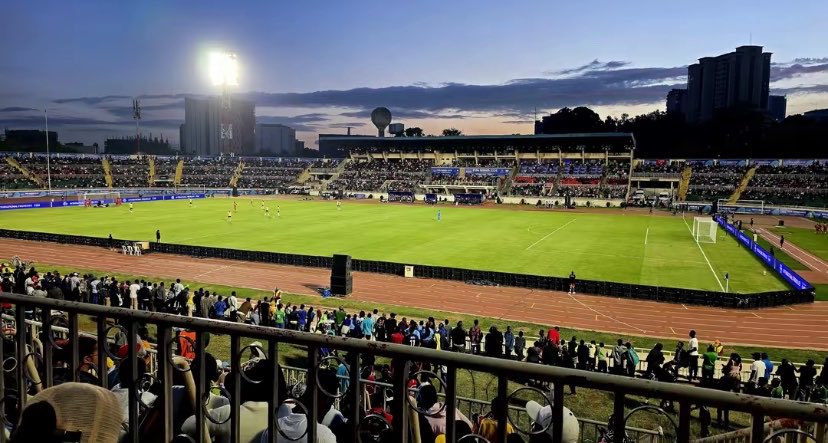
For the first time, Nyayo Stadium lights up this Friday purely for athletic stars, as they take the blocks at @KipKeinoClassic 🇰🇪
Kenyans are in for a spectacle, 800m Olympic Champion Emmanuel Wanyonyi, 100m Commonwealth Champion @Ferdiomanyala, 200m Olympic Gold medalist Gabby Thomas, just a glimpse of a packed field.
The program kicks off at 1.00pm but the core events begin at 4.00pm bringing all the hype under the stars.
But what has us all intrigued is the introduction of the Wavelight tech. Tradition meeting innovation.
The Wavelight tech is a LED system built inyo the running track and the lights move at a preset pace giving athletes a real-time visual guide to help them hit targets. Might we see a World record this Friday?
Happening now: activists gathered at Kilimo House to protest against Kenya allowing toxic pesticides in the country.
67 of Kenya's 141 registered pesticide ingredients are classified as highly hazardous. They're in our rivers. Our soil. And Our food.
State announced a ban which they are not enforcing or monitoring.
They are demanding action to stop feeding us poison.