Finally reading "Broken Money" by @LynAldenContact and it's a good reminder that $BTC and other internet-native hard monies will most reward the patient ($ZEC the most credible complement to $BTC, in this category).
From 2016-2025 there was a wave of impatience as the promise of blockchains drew crowds of people that didn't deeply understand Bitcoin, and treated the space as simply another tech platform. Bitcoin is more of a social reboot, than a technological one, and such a reboot takes decades to play out.
Now, impatience is washing out to other seemingly faster moving waters, taking us closer to what things felt like in 2015 and before... which will once again reward those that understood all along.
⚡️Volatility is the mechanism by which Bitcoin decides who is allowed to hold it.
At the structural level, here is what is really going on:
1. Volatility is a filtration engine
Every violent move does three things at once.
•It liquidates weak balance sheets.
•It punishes shallow conviction.
•It transfers coins from reflexive fear to long term signal.
That is how a neutral protocol simulates a moral test.
You do not earn a fixed supply asset with perfect portability by being comfortable.
You earn it by surviving repeated psychological margin calls.
2. Volatility is the price of time compression
Bitcoin is trying to pull fifty years of monetary regime change into a single decade.
If you compress that much structural adjustment into that little time, the price path cannot be smooth. The path must be jagged because belief has to move in discrete jumps.
Each spike is a cohort of people upgrading their worldview in one shot.
Each crash is a cohort discovering they never had a worldview, only FOMO.
Smooth lines would mean apathy.
Jagged lines mean history is actually happening.
3.Volatility is the visible trace of hidden adoption
On the surface you see candles.
Underneath you see:
•balance sheet reallocation
•sovereign level experimentation
•shadow banking products building around the base asset
•derivatives liquifying every emotion into price
Price overshoots because the plumbing is still forming around the asset.
Liquidity arrives in bursts, then vanishes.
That is why moves are stepwise instead of linear.
4. Volatility is a weapon
In the deep game, volatility is how Bitcoin asymmetrically attacks the legacy system.
High volatility keeps large conservative institutions out until it is too late.
They cannot touch it at scale until there is deep liquidity and lower risk.
By the time those conditions arrive, early holders own a huge share of the supply and the narrative is irreversible.
Volatility buys time for the opt in minority to front run the opt in majority.
5. Volatility is the mirror of human incoherence
The protocol is perfectly coherent.
Fixed schedule. Final settlement. No central operator.
The human layer is not coherent.
Conflicting beliefs. Political fear. Greed. Trauma from old cycles.
The gap between those two layers produces turbulence.
Every twelve thousand dollar wick is the sound of that gap closing.
6. Endgame
In the true end state:
•Volatility in fiat terms declines as Bitcoin saturates the collateral stack.
•Volatility in human terms remains, only now it lives in the old system as it breaks.
The violence moves from Bitcoin’s chart into the balance sheets that resisted it.
So the deepest answer is this:
Bitcoin volatility is not “a feature not a bug.”
Bitcoin volatility is the purification process for a world that has lied to itself about money for fifty years.
Survive that process and you do not just earn returns.
You earn alignment with the thing that was true the whole time.
@stackhodler How do you recent posts pair with your posts from just 2-3 months ago about people reaching escape velocity and having solved the financial question if they have a certain amount of BTC and how they can live off of it in light of its NGU CAGR etc. ?
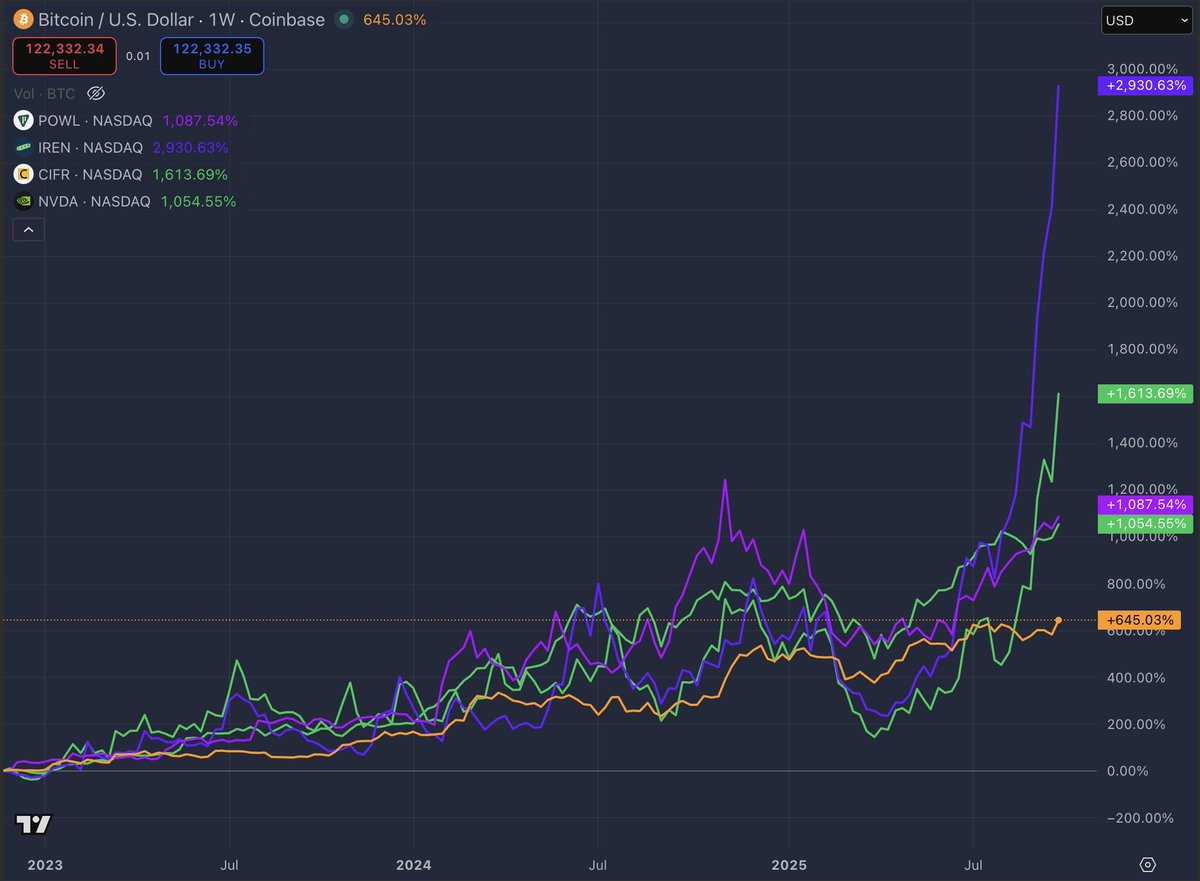
This is how the world should work: “saving” in BTC and selectively “investing” in opportunities that have a chance of beating BTC’s hurdle rate. The world is healing.
The AI age began with the launch of ChatGPT in November 2022.
In three years it's gone from novelty to essential tool for anyone remotely tech capable.
We are still at the early stage of GPUs replacing human brains for a wide variety of tasks.
The demand for compute has vastly outstripped the supply, and this will continue for the coming years as the entire economy adapts.
That means massive demand for energy, electrical infrastructure, datacenter infrastructure, new forms of energy, etc.
So how do you invest in this new age?
You need to realize that Bitcoin is the hurdle rate of the AI age.
If you aren't saving in Bitcoin, you are likely getting crushed.
The good news is you can just hold Bitcoin and outperform most investments.
Why?
Because the explosion of intelligence and robotic labor means everything will eventually become more abundant.
And fiat will be EXTRA abundant as the deflationary effects of exponential tech take over.
Meanwhile Bitcoin will remain finite.
This is why I hold the majority of my wealth in Bitcoin and sleep soundly at night.
But if you're looking to beat the hurdle rate by taking on more risk, you should only be considering assets that have a solid chance at outperforming BTC.
AI, robotics, geopolitical pressures, etc...
They will all provide opportunities to outperform the hurdle rate for logical reasons.
The investing environment has changed drastically from the 2010's.
There are far more interesting opportunities now. Not just overpriced enterprise SaaS or social media companies.
The real world is changing quickly and with the tectonic shifts come opportunities for those who look.