@immad LimoNet is building Ethiopia’s logistics backbone through a scalable hub-and-spoke network. By turning local shops into micro-fulfillment hubs, we cut last-mile costs, expand nationwide delivery, and power the future of e-commerce, fintech, and digital trade for 130M+ people.
@grok@tewdemam@DrNaoll Of all the cleaning business is the only viable option i can see. Others need a little mors capital. Or simply hoard some food oil 😂
Introducing the Kia Vision Meta Turismo — our first bold glimpse into the future of mobility. More than a car, it combines human-centered design with advanced technology to deliver emotional and immersive experiences.
Because in every journey, it’s the moments between movement that truly matter.
Moments to movement — redefining the future of mobility.
The Kia Vision Meta Turismo.
#Kia #KiaVisionMetaTurismo #MovementThatInspires
WhatsApp End-to-End Encryption vs. Forensic Extraction
Although WhatsApp uses end-to-end encryption to protect messages, calls, and shared media during transmission, this protection only applies while the data is moving between devices. Once the content reaches the device, it is stored unencrypted within WhatsApp’s local databases and media folders.
Out of the volumes of content, such as 733,543 WhatsApp messages, along with videos, audios, images, and documents.
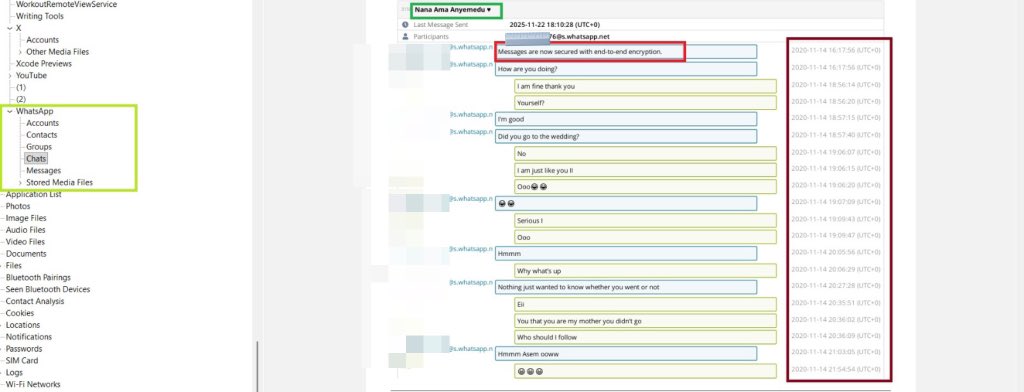
I was able to get a conversation between my kid sister @ama_Anyemedu in November 11, 2020.
The chat preview shows a typical WhatsApp conversation recovered from a mobile forensic extraction. At the top of the chat, WhatsApp displays the standard banner “Messages are now secured with end-to-end encryption.”
This banner simply means that when messages are being transmitted between two devices, WhatsApp’s servers cannot read them because they are protected by encryption keys stored only on the users’ devices.
However, end-to-end encryption does NOT protect data stored on the device itself.
Mobile forensics work by accessing the phone’s internal storage, not by intercepting messages from WhatsApp servers. Once a device is unlocked or decrypted by the lawful extraction process, the tool can read the local WhatsApp databases stored on the device (usually the `msgstore.db` and related SQLite databases).
This is why, despite the presence of the "end-to-end encryption" banner, the forensic tool is still able to extract:
* Full chat history
* Timestamps
* Participants
* Message contents
* Attachments
* Deleted messages (if still recoverable in the database)
End-to-end encryption protects data in transit, not data *at rest* on the device.
Forensic tools exploit lawful access to the device’s decrypted file system, enabling them to parse and display the stored WhatsApp database, which is why you can see the complete message timeline, content, and timestamps on the right side.
Me: "ChatGPT, are these berries poisonous?"
ChatGPT: "No, these are 100% edible. Excellent for gut health."
Me: "Awesome"
# eats berries .... 60 minutes later
Me: "ChatGPT, I'm in the emergency ward, those berries were poisonous."
ChatGPT: "You're right. They are incredibly poisonous. Would you like me to list 10 other poisonous foods?"
And this, folks, is the current state of AI reliability.
Ethiopia’s tax push is turning into a double-edged sword. As the government tightens enforcement to boost revenue, businesses face mounting fines, audits, and closures. Can fiscal ambition and economic vitality coexist?
Read More: https://t.co/7U1EuyNpCG
Our prisoners also have families, children, homes, and dreams.
Welcome home.
Still more than 10,000 captives are unlawfully held by Israel. Call for their release.