Let’s make those people famous who abused our PM or Hindu dharma using slogans or posters.
This video must go viral so that it reaches her parents and relatives, so they can teach her a lesson about upbringing and etiquette.
ನಮ್ಮ ನೆಚ್ಚಿನ ರಾಷ್ಟ್ರೋತ್ಥಾನ ಪರಿಷತ್ 5ನೇ ವರ್ಷದ 'ಕನ್ನಡ ಪುಸ್ತಕ ಹಬ್ಬ'ವನ್ನು ಆಯೋಜಿಸಿದೆ. ಕನ್ನಡ ಮತ್ತು ಸಾಹಿತ್ಯಪ್ರೇಮಿಗಳಿಗೆಲ್ಲ ಇದು ನಿಜಕ್ಕೂ ಹಬ್ಬವೇ.
ಡಿ.7ರವರೆಗೆ ಬೆಂಗಳೂರಿನ ಚಾಮರಾಜಪೇಟೆಯ ಕೇಶವಶಿಲ್ಪ ಸಭಾಂಗಣದಲ್ಲಿ ನಡೆಯಲಿದೆ. ನೀವೂ ಭೇಟಿ ಕೊಡಿ.
#ಕನ್ನಡ_ಪುಸ್ತಕ_ಹಬ್ಬ
Learn Sanskrit 10 - Reading Sanskrit.
Save this post, it will be helpful when you are trying to read on your own.
When you start reading Sanskrit, recognising patterns helps a lot, especially if you don't want to memorise grammar rules.
The words are categorized based on the ending sound.
For example lets take masculine words-
Ending in "a" sound - राम (Rāma)
Ending in "i" sound - अग्नि (Agni)
Ending in "u" sound - भानु (Bhanu)
Nouns can play one of the following roles in a sentence
1. Doing the action
2. On whom the action is done
3. With what/whom the action isdone
4. For whom the action is done
5. How action connects two entities
6. how is one entity related to other
7. Where did the action happen
In the words ending in a,i or u sound,
1. When they are doing the action or are independent. They end with a Visarga
रामः, भानुः, अग्निः
2. When action is being done to them, they end in म्.
रामम्, भानुम् , अग्निम्
3. When action is being done with help of or along with them, they end with एन or एण for a, ना for the other two
रामेण, भानुना, अग्निना
4. When action is done for them -
रामाय, भानवे, अग्नये
5. When an entity is separating, coming from from them, they end in-
रामात् , भानोः, अग्नेः
6. When we are sowing relation (or ownership) wirh them -
रामस्य, भानोः, अग्नेः
7. When action is happening in/ on /within them -
रामे, भानौ, अग्नौ
Let's take example from Shastras
विवासनं च रामस्य - विवासनम् (Exile) of Rāma
दशरथः विवासयामास रामं - Dashratha exiled Rāma
I will post detailed example in the next post.
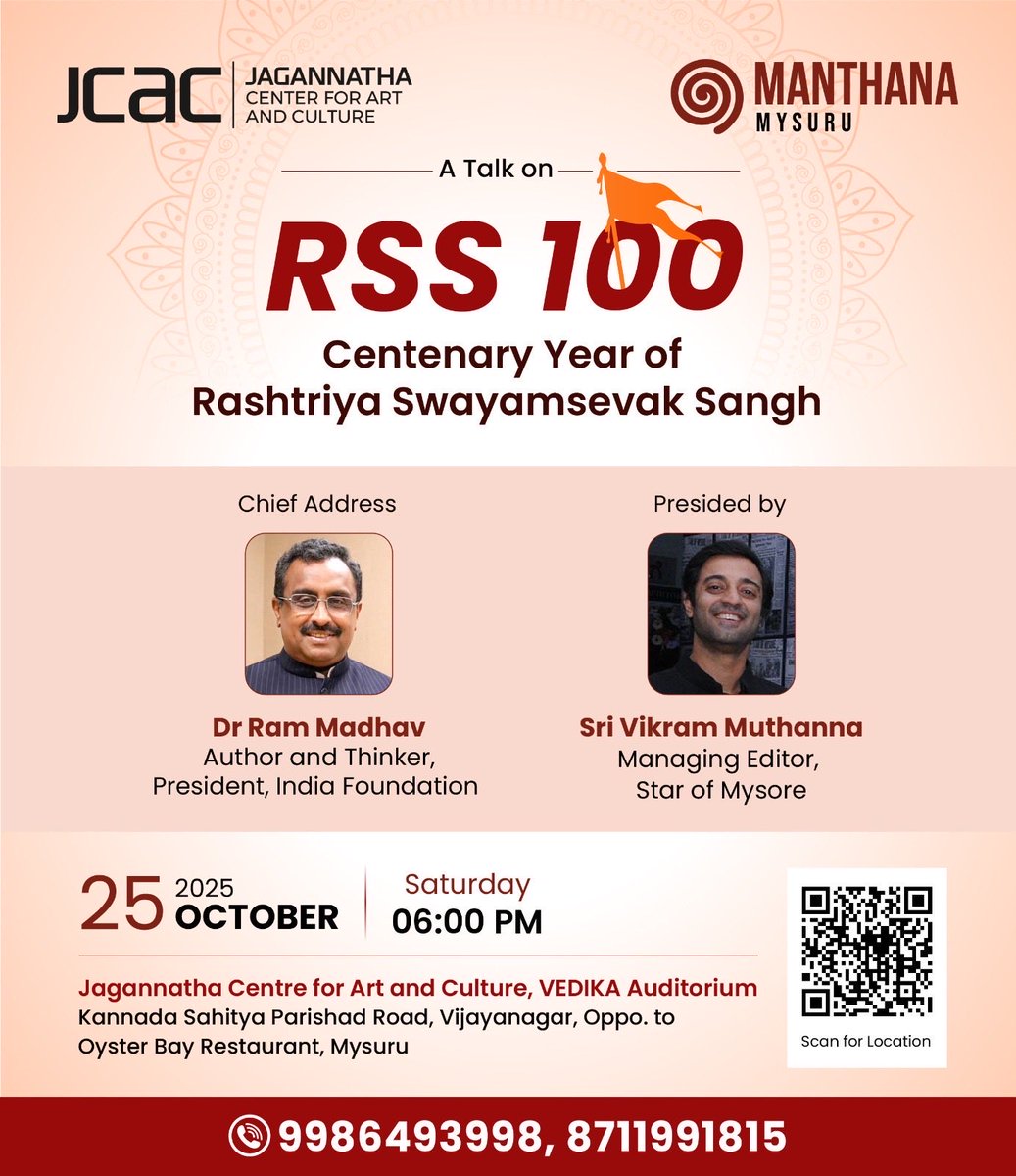
Today 6.00 PM at Mysuru.
Talk and Discussion on RSS@100 by Dr Ram Madhav @rammadhav_ , presided by Vikram Muthanna, Managing Editor, Star of Mysore, today on October 25, 2025 Saturday at 6.00 PM at Jagannatha Centre for Art and Culture, Mysuru. #RSS100Years
Sanskrit words and their meanings
पिता - One who protects
माता - One who is most respected
जननी - One who gives birth
युवा - One who plans before acting
शूद्र - One who worries / cries a lot
पुरुष - One who moves forward
महिला - One who is respected
Try to read this on your own -
रक्षिता स्वस्य धर्मस्य स्वजनस्य च रक्षिता ।
वेदवेदाङ्गतत्त्वज्ञो धनुर्वेदे च निष्ठितः।।
From Ramayana, it's describing Rāma.
Word by word translation -
रक्षिता - Protector
स्वस्य - of own
धर्मस्य - of dharma
स्वजनस्य - of own people
च - and
रक्षिता - Protector
वेद-वेदाङ्ग-तत्वज्ञः - Knows the depths of Vedas and Vedangas
धनुर्वेदे - in Dhanurveda (Knowledge of War)
च निष्ठितः - and is accomplished
Meaning - He (Rāma) is protector of his Dharma, protector of his people, Knows the depths of Vedas and Vedangas (Kalpa, Shiksha, Jyotisha, Nirukta, Vyakarana, Chhanda) and an expert warrior.
Learn Sanskrit 5 - (Feminine words ending in ā)
We have covered अकारान्त पुल्लिङ्ग and नपुंसकलिङ्ग words, today let's look at feminine words.
आकारान्त स्त्रीलिङ्ग are the words that end in आ sound.
लता, रमा, राधा, सीता, तृष्णा etc
When these words are in Prathma (Doing the action) there is no change, they remain the same.
For example
सीता रामम् अपश्यत् - Sita looked at Rāma
When these words are being acted upon, we just add a म् to them
For example
सीतां रामः अपश्यत् - Rāma looed at Sita.
In the next post, I will provide a list of common Sanskrit words in all 3 Genders.
To show relation, in Masculine and Neuter (अकारान्त) words we were adding स्य
In Feminine, we add याः to the words
सीतायाः पुस्तकम् - Sita's Book
राधायाः वस्त्रम् - Radha's cloth
Now you can create some sentences like
सीता रामस्य पुस्तकम् अपश्यत् - Sita saw the book of Rāma.
I will give a summary and practice exercise for first 5 lessons tomorrow.
Anyone interested in learning Yoga-Shastra and start practicing it in daily life?
It helps develop concentration, better memory and remove mental stress and anxiety.
I can provide step by step guidance on how to start if ppl are interested.
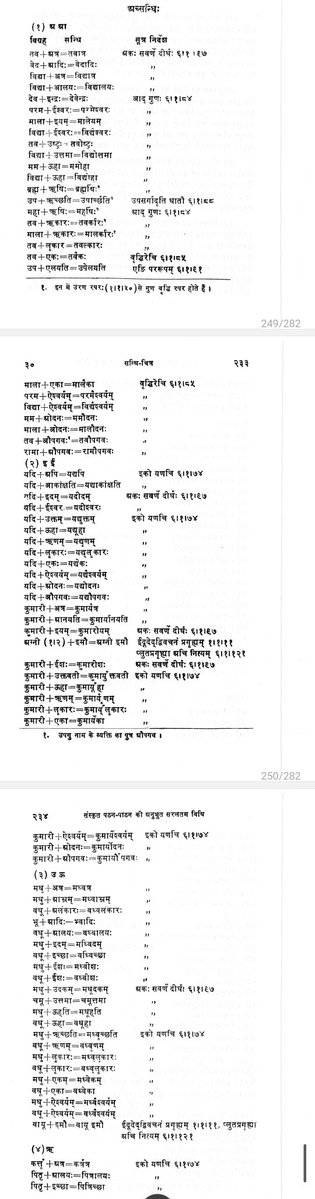
In the Space today, I am going to teach Sandhi as well. Today you will get to know why Sanskrit is the most logical and scientific language.
I am attaching Sandhi examples for reference. Pls save them
Source - संस्कृत..सरलतम विधि By पण्डित ब्रह्मदत्त जिज्ञासु
- अच् सन्धि
Learn Sanskrit - Example
You can already start understanding Sanskrit by lesson 3. For example the following composition by Adi Shankara -
अच्युतं केशवं रामनारायणं
कृष्णदामोदरं वासुदेवं हरिम्
श्रीधरं माधवं गोपिकावल्लभं
जानकीनायकं रामचन्द्रं भजे
भजे means I worship, all other words in this are in Dwitiya Vibhakti. You can attach all words with "I worship" and get the meaning of this beautiful composition.
अच्युतं भजे - I worship the Achyuta (him who never degrades and is eternal)
केशवं भजे - I worship Keshav
रामनारायणं भजे - I worship Rāma who is Narayana
Similarly with all the other words.
Learn Sanskrit - Practice exercise 1
Verbs -
(गम् - to go)
अगच्छत् - He/she went
अगच्छन् - they went
अगच्छम् - I went
अगच्छाम - we went
(खाद्- to eat )
अखादत् - he/she ate
अखादन् - they ate
अखादम् - I ate
अखादाम - we ate
पठ - to read (find the forms on your own)
सः - he
ते - they
अहम् - I
वयम् - we
(Use dictionary to get meaning of words you don't understand)
Translate these to English.
सः गृहम् अगच्छत्
ते वनम् अगच्छन्
अहं पाठशालाम् अगच्छम्
वयं नगरम् अगच्छाम्
सः फलम् अखादत्
ते भोजनम् अखादन्
वयम् अन्नम् अखादाम
सः पुस्तकम् अपठत्
ते शास्त्रम् अपठन्
अहं पत्रम् अपठम्
वयं काव्यम् अपठाम
सः उद्यानम् अगच्छत्
ते सरोवरम् अगच्छन्
अहं मन्दिरम् अगच्छम्
वयं ग्रामम् अगच्छाम
सः रोटिकाम् अखादत्
ते मोदकम् अखादन्
वयं मिष्टान्नम् अखादाम
Create 20 sentences in sanskrit using above 3 roots.
You can post your solutions in the comments.
Karnataka: Veteran RSS Karyakarta, Former Ksheetreeya Karyavah, Former National President of Rashtriya Shaikshik Mahasangh, Former MLC, Former President of The Mythic Society Sri Kru Narahari (93 Years) no more. #OmShanti
He was younger brother of Swa. Kru Sooryanarayan Rao ji.
ಬೆಂಗಳೂರು: ಜ್ಯೇಷ್ಠ ಕಾರ್ಯಕರ್ತ, ಈ ಹಿಂದೆ ರಾಷ್ಟ್ರೀಯ ಸ್ವಯಂಸೇವಕ ಸಂಘದ ಕ್ಷೇತ್ರೀಯ ಕಾರ್ಯವಾಹರಾಗಿ, ರಾಷ್ಟ್ರೀಯ ಶೈಕ್ಷಿಕ ಮಹಾಸಂಘದ ಅಖಿಲ ಭಾರತೀಯ ಅಧ್ಯಕ್ಷರಾಗಿ, ವಿಧಾನ ಪರಿಷತ್ ಸದಸ್ಯರಾಗಿ, ದಿ ಮಿಥಿಕ್ ಸೊಸೈಟಿಯ ಅಧ್ಯಕ್ಷರಾಗಿ ಕಾರ್ಯನಿರ್ವಹಿಸಿದ್ದ ಶ್ರೀ ಕೃ. ನರಹರಿ (93 ವರ್ಷಗಳು) ಇಂದು ಬೆಳಗ್ಗೆ 4.30ಕ್ಕೆ ನಿಧನರಾಗಿದ್ದಾರೆ.
ವಿವರಗಳನ್ನು ತಿಳಿಸಲಾಗುವುದು.
Learn Sanskrit 3 - [Basic sentence formation]
Now, I would introduce the concept of Kārak.
In the first lesson, I briefly mentioned that words modify based on how they are used in a sentence.
1. Karta (कर्ता) - In a sentence, the one who is doing an action is Karta.
2. Karma (कर्म) - The entity on which the action is performed.
For example -
रामः रावणम् अपश्यत् - Rāma saw Rāvana
रावणः रामम् अपश्यत् - Rāvana saw Rāma
When the action of seeing was done by Rāma, we wrote Rāmah in the sentence; when it was done by Rāvana, we wrote Rāvanah.
And when Rāma was being seen, we wrote Rāmam; when Rāvana was being seen, we wrote Rāvanam.
This is how Kārak works in a sentence; these are also called Vibhaktis.
Hence, even if you jumble up the words, the meaning of the sentence remains the same.
रामः रावणम् अपश्यत्
रावणम् अपश्यत् रामः
रामः अपश्यत् रावणम्
रावणम् रामः अपश्यत्
All of them mean the same thing.
How a word is modified depends on gender and the ending of the word.
A word like Rāma is a-karanta(अकारान्त) because the ending sound is 'a' and the word is masculine.
Agni is i-karanta (इकारान्त) because the ending sound is 'i'.
For now, we have covered two Vibhaktis, the first and second. Some sentences for your practice - (you can get the meaning of verbs used by using the method shown in lesson 2)
I will cover verbs in the past tense in detail in the next lesson; for now, just focus on Vibhaktis.
Detailed explanation is in the video attached.
Anant Kanhere, who sacrificed his life for the motherland at the age of 18!
A young man from Konkan goes to Sambhajinagar (Aurangabad) for secondary education, takes part in revolutionary work there, gets a pistol sent by Mr. Savarkar from London and kills a treacherous and high-ranking Englishman, all of it is extraordinary and impossible! But the name of the young man who made this impossible act possible was Anant Laxman Kanhere!
Anantrao was born in 1891 in the village of Ayni-Mete in Ratnagiri district. He went to Aurangabad to study English with his maternal uncle. After a few years, he started living in a rented room with Gangaram Marwadi. Kashinath Tonpe of the freedom fighter secret society of Nashik gave Gangaram and Anantrao the oath of the secret society. After Madanlal Dhingra's revenge against Curzon Wylie, Anantrao also became impatient with such an act. Then Gangaram tested Anantrao by placing hot iron tongs on his hands and asking him to hold the hot glass of a lit chimney with both hands. Despite lighting both lamps, Anantrao's posture was unwavering!
Around this time, a cruel and hypocritical officer named Jackson was the District Collector of Nashik. He had imprisoned true lawyers, kirtan singer Tambe Shastri, Babarao Savarkar and other patriots. Jackson wrote his obituary for many such misdeeds. It was this fate that chose Anantrao. Anantrao practiced pistol shooting to kill Jackson. He went to the District Collector's office and looked at Jackson carefully. 'If Jackson is killed and has to be hanged, at least his parents should have a photograph of him as a memento'; so he also took a photograph of himself.
On December 21, 1909, a rehearsal of the play 'Sharda' by the Kirloskar Natak Mandali was organized in the Vijayanand Theatre of Nashik in honor of Jackson. As Jackson was entering the theatre through the door, Anantrao, who had already arrived, fired a shot at Jackson. It went through his armpit. Anantrao, acting quickly, fired four shots at Jackson from the front. Jackson collapsed on the spot. Anantrao calmly surrendered to the guards.
Anantrao and his associates Anna Karve and Vinayak Deshpande were sentenced to death on the charge of murdering Jackson. On April 19, 1910, these three revolutionaries were hanged at 7 am in Thane jail with a courageous attitude. Despite the request of their relatives, the British government cremated the bodies of all three on the banks of the Thane creek and threw their ashes into the creek so that no one would get them.
We are free today because of the sacrifices of many like martyr Anant Kanhere, who sacrificed his life for the country at the age of 18.
Learn Sanskrit 2 - [Introduction to Verbs]
Let's start with the famous Shloka from Geeta -
यदा यदा हि धर्मस्य ग्लानिः भवति भारत।
अभ्युत्थानमधर्मस्य तदाऽऽत्मानं सृजामि अहम्।।
yadā yadā hi dharmasya glāniḥ rbhavati bhārata.
abhyutthānamadharmasya tadā''tmānaṃ sṛjāmi aham.
Before starting with verbs, let's look at some common words like यदा / yadā and कदा/ kadā
These words do not change their forms.
कदा means "when?" (Hindi कब), its a question. यदा means "whenever" (जब).
हि indicates certainly or surely
There are two verbs in this Shloka that we will look at. भवति and सृजामि
In Sanskrit, there is something called as Verb root. It is the basic element which is modified to form various forms of a verb. For example the root सृज् means "to create".
This root is modified to various forms, such as
सृजामि - I create
सृजति - he creates
सृजथ - you all create
सृजावः - we both create
These verb forms are represented in form of verb tables like the one attached with this post.
You don't have to memorize these tables, you can easily find them online (on resources I shared), and as you practice you will automatically learn.
However it is important to learn how to find them and how to understand them.
To find them is easy, go to Ashtadhyayi . Com, click on धातुपाठः and in the search bar type the word you want (in this case सृजामि). I will attach a Video to guide you on this.
Now how to understand it. The first column is singular, second column is Dual, and third column is plural. Similarly, first row is third person, second row is second person and third row is first person. (Detailed explaination in the video attached)
In a sentence, there are basically three roles -
1. One who is doing the action
2. One on whom the action is done
3. The action itself
In the shloka above Krishna says
आत्मानम् अहम् सृजामि
ātmānam aham sṛjāmi
Aham means "I" this is the doer
ātmānam mean "To self" this is the one on whom action is done.
sṛjāmi is the action of creating.
Can be literally translated as "I create myself" although the actual interpretation in the shloka will depend on context.
We will start with Past tense and basics of sentence formation from next lessons onwards.
#Learn_Sanskrit
Estimated food waste per capita (in Kg):🥘
🇧🇷 Brazil — 94 kg
🇬🇭 Ghana — 84 kg
🇩🇪 Germany — 78 kg
🇨🇳 China — 76 kg
🇺🇸 United States — 73 kg
🇮🇳 India — 55 kg
🇮🇩 Indonesia — 53 kg
🇿🇦 South Africa — 47 kg
🇷🇺 Russia — 33 kg
🇵🇭 Philippines — 26 kg
(UNEP’s Food Waste Report 2024)