Introducing Mol-1: Open Frontier Biomolecular Intelligence 🚀🚀🚀
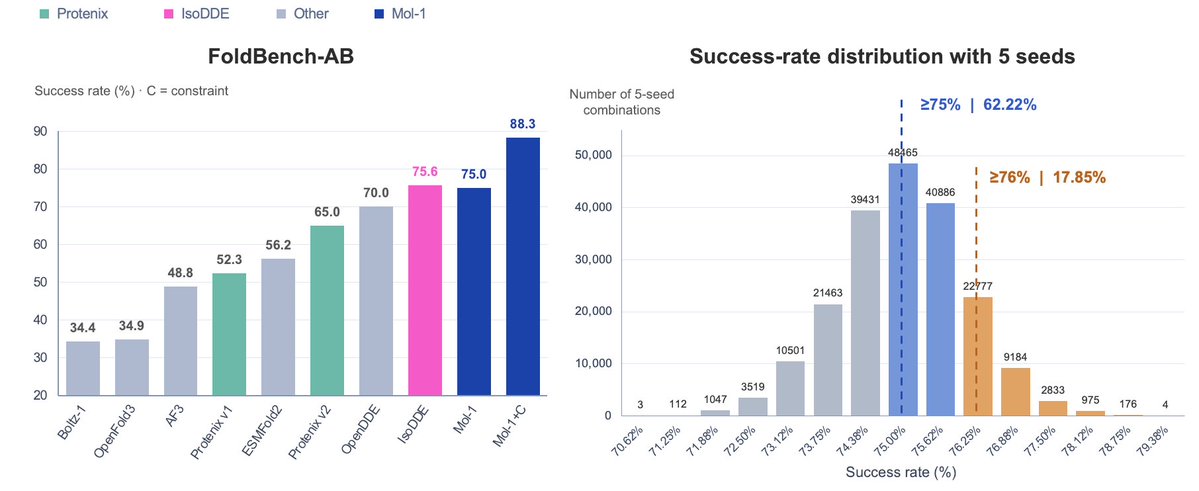
📊 75.0% on FoldBench-AB, near IsoDDE's reported 75.58%!!!
🧬 60k-token assemblies on one single H20, outperforming Anthropic 8/10.
🎯 VHHs binding hit rate as high as 63% with best SPR KD at 43 pM.
GitHub: https://t.co/GDDv3YfL9G
Try it: https://t.co/t2cXOQOBqO
Raising the bar for models with binding-site guidance:
🎯Given reference-derived epitope or pocket inputs, Mol-1-constraint leads all five tested models under both standard and stricter criteria on Foldbench targets:
🧬 Antibody–antigen: 45.4% at DockQ >0.80, compared with Boltz-2’s 25.6%, which is 19.8 percentage points higher.
💊 Protein–ligand: 75.1% standard success (iLDDT ≥0.8 and ligand RMSD ≤2 Å) and 55.4% strict success (≥0.9 and ≤1.5 Å), versus Boltz-2’s 63.8% and 36.6%.
Evaluated on 160 FoldBench antibody–antigen and 511 protein–ligand interfaces shared across all models with reference binding-site.
(3/3)
Introducing Mol-1-constraint: Guide biomolecular structure prediction with what you know. 🧬🚀
🎯 Three ways to steer predictions: binding sites, specific contacts, and regions to avoid.
Turn prior knowledge into better molecular predictions.
Code & weights: https://t.co/iOR61GrTMa
Try it on our platform: https://t.co/N6DqPA9Wze
(1/3)
#AIforScience #ProteinStructure
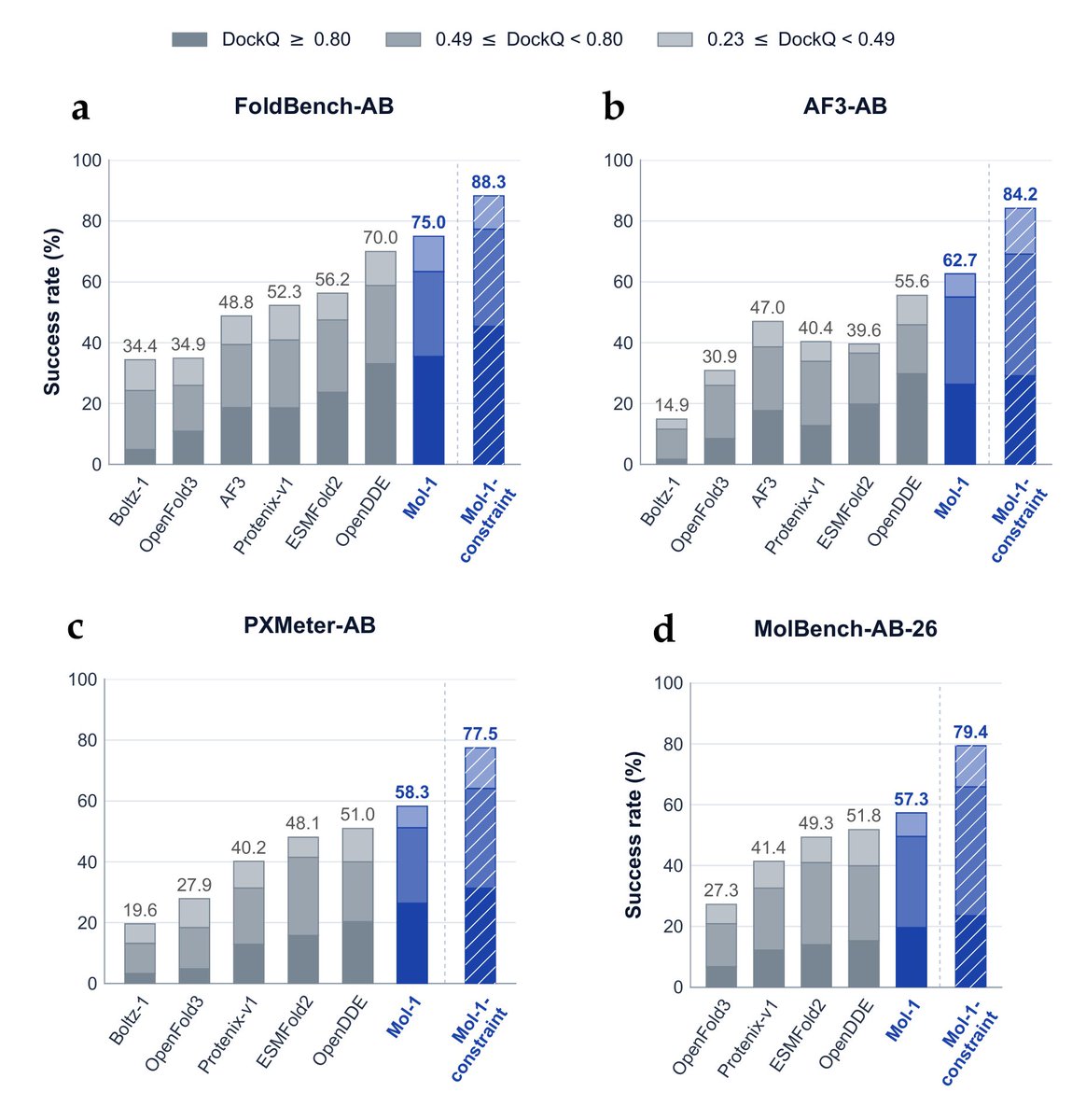
Benchmark against popular open-source cofolding models: Mol-1-constraint achieved:
🧬 Antibody–antigen: 75.0% → 88.3% success, from Mol-1 to Mol-1-constraint, on FoldBench-AB (DockQ >0.23).
💊 Protein–ligand: 36.1% → 63.9% on Runs N’ Poses’ 0–20 similarity bin, which is 27.8 percentage points above Mol-1!
📈 Protein-peptide: from 54.1% to 60.2% success rate of DockQ>0.80 on MolBench-Peptide-26.
(2/3)
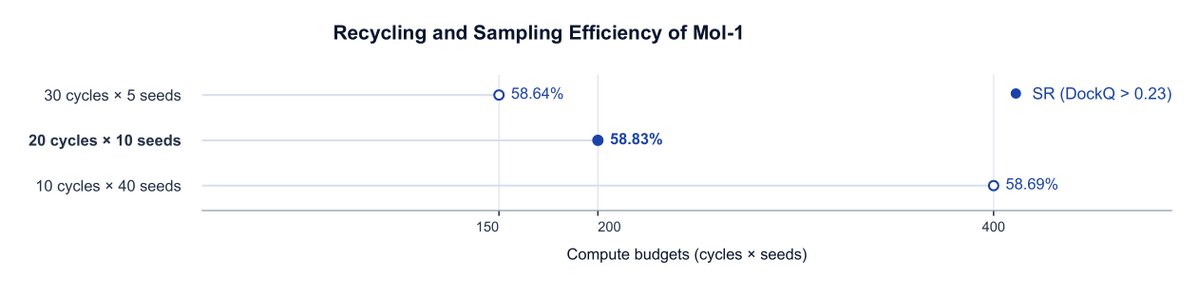
🧬 Mol-1 turns additional inference compute into better antibody–antigen predictions.
Two complementary ways to scale: sample more candidates and refine more deeply.
On MolBench-AB-26:
📈 More sampling: Increasing from 1 to 100 seeds raises mean DockQ from 0.359 to 0.463, with prediction quality continuing to improve through 100 seeds.
🔄 Deeper refinement: At a fixed 5-seed budget, increasing recycling from 10 → 20 → 30 cycles raises the success rate from 53.5% → 57.3% → 58.7%.
⚡ Better sampling efficiency: 30 cycles × 5 seeds achieves 58.64% success, compared with 58.69% for 10 cycles × 40 seeds—comparable accuracy with 8× fewer seeds.
Mol-1 gives researchers two practical ways to turn inference compute into stronger molecular predictions.
Code & weights: https://t.co/GDDv3YgiZe
#AIforScience #ProteinStructure
@sokrypton@Patrick18287926 Thanks for including Mol-1 in https://t.co/ZOMilwKjWt, Sergey! The MCTS approach looks cool as well. In our approach, we used LLM to generate proposals which might be replaced by MCTS.
Mol-1 agent: large protein assemblies on a single NVIDIA H20, outperforming Anthropic 9/10.
In our 10-case evaluation (8,000-60,120 residues), 8 assemblies reached TM-score ≥0.9. The five 30K-60K-residue capsid cases scored 0.993-0.999; Anthropic's published runs for these cases produced collapsed structures.
The ~10K group is mixed: Mol-1 has higher reported TM-scores on 4 of 5 cases, but is lower on 7UTD (0.478 vs 0.96).
These results come from a long-running, iterative prediction-and-assembly workflow, taking tens of hours. The figure compares published results under different hardware and inference settings; it is not a controlled head-to-head benchmark.
Reports:
Mol-1: https://t.co/dRAa4J103x
Anthropic: https://t.co/TEdtSulP4k
@m_goes_distance Recently, we released an open weight model (Mol-1) that matches the performance of closed frontier, Isomorphic's IsoDDE. We release it in open so that the community can build on this to advance the frontier faster. https://t.co/2c8BvKxX65
Introducing Mol-1: Open Frontier Biomolecular Intelligence 🚀🚀🚀
📊 75.0% on FoldBench-AB, near IsoDDE's reported 75.58%!!!
🧬 60k-token assemblies on one single H20, outperforming Anthropic 8/10.
🎯 VHHs binding hit rate as high as 63% with best SPR KD at 43 pM.
GitHub: https://t.co/GDDv3YfL9G
Try it: https://t.co/t2cXOQOBqO
15/15 📍 Three residues can provide a useful structural clue.
In three case studies, we supplied three-residue site hypotheses informed by literature and monomer structures.
With Mol-1-constraint, DockQ improved:
• 0.014 → 0.874
• 0.011 → 0.739
• 0.200 → 0.863
These examples show how sparse biological hypotheses can guide complex prediction.
#AIforScience
1/15 🧬 Mol-1 on antibody structure prediction: on par with IsoDDE, open to build on.
75.0% median success at DockQ > 0.23, on par with IsoDDE’s reported 75.58%.
Across all 201,376 five-seed combinations from 32 seeds, 62.22% matched or exceeded 75% success—showing robust performance across seed selections.
We release the model code and weights so researchers can run Mol-1 in their own environment and build on its capabilities.
Code & weights: https://t.co/GDDv3YgiZe
Try Mol-1: https://t.co/t2cXOQP9gm
#AIforScience #DrugDiscovery