I trade systems, not hunches | Momentum investing + MCX futures | Risk is the only thing worth managing | Credit & Risk professional. Trader. Student of markets
I've been trading Indian markets seriously for 3 years.
The biggest lesson wasn't about entries, indicators, or strategies.
It was embarrassingly simple.
Token burn is just the new cloud bill.
Every infrastructure shift looks cheap until it scales.
AWS looked like magic until the invoices arrived.
AI agents will follow the same curve — early adopters love the productivity, finance teams hate the bill.
The winners will be those who figure out cost-per-output, not just cost-per-token.
Same discipline. New variable.
@DekmarTrades Price action without any other trend indicator is quite dangerous. Multiple tests of same level has a higher probability of a good breakout or breakdown. As a trend follower, this stock is a low conviction trade
The life arbitrage play is real but it has a hidden risk.
It works only as long as India remains a low cost economy.
Inflation in India has been quietly eroding that advantage — property, healthcare, education costs are now dollar-comparable in metros.
The smarter NRI play isn't just saving in USD.
It's being selective about where in India you spend — Tier 2 cities still offer the arbitrage. Mumbai and Bangalore increasingly don't.
Currency is only half the equation. Cost of living is the other half.
Rupee at 96.80. A record low.
Everyone is blaming the Iran war.
But the war just accelerated what was already coming.
India imports crude. Crude is in a war premium. Rupee pays the price.
The real question nobody asks:
Why does India's currency have no buffer when oil spikes?
-Because we never built one.
Gold reserves help.
But the structural oil import dependency is the wound.
Until that changes, every Middle East crisis will find the rupee.
#INR #Rupee #MacroIndia #CrudeOil
The productivity paradox is real but the timeline is wrong.
Every transformative technology looks unproductive in the adoption phase.
Electricity didn't show up in productivity stats for 20 years after widespread adoption.
The 30y yield is the real risk — not AI's productivity lag.
Expensive long term capital reprices every asset that was built on cheap debt assumptions.
That's the nugget worth worrying about.
Record jet fuel yields tell you something crude headlines don't.
Refineries optimise for margin, not sentiment. When jet fuel cracks hit record levels, they shift output fast.
This is supply responding to demand signals in real time — exactly how commodity markets are supposed to work.
The bigger implication: crude demand isn't collapsing. It's just moving from gasoline to aviation.
Global air travel is the demand story nobody is talking about while everyone debates oil's death.
Rupee depreciation isn't always wealth destruction.
It depends which side of the balance sheet you're on.
Exporters — IT, pharma, textiles — earn more in rupee terms when dollar strengthens.
NRI remittances buy more back home.
Gold held in rupee terms appreciates automatically.
The problem isn't depreciation itself. It's that most Indian household wealth sits in fixed deposits and real estate — neither benefits from a weaker rupee.
Asset allocation is the real conversation nobody is having.
Bond markets are flashing red.
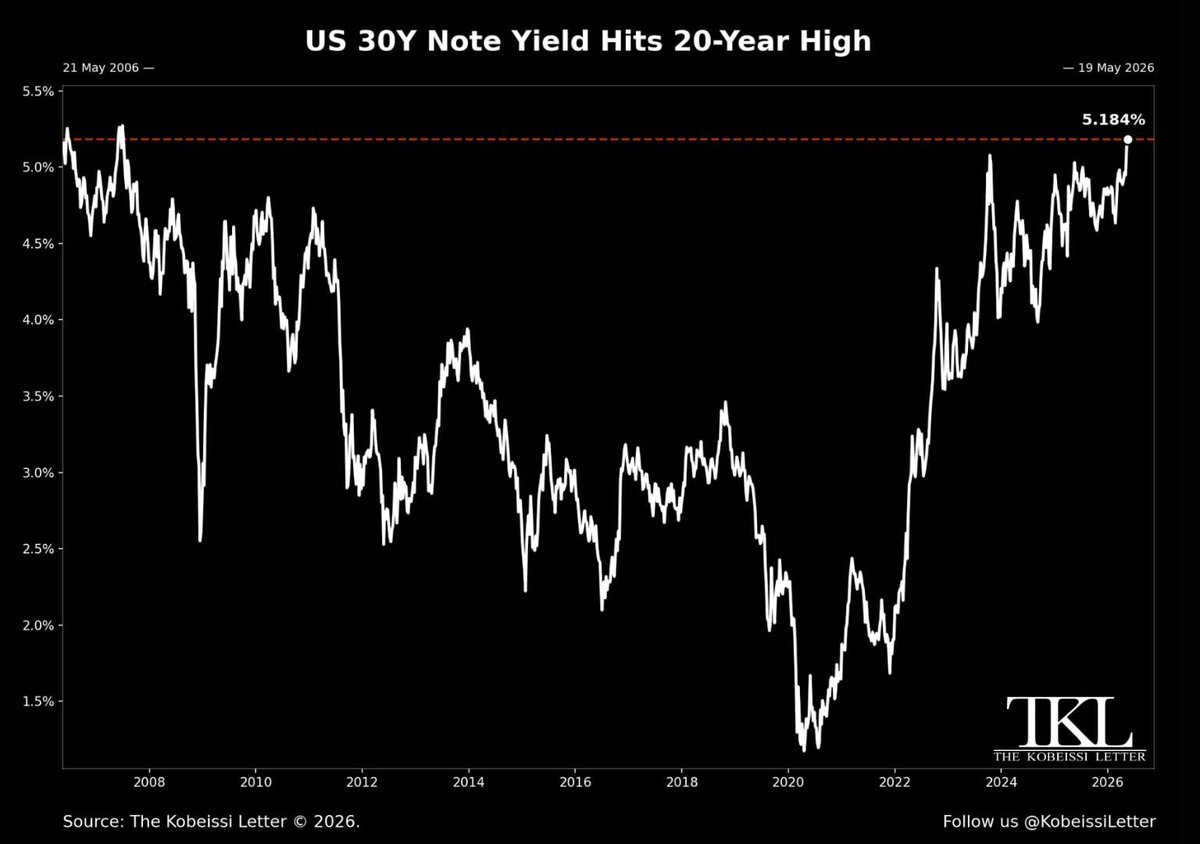
Today, the US 30Y Note Yield officially hit its highest level since July 2007, at 5.19%.
This will soon become Americans’ biggest problem, yet the vast majority do not even know it is happening.
What is happening? Let us explain.
(a thread)
5.19% on the 30Y isn't a crisis level — it's a return to pre-2008 normal. The 2010-2021 sub-3% world was the QE-sustained anomaly. The "biggest problem" framing assumes 2% rates were the natural baseline; they weren't. What's actually flashing red is the housing and corporate debt that got priced as if they were.
Yields rising is real. "1970s-scale" is hyperbole — 10Y went from 6% to 15% then; this is a 70-100bp move. And gold has worked, but the drivers (CB buying, fiscal-credibility debasement, geopolitical hedging) don't match the original "dollar collapse + hyperinflation" thesis. Right outcome, wrong mechanism is still wrong.
"Not major threats" is correct on first-order math — DII flows offset FII. It's wrong on second-order. FIIs still set the marginal price in large caps. Weak INR forces RBI to burn reserves, narrowing the rate-cut runway. Both compress multiples. First-order plays out in months; second-order in 18-24.
22% CAGR over 9 years (28K → 175K) is the answer to "gold is dead." Most who say it are using USD as the yardstick — but in INR, gold has compounded faster than Nifty since 2020. Half the return is the metal; half is INR doing what it always does. Both are reasons to hold a slice.
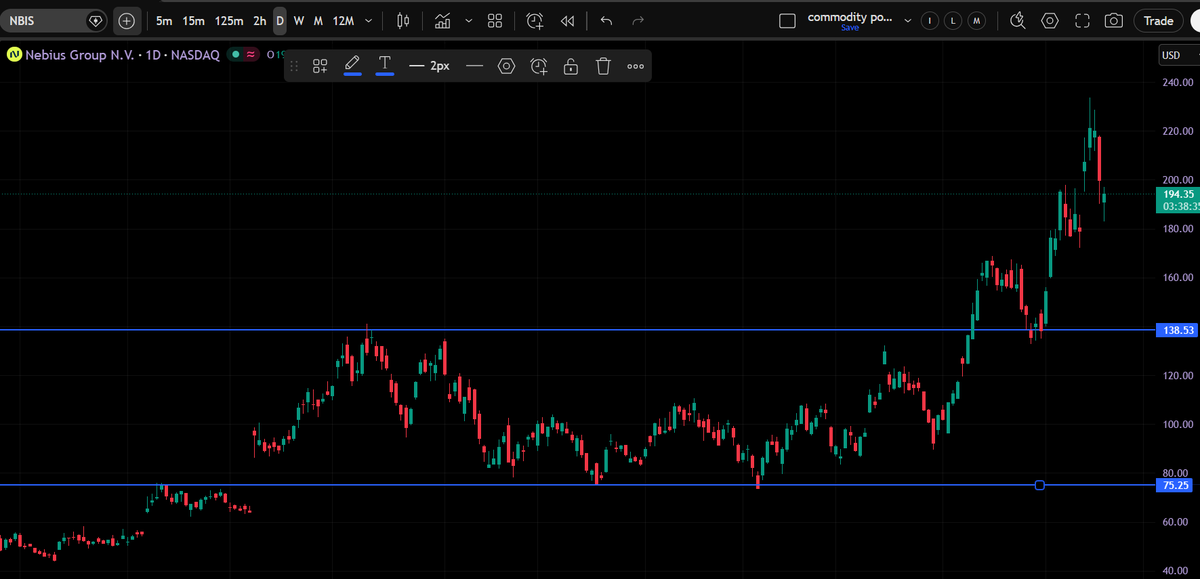
NBIS is high-beta AI infra with real underlying numbers. Setup respects both: wait for $230 to confirm, size so a stop near $180 is a survivable loss, never chase the middle. Diversify across AI infra names rather than concentrate — execution risk is single-name, not sector.
What's your AI infra exposure look like — single name or basket?
#NBIS #AICloud #MomentumTrading
NBIS pulled back to $194 from the $235 ATH — about -17% off highs after a +32% earnings rally. The base from $75 → $138 took ~12 months to build. The next setup isn't chasing the rally. It's waiting for a clean break above $230 to confirm continuation. Here's the plan 👇
The trade plan (not advice):
→ Trigger: break and hold above $230 — confirms continuation past recent ATH
→ First support: ~$180 (recent pullback low)
→ Structural support: $138 — the breakout level. Below that = thesis broken
→ Wait-zone: $180–$230.
No signal, just chop. Sit out.
"Imploding" is the wrong frame. UK and US have spiked before — the structural break is Japan. JGB 30Y above 4% for the first time ever means the global yield anchor is gone. Japanese institutions repatriating = less demand for foreign bonds → US/EU long end catches up with a lag. The trade isn't "doom." It's curve steepeners, short long-duration equities, and every EM with USD debt watched for refi pressure.
USD-based investors: Nifty needs +10% in INR just to break even in USD over 6 months. The "India outperformance" story looks very different from a dollar lens.
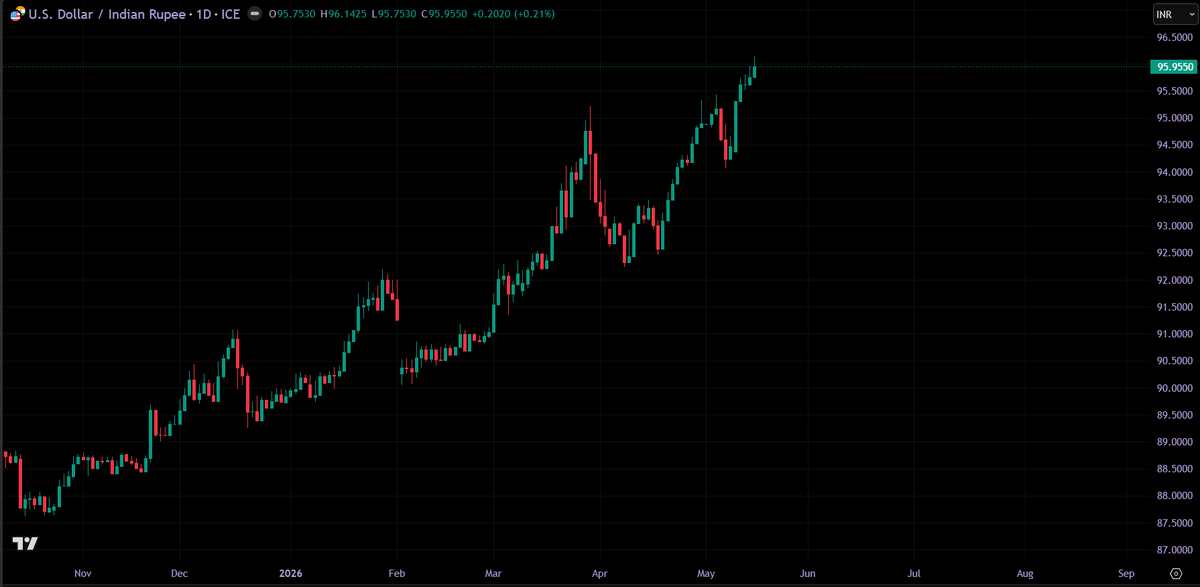
Risk to the export trade: RBI verbal intervention can chop 1-2% off USDINR in days. Stop above 94 for any momentum positioning.
Where's your line — long exports now, or wait for the pullback?
#USDINR #IndianMarkets #MomentumTrading #MCX
USDINR broke out cleanly today. 95.95, fresh highs. The April pullback to 92.30 made a textbook higher low — the breakout was set up there, not today. A 9% INR move in 6 months changes the math on every Indian equity allocation. How to trade it 👇
Direct losers:
→ Energy importers — IOC, BPCL, HPCL face GRM compression and inventory hits.
→ FMCG with imported raw mat — HUL, Nestle, Asian Paints (crude derivatives).
→ Aviation — fuel + lease costs in USD with INR revenue.
→ Auto with CKD imports.
Importers carry the tax; exporters get the windfall.