I remember watching Back To the Future Part II sometime before the date of the plot’s setting, and being amused by the renditions of 2015 life. Some things seemed outlandishly silly, and others seemed hopelessly outdated.
I doubt the intention was to make the depiction of 2015 comedic. But we are just pretty bad at extrapolating future tech and the life impacts that come of it. Our primers for future life are deeply anchored by the normalcies of today. It’s difficult to predict what changes will land, which stick, and which eventually shift the new normals by several standard deviations.
When the mobile phone first rolled out in the 1990s, it was an accelerant for business growth. But it remained insulated to a limited business-centric market, inaccessible to the masses. Yet through small iterative changes and manufacturing optimizations with cheaper and more scalable parts, these now-ubiquitous devices are accessible to, and have changed the day-to-day lives of just about everyone.
The iPhone continues to be a great example of that shift. I recall a lot of 🤯 reactions when the iPod Touch suddenly transformed into a phone! Ridiculed at first, it is now hard to argue against the utility that a seamless form factor and a dynamic interface bring. What we do on and with our phones today once seemed impossible. And with the rollout of newer folding phones with different screen resolutions and screen real estate, I’m certain we’ll see more usage shifts in ways that we can’t yet fathom.
When credit cards first hit the market, they were met with extreme skepticism and largely negative connotations. With the exception of Diners Club, credit and its associated cards were seen with distrust. It took concerted effort to reverse its reputation before becoming widely adopted as a form of modern money for both consumers as well as merchants. Decades later, cashless is oft seen as the preferred mode of exchange. Doubtful anyone in 1950s expected an economy to run without cash, let alone through tap-to-pay interfaces on a cordless, full-color screened, button-less phone-that-is-really-a-mini-computer that fits in your back pocket!
The ubiquity of cashless payments and tiny pocket-sized super computers may have been hard to picture at their respective beginnings, but their impact on the ways of today’s world is undeniable. That is my vision for Monad and what blockchain brings more broadly. I’m betting that we haven’t, and perhaps can’t, see the full picture yet.
Monad in its current form is a strong foundational layer. It has the inherent performance, scale, and decentralized properties that are requisites to further innovation. What comes next are the iterative improvements. The seemingly small UX changes. The incremental augmentations to consensus. And better interfaces for tedious, confusing, or historically dangerous user flows.
And the pace at which these changes are coming is impressive. A small sample here, with Mera having been launched TODAY!
> Mera (https://t.co/mLg4okEVLj) - an open-source library that gives a two-click passkey experience to onchain apps! This is huge UX unlock in today’s friction-heavy crypto onboarding flows.
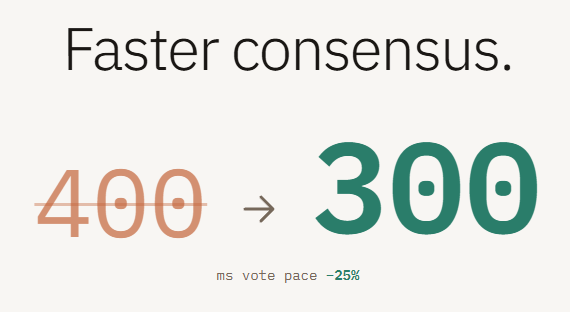
> Cadence (https://t.co/h1d4poBBAU) - a multi-proposer BFT consensus mechanism with defense against malicious MEV coming to Monad soon
> App-specific sequencing https://t.co/q8k3Wsnvko
What’s better? The fact that Monad is open, accessible, and for everyone. It is excellent tech that is not just for the elite nor just for businesses. It is built to be open and built to be scalable for use cases we haven’t even dreamt of yet.
I reject the notion that “there is nothing left to optimize”, as told to me by another blockchain’s founder. I’m proud of seeing the work that the team at @category_xyz is spearheading. I’m proud of the work that @monad foundation is focused on. I’m proud to say that the Monad we see today is not the Monad that will be a year from now, perhaps several standard deviations away.