Excited to share that we have joined the @Circle Alliance Program, a global community of teams focused on bringing the world on-chain, powered by USDC!
Today marks another important milestone for Perfect Information Labs.
The Onchain Tokenomist Executor is now live on Arc Testnet.
It implements the protocol's native executor role—an optional, vault-scoped identity that enables AI agents to help scale token economies by reading protocol state and constructing protocol-specific operations according to rules defined by the tokenomics deployer.
Over the past few days we also:
• Integrated @circle Gateway and x402 nanopayments for USDC-based #agent payments.
• Published public documentation and an OpenAPI specification.
• Submitted the service for review on the Circle Agent #Marketplace.
The long-term goal remains the same: making token economies programmable, scalable, and AI-native.
Documentation:
https://t.co/Md2yJORheN
OpenAPI:
https://t.co/vOCDwiToBm
@samconnerone@arc@BuildOnCircle
As more crypto projects and exchanges shut down, the industry continues searching for explanations.
Tokenomics.
Governance.
Liquidity.
Regulation.
Market conditions.
Execution.
Each explanation matters.
Yet the same pattern continues to recur.
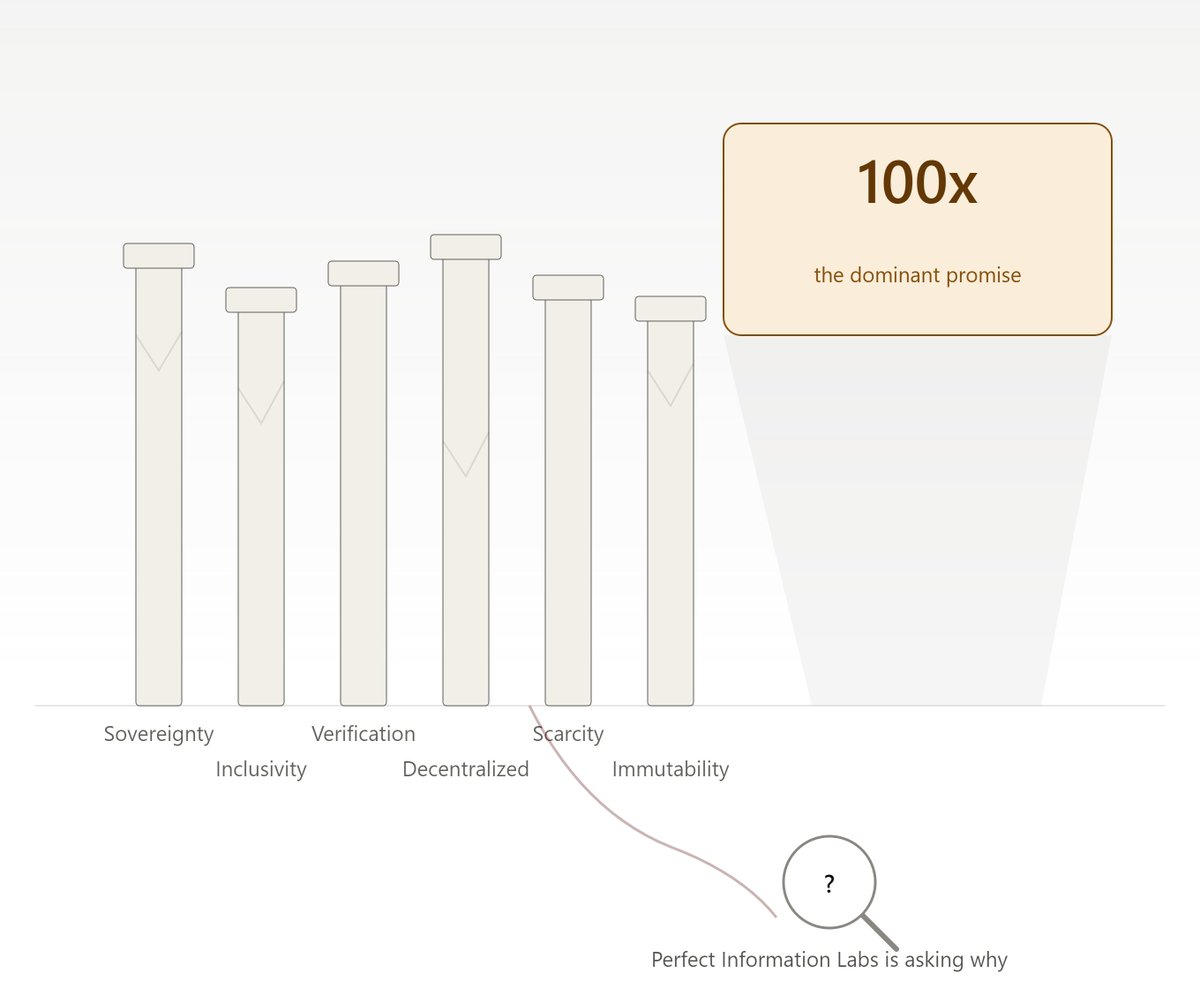
At blockchain's inception, the promise was different:
Sovereignty.
Decentralize.
Inclusivity.
Collective verification.
Individual verification.
Immutability.
Scarcity and deflationary discipline.
Today, the industry's dominant promise is often much simpler:
100x 📈.
At Perfect Information Labs, we've been investigating a difficult question:
If token mechanisms continue evolving around speculative expectations rather than the principles that originally gave the #blockchain its economic legitimacy, is recurring token failure becoming inevitable?
We asked:
Is recurring token failure becoming inevitable?
Here's what we found.
Every token begins with a narrative.
Token launch protocols have their own narratives. Projects have their own narratives. Every new innovation in Web3 introduces another narrative.
Those narratives shape how protocols are designed, how project teams position themselves, and ultimately how token mechanisms are built.
When those narratives diverge from blockchain's inception promises, they introduce structural vulnerabilities into the mechanisms themselves.
Those vulnerabilities don't need to be exploited to matter.
Their mere presence weakens participant confidence—for those deciding whether to participate, and for those deciding whether to remain.
This is why the same explanations continue to reappear under different labels:
• Poor tokenomics
• Weak governance
• Bad actors
• Liquidity
• Market conditions
Each explains a symptom.
None explains why the same pattern keeps recurring.
The root is simpler.
A token has only one enduring source of legitimacy:
the #blockchain itself and the collective participation that secures it.
Everything else should preserve that—not replace it.
Following a year of research and development, the infrastructure originally pioneered in the Nexus ecosystem has now migrated to the @arc Network.
Today, we introduce Perfect Information Labs.
Web3 promised transparency. What it delivered was a game of hidden information.
Every time capital meets a new token, participants enter a contest where one side knows more than the other. Economic rules are declared after capital has already committed. Tokenomics are amended. Liquidity disappears. Supply changes. Distribution is controlled by the same party responsible for executing it. Participants are expected to trust that the rules will be honored, rather than verify that they cannot be broken.
The problem is not that these failures occur.
The problem is that they are structurally permitted.
This has transformed every participant—developers, investors, communities, and institutions—into speculators. Decisions are no longer made from complete, verifiable information, but from assumptions about what others may or may not do in the future.
That is not what blockchains were supposed to enable.
In game theory, a game of perfect information is one where every participant makes decisions from the same complete and verifiable state. Blockchain already gave us transparent ledgers. What it never gave us was transparent economic infrastructure.
Perfect Information Labs exists to close that gap.
We believe that if an economic rule determines the outcome of a system, it should not exist as a social agreement.
It should exist as executable protocol logic.
Not declared.
Enforced.
Not promised.
Verifiable.
Not trusted.
Immutable.
Our mission is to transform economic coordination from documents and discretionary processes into programmable systems where the rules governing capital become part of the protocol itself.
This is the foundation upon which we believe the next generation of Web3 will be built.
The infrastructure is now live on the Arc Network.
📄 Documentation: https://t.co/U3b0usoxa2
🌐 Portal: https://t.co/cqCelL0uTp
Immutable, verifiable token parameters at #launch are a preview of a token’s future.
When supply, distribution, liquidity, and guarantees are defined onchain from day one, participants don’t speculate on intent — they evaluate outcomes.
#Gm CT
Appreciate the space to explain the thinking.
Exhibition is about turning guarantees into execution — not narratives.
Glad to build where verifiability is treated as infrastructure, not a slogan.
Over the last two months, Exhibition’s testnet UI has been refined, and the protocol continues to function as designed.
Exhibition assumes that early markets shouldn’t fragment liquidity. Shared execution layers — such as @Nexuslabs exchange layer — make it possible for launch guarantees to extend beyond a single application as the network matures
Determinism isn’t an app-level feature.
It’s an execution property.
If execution allows ambiguity or discretion, everything built on top inherits that risk.
Frameworks that make execution final and observable turn guarantees from promises into structure.
Really enjoyed talking with @danielmcglynn on Exponential at @NexusLabs — we covered how my path from early Web3 experiences led to building Exhibition DeFi and why determinism matters for token launches.
Episode 21 is now up:
https://t.co/7MMwRMZy2f
#BuildingOnNexus#NexusL1
Don’t build gambling wrapped in infrastructure language.
If risk exists, make it explicit.
If discretion exists, remove it.
Markets don’t fail because users are irrational.
They fail because incentives and guarantees are unclear.
In a world where trust still means “just believe us,” what happens when we replace it with proof?
Date: 2.3.2026
Time: 18:00-22:00
Location: Seoul, Korea
Join @martinmarin and @jensgroth16 in Seoul for an evening on verifiability in finance https://t.co/u74nzSRYpD