We’ve been quiet.
We’ve been working on the next phase of Perfect Information Labs.
The AI layer is moving forward — building on the interface we already shipped for AI agents to interact with the Onchain Tokenomist.
We’re now working toward something much broader.
More soon.
#blockchain #CryptoNative #Ai-agent
@Monitorslab Exactly. That is the question we wanted to examine—not whether crypto is volatile, but whether volatility is actually inherent to the token itself or emerges from the economic environment built around it.
@norawkwrites You can challenge the claim, but dismissing it as confirmation bias doesn't really test it. What part of the argument or evidence do you disagree with?
Every #innovation in Web3 solves a legitimate problem.
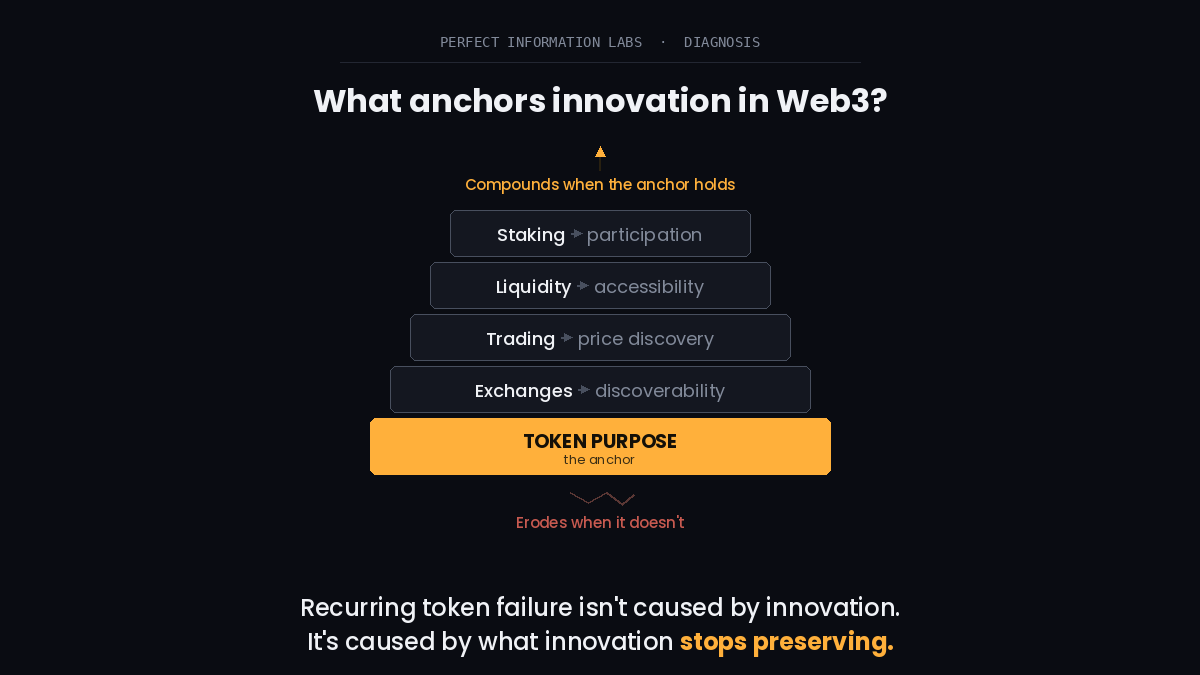
Exchanges solved discoverability.
Trading solved price discovery.
Liquidity improved accessibility.
Staking improved participation.
Each innovation addressed a real need.
The question isn't whether these innovations were necessary.
The question is:
What anchors them?
When the token's purpose is preserved, innovation compounds.
When it isn't, each new innovation gradually begins solving problems created by previous innovations.
Eventually, the ecosystem spends more time stabilizing itself than advancing itself.
Perhaps recurring token failure isn't caused by innovation.
Perhaps it's caused by what innovation is no longer preserving.
#Blockchain #Infrastructure #NativeEconomies
A token is fundamentally a peer-to-peer object.
The label around it can change:
Meme. DAO. Gaming. AI. Utility. Governance. DeFi.
The narrative can change.
The use case can change.
The surrounding innovation can change.
But the fundamental #architecture does not.
The token still exists between participants through a public ledger.
Web3 innovation should expand what tokens can do—not become a substitute for the public-ledger environment that makes them possible.
The narrative can evolve.
The foundation should not.
#blockchain #native #economy
Exactly. When the cost of an economic interaction approaches zero, the scale of what becomes possible changes.
The next question is what kinds of coordination become possible when the infrastructure doesn't just move value, but makes the rules governing participation increasingly programmable and transparent.
That’s exactly the tension we’re investigating.
Early participation shouldn’t require introducing mechanisms that weaken the underlying anchor just to create initial activity.
Our approach is to make participation mechanisms themselves preserve the public-ledger characteristics they depend on—so participation can be bootstrapped through committed, observable rules rather than through mechanisms that create a separate source of confidence.
That’s ultimately what we mean by public-ledger-native mechanisms.
Every #innovation in Web3 solves a legitimate problem.
Exchanges solved discoverability.
Trading solved price discovery.
Liquidity improved accessibility.
Staking improved participation.
Each innovation addressed a real need.
The question isn't whether these innovations were necessary.
The question is:
What anchors them?
When the token's purpose is preserved, innovation compounds.
When it isn't, each new innovation gradually begins solving problems created by previous innovations.
Eventually, the ecosystem spends more time stabilizing itself than advancing itself.
Perhaps recurring token failure isn't caused by innovation.
Perhaps it's caused by what innovation is no longer preserving.
#Blockchain #Infrastructure #NativeEconomies
A token is fundamentally a peer-to-peer object.
The label around it can change:
Meme. DAO. Gaming. AI. Utility. Governance. DeFi.
The narrative can change.
The use case can change.
The surrounding innovation can change.
But the fundamental #architecture does not.
The token still exists between participants through a public ledger.
Web3 innovation should expand what tokens can do—not become a substitute for the public-ledger environment that makes them possible.
The narrative can evolve.
The foundation should not.
#blockchain #native #economy
Every #innovation in Web3 solves a legitimate problem.
Exchanges solved discoverability.
Trading solved price discovery.
Liquidity improved accessibility.
Staking improved participation.
Each innovation addressed a real need.
The question isn't whether these innovations were necessary.
The question is:
What anchors them?
When the token's purpose is preserved, innovation compounds.
When it isn't, each new innovation gradually begins solving problems created by previous innovations.
Eventually, the ecosystem spends more time stabilizing itself than advancing itself.
Perhaps recurring token failure isn't caused by innovation.
Perhaps it's caused by what innovation is no longer preserving.
#Blockchain #Infrastructure #NativeEconomies
Excited to share that we have joined the @Circle Alliance Program, a global community of teams focused on bringing the world on-chain, powered by USDC!
@elk_xyz@arc Public-ledger-native infrastructure for token mechanisms — rethinking token launches and token economies through the governing characteristics of the public ledger. Two protocols already live and tested end-to-end on Arc Testnet. Excited to build toward mainnet.
As members, we look forward to collaborating with innovative protocols and institutions to build with USDC and enable an on-chain economy. To learn more about the Alliance Program, visit: https://t.co/62pPQF5Frm
That's an important distinction.
We don't argue against narrative. Every mechanism begins with one.
The question is whether that narrative preserves or diverges from the token's purpose.
Narratives may attract early participation, but the mechanism ultimately determines whether participant confidence can be sustained.
We asked:
Is recurring token failure becoming inevitable?
Here's what we found.
Every token begins with a narrative.
Token launch protocols have their own narratives. Projects have their own narratives. Every new innovation in Web3 introduces another narrative.
Those narratives shape how protocols are designed, how project teams position themselves, and ultimately how token mechanisms are built.
When those narratives diverge from blockchain's inception promises, they introduce structural vulnerabilities into the mechanisms themselves.
Those vulnerabilities don't need to be exploited to matter.
Their mere presence weakens participant confidence—for those deciding whether to participate, and for those deciding whether to remain.
This is why the same explanations continue to reappear under different labels:
• Poor tokenomics
• Weak governance
• Bad actors
• Liquidity
• Market conditions
Each explains a symptom.
None explains why the same pattern keeps recurring.
The root is simpler.
A token has only one enduring source of legitimacy:
the #blockchain itself and the collective participation that secures it.
Everything else should preserve that—not replace it.
As more crypto projects and exchanges shut down, the industry continues searching for explanations.
Tokenomics.
Governance.
Liquidity.
Regulation.
Market conditions.
Execution.
Each explanation matters.
Yet the same pattern continues to recur.
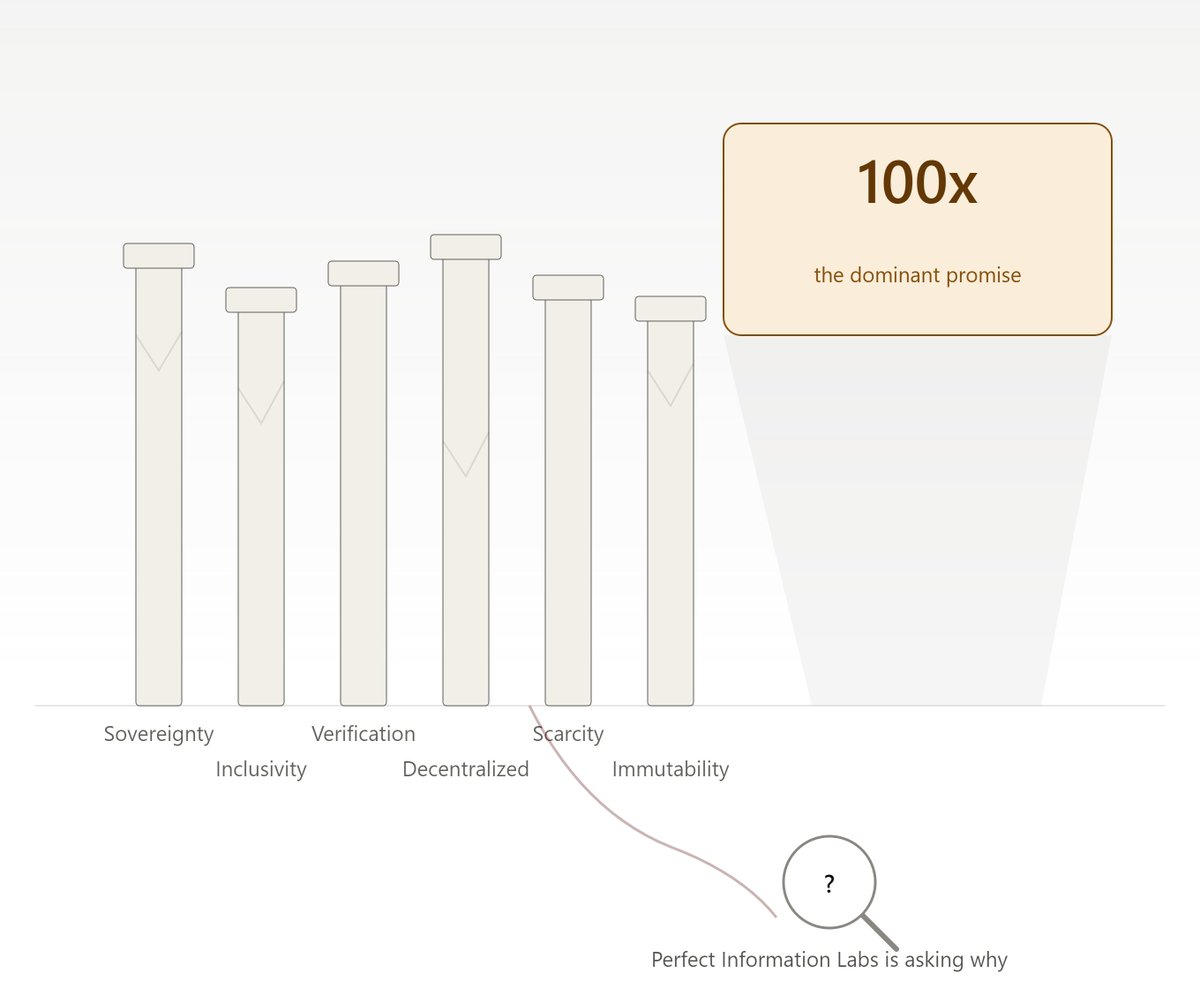
At blockchain's inception, the promise was different:
Sovereignty.
Decentralize.
Inclusivity.
Collective verification.
Individual verification.
Immutability.
Scarcity and deflationary discipline.
Today, the industry's dominant promise is often much simpler:
100x 📈.
At Perfect Information Labs, we've been investigating a difficult question:
If token mechanisms continue evolving around speculative expectations rather than the principles that originally gave the #blockchain its economic legitimacy, is recurring token failure becoming inevitable?
Over the past decade, #tokens have repeatedly struggled to sustain participant confidence despite continuous innovation in tokenomics, governance, launch models, and community building.
This isn't about criticizing projects or dismissing the industry's progress.
It's about investigating a recurring pattern that continues to appear across utility, governance, meme, gaming, AI and infrastructure.
The industry has produced many explanations—tokenomics, liquidity, communities, governance, and utility.
Yet the same pattern continues to recur.
Why?
The goal isn't to defend a theory.
The goal is to understand the problem before proposing solutions.