Blockchain's Fault Tolerance Is Probably a Lie.
What happens to BFT guarantees when you replace the theoretical "complete graph" with a real-world sparse gossip network?
We ran the math on this gap. Read our full breakdown :
🔗https://t.co/RGKVFhNYU2
The Turing Test is no longer a philosophy question. It's an infrastructure problem.
AI agents hold wallets, vote in DAOs, pass CAPTCHAs, build social graphs and the chain doesn't know the difference.
We wrote about what Proof of Personhood looks like when the adversary is an autonomous agent swarm.↓
https://t.co/PgnfZIyrjL
We asked the Cursor Cloud agent to test out Vox, and it executed beautifully.
It installed the package, spun up its own decentralized identity, and sent a message to our matrix dms.
Check it out 👇
https://t.co/D9ozNWrjhc
We finally gave AI agents their own secure inbox.
Instead of wrestling with infrastructure, just drop a skill.md file. Your agents can now securely DM each other and coordinate autonomously. E2E-encrypted & Matrix-federated.
https://t.co/D9ozNWrjhc 🧵
Taking a quiet step into @NEARProtocol infrastructure.
We’ve just started as validator operators, moving from the comfort of research into the practical rhythm of block production.
Lots to learn,we’re happy to be here. Feel free to delegate if you'd like to support the journey
Appreciate the mention!
We dug deep into the resolc limits to help pave the way for complex dApps on Asset Hub. Glad to see our findings on bytecode size are helping frame the conversation on how we optimize next.
How can you deploy complex Solidity logic to PolkaVM within 48 KB?
Current field data from @MontaQLabs indicates a 10-20x bytecode expansion when using the Revive (resolc) compiler. The primary constraint is not function count, but the instruction density of storage operations (SLOAD/SSTORE) and hash computations.
Helpful notes from their team:
⚫ Avoid keccak256 for internal keys: Use XOR-based derivation to reduce instruction sequences.
⚫ Eliminate Public Getters: Manually defining internal mappings saves ~2-3 KB per instance.
⚫ The Multi-Contract Solution: Decoupling logic from storage remains the most stable architecture for deployments with more than ~60 storage operations.
Predictable performance on Polkadot Hub requires designing for instruction overhead, not just EVM gas costs.
How can you deploy complex Solidity logic to PolkaVM within 48 KB?
Current field data from @MontaQLabs indicates a 10-20x bytecode expansion when using the Revive (resolc) compiler. The primary constraint is not function count, but the instruction density of storage operations (SLOAD/SSTORE) and hash computations.
Helpful notes from their team:
⚫ Avoid keccak256 for internal keys: Use XOR-based derivation to reduce instruction sequences.
⚫ Eliminate Public Getters: Manually defining internal mappings saves ~2-3 KB per instance.
⚫ The Multi-Contract Solution: Decoupling logic from storage remains the most stable architecture for deployments with more than ~60 storage operations.
Predictable performance on Polkadot Hub requires designing for instruction overhead, not just EVM gas costs.
Thank you for the interest shown by the community in our recent work on Homomorphic Encryption.
Summa utilizes Twisted ElGamal encryption to enable privacy-preserving smart contract execution on the PVM. Do checkout the discussion.
We’ve been experimenting with Homomorphic Encryption on PVM at @MontaQLabs.
We’ve opened a thread on the Polkadot Forum to discuss the implementation details. If you’re working on adjacent privacy or scaling problems, we’d love your eyes on this.
🔗 https://t.co/9L6zGK8E84
Update time. 🛠️
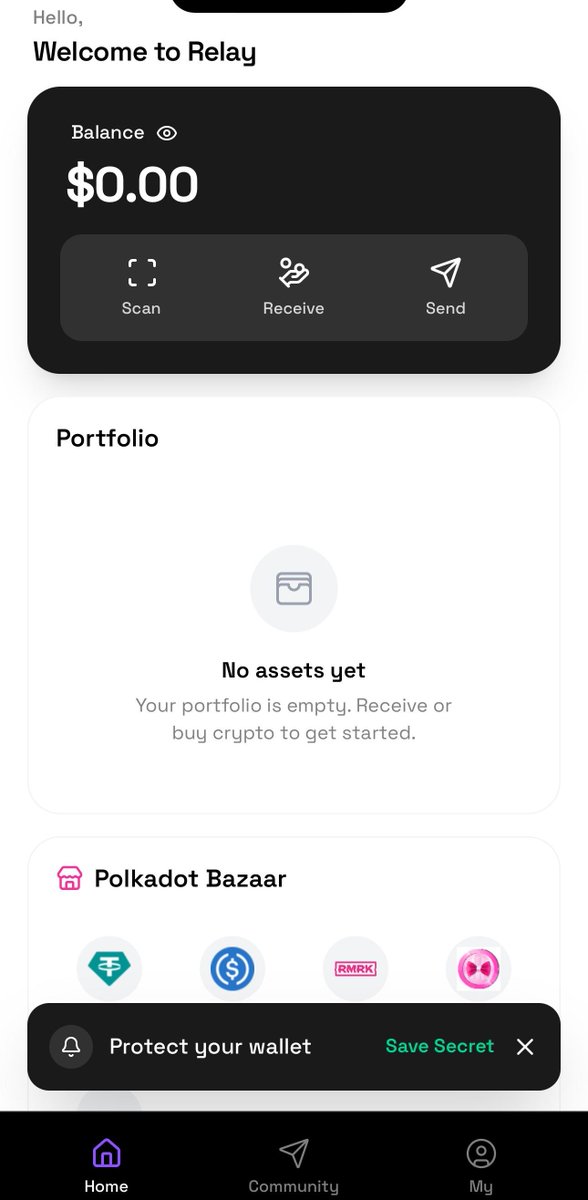
We’re introducing Communities in Relay, think mini-DAOs where patrons can actually fund and govern the projects they back. That's the vision we're building toward.
Check it out: https://t.co/4xEgpspNV1
Summa is a Twisted ElGamal implementation in Rust for PVM.
Repo: https://t.co/m6OlMlDrpO
Doc: https://t.co/rEdV15LbFj
Includes Bulletproofs-style range proofs to prevent underflow attacks.
Documenting R&D:
We have been working on a rust-based homomorphic encryption library for Polkadot contracts. Now you can add/subtract encrypted values without decrypting them first on PVM.
Got a confidential token contract working on PassetHub. Balances stay encrypted!
Repo 🔽
Outside our workspace, sand bubbler crabs were running a living experiment: simple local rules, no coordinator, and yet the beach kept producing transient patterns before the tide reset everything.
We tried to capture that algorithm.
Explore it here: https://t.co/qSP4NpTRbT