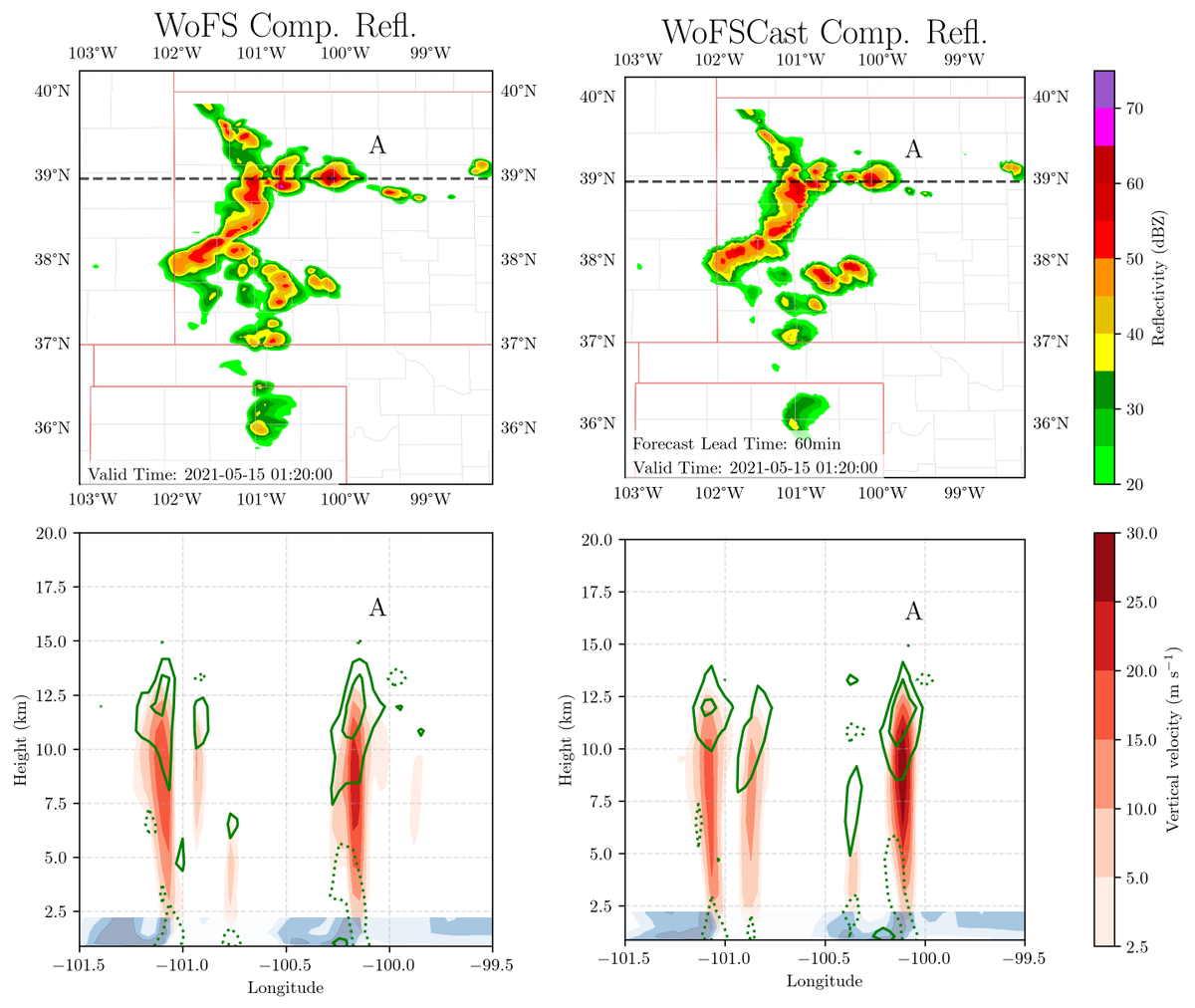
Can we use AI to predict thunderstorm evolution?
Recently published in @theAGU GRL, we refactored @GoogleDeepMind's GraphCast for regional modeling and trained it on @CIWRO_ / @NOAANSSL's archived Warn-on-Forecast System (WoFS) data.
Meteorologists are turning to AI as a quick, efficient alternative to traditional weather prediction algorithms.
Now researchers including @MontePhD & @corey_potvin have extended this tech to cover localized extreme weather as well as global forecasts. https://t.co/pcSccHjqJS
The craziest result: Although the training inputs did not include time of day or any social data, the local storm report (LSR)-trained model produced lower probs at night. This suggests that the biases were coming from the physical environment
WoFSCast is the first AI system trained and developed to emulate a sub-hourly convection-allowing weather model (CAM). WoFSCast speeds up forecast generation versus WoFS by at least a factor of ten, from minutes to seconds. #AMS2025
@shoyer Incorporating convection-allowing model (CAM) guidance into operations (e.g., at the storm prediction center; SPC) has revolutionized severe weather prediction over the last 2 decades.
@shoyer In terms of statistical downscaling, you can't hallucinate the scales that aren't there. Weather is a multi-scale phenomenon, and for current applications (e.g., severe weather forecasting), you have to simulate the mesoscales and storm-scales.